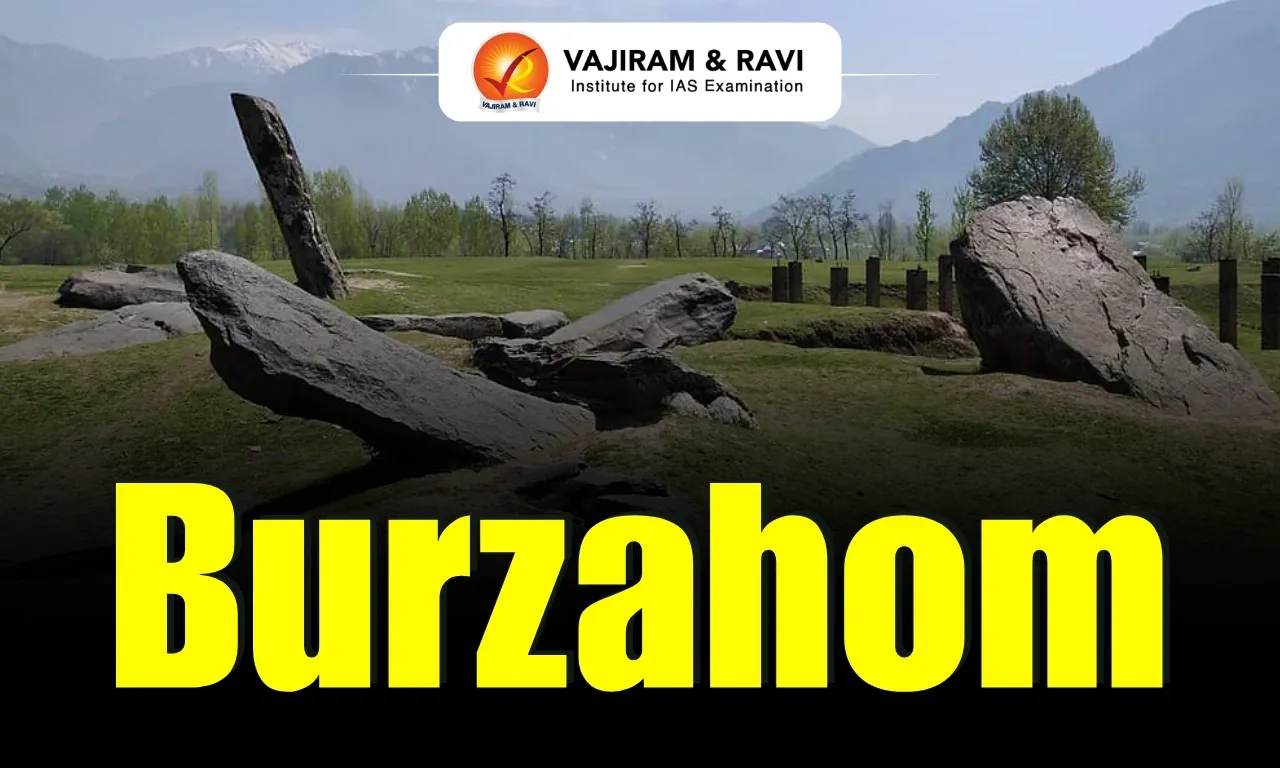
Burzahom is a major prehistoric archaeological site revealing a Neolithic settlement with distinctive pit dwellings, stone and bone tools, pottery, agriculture, animal domestication, and burial practices. It provides valuable evidence of early settled life in the region.
The Burzahom archaeological site presents a detailed picture of prehistoric life between approximately 3000 BCE and 1000 BCE, including changes in architecture, tool-making, agriculture, burial practices, pottery and artistic expression. Thi site is particularly notable for its subterranean pit dwellings, stone and bone tools, burial remains, megalithic structures and evidence of the cultivation of wheat, barley and lentils.
Burzahom Meaning
The word Burzahom means "place of birch" in the Kashmiri language. It is an important archaeological site located near Srinagar in the Kashmir Valley. Excavations have revealed a long sequence of human occupation, beginning with the Neolithic Age and continuing into the Megalithic Culture of India and early historical phases.
- Way of Life: The inhabitants practised agriculture and animal domestication, while hunting and fishing also formed part of their subsistence.
- Archaeological Remains: It includes stone and bone tools, handmade pottery, beads and other artefacts, reflecting their technological and economic life.
- Importance: The site of Burzahom tells a very comprehensive picture of life between 3000 BCE and 1000 BCE, from architectural transitions to the evolution of tool-making methods to the introduction and distribution of lentils in northwestern India.
Burzahom Archaeological Site Phases
Burzahom has a four-fold cultural sequence, identified through successive archaeological layers. Periods I and II belong to the Neolithic phase, Period III to the Megalithic phase, and Period IV to the Early Historic phase.
Period I Aceramic Neolithic
The earliest phase is associated with subterranean pit dwellings. These pits were dug into the natural soil, probably using long stone celts. The excavation marks left by these tools can still be observed. This period is notable for the absence of burial practices and cultivation evidence.
- Tools and Material Culture: People used stone, bone and antler tools, including harpoons, needles, awls, spear points, arrowheads, daggers, scrapers, axes, chisels, adzes, pounders and picks. These tools indicate skilled hunting and emerging knowledge of cultivation.
- Features of the Pit Dwellings
- Pits were generally circular or oval, narrow at the top and wider at the base.
- Wooden post-holes suggest birch coverings, likely used for protection from harsh weather.
- Shallower pits may have been used for storage or as seasonal dwellings.
- Stone hearths were found near pit entrances, showing that activities also took place at ground level.
- Quadrangular pits with birch coverings, hearths and storage pits were also found.
Period II Ceramic Neolithic
Period II saw developments in architecture, pottery, tools, agriculture and burial practices. Earlier pits were filled and reused, while mud and mud-brick structures with rammed karewa soil floors were constructed. Floors were sometimes plastered with mud and coated with red ochre.
- Pottery and Tools: Findings include black ware, red ware, painted pottery, globular pots, jars, funnel-shaped vessels and wheel-made red ware. A notable red-ware pot bears a horned figure, while another wheel-made pot contained about 950 beads, including agate and carnelian beads.
- Stone and bone tools became more refined, including harvesters, double-edged picks, needles and a distinctive hollow-bone borer. Painted pottery may indicate trade or external cultural contacts.
- Art, Burials and Trepanation: An engraved stone showing a hunting scene with human figures, a dog and a representation of the sun's path provides evidence of Neolithic artistic and symbolic practices.
- The earliest formal pit burials belong to Period II. Oval pits were dug into house floors, and bodies were often placed in crouched positions with red ochre on the bones.
- Some burials were associated with animal remains. One unusual burial contained five wild dogs and an antler.
- Burzahom also provides evidence of trepanation, with seven complete and four incomplete cases identified.
Period III Megalithic Phase
The Neolithic phase was followed by the Megalithic culture, marked by the erection of large stones or menhirs, probably for commemorative purposes. This phase reflects both continuity and change in Burzahom's material culture. Major remains include:
- Menhirs and rubble structures
- Gritty red-ware and wheel-made pottery
- Metal objects
- Continued use of stone and bone tools.
Period IV Early Historic Phase
The final phase belongs to the Early Historic or Post-Megalithic Period, dated to approximately the 3rd–4th century CE. The remains include: Mud-brick structures, Wheel-made pottery, and Metal objects. This shows that human activity at Burzahom continued beyond the Neolithic and Megalithic phases.


Burzahom Major Findings
Excavations at Burzahom revealed a rich archaeological record that helps reconstruct the technological, economic, artistic and ritual life of prehistoric Kashmir. The following are the major discoveries.
- Structural Remains: Excavations revealed subterranean pits, chambers, hearths, post-holes and storage features, followed by mud and mud-brick structures in later phases. These remains demonstrate changes in settlement patterns and construction techniques over time.
- Material Assemblage: The site yielded a wide range of stone, bone and antler tools, including harpoons, needles, awls, spear-points, arrowheads, daggers, scrapers, axes, chisels, adzes, pounders and picks.
- Beads made from materials such as agate and carnelian were also recovered, reflecting the diverse technological activities of the inhabitants.
- Ceramic Evidence: Excavations produced different varieties of pottery, including steel-grey, dull red, brown, buff and black wares. Later phases show changes in pottery forms and manufacturing techniques, including the use of the potter's wheel.
- A notable discovery is a wheel-made red-ware pot containing approximately 950 beads, including agate and carnelian beads.
- Burial Evidence: Burials, particularly from Period II, provide important evidence of funerary practices. Oval burial pits containing human remains have been found, with skeletons often placed in crouched positions. Some burials were associated with animal remains.
- The site has also yielded evidence of trepanation, with seven complete and four incomplete instances recorded.
- Agricultural Evidence: Archaeobotanical analysis and associated tools provide evidence for the cultivation of wheat, barley and lentils during Periods I and II. The presence of lentils is particularly important for understanding the wider cultural connections of the Burzahom community.
- Animal Husbandry and Hunting: Archaeological evidence indicates the presence of domesticated sheep, goats, cattle, buffalo and dogs, alongside remains of wild animals. This suggests a subsistence pattern that combined animal husbandry, agriculture and hunting.
- Artistic Evidence: An engraved stone depicts a hunting scene involving human figures and a dog, along with representations of the sun. The engraving provides important evidence of prehistoric artistic and symbolic expression.
- External Contacts: Evidence including the presence of lentils, agate and carnelian beads, and similarities in some material remains suggests cultural interaction between Kashmir and regions beyond it.
- The archaeological evidence indicates that Kashmir served as an important link between Central Asia, South-West Asia, the Himalayan region and the Indian subcontinent.
Burzahom Significance
Burzahom is significant for understanding the development of prehistoric society in the Kashmir Valley, as its archaeological sequence records changes from Neolithic to Megalithic and Early Historic cultures. It is particularly valuable for studying the evolution of settlement patterns, technology, subsistence, and cultural practices over a long period.
- Northern Neolithic Tradition: Burzahom is a key representative of the Northern Neolithic culture, distinguished by its distinctive material assemblage and settlement pattern.
- Understanding Human Adaptation: The site demonstrates how prehistoric communities adapted their habitation and material culture to the Himalayan environment.
- Cultural Interaction: Its location in Kashmir provides evidence of interaction between Central/South-West Asia and the Indian subcontinent, making the valley an important cultural corridor.
- Social and Ritual History: Burial practices, animal-associated burials and evidence of trepanation provide insights into the ritual and social behaviour of prehistoric communities.
- UNESCO Recognition: Burzahom is on UNESCO’s Tentative List under the cultural category, reflecting its outstanding archaeological value in documenting the transition from Neolithic to Megalithic and Early Historic phases in Kashmir.
Burzahom Decline
The archaeological sequence indicates that Burzahom underwent cultural and settlement transformations rather than simply experiencing an abrupt disappearance.
- After the Neolithic phases, the site transitioned into the Megalithic phase, characterised by menhirs, rubble structures and new material forms.
- This was subsequently followed by the Early Historic/Post-Megalithic phase, dated to the 3rd–4th century CE, when mud-brick structures, wheel-made pottery and metal objects were present.
- Thus, the archaeological evidence suggests a long sequence of changing habitation and cultural practices rather than a single clearly documented event responsible for the site's decline.
Burzahom UPSC PYQs
Q1: Consider the following pairs: (UPSC Prelims 2021)
| Sl. No | Historical Place | Well-known for |
|
1 |
Burzahom |
Rock-cut shrines |
|
2 |
Chandra-ketugarh |
Terracotta art |
|
3 |
Ganeshwar |
Copper artifacts |
Which of the pairs given above is/are correctly matched?
- a) 1 only
- b) 1 and 2 only
- c) 3 only
- d) 2 and 3
Ans: (d)

 Last updated on Oct, 2026
→ UPSC 2027 Notification will be released on 13 January 2027 at upsconline.nic.in.
→ Check Nobel Prize 2026 Winners List here.
→ Download PIB PRiSM Monthly Magazine 2026 here.
→ Check UPSC Monthly Current Affairs Magazine The Recitals here.
→ Check out the latest UPSC Syllabus here.
→ Download UPSC Model Answers for Mains 2026
→ UPSC Mains Question Paper 2026 is out now for Essay & GS Paper 1, 2, 3 & 4.
→ UPSC Calendar 2027 has been released.
→ Enroll in Vajiram & Ravi’s UPSC Mains Test Series 2027 for structured answer writing practice, expert evaluation, and exam-oriented feedback.
→ Join Vajiram & Ravi’s UPSC Mentorship Program 2027 for personalized guidance, strategy planning, and one-to-one support from experienced mentors.
→ Go through the UPSC Mains Previous Year Papers to enhance your preparation.
→ UPSC has released UPSC Toppers List 2025 with the Civil Services final result on its official website.
→ Also check Best UPSC Coaching in India
Burzahom FAQs
Q1. What is Burzahom famous for?+
Q2. Is Burzahom a UNESCO World Heritage Site?+
Q3. What is the first Neolithic site found in Kashmir?+
Q4. Why is Burzahom called the place of birch?+
Q5. Who discovered Burzahom?+
Tags: burzahom quest upsc ancient history notes