
'Disinvestment' refers to the sale of a part or whole of the government’s equity in Public Sector Undertakings (PSUs) to mobilise resources, improve efficiency, and encourage private-sector participation. It has emerged as an important economic reform initiative in India following the Liberalisation, Privatisation, and Globalisation (LPG) reforms of 1991. The policy also seeks to unlock the value of public assets, promote better corporate governance, and enable the government to focus on strategic and developmental priorities.
Although privatisation and disinvestment are closely related, they are not synonymous. Disinvestment may involve a partial stake sale without transferring management control, whereas strategic disinvestment may transfer ownership and management to private investors, depending on the extent of the stake sold.
Disinvestment Meaning
It is the process by which an organisation or the government sells all or a portion of its ownership in a business, subsidiary, or asset in order to increase mobilisation of resources or enhance operational efficiency. The Department of Investment and Public Asset Management (DIPAM) is the nodal department responsible for government disinvestment.
- In the Indian context, it mostly refers to the selling of government equity in Central Public Sector Enterprises (CPSEs) to the general public, financial institutions, or private investors.
Disinvestment Types
Disinvestment strategies based on the goal of the share sale and the amount of ownership are used by the government. Some strategies entail giving ownership and control to private companies or strategic investors, while others permit the government to maintain management control. These are discussed below.
Minority Disinvestment
The government retains majority ownership and management control while selling a portion of its shares through minority disinvestment.
- After the sale, the government often retains more than 50% of the stake.
- This approach is typically carried out by:
- Offer to Sell (OFS).
- Exchange-traded funds (ETFs) and initial public offerings (IPOs).
- Stake sales in NTPC, NHPC, Power Grid Corporation, and Rural Electrification Corporation are a few examples.
Majority Disinvestment
In a majority disinvestment, the government transfers management authority to another organisation by reducing its ownership to below 50%.
- The purchaser could be:
- A private business.
- An Additional Public Sector Business.
- An astute investor.
- Significant reorganisation and increased operational efficiency are typically the outcomes of this strategy. BALCO, Modern Foods, and CMC Ltd. are a few examples.
Strategic Disinvestment
It entails transferring managerial control and selling all or a significant portion of the government's ownership in a CPSE.
- Government ownership and management control in CPSEs are sold to a private strategic buyer or buyers in the case of privatisation, which is a subset of strategic disinvestment.
- In other instances, government equity and control are transferred to another CPSE.
Total Privatisation
Transferring all ownership and management control to a private company is known as complete privatisation.
- In these situations, the government completely withdraws from the business.
- This is the greatest level of disinvestment and is typically used for non-strategic industries where it is deemed superfluous to maintain government ownership.


Disinvestment Objectives
Disinvestment is a crucial economic reform that aims to strengthen the government's budgetary position, increase the effectiveness of public sector businesses, and promote sustainable economic growth. The following are the main goals:
- Lessen the Financial Burden: By disinvesting, the government can lessen the cost of continuing to subsidise PSUs that are losing money.
- Enhance Public Budgets: It generates non-tax revenue, which enhances fiscal management and lessens reliance on borrowing.
- Boost Productivity: Better corporate governance, accountability, creativity, and managerial effectiveness are brought about by private involvement.
- Encourage rivalry: Increased involvement from the private sector fosters a competitive market environment that promotes improved service delivery and productivity.
- Open Up Public Funds: It is possible to reallocate capital that is tied up in commercial businesses to industries that produce higher social returns.
- Promote Greater Public Ownership: PSU share public offerings increase financial inclusion and encourage retail involvement in the capital market.
Disinvestment Importance
Disinvestment has emerged as a key policy tool for enhancing the use of public resources. It helps infrastructure development, budgetary consolidation, and effective resource allocation in addition to improving Public Sector Undertakings' (PSUs') operational performance. Its importance is discussed below.
- Enhances Financial Situation: It produces significant non-tax income that improves state finances and the fiscal deficit.
- Finances the Development of Infrastructure: The money raised can be used for urban development, ports, railroads, roadways, and digital infrastructure.
- Encourages Spending in the Social Sector: Stake sales proceeds can be used to fund social welfare, healthcare, education, and nutrition initiatives.
- Cuts Down on Public Debt: The revenues can be used by the government to reduce borrowing requirements and improve debt sustainability.
- Increases PSU Efficiency: Productivity and profitability are boosted by professional management, enhanced accountability, and market discipline.
- Promotes Investment: Increased private involvement increases investor confidence and facilitates corporate transactions.
- Unlocks Unused Public Resources: Better use of public funds that would otherwise be trapped in underperforming businesses is made possible by disinvestment.
Disinvestment Challenges
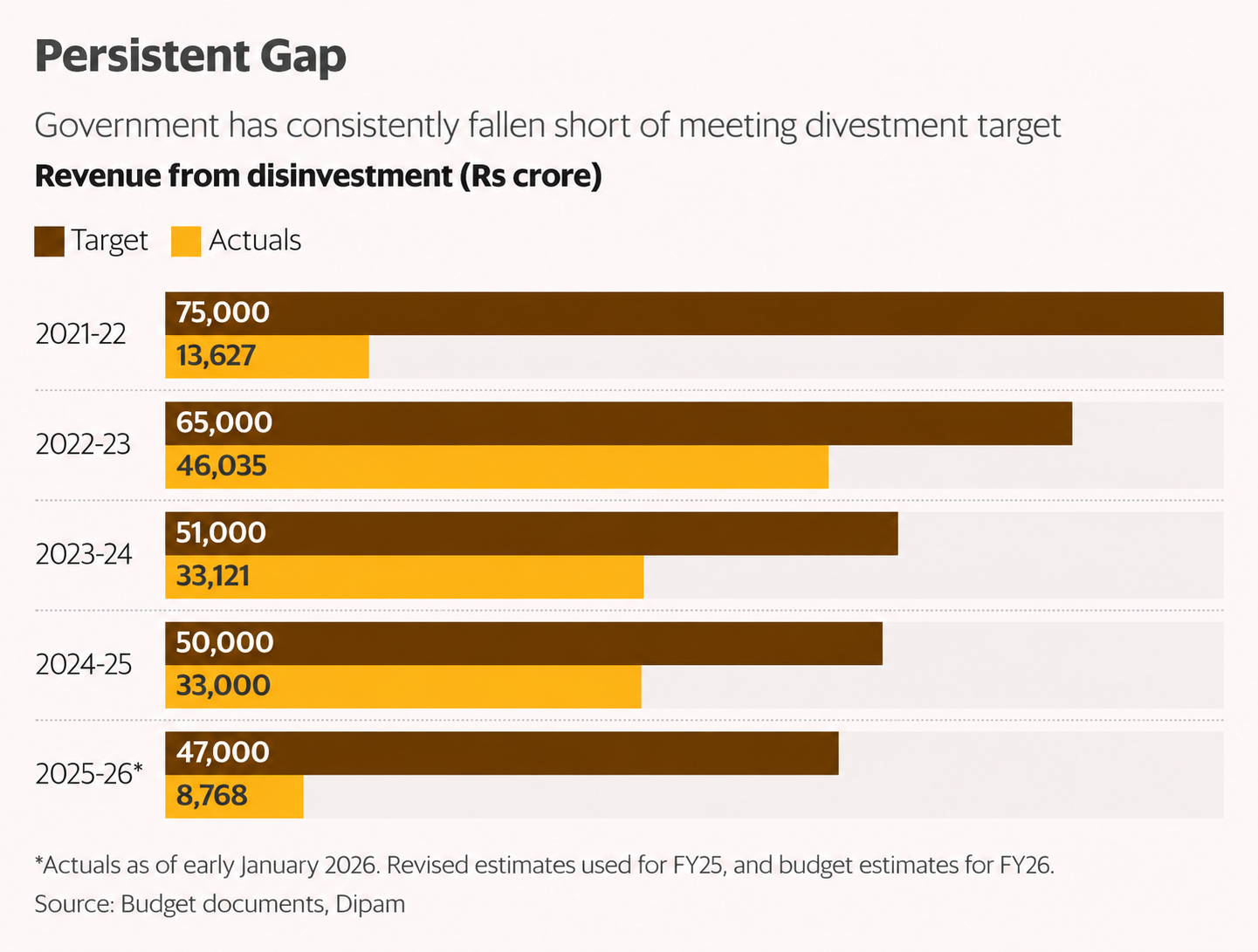
In India, disinvestment is confronted with several administrative, political, and economic obstacles. It is frequently slowed down and its results impacted by problems like stakeholder resistance, valuation issues, market uncertainty, and procedural delays. The major challenges are discussed below:
- Political Disagreement: Political parties frequently oppose stake sales because of worries about strategic assets and public control.
- Employee Opposition: Trade unions are concerned about changes in service conditions, job losses, and decreased employment security.
- Undervaluation of Resources: Important public assets may be sold for less than their intrinsic value when the market is sluggish.
- Future Dividend Income Loss: The government's periodic dividend earnings are decreased when lucrative PSUs are sold.
- Strategic Issues: In defence PSUs, strategic ports, or major energy assets, it may raise concerns over foreign influence and national security.
- While India manages foreign investments abroad, disinvesting strategic infrastructure to foreign entities with close ties to adversaries (such as Chinese corporations) highlights severe national security risks.
- Conditions of the Market: The programmes may be delayed or less successful due to negative investor sentiment or financial market volatility.
- Delays in Procedures: The procedure is frequently slowed down by legal challenges, valuation concerns, regulatory clearances, and administrative difficulties.
Disinvestment Way Forward
Disinvestment should prioritise enhancing efficiency, bolstering governance, and fostering sustainable economic growth in addition to generating cash in order to accomplish its stated goals. Strategic national interests can be protected while maximising public benefit through an open and fair approach.
- Adopt a Strategic and Sector-Specific Approach: The divestment should be prioritised in non-strategic sectors where private participation can improve efficiency, while the government should maintain an appropriate presence in critical sectors like defence, atomic energy, and railways.
- Strengthen DIPAM: The Department of Investment and Public Asset Management (DIPAM) should be further strengthened with greater institutional capacity, professional expertise and transparent processes to improve valuation, transaction management and monitoring of decisions.
- Ensure Transparent and Competitive Valuation: It should be prioritised to prevent undervaluation of public assets and enhance public confidence in the process.
- Improve Corporate Governance Before Sale: To maximise firm value and draw in quality investors, financial restructuring, expert management, and increased operational efficiency should be implemented before divestment.
- Use Earnings to Create Capital: Instead of being largely used to cover short-term fiscal deficits, the revenue should be directed toward infrastructure development, healthcare, education, research, renewable energy, and debt reduction.
- Safeguard Workers' Interests: To guarantee a smooth transition, divestment should be accompanied by comprehensive employee welfare initiatives, including skill development, reskilling, voluntary retirement plans (VRS), and social security benefits.
Disinvestment UPSC PYQs
Q1. Industrial growth rate has lagged behind in the overall growth of Gross-Domestic- Product (GDP) in the post-reform period. Give reasons. How far are the recent changes in Industrial Policy capable of increasing the industrial growth rate? (UPSC Mains 2017)
Q2. Examine the impact of liberalisation on companies owned by Indians. Are they competing with the MNCs satisfactorily? (UPSC Mains 2013)
Q3. Why is the Government of India disinvesting its equity in the Central Public Sector Enterprises (CPSEs)? (UPSC Prelims 2011)
- The Government intends to use the revenue earned from the disinvestment mainly to pay back the external debt.
- The Government no longer intends to retain the management control of the CPSEs.
Which of the statements given above is/are correct?
a) 1 only
b) 2 only
c) Both 1 and 2
d) Neither 1 nor 2

 Last updated on Oct, 2026
→ UPSC 2027 Notification will be released on 13 January 2027 at upsconline.nic.in.
→ Check Nobel Prize 2026 Winners List here.
→ Download PIB PRiSM Monthly Magazine 2026 here.
→ Check UPSC Monthly Current Affairs Magazine The Recitals here.
→ Check out the latest UPSC Syllabus here.
→ Download UPSC Model Answers for Mains 2026
→ UPSC Mains Question Paper 2026 is out now for Essay & GS Paper 1, 2, 3 & 4.
→ UPSC Calendar 2027 has been released.
→ Enroll in Vajiram & Ravi’s UPSC Mains Test Series 2027 for structured answer writing practice, expert evaluation, and exam-oriented feedback.
→ Join Vajiram & Ravi’s UPSC Mentorship Program 2027 for personalized guidance, strategy planning, and one-to-one support from experienced mentors.
→ Go through the UPSC Mains Previous Year Papers to enhance your preparation.
→ UPSC has released UPSC Toppers List 2025 with the Civil Services final result on its official website.
→ Also check Best UPSC Coaching in India
Disinvestment FAQs
Q1. What do you mean by disinvestment?+
Q2. What is the target of disinvestment in 2026?+
Q3. Who is responsible for disinvestment?+
Q4. What is another name for disinvestment?+
Q5. What is an example of divestment?+
Tags: disinvestment quest upsc economy notes