The Central Pollution Control Board (CPCB), established in 1974, is India’s apex body for environmental regulation, pollution control, and monitoring under the Ministry of Environment, Forest, and Climate Change. It provides policy guidance, technical support, and regulatory oversight to the Centre, States, and Union Territories, aiming to ensure clean air, safe water, and sustainable environmental practices.
CPCB sets standards for air, water, and industrial effluents, supports research, implements programs, and engages citizens in environmental monitoring through programmes like the National Clean Air Programme (NCAP) and the National Ambient Air Quality Monitoring Programme (NAMP). CPCB is central to India’s environmental governance, pollution control, and public health protection.
Central Pollution Control Board (CPCB) About
Central Pollution Control Board, established in 1974, is a statutory organisation under the Water (Prevention and Control of Pollution) Act, 1974. Its mandate was expanded under the Air (Prevention and Control of Pollution) Act, 1981, and further by the Environment (Protection) Act, 1986.
- Legal Status: CPCB is a body corporate with perpetual succession and a common seal. It is empowered to acquire, hold, and dispose of property, and to sue or be sued in its own name.
- Vision: To promote the cleanliness of streams, wells, and the overall environment by preventing, controlling, and abating pollution, thereby improving the quality of air, water, and the environment in India.
- Mission: To provide technical leadership and scientific guidance for pollution control, conduct real-time monitoring and data dissemination, and formulate standards for pollution emissions and environmental parameters.
- It coordinates with State Pollution Control Boards (SPCBs) and supports sustainable environmental governance through policy advisory and enforcement mechanisms.
Central Pollution Control Board (CPCB) Objectives
Central Pollution Control Board (CPCB ) primary objective is to prevent, control, and abate pollution in India’s air and water. Its activities combine monitoring, regulation, research, and advisory functions to support national environmental policies.
- Water Pollution Control: CPCB works to maintain the cleanliness of rivers, streams, lakes, and wells by preventing, controlling, and reducing water pollution, thereby protecting public health and ecological balance.
- Air Pollution Control: CPCB monitors and regulates air quality nationwide to prevent and reduce air pollution, mitigating its harmful effects on health and the environment.
- Air Quality Monitoring: Through the National Air Monitoring Programme (NAMP), CPCB tracks air quality trends, providing essential data for industrial and urban planning.
- Its automatic monitoring station at Indraprastha Trikuta Overpass (ITO), New Delhi, regularly measures key pollutants, including Respirable Suspended Particulate Matter (RSPM), Suspended Particulate Matter (SPM), CO, Ozone (O₃), SO₂, and NO₂, with weekly updates.
- Water Quality Monitoring: The Central Pollution Control Board monitors rivers, lakes, ponds, and wells to assess pollution levels and ensure suitability for agriculture, industry, wildlife, and human consumption. Data collected guides policies to preserve and restore India’s freshwater resources.
Central Pollution Control Board Headquarters
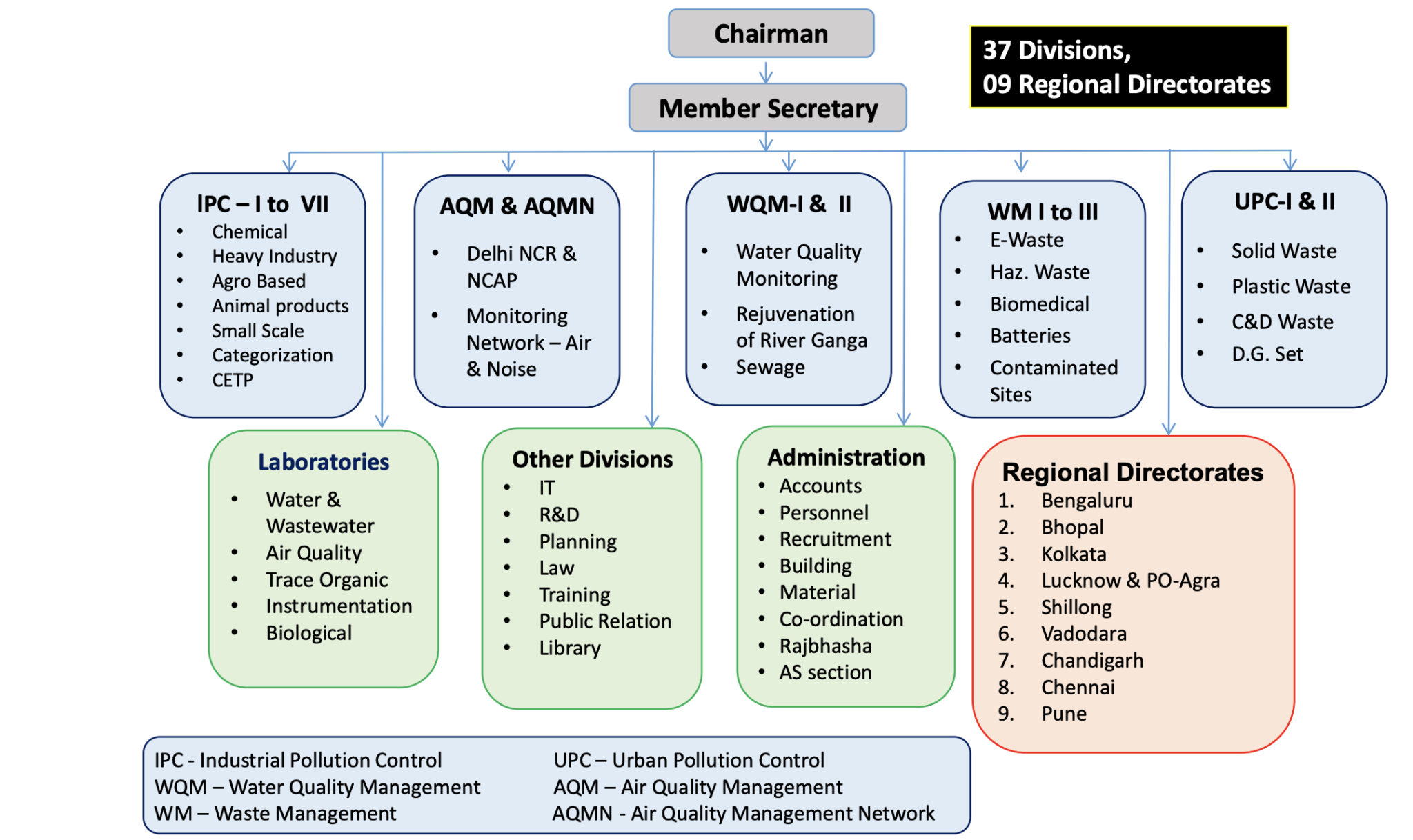
The CPCB's headquarters are in New Delhi, with nine regional directorates and one project office. CPCB headquarters is currently divided into 22 divisions. Each section has its own in-charge and individual aims.
Central Pollution Control Board History
The evolution of the CPCB reflects India's expanding legal and institutional framework for controlling pollution and protecting the environment. Over the years, the CPCB's mandate has broadened from primarily addressing water pollution to covering air pollution and wider environmental concerns.
- 1974: The CPCB was established on 23 September 1974 under the Water (Prevention and Control of Pollution) Act, 1974. It was created to address increasing concerns over the pollution of water bodies and to promote measures for preventing and controlling water pollution.
- 1981: The enactment of the Air (Prevention and Control of Pollution) Act, 1981 expanded the CPCB's responsibilities. The Board was given a wider role in monitoring and controlling air pollution across the country.
- 1986: The Environment (Protection) Act, 1986, further strengthened the CPCB's role in environmental protection. The Board became involved in supporting the implementation and enforcement of various environmental regulations and standards framed by the Central Government.
- 1988: Initially known as the Central Board for the Prevention and Control of Water Pollution, the institution was renamed the Central Pollution Control Board (CPCB) in April 1988.
- 2025: During the CPCB's 51st Foundation Day celebration on 22 September 2025, Union Minister Bhupender Yadav announced the establishment of new CPCB laboratories in Pune and Shillong.
- The event also featured the launch of SAMEER App Version 2.0, the release of technical publications, and the foundation stone laying for a new CPCB building.


Central Pollution Control Board Functions
The Central Pollution Control Board (CPCB) acts as India’s apex regulatory, advisory, and coordinating authority for pollution control, guiding the Central Government, State Pollution Control Boards (SPCBs), and Union Territory (UT) administrations in preventing, controlling, and abating water and air pollution.
Functions at the National Level
Central Pollution Control Board (CPCB) formulates environmental standards, implements pollution control programmes, conducts research, and coordinates with State Pollution Control Boards (SPCBs) to ensure uniform and effective regulation across India at the national level.
- Advisory Role: Advises the central government on all matters concerning pollution control, improvement of air quality, and environmental policies.
- Program Planning and Implementation: Designs and executes nationwide programs aimed at preventing, controlling, and abating water and air pollution.
- Coordination: Coordinates activities of SPCBs across the country and resolves disputes among them.
- Technical Assistance and Research: Provides technical guidance to State Boards, conducts and sponsors research on water and air pollution, and develops effective methods for pollution prevention and control.
- Capacity Building: Plans and organises training programs for personnel engaged in pollution prevention and control.
- Public Awareness: Implements mass awareness campaigns through media to educate the public on pollution prevention, control, and mitigation measures.
- Data Management and Information Dissemination: Collects, compiles, analyses, and publishes technical and statistical data related to pollution and effective control measures.
- Standards and Guidelines: Prepares manuals, codes, and guidelines for sewage treatment, trade effluents, air pollution control equipment, stacks, and ducts, and lays down or revises standards for water quality (streams or wells) and air quality, in consultation with State Governments.
- Other Functions: Performs any additional functions as prescribed by the Government of India.
Functions in Union Territories (UTs)
Central Pollution Control Board (CPCB) has delegated powers under the Water (Prevention and Control of Pollution) Act, 1974, Water Cess Act, 1977, and Air (Prevention and Control of Pollution) Act, 1981, to respective local administrations in the Union Territories. However, it continues to monitor, guide, and supervise implementation in coordination with SPCBs.
- Advisory Role: Advises local administrations on the suitability of locations for industries likely to cause air or water pollution.
- Standards and Regulations: Prescribes standards for sewage treatment, trade effluents, and emissions from automobiles, industrial plants, and other pollution sources.
- Technical Development: Develops efficient, reliable, and economically viable methods for sewage and effluent disposal, as well as air pollution control techniques.
- Air Pollution Control Areas: Identifies air pollution control areas under the Air (Prevention and Control of Pollution) Act, 1981.
- Monitoring and Inspection: Conducts assessments of ambient air and water quality, inspects wastewater treatment plants, air pollution control equipment, and industrial processes, and takes necessary measures for prevention, control, and abatement of pollution.
Central Pollution Control Board Organisational Structure
The Central Pollution Control Board (CPCB) functions through a structured institutional framework that enables it to coordinate pollution-control activities across India. The Board works under the Ministry of Environment, Forest and Climate Change (MoEFCC) and collaborates with State Pollution Control Boards (SPCBs), Pollution Control Committees (PCCs), government agencies, research institutions, and other stakeholders.
- Chairperson: The CPCB is headed by a Chairperson who provides overall leadership and guides the Board's policy and regulatory functions.
- Member Secretary: The Member Secretary serves as the principal executive officer and is responsible for the day-to-day administration and implementation of the Board's programmes.
- Central Board: The CPCB's governing body includes representatives from the Central Government, State Governments, local authorities, and other specified stakeholders. It provides direction for the Board's activities and pollution-control programmes.
- Head Office: The CPCB's headquarters in Delhi coordinates national-level programmes, technical activities, policy implementation, research, monitoring, and administrative functions.
- Zonal and Regional Offices: The Board maintains offices in different parts of the country to support field-level implementation, environmental monitoring, inspection, and coordination with State and local authorities.
- Laboratories: CPCB operates a network of environmental laboratories that undertake analysis and monitoring of air, water, soil, and other environmental parameters. These facilities provide scientific and technical support for pollution-control activities.
- Coordination with SPCBs and PCCs: CPCB works closely with State Pollution Control Boards and Pollution Control Committees to coordinate implementation of pollution-control laws, establish standards, monitor compliance, and address environmental issues.
Central Pollution Control Board Significance
Central Pollution Control Board (CPCB) forms the foundation of India’s environmental governance, integrating scientific research, regulatory enforcement, industrial guidance, policy support, and public engagement to achieve cleaner air, safer water, and sustainable environmental health.
- Pollution Control and Cleaner Technologies: CPCB promotes Zero Liquid Discharge (ZLD), categorises thermal power plants, implements innovative solutions like zig-zag firing in brick kilns, drives bio-mining of legacy waste, and formulates Environmental Compensation regimes.
- Waste Management: It manages solid, biomedical, electronic, and hazardous wastes, ensuring producers take responsibility through Extended Producer Responsibility (EPR) frameworks.
- Scientific Capacity and Data Accuracy: CPCB ensures reliable environmental data through Analytical Quality Control (AQC) exercises, supporting effective policymaking and enforcement.
- Coordination and Advisory Role: It advises the Central Government, Union Territories, and State Pollution Control Boards (SPCBs), sets national standards, and promotes training and awareness to harmonise pollution control efforts.
- Public Health and Emergency Response: CPCB supports emergencies, such as COVID-19, by facilitating oxygen production from nitrogen plants,and engages the public in pollution monitoring via the SAMEER App.
Central Pollution Control Board Initiatives
Central Pollution Control Board (CPCB) combines regulation, scientific monitoring, and citizen engagement to tackle air, water, and industrial pollution. Key Initiatives include:
- National Clean Air Programme (NCAP): NCAP is India’s flagship initiative to improve urban air quality, targeting over 130 non-attainment cities that fail to meet National Ambient Air Quality Standards (NAAQS).
- The PRANA portal enables real-time city-wise monitoring of PM₂.₅ and PM₁₀ reduction measures, supports performance-based funding, and promotes public participation and transparent progress tracking.
- National Ambient Air Quality Monitoring Programme (NAMP): NAMP tracks pollutants such as SO₂, NO₂, and particulate matter nationwide, informing policy and compliance.
- Swachh Vayu Survekshan ranks cities annually to promote best practices, while the SAMEER App provides real-time AQI updates and allows citizens to report pollution sources for prompt action.
- National Water Quality Monitoring Programme (NWMP): NWMP regularly assesses rivers, lakes, and other water bodies, supporting interventions like the Namami Gange Programme.
- The Polluted River Stretch Programme identifies critically polluted stretches, prioritising state-led restoration projects.
- National Action Plan for Municipal Solid Waste Management: It is a strategic framework of CPCB which ensures the scientific collection, segregation, processing, and disposal of municipal waste, promoting recycling, composting, and sustainable urban waste management.
- Hazardous Waste Inventory is a centralised database maintained by CPCB to track hazardous waste generators, handlers, and disposal facilities.
- COINDS: Comprehensive Industry Documents (COINDS) are sector-specific manuals and guidelines prepared by CPCB to provide standards, best practices, and pollution control measures for industries.
- Common Effluent Treatment Plants (CETPs): They offer cluster-based wastewater treatment for small and medium industries, reducing localised industrial pollution.
- Noise Pollution Regulation: CPCB enforces standards on industrial, transport, and community noise through monitoring and awareness campaigns, applied in major hubs such as the Delhi Metro and Bengaluru airport.
Central Pollution Control Board Latest Updates
Central Pollution Control Board (CPCB) revised its industrial classification in April 2025, covering 419 industrial sectors. It categorised them into five groups—Red, Orange, Green, White, and a new Blue category-based on their pollution potential, compliance requirements, and environmental impact.
- Red and Orange: High-polluting industries that require strict regulatory controls and close monitoring.
- Green and White: Medium-to-low polluting industries with simplified compliance norms, encouraging environmentally responsible practices.
- Blue (New): Focuses on Essential Environmental Services (EES) such as waste-to-energy, biomining, and other sustainable environmental initiatives, incentivized through extended consents and regulatory facilitation.
- Aim: The revised classification aims to strengthen regulatory efficiency, promote sustainable industrial practices, and provide incentives for environmentally beneficial sectors, aligning industrial growth with pollution control objectives.
Central Pollution Control Board Challenges
Central Pollution Control Board (CPCB) faces significant challenges in enforcing environmental regulations, including limited resources, coordination gaps with State Pollution Control Boards (SPCBs), judicial interventions, and others. Addressing these issues is essential for effective pollution control and sustainable environmental governance.
- Limited Resources: CPCB faces financial and manpower constraints, limiting its capacity to monitor industries, collect data, and enforce pollution control measures nationwide.
- Slow approval and release of environmental funds hinder CPCB’s timely implementation of pollution control projects.
- Coordination with State Pollution Control Boards (SPCBs): Effective pollution control relies on collaboration, but capacity gaps, limited funding, and weak enforcement in some SPCBs reduce the impact of national initiatives.
- Judicial Intervention: While the National Green Tribunal (NGT) plays a key role in environmental protection, overreach can bypass CPCB’s regulatory processes, creating tensions and complicating enforcement.
- Public Awareness and Compliance Monitoring: Limited public awareness about pollution norms and citizens’ environmental rights hampers compliance.
- CPCB faces challenges in monitoring violations and ensuring industries and the public adhere to environmental regulations.
- Technological and Data Management Constraints: CPCB faces difficulties in real-time data collection and in integrating advanced technologies like AI and remote sensing.
- Maintaining data accuracy across its monitoring networks is also a challenge, which affects timely decision-making and enforcement.
Central Pollution Control Board UPSC PYQs
Q1: How is the National Green Tribunal (NGT) different from Central Pollution Control Board (CPCB)? (UPSC Prelims 2018)
- The NGT has been established by an Act and CPCB has been created by an executive order of the government.
- The NGT provides environmental justice and helps reducing the burden of litigation in the High Courts whereas the CPCB promotes the cleanliness of streams and wells , aims to improve the quality of air in the country.
- In Kerala, a little over 60 percent agricultural households reported to have maximum income from sources other than agricultural activities.
Which of the statement(s) given below is/are correct?
a) 1 only
b) 2 only
c) Both 1 and 2
d) Neither 1 nor 2
Ans: (b)

 Last updated on Oct, 2026
→ UPSC 2027 Notification will be released on 13 January 2027 at upsconline.nic.in.
→ Check Nobel Prize 2026 Winners List here.
→ Download PIB PRiSM Monthly Magazine 2026 here.
→ Check UPSC Monthly Current Affairs Magazine The Recitals here.
→ Check out the latest UPSC Syllabus here.
→ Download UPSC Model Answers for Mains 2026
→ UPSC Mains Question Paper 2026 is out now for Essay & GS Paper 1, 2, 3 & 4.
→ UPSC Calendar 2027 has been released.
→ Enroll in Vajiram & Ravi’s UPSC Mains Test Series 2027 for structured answer writing practice, expert evaluation, and exam-oriented feedback.
→ Join Vajiram & Ravi’s UPSC Mentorship Program 2027 for personalized guidance, strategy planning, and one-to-one support from experienced mentors.
→ Go through the UPSC Mains Previous Year Papers to enhance your preparation.
→ UPSC has released UPSC Toppers List 2025 with the Civil Services final result on its official website.
→ Also check Best UPSC Coaching in India
Central Pollution Control Board FAQs
Q1. What is the main role of the Central Pollution Control Board?+
Q2. When was the Central Pollution Control Board established in India?+
Q3. Who is the present chairman of the Central Pollution Control Board?+
Q4. What is CPCB's main purpose?+
Q5. Where is CPCB headquartered?+
Tags: central pollution control board cpcb quest UPSC Environment and Ecology Notes