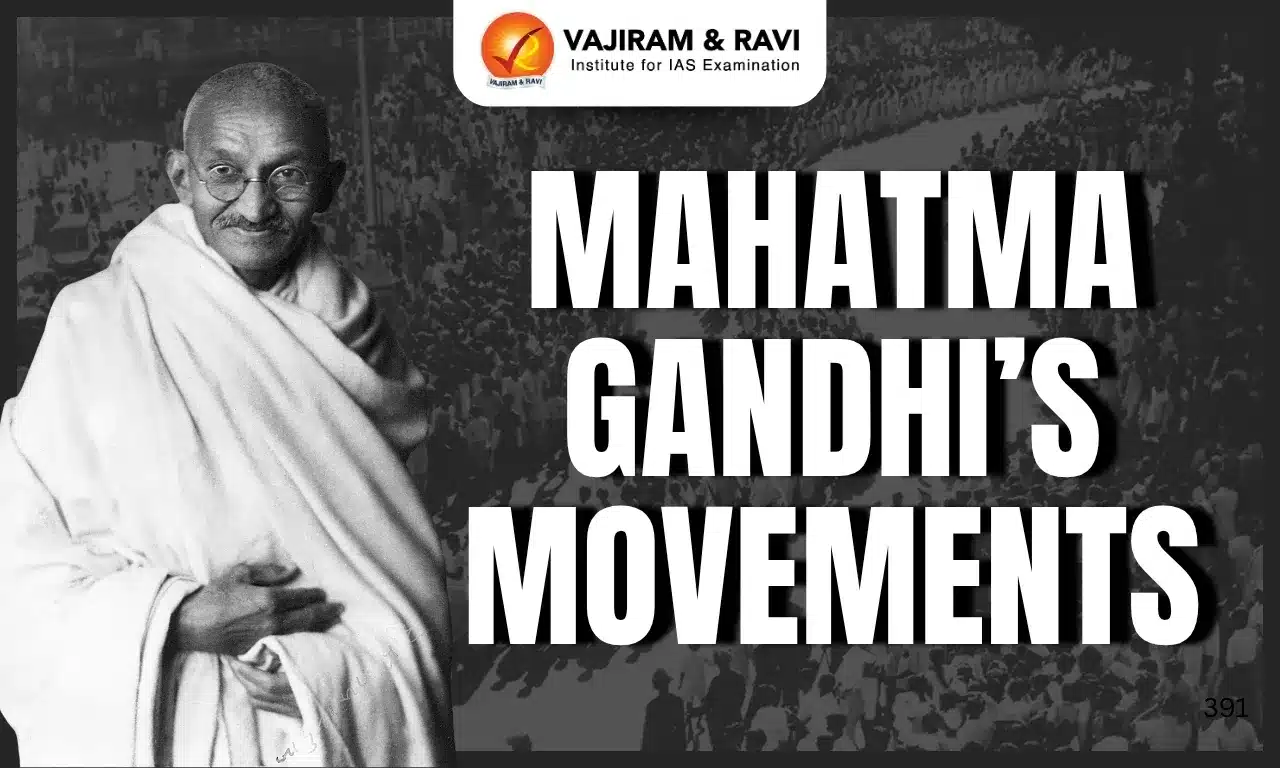
Mahatma Gandhi, born Mohandas Karamchand Gandhi, was India’s foremost leader in the struggle against British colonial rule. He transformed the freedom movement into a mass movement through the principles of Satyagraha, Ahimsa, truth, self-reliance, and civil disobedience.
Gandhi’s political methods enabled ordinary people—peasants, workers, women, students, and traders—to participate in public life. His leadership shaped India’s national movement and influenced civil-rights and anti-colonial struggles across the world.
Mahatma Gandhi Biography
Mahatma Gandhi was born on 2 October 1869 in Porbandar, then part of the princely state of Kathiawar. His full name was Mohandas Karamchand Gandhi.
- Mahatma Gandhi Father Name: His father's name was Karamchand Uttamchand Gandhi, popularly known as Kaba Gandhi. He served as a diwan in several princely states, including Porbandar.
- His mother, Putlibai Gandhi, deeply influenced his ethical and religious outlook.
- Mahatma Gandhi Children: Gandhi married Kasturba Gandhi in 1883. He had four sons: Harilal Gandhi, Manilal Gandhi, Ramdas Gandhi, and Devdas Gandhi.
- Education and Career: He moved to London in 1888 to study law and was called to the Bar in 1891. After having limited success as a lawyer in India, he relocated to South Africa in 1893 for legal work. This journey marked a watershed moment in Mahatma Gandhi's life.
Mahatma Gandhi History
Mahatma Gandhi's life took a decisive turn in South Africa (1893-1914), where racial discrimination inspired him to create Satyagraha. He returned to India in 1915, guided by Gopal Krishna Gokhale, and quickly rose to prominence as a national leader through nonviolent resistance to India's political, social, and economic struggles.
Mahatma Gandhi in South Africa
Mahatma Gandhi lived in South Africa from 1893 to 1914, where he experienced racial discrimination and developed his method of political resistance, Satyagraha.
- A defining incident occurred when he was removed from a first-class railway compartment at Pietermaritzburg despite holding a valid ticket. This experience exposed him to the systematic discrimination faced by Indians.
- Gandhi organised the Indian community and founded the Natal Indian Congress in 1894. He challenged discriminatory laws concerning registration, immigration, voting rights, and movement.
- He also established the Phoenix Settlement in 1904 and Tolstoy Farm in 1910. In 1906, he launched Satyagraha against discriminatory laws, developing non-violent resistance as a political method.
- His South African experience strengthened his leadership and organisational skills before his return to India in January 1915.
Mahatma Gandhi’s Arrival in India
Gandhi returned to India in January 1915 after more than two decades in South Africa. Following Gopal Krishna Gokhale’s advice, he travelled extensively across India to understand its social and economic conditions before directly entering active politics. He founded the Sabarmati Ashram near Ahmedabad in 1917. The ashram became an important centre for training volunteers in truth, non-violence, manual labour, communal harmony, khadi, and self-reliance.


Mahatma Gandhi Philosophy and Teachings
Mahatma Gandhi’s philosophy was not limited to political freedom. He believed that true independence required ethical conduct, economic self-reliance, social equality, and dignity for every individual.
- Truth: For Gandhi, truth or Satya was the highest moral principle. He believed that political action should be guided by honesty, justice, and moral courage.
- Non-Violence: Ahimsa, or nonviolence, was central to Gandhi's philosophy. He opposed violence not out of weakness, but because he believed nonviolence was a more effective and ethical way to combat injustice.
- Satyagraha: Satyagraha refers to an insistence on the truth. It entailed nonviolent resistance to unjust laws or authority. Its tactics included peaceful protest, fasting, boycotting, non-cooperation, civil disobedience, and a willingness to accept punishment.
- Swaraj: Gandhi's concept of Swaraj encompassed more than just political independence from British rule. It also implied self-government, self-discipline, village development, economic autonomy, and responsible citizenship.
- Sarvodaya: It refers to the welfare of all. Gandhi believed that economic and political progress should primarily benefit the poorest and most vulnerable members of society.
Mahatma Gandhi's Movements in Early Phase
Gandhi’s early movements in India (1917–1918) marked the beginning of his experiments with Satyagraha and non-violent mass mobilisation. The three major struggles were Champaran Satyagraha (1917) against indigo cultivation, Ahmedabad Mill Strike (1918) over workers’ wages, and Kheda Satyagraha (1918) against land-revenue collection during crop failure.
Champaran Satyagraha (1917)
Champaran Satyagraha was the first attempt at mobilising the Indian masses by Gandhi at the invitation of Rajkumar Shukla in the context of the indigo peasants of Champaran. This Gandhian Movement was the First Civil Disobedience in India.
- It was primarily triggered by the oppressive ‘Tinkathia system’, under which peasants were forced to cultivate indigo on 3/20th (15%) of their total land.
- Gandhi intervened in the matter but was asked to leave the place by the authorities. However, Gandhi refused to leave, thus disobeying the order.
- Eventually, Gandhi was able to convince the government about the ills of the tinkathia system and to look into the matter.
- The government appointed a committee to go into the matter and nominated Gandhi as a member. As a result, the tinkathia system was abolished, and in a compromise settlement, only 25 % of the money taken by peasants was compensated.
- Participants include Rajendra Prasad, Narhari Parekh, and J.B. Kripalani
Ahmedabad Mill Strike (1918)
Following the Champaran Satyagraha, the next step in mobilising the masses was the workers of Ahmedabad's urban centre. Ahmedabad Mill Strike was the result of a disagreement between the textile workers and the mill owners that arose in March 1918 regarding the end of the plague bonus.
- Mill owners paid bonuses of 75% of their salary to retain the workers during the outbreak of the plague in 1917. But after the end of the plague, workers were demanding an increase of 50 % in wages while mill owners were advocating discontinuance of the bonus. As a result, a deadlock was created.
- Gandhi intervened at the request of Anusuya Sarabhai and undertook a fast unto death. As a result, owners agreed to the 35% wage hike.
- This was the first movement where fasting, a means of self-suffering to create moral pressure, was used by Gandhi as a political weapon in India.
Kheda Satyagraha (1918)
Kheda Satyagraha was the first instance of Non-Cooperation led by Gandhi in the Indian National Movement. It took place in 1918 when, due to the failure of the monsoon, peasants in the Kheda district faced severe distress and demanded revenue relief from the government in light of crop failure and rising prices.
- According to the government's famine code, cultivators were entitled to total remission if crop yield fell below 25% of the average. But the authorities rejected it. As a result, peasants turned to Gandhi.
- Gandhi intervened on behalf of the poor peasants, advising them to withhold payment and 'fight unto death against such a spirit of vindictiveness and tyranny.'
- The government ordered it to be restrained in the collection of revenues (collected only from those ryots who could afford to pay) and not to confiscate lands. Gandhi decided to withdraw from the struggle.
- Participants: Sardar Vallabhbhai Patel, Narahari Parikh, and Indulal Yagnik.
Mahatma Gandhi's Movements in Indian Freedom Struggle
Mahatma Gandhi transformed the Indian freedom struggle by introducing Satyagraha, Ahimsa and non-violent mass mobilisation as central instruments of resistance against colonial rule. His leadership connected the national movement with the everyday grievances of peasants, workers and ordinary citizens.
Satyagraha Against Rowlatt Act (1919)
Gandhi launched Satyagraha against the Rowlatt Act, which was based on the recommendations of a Sedition Committee formed in 1917 under Justice Sidney Rowlatt to suppress revolutionary activities and investigate ‘seditious conspiracy’.
- The committee's proposals led to the Rowlatt Act (Anarchic and Revolutionary Offenses Act of 1919), passed by the Imperial Legislative Council, aiming to curtail the civil liberties of the Indian people.
- The Rowlatt Act allowed political and revolutionary activists to be tried without judicial proceedings or even imprisoned without trial for two years. It also suspended the right to habeas corpus and the right to appeal. (Read more about Types of Writs)
- Gandhiji called it the “Black Act '' and launched the satyagraha against the Act. It involved fasting, praying, disobeying laws, and risking arrest and imprisonment. The satyagraha brought Gandhi to the centre of the Indian national movement.
- Gandhi also organised the Satyagraha Sabha, his organisation, to carry out the movement. However, due to the violence in some parts of India, Gandhi had to call off the Satyagraha.
- Gandhi's ability to connect with the masses was demonstrated during this Satyagraha. Gandhian ideology and methods for the freedom struggle (Non-violence and Satyagraha) were introduced to the Indian masses.
Non-Cooperation Movement (1921-22)
Non-Cooperation Movement was launched by Mahatma Gandhi in 1920 as a response to the horrific Jallianwala Bagh massacre, which occurred amidst widespread protests against the repressive Rowlatt Act.
- In September 1920, the Congress held a special session in Calcutta and resolved to accept Gandhi's proposal of non-cooperation with the British government until Khilafat and Punjab grievances were addressed, and self-government was established.
- This Gandhian movement was merged with the Khilafat movement, which demanded that the Turkish Sultan or Khalifa retain control over the Muslim sacred places in the erstwhile Ottoman Empire.
- Mahatma Gandhi withdrew the non-cooperation movement following the Chauri Chaura incident on 5 February 1922, in which 23 police officers were killed. After the withdrawal, he focused on the constructive programme of social reforms.
Civil Disobedience Movement (1930-34)
Civil Disobedience Movement, also known as the Salt Satyagraha, was the second major mass movement following the Non-Cooperation Movement and marked a significant step forward in expanding the social base of India’s freedom struggle.
- Gandhi declared at the Calcutta Congress in 1928 that the British must grant India dominion status, or the country would erupt in a revolution for complete independence. The British paid no attention to this. As a result, the INC in its Lahore session (1929) demanded ‘Punra Swaraj’, and decided to celebrate 26th January as ‘Independence Day’. It also declared that a civil disobedience movement would be started under the leadership of Gandhi.
- Gandhi announced the 'Dandi March' against the unjust tax on salt as part of the movement. On April 6, 1930, he violated the salt regulations, thereby launching the Civil Disobedience Movement.
- Induced by Gandhi's extraordinary endeavours at Dandi, defiance of the salt laws spread throughout the country. However, it was halted for a period after the Gandhi-Irwin Pact.
- When the movement was resumed after the failure of the Second Round Table Conference, it began to dwindle towards the end of 1932. It was officially withdrawn in May 1934.
Quit India Movement (1942)
Quit India Movement (August Kranti Movement) was the ‘third great wave’ of India’s struggle for freedom, launched on August 8, 1942, under the leadership of Mahatma Gandhi. This Gandhian Movement was more of a rejection of British rule than a traditional Satyagraha.
- It was the result of Indian disillusionment with British rule, with the immediate causes being the failure of the Cripps Mission and the hardships caused by World War II.
- On August 8, 1942, the All India Congress Committee met at Gowalia Tank in Bombay and passed the famous Quit India Resolution. On the same day, Gandhi issued his 'Do or Die' call. It demanded an end to British rule in India with immediate effect, the formation of a provisional government after the war, and the declaration of free India.
- As a result, major leaders of the Indian National Congress were arrested and imprisoned without trial by British officials. However, the protests continued across the country with huge mass participation.
- Although it did not immediately achieve its goals, it contributed to the weakening of British rule and paved the way for the independence of India.
Mahatma Gandhi’s Movements Impact
Gandhi’s movements broadened the social base of Indian nationalism and transformed the freedom struggle into a sustained mass movement. His methods of Satyagraha and non-violence gave ordinary people a means to participate in the struggle against colonial rule.
- Mass Mobilisation: Brought peasants, workers, women, students and middle classes into the national movement, making nationalism more socially widespread.
- Political Awakening: Developed political consciousness among ordinary Indians and connected local grievances with the greater demand for Swaraj.
- New Methods of Resistance: Established Satyagraha, non-cooperation, boycott and civil disobedience as major tools of anti-colonial struggle.
- Challenge to Colonial Authority: Boycotts, refusal to cooperate and violation of colonial laws undermined the legitimacy and functioning of British rule.
- National Unity: Provided a common political platform for diverse groups, while Gandhi consistently promoted communal harmony and social reform.
- Social Reform: Linked political freedom with issues such as untouchability, Khadi, village industries and constructive work.
- Women’s Participation: Mass movements, particularly the Civil Disobedience Movement, created greater opportunities for women to participate actively in nationalist politics.
Contemporary Relevance of Gandhiji
Mahatma Gandhi remains relevant in the modern world because many societies continue to face violence, inequality, discrimination, environmental damage, and political conflict.
- Non-Violent Protest: His methods continue to influence peaceful movements for civil rights, democracy and social justice.
- Movements like Black Lives Matter and Extinction Rebellion (for climate change) use Gandhian methods of peaceful protests.
- Self-Reliance (Swaraj): Self-reliance encourages economic independence, local production, and supporting local communities. Initiatives like Atma Nirbhar Bharat (Self-Reliant India) draw heavily from Gandhi’s vision of decentralisation.
- Truth (Satya): Truthfulness is vital for ethical journalism and countering misinformation on the internet. Fact-checking websites, open journalism, and campaigns against "fake news" on social media reflect Gandhi's lifelong pursuit of truth.
- Social Harmony: Gandhi's emphasis on communal harmony and dialogue remains relevant in societies facing social and religious divisions.
- Rural Development: His emphasis on villages, decentralisation and self-reliance continues to influence debates around inclusive development.
Mahatma Gandhi Death and Assassination
Mahatma Gandhi was assassinated on 30 January 1948 in New Delhi at the age of 78. He was on his way to an evening prayer meeting at Birla House when Nathuram Vinayak Godse shot him at close range. Gandhi’s death caused deep grief across India and drew global attention. In his final days, he had worked tirelessly to promote peace, communal harmony, and reconciliation after Partition-related violence. Gandhi’s legacy continues to represent truth, non-violence, courage, and service, inspiring people and justice movements worldwide.
Mahatma Gandhi UPSC PYQs
Q1: What were the events that led to the Quit India Movement? Point out its results. (UPSC Mains 2024)
Q2: The same Gandhiji who withdrew the Non-Cooperation Movement on the issue of violence at Chauri-Chaura refused to condemn people’s violence during the Quit India Movement. Do you think that he was losing faith in the efficacy of non-violence and was willing to deviate from this path? Elucidate. (UPSC Mains 2021)
Q3: Do you agree with the fact that the virtual failure of the Non-Cooperation Movement and the gloom that descended on the nationalist scene created conditions for revolutionary activities? Discuss. (UPSC Mains 2020)
Q4: Consider the following subjects with regard to the Non-Cooperation Programme:
1. Boycott of law-courts and foreign cloth
2. Observance of strict non-violence
3. Retention of titles and honours without using them in public
4. Establishment of Panchayats for settling disputes
How many of the above were parts of the Non-Cooperation Programme? (UPSC prelims 2025)
a) Only one
b) Only two
c) Only three
d) All the four
Ans: (c)
Q5: Consider the following statements in respect of the Non-Cooperation Movement:
1. The Congress declared the attainment of ‘Swaraj’ by all legitimate and peaceful means to be its objective.
2. It was to be implemented in stages with civil disobedience and non-payment of taxes for the next stage only if ‘Swaraj’ did not come within a year and the Government resorted to repression.
How many of the above were parts of the Non-Cooperation Programme? (UPSC prelims 2025)
a) 1 only
b) 2 only
c) Both 1 and 2
d) Neither 1 nor 2
Ans: (c)
| Other Related Posts | |
| Mahatma Gandhi's Movements | Ahmedabad Mill Strike |
| Satyagraha | Kheda Satyagraha |
| Champaran Satyagraha | Vaikom Satyagraha |

 Last updated on August, 2026
→ UPSC Mains 2026 commenced on 21st August 2026 and will continue through 30th August 2026, as per the official examination schedule.
→ UPSC Mains Question Paper 2026 is out now for Essay & GS Paper 1, 2, 3 & 4.
→ UPSC Mains GS Paper 1 2026 is out now.
→ UPSC Mains GS Paper 2 2026 is out now.
→ UPSC Mains GS Paper 3 2026 is out now.
→ UPSC Mains GS Paper 4 2026 is out now.
→ Check out the latest UPSC Syllabus 2026 here.
→ UPSC Mains Admit Card 2026 is now out.
→ Enroll in Vajiram & Ravi’s UPSC Mains Test Series 2027 for structured answer writing practice, expert evaluation, and exam-oriented feedback.
→ Join Vajiram & Ravi’s UPSC Mentorship Program 2027 for personalized guidance, strategy planning, and one-to-one support from experienced mentors.
→ Go through the UPSC Mains Previous Year Papers to enhance your preparation.
→ Download UPSC Mains Essay Paper 2025, UPSC Mains GS Paper-I 2025, UPSC Mains GS Paper-II 2025, UPSC Mains GS Paper-III 2025, UPSC Mains GS Paper-IV 2025, UPSC Mains English (Compulsory) Paper 2025, UPSC Mains Hindi (Qualifying) Paper 2025 here.
→ UPSC has released UPSC Toppers List 2025 with the Civil Services final result on its official website.
→ UPSC Calendar 2027 has been released.
→ Also check Best UPSC Coaching in India
Mahatma Gandhi FAQs
Q1. What was Gandhi's famous quote?+
Q2. Was Mahatma Gandhi famous for?+
Q3. Why did Mahatma Gandhi go to South Africa?+
Q4. What is Gandhi's famous slogan?+
Q5. What were the 3 Satyagraha launched by Gandhiji?+
Tags: mahatma gandhi quest upsc modern indian history notes