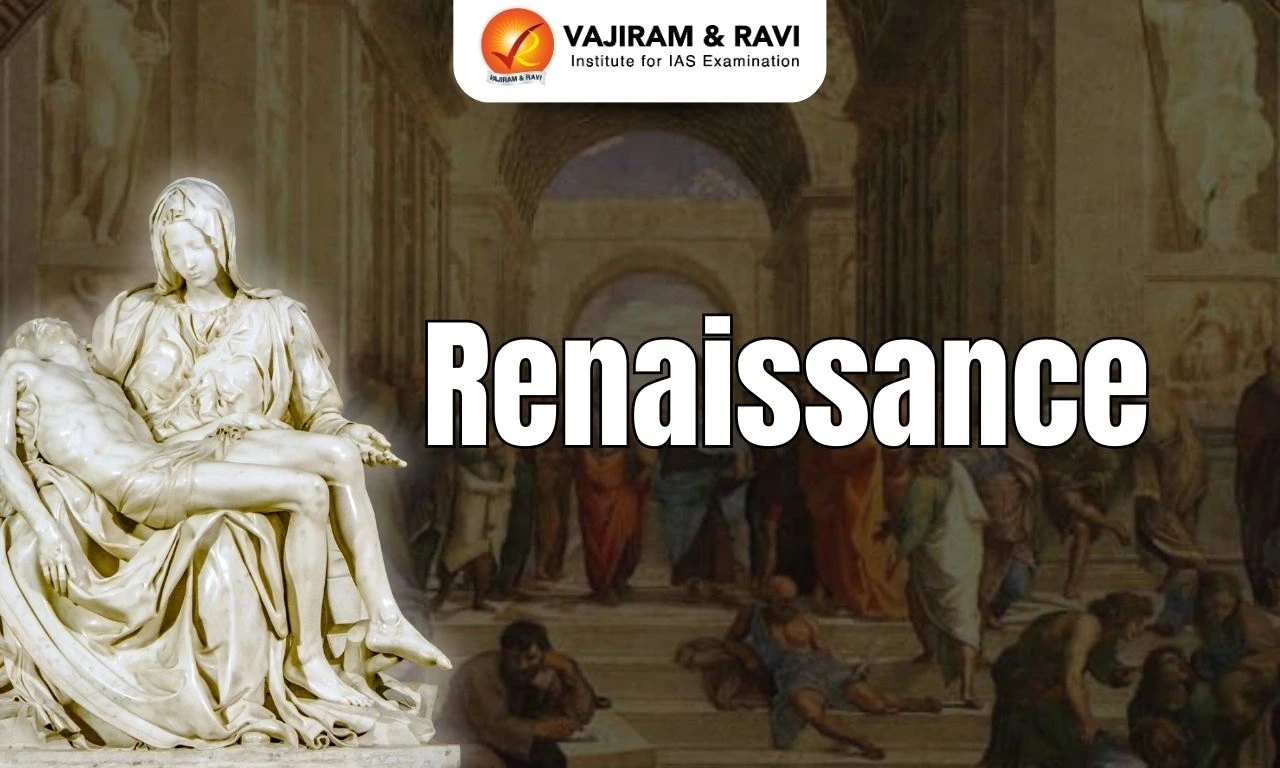
The Renaissance was a major intellectual, cultural, artistic, and scientific movement that began in Italy during the 14th century and gradually spread across Europe. The term "Renaissance" means “rebirth”, referring mainly to the revival of interest in the classical Greek and Roman heritage.
The movement marked a transition from the medieval period to the early modern period. It encouraged humanism, rational thinking, scientific inquiry, individualism, and new forms of artistic expression. The Renaissance played an important role in shaping modern European society, science, literature, art, and political thought.
Renaissance Definition
The Renaissance, a transformative period between the Middle Ages and Modernity, is often described as a ‘rebirth’ of Classical learning and wisdom. Originating in 14th-century Italy (Florence), it marked a significant departure from the medieval period, ushering in a renewed interest in the cultural and intellectual achievements of ancient Greece and Rome.
Renaissance Causes
The Renaissance movement emerged in Europe through a combination of economic, political, intellectual, and cultural changes that encouraged the revival of classical learning and new approaches to human life and knowledge.
- Revival of Classical Learning: Renewed interest in the literature, philosophy, and art of ancient Greece and Rome encouraged humanism and intellectual inquiry.
- Fall of Constantinople (1453): The migration of Byzantine Greek scholars and manuscripts to Western Europe contributed to the revival of Greek classical knowledge.
- Decline of Feudalism: The weakening of the feudal order and growth of towns and commerce created greater space for urban and intellectual life.
- Spread of Printing: Gutenberg's movable-type printing press in Europe enabled books and ideas to circulate more widely, accelerating intellectual exchange.
- Rise of Humanism: Humanist scholars shifted greater attention towards human beings, classical texts, education and worldly concerns, alongside existing religious thought.
- Expansion of Education: The growth of universities and secular learning increased interest in literature, philosophy, history and science.
- Cultural Interaction: Trade and contact with the Byzantine and Islamic worlds helped transmit classical and scientific knowledge to Western Europe.
- Changing Intellectual Outlook: Greater emphasis on observation, inquiry and individual achievement encouraged people to question established ideas and explore new fields of knowledge.


Renaissance Characteristics
The Renaissance had several distinctive characteristics that separated it from much of medieval intellectual culture. The following are some of the notable characteristics of the Renaissance movement:
- Humanism: The Renaissance sparked a movement known as Humanism, which emphasised the potential value and goodness of human beings, celebrated individualism, and promoted the study of subjects like philosophy, history, and literature.
- The thinkers of the Renaissance, such as Dante, Petrarch, and Cicero, advocated for a human-centric worldview rather than a religion-centric one.
- Humanism was the main intellectual basis of the Renaissance.
- Classical Revival: There was a surge in the study of classical texts, art, and architecture.
- This revival led to a new appreciation for balance, symmetry, and harmony, principles that were embodied in Greek and Roman art and architecture.
- Cultural Exchanges: The increased trade and interaction with different cultures, particularly during the Crusades, brought a wealth of knowledge and ideas to Europe.
- This exchange of ideas led to a greater understanding of the world and a desire to explore new territories and concepts.
- Rediscovery of Antiquity: The unearthing of ancient texts during the fall of Constantinople spurred a revival of Greek and Roman philosophies and arts.
- Scholars began to study these texts, leading to a renewed interest in humanism, science, and the arts.
- Scientific Advancements: The Renaissance was a period of great scientific advancements.
- The acceptance of the Copernican heliocentric model over the Ptolemaic geocentric system and Kepler’s laws of planetary motion revolutionised astronomy and paved the way for future scientific discoveries.
- Economic Growth: The decline of feudalism and the rise of commerce led to the growth of cities and the middle class.
- This economic prosperity funded the arts and supported the spread of Renaissance ideas.
- Technological Progress: Innovations like paper, printing, the compass, and gunpowder had profound effects on society. These technologies revolutionised communication, navigation, and warfare.
Renaissance Prominent Figures
The Renaissance produced remarkable thinkers, artists, writers, and scientists whose ideas transformed European art, literature, politics, and science, laying important foundations for modern thought and culture. Important thinkers of the Renaissance era include the following:
- Lorenzo de’ Medici: Known as Lorenzo the Magnificent, he was a patron of the arts who played a crucial role in strengthening the culture of the Renaissance in Florence.
- Leonardo da Vinci: Often described as the archetype of the ‘Renaissance man,’ Leonardo da Vinci is known for his works in art, science, and engineering. His works, such as the Mona Lisa and the Last Supper, are celebrated for their beauty and detail.
- Michelangelo: A master sculptor, painter, and architect, Michelangelo’s works, including the Sistine Chapel ceiling and the Statue of David, are celebrated for their beauty, detail, and portrayal of human emotion.
- Nicolaus Copernicus: A polymath who proposed the heliocentric model of the universe, challenging the established geocentric model. His work laid the foundation for modern astronomy.
- Thomas More: A philosopher and statesman, best known for his work ‘Utopia,’ which depicted an ideal society. His ideas influenced political thought and presented a critique of contemporary society.
Renaissance Impacts
The Renaissance had far-reaching impacts. It transformed European society by encouraging scientific inquiry, artistic innovation, humanism, religious reform, exploration, and new political ideas, laying the foundations of the modern age.
- Scientific Inquiry: It laid the groundwork for modern science through a more empirical and rational approach to understanding the world.
- This shift in thinking led to significant advancements in various fields, including physics, astronomy, and biology.
- Artistic Evolution: The Renaissance produced new artistic techniques and masterpieces that continue to influence art today. The use of perspective, realistic depiction of the human body, and the use of light and shadow transformed the visual arts.
- Examples: Leonardo da Vinci’s “Mona Lisa” and Michelangelo’s “David” are renowned for their realistic portrayal of the human form and innovative use of perspective and shading.
- Religious and Political Thought: The Renaissance introduced new ideas that challenged traditional views, leading to religious reforms and changes in governance.
- The questioning of authority and emphasis on individualism led to significant societal changes, including the Protestant Reformation.
- Examples: Martin Luther’s Ninety-Five Theses sparked the Protestant Reformation, leading to significant religious and political changes across Europe.
- Cultural Bridge: The Renaissance acted as a bridge from the medieval world to the modern age, setting the foundation for future advancements in various fields. It marked the beginning of the modern era, influencing every aspect of human life, from art and science to politics and education.
- Examples: The invention of the printing press by Johannes Gutenberg facilitated the spread of Renaissance ideas, leading to increased literacy rates and the democratisation of knowledge.
- Humanism: Human beings became the central concern of scholars. They believed in human potential and the right to seek joy and pleasure in this world, contrary to the Medieval Church's beliefs.
- Humanism found expression in the works of artists like Leonardo da Vinci, Michelangelo, Raphael, Botticelli, and Titian.
- Global Exploration: The Age of Discovery, driven by adventurers like Christopher Columbus and Vasco da Gama, led to the discovery of new lands. This expanded the known world and led to a greater exchange of ideas and resources.
- It was desirable for Europe after the Fall of Constantinople in 1453. However, this gave rise to colonialism later.
Renaissance and Enlightenment
The Enlightenment, or the Age of Reason, was an intellectual and philosophical movement that emerged in Europe during the 17th and 18th centuries. Its origins can be traced back to the Renaissance's emphasis on humanism, individualism, and the pursuit of knowledge beyond religious doctrine, which laid the foundation for questioning traditional authority.
- Key Characteristics: Characterised by a strong emphasis on reason, rationality, and scientific inquiry, the Enlightenment championed the use of logic and empirical evidence as the primary sources of knowledge.
- Thinkers challenged established authorities, superstitions, and religious dogmas, encouraging the acquisition of knowledge through observation and scientific investigation.
- Political and Social Impact: The Enlightenment formulated the ideas of natural rights and the social contract, proposing that legitimate government derives from the people's consent and is tasked with safeguarding individual rights.
- It advocated for balanced governance, constitutionalism, and the rule of law, promoting checks and balances and avoiding power monopolies.
- Religious Tolerance and Secularism: These were key principles, with scholars contesting the dominance of the Church and religious dogmas, advocating for the separation of church and state.
- The era was marked by a belief in human progress through reason, scientific understanding, and education, spurring social, political, and economic reforms.
- Influential Thinkers such as:
- René Descartes: Known for his famous phrase “I think, therefore I am", Descartes emphasised reason and scepticism.
- Voltaire: A fierce advocate for freedom of speech and religious tolerance.
- John Locke: His ideas on natural rights and the social contract influenced democratic thought.
- David Hume: A sceptic who explored the limits of human knowledge.
- Immanuel Kant: His work bridged reason and morality.
- Adam Smith: A pioneer in economics, emphasising free markets.
- Jean-Jacques Rousseau: His social contract theory influenced political philosophy.
- Major Events and Impact:
- The Enlightenment was a driving force behind major events like the Scientific Revolution, the Glorious Revolution in England, the American Revolution, and the French Revolution, which were influenced by its ideals of liberty, equality, and democracy.
- The impact of the Enlightenment was far-reaching, reviving scientific inquiry, motivating exploration and discovery, influencing nationalism, and transforming artistic styles.
- The invention of the printing press facilitated the spread of Enlightenment ideas, national languages, and literary traditions, shaping the modern world we know today.
Renaissance Decline
The Renaissance declined due to shifting trade routes, devastating European warfare, and strict religious censorship that stifled creative and intellectual freedom.
- The Italian Wars (1494-1559): Decades of foreign invasions by France, Spain, and the Holy Roman Empire destabilised Italian society and deprived local city-states of their independence.
- The Sack of Rome (1527): Troops of Holy Roman Emperor Charles V sacked Rome, which many historians regard as the definitive symbolic end of the High Renaissance.
- Shift in Global Trade: The emergence of Atlantic trade routes after the Age of Discovery diminished the economic supremacy of Mediterranean and Italian merchant republics. Wealthy benefactors no longer had the resources to fund large artistic endeavours.
- Protestant Reformation: The Protestant Reformation prompted the Catholic Church to undertake the Counter-Reformation. In 1545, the Council of Trent founded the Roman Inquisition, which censored creative works and made challenging church dogma punishable by death. This inhibited the open humanist inquiry that characterised the age.
- Evolution into New Eras: Artistic expression went toward Mannerism (exaggerated, tense forms), followed by Baroque styles. By the 17th century, the cultural focus had shifted to the Scientific Revolution and Age of Enlightenment.

 Last updated on Oct, 2026
→ UPSC 2027 Notification will be released on 13 January 2027 at upsconline.nic.in.
→ Check Nobel Prize 2026 Winners List here.
→ Download PIB PRiSM Monthly Magazine 2026 here.
→ Check UPSC Monthly Current Affairs Magazine The Recitals here.
→ Check out the latest UPSC Syllabus here.
→ Download UPSC Model Answers for Mains 2026
→ UPSC Mains Question Paper 2026 is out now for Essay & GS Paper 1, 2, 3 & 4.
→ UPSC Calendar 2027 has been released.
→ Enroll in Vajiram & Ravi’s UPSC Mains Test Series 2027 for structured answer writing practice, expert evaluation, and exam-oriented feedback.
→ Join Vajiram & Ravi’s UPSC Mentorship Program 2027 for personalized guidance, strategy planning, and one-to-one support from experienced mentors.
→ Go through the UPSC Mains Previous Year Papers to enhance your preparation.
→ UPSC has released UPSC Toppers List 2025 with the Civil Services final result on its official website.
→ Also check Best UPSC Coaching in India
Renaissance FAQs
Q1. What is the Renaissance in India?+
Q2. Why is it called a Renaissance?+
Q3. What is the synonym for Renaissance?+
Q4. What are the main ideas of the Renaissance?+
Q5. Who is the father of the Renaissance?+
Tags: quest renaissance UPSC World History Notes