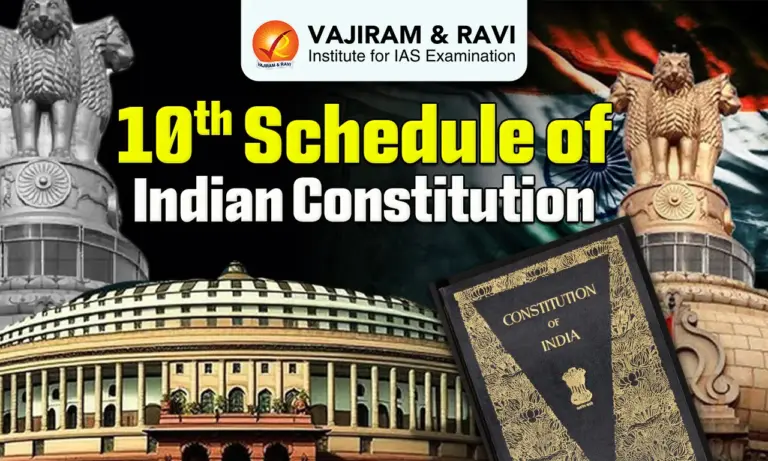
The 10th Schedule of Indian Constitution, added through the 52nd Amendment in 1985, introduced as the Anti-Defection Law. It was the first time the term “political party” officially appeared in the Constitution. This law was brought in to curb political defections, a growing problem at the time and to ensure elected representatives remained loyal to the party on whose ticket they won.
What is Defection?
Defection happens when a member of a political party abandons their loyalty to the party either by resigning or switching sides. For example, a politician might quit their party in one state and join another in a different state, often for personal or political gain. This kind of party-hopping disrupts governance, weakens public trust, and raises serious concerns about the leader’s commitment to voters and party ideology.
10th Schedule of Indian Constitution Provisions
- Definition: Defection happens when a legislator voluntarily gives up their party membership or votes against the party’s official line. It doesn’t have to be a formal resignation even actions or statements can signal defection.
- Grounds for Disqualification: A member caught defying the party whip or switching sides without proper approval can be disqualified from their seat. This applies to both elected and nominated members.
- What Doesn’t Count as Defection: There are exceptions. For example, if a legislator is elected as the Speaker of the House and then resigns from their party to maintain neutrality, they won’t be disqualified.
- Role of Courts: While the Tenth Schedule tried to keep courts out of defection cases, the Supreme Court in Kihoto Hollohon vs Zachillhu (1992) made it clear: the Speaker’s decisions can be reviewed by the courts under Articles 32 and 226.
- Framing the Rules: Each House, the Lok Sabha or a State Assembly can set its own rules for handling defection cases. The Speaker or Chairman gets the authority to do this, which gives some flexibility based on the House’s needs.
Also Check: 1st Schedule of Indian Constitution





Anti-Defection Law Process
When a legislator is suspected of defection, a petition can be filed before the Speaker or Chairman of the House. Contrary to popular belief, there’s no requirement for one-third of party members to sign it, anyone, including another legislator, can raise the complaint.
The Speaker (or Chairman in the Rajya Sabha or State Councils) reviews the petition, examines the facts, and may seek explanations from the accused member. If satisfied that defection has taken place, the member is disqualified under the Tenth Schedule.
Here’s the thing: the Speaker’s decision is considered final within the House, but it isn’t above judicial review. The disqualified member can challenge the ruling in the High Court or Supreme Court and not appeal to the President. The part about the President and Election Commission only applies in cases involving disqualification under Articles 102 or 191, not defection.
Also Check: 4th Schedule of Indian Constitution
10th Schedule of Indian Constitution Merits
- Stability in Governance: The 10th Schedule of Indian Constitution has helped prevent the chaos of frequent party-switching. By keeping legislators from jumping ship for personal gain or political bargains, it adds a layer of stability to both state and central governments. Fewer defections mean fewer mid-term collapses and smoother continuity in governance.
- Preserving the Voter’s Mandate: The anti-defection law protects the spirit of the vote. When a candidate wins on a party ticket, they’re expected to stick with that party’s platform. Switching sides mid-term is seen as a betrayal not just of the party, but of the voters who backed that candidate. This law helps keep that trust intact.
10th Schedule of Indian Constitution Demerits
- Weakening Independent Voices: One major criticism of the Anti-Defection Law is that it clips the wings of independent thinking within parties. Legislators who disagree with their party’s stance on key issues often stay silent not because they’re convinced, but because speaking out could cost them their seat. This stifles healthy debate and turns representatives into rubber stamps.
- Tool for Political Control: The law, meant to curb opportunism, has sometimes been turned into a political weapon. Party leaders have used the threat of disqualification to silence dissent or force compliance. Instead of addressing genuine concerns from within, parties have used the law to enforce loyalty through fear.
Also Check: 7th schedule of indian constitution
Anti-Defection Law Case
The phrase “Aaya Ram Gaya Ram” became a political shorthand for party-hopping in India. It goes back to 1967, when Haryana MLA Gaya Lal famously switched parties three times in a single day. That moment exposed just how easily politicians could jump ship for personal or political gain. It was this kind of instability that pushed Parliament to introduce the Anti-Defection Law in 1985. Keep elected officials loyal to their party, reduce political chaos, and protect the spirit of democracy. So when someone says “Aaya Ram Gaya Ram,” they’re pointing to the deeper issue of political flip-flopping.
10th Schedule of Indian Constitution Recent Development
- 91st Amendment Act, 2003: This amendment tightened the rules by disallowing splits in a party as a ground to avoid disqualification. Only mergers were recognized as valid, if at least two-thirds of members agree, the merger is legal and those members won’t face disqualification.
- 97th Constitutional Amendment (Clarification): This doesn’t actually relate to the anti-defection law, it dealt with cooperative societies. The confusion might come from proposals or private members’ bills, but there’s no official 97th Amendment affecting the Tenth Schedule.
Time Limit on Defection Cases: While various court judgments and recommendations have pushed for a clear deadline (often suggesting three months), no constitutional amendment has officially fixed this time frame. It’s been a subject of debate but isn’t yet part of the law.

 Last updated on March, 2026
→ UPSC Final Result 2025 is now out.
→ UPSC has released UPSC Toppers List 2025 with the Civil Services final result on its official website.
→ Anuj Agnihotri secured AIR 1 in the UPSC Civil Services Examination 2025.
→ UPSC Marksheet 2025 is now out.
→ UPSC Notification 2026 & UPSC IFoS Notification 2026 is now out on the official website at upsconline.nic.in.
→ UPSC Calendar 2026 has been released.
→ Check out the latest UPSC Syllabus 2026 here.
→ UPSC Prelims 2026 will be conducted on 24th May, 2026 & UPSC Mains 2026 will be conducted on 21st August 2026.
→ The UPSC Selection Process is of 3 stages-Prelims, Mains and Interview.
→ Prepare effectively with Vajiram & Ravi’s UPSC Prelims Test Series 2026 featuring full-length mock tests, detailed solutions, and performance analysis.
→ Enroll in Vajiram & Ravi’s UPSC Mains Test Series 2026 for structured answer writing practice, expert evaluation, and exam-oriented feedback.
→ Join Vajiram & Ravi’s Best UPSC Mentorship Program for personalized guidance, strategy planning, and one-to-one support from experienced mentors.
→ Shakti Dubey secures AIR 1 in UPSC CSE Exam 2024.
→ Also check Best UPSC Coaching in India
10th Schedule of Indian Constitution FAQs
Q1. What is the 10th Schedule of the Indian Constitution?+
Q2. When was the 10th Schedule added?+
Q3. What is the purpose of the 10th Schedule?+
Q4. Who decides disqualification under the 10th Schedule?+
Q5. What is considered defection under the 10th Schedule?+
Tags: 10th schedule 10th schedule of Indian constitution