What is the Genetic Engineering Appraisal Committee (GEAC)?

Genetic Engineering Appraisal Committee

About Genetic Engineering Appraisal Committee (GEAC):

  • It is the statutory committee constituted under the “Rules for the Manufacture, Use/Import/Export and Storage of Hazardous Micro Organisms/Genetically Engineered Organisms or Cells (Rules, 1989)” framed under the Environment (Protection) Act, 1986. 
  • It was earlier called the Genetic Engineering Approval Committee, which was changed to Genetic Engineering Appraisal Committee in the year 2010.
  • It functions in the Ministry of Environment, Forest, and Climate Change (MoEF&CC).
  • The functions of GEAC as prescribed in the Rules 1989 are as follows:
    • To appraise activities involving large-scale use of hazardous microorganisms and recombinants in research and industrial production from the environmental angle.
    • To appraise proposals relating to the release of genetically engineered organisms and products into the environment, including experimental field trials.
    • The committee or any persons authorized by it has powers to take punitive action under the Environment Protection Act.
  • It keeps a check on the use, import, and export of genetically modified (GM) organisms and crops.
  • Clearance of GEAC is mandatory for the environmental releaseof GM crops.
  • Composition:
    • GEAC is chaired by the Special Secretary/Additional Secretary of MoEF&CC and co-chaired by a representative from the Department of Biotechnology (DBT).
    • Presently, it has 24 members and meets every month. The members comprise experts from other ministries as well as institutions such as the ICAR, ICMR, CCMB, and so on.
New Rules Governing the Selection of Experts:
  • Under the new rules, an “expert member” ought to be disclosing their “interest” that could conflict with their duties.
  • The expert is also expected to take all steps necessary to ensure that any conflict of interest not affect any decision of the GEAC.
  • An expert member with any direct or indirect association with a matter being discussed in a meeting of the committee is obliged to disclose this prior to the meeting.
  • Unless specifically requested by the committee, the expert is expected to recuse their selves from the meeting.
  • All selected members would also have to fill out a form detailing their professional affiliations to a decade prior to joining the committee.

Q1: What is genetic modification (GM) of crops and how is it done?

GM is a technology that involves inserting DNA into the genome of an organism. To produce a GM plant, new DNA is transferred into plant cells. Usually, the cells are then grown in tissue culture where they develop into plants. The seeds produced by these plants will inherit the new DNA. Source: TH

What is the Rural Community Immigration Class (RCIC) Scheme?

Rural Community Immigration Class

About Rural Community Immigration Class Scheme: 

  • It is a new programme launched by Immigration, Refugees and Citizenship Canada (IRCC) in December 2024.
  • It aims to address labour shortages and promote development in smaller rural communities by attracting individuals willing to settle long-term in these areas.
  • Eligibility
    • Education Level: Applicants can include those with 10+2, graduation, or secondary school qualifications.
    • Studies: Students who have completed at least 18 months of study in one of the designated communities are eligible to apply for PR directly. Those who studied outside these communities can also apply but must meet additional conditions.
    • Job Offer: Applicants need a job offer letter from a registered or designated employer in the community. This job offer can be in any category, including non-skilled roles. The offer must be submitted to the community, which will then issue a certificate supporting the PR application.
    • Work Experience: Relevant work experience is typically required, though this condition may be waived for international graduates who meet certain criteria.
    • Language Proficiency: Applicants must meet the Canadian Language Benchmark (CLB) requirements based on the job’s NOC TEER (National Occupational Classification Training, Education, Experience, and Responsibilities) level: TEER 0-1: CLB 6,TEER 2-3: CLB 5 and TEER 4-5: CLB 4
    • Financial Proof: Applicants must demonstrate they have at least half of the low-income threshold for rural areas (as determined by Statistics Canada) to sustain themselves for one year.
    • Intent to Reside: Candidates must provide genuine proof of their intention to live in the designated rural community.

Q1: What is Brain Drain?

It refers to the international transfer of human capital resources and it is applied mainly to the migration of highly educated people from developing to developed countries. Source: IE

Brazilian Velvet Ant

Brazilian Velvet Ant

About Brazilian Velvet Ant: 

  • Velvet ants are a group of parasitic wasps that are well known for a suite of defensive adaptations including bright coloration and a formidable sting.
  • Appearance: They’re wasps, some of which are wingless, and are named in part for their exteriors. Velvet ant is known for its distinct black and white markings.
  • Habitat: It is found in shrub desert in Brazil called the Caatinga.
  • Characteristics
    • It demonstrates remarkable mobility and covers significant distances in pursuit of hosts on the ground.
    • It is usually found throughout the day, peak activity typically coincides with the early morning and late afternoon, during periods of subdued sunlight.
    • It is recently found that the black parts on female velvet ants were actually ultrablack so that they absorbed nearly all visible light.
  • Why this finding is Unique?
    • Ultrablack pigmentation is rare in the animal kingdom.
    • In organisms that have it, it helps them hide from predators, regulate body temperature or even attract mates, as the contrast against brighter colors can be visually enticing.

Q1: What is a Parasite?

It is an organism that lives on or in another organism, the host, and gets its food from or at the expense of its host. Source: IE

Banana Cultivation

Banana Cultivation

About Banana:

  • It is basically a tropical crop and the second most important fruit crop in India next to mango.
  • Required Climatic Condition
    • Temperature: It grows well in a temperature range of 15ºC – 35ºC with relative humidity of 75-85%.
    • It prefers tropical humid lowlands and is grown from the sea level to an elevation of 2000m.
    • Soil: Deep, rich loamy soil with pH between 6.5 -7.5 is most preferred for banana cultivation. Soil for banana should have good drainage, adequate fertility and moisture. Saline solid, calcareous soils are not suitable for banana cultivation.
    • In India this crop is being cultivated in climate ranging from humid tropical to dry mild subtropics through selection of appropriate varieties.
  • Varieties cultivated in India : Dwarf Cavendish, Robusta, Monthan, Poovan, Nendran, Red banana, Nyali, Safed Velchi, Basrai, Ardhapuri, Rasthali, Karpurvalli, Karthali and Grand Naine etc.
  • Major Producing states: Andhra Pradesh, Maharashtra, Gujarat, Karnataka, Kerala etc.

Q1: What is Agricultural and Processed Food Products Export Development Authority (APEDA)?

APEDA was established by the Government of India under the Agricultural and Processed Food Products Export Development Authority Act of 1985. It works under the Ministry of Commerce and Industry. Source:DDNews

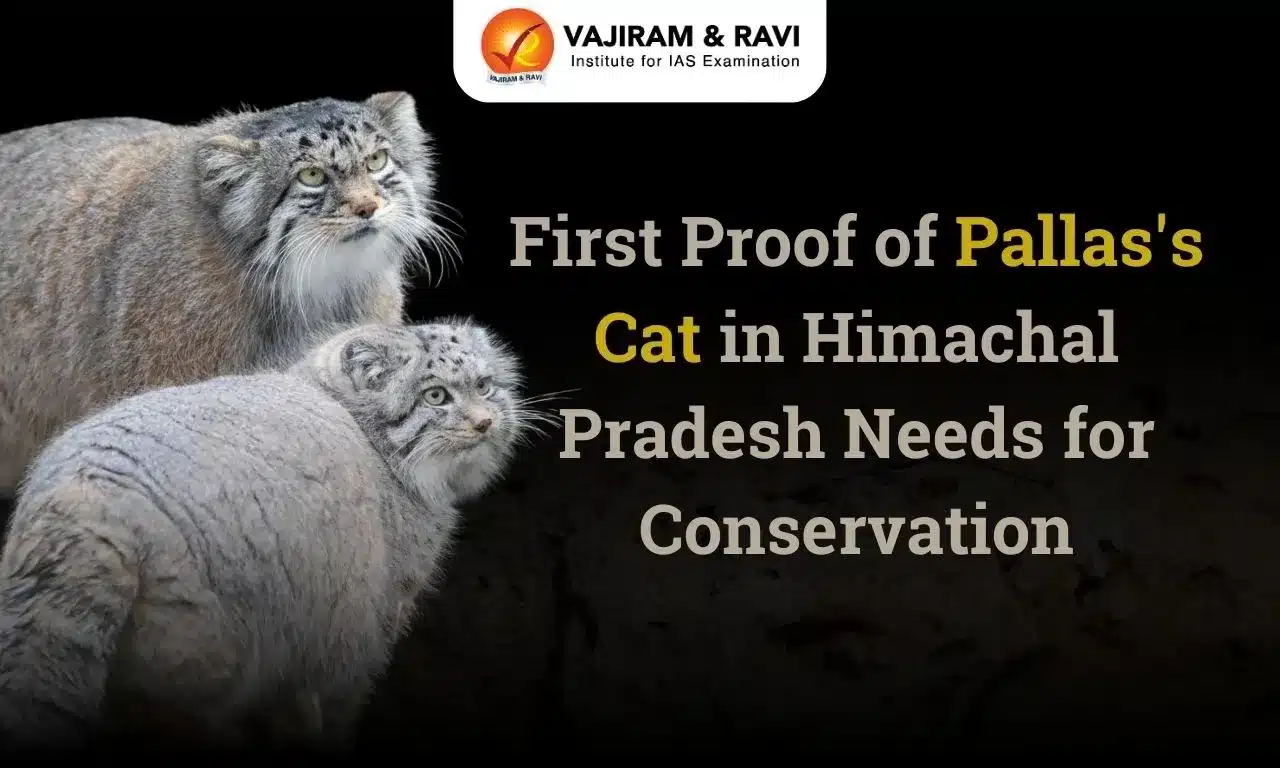
Pallas’s Cats

Pallas’s Cats

About Pallas’s Cat:

  • The Pallas’s cat, or manul (Otocolobus manul), is a small, long-haired cat (family Felidae).
  • It was named Pallas’s cat after Peter Simon Pallas, who first described it in 1776 based on specimens collected near Lake Baikal, Russia.
  • Distribution:
    • They are primarily found in Central Asia, with their range extending to western Iran, Mongolia, China, Russia (on the border of Mongolia and China), Kazakhstan, and Kyrgyzstan.
    • In these regions, these cats inhabit mountainous plains and semi-desert foothills.
  • Features:
    • It is a soft-furred animal about the size of a house cat and is pale silvery gray or light brown in colour.
    •  Head and body length ranges from 45 to 60 centimetres (18 to 24 inches) with an additional 23–30 cm for the tail; weight ranges from 2.5 to 3.5 kilograms (5.5 to 7.7 pounds).
    • The Pallas’s cat is distinguished by abroad head with high-set eyes and low-set ears.
    • The end of its tail is ringed and tipped with black, and some individuals have vague, dark markings on the body.
    • The fur of the underparts is about twice as long as that of the upperparts and possibly represents an adaptation to the cat’s habitual lying and crouching on cold ground.
  • Conservation Status:
    • IUCN Red List: Least Concern
    • CITES: Appendix II

Q1: What is a snow leopard?

It is a large, long-haired Asian cat, classified as either Panthera uncia or Uncia uncia in the family Felidae. Snow leopards live across a vast area in northern and central Asia's high mountains, including the Himalayan region. In the Himalayas, they live in high alpine areas, mostly above the tree line and up to 18,000 feet in elevation. They are found in 12 countries, including China, Bhutan, Nepal, India, Pakistan, Russia, and Mongolia. Source: TOI

Enquire Now