Money Supply, Types, Components, Role of RBI, Impact

Money Supply

What is Money?

Money is anything that is widely accepted in exchange for goods and services. It serves as a medium to buy and sell, a way to measure value, and a store of wealth for future use. Money can exist in physical forms like coins and notes or in digital forms like bank deposits and online payments. It is essential for smooth economic transactions and trade.

Characteristics and Functions of Money

  • Medium of Exchange: Money eliminates the inefficiencies of barter trade by providing a common standard accepted by all for buying and selling goods and services.
  • Unit of Account: Money provides a consistent measure to value goods and services, enabling price comparison and economic calculation.
  • Store of Value: Money retains its value over time, allowing individuals and businesses to save and plan for the future.
  • Standard of Deferred Payment: Money is used to settle debts and contractual obligations, facilitating credit and lending.
  • Liquidity: Money is the most liquid asset, easily convertible into goods, services, or other forms of wealth.
  • Acceptability: Money is widely accepted within an economy for transactions and payments.

Types of Money

Money exists in different forms depending on its nature, acceptability, and the way it is used in the economy. Understanding the different types of money is essential to study money supply, monetary policy, and banking.

1. Commodity Money

Commodity money is a form of money that has intrinsic value, meaning it is valuable in itself and can be used for purposes other than trade. Historically, people used metals or goods as a medium of exchange. Examples: Gold coins, silver coins, copper coins, salt, or cattle in ancient economies.

2. Fiat Money

Fiat money is money issued by a government and accepted as legal tender, even though it has no value in itself. Its value comes entirely from the trust people place in the issuing authority and its legal acceptance for payments. Examples: Indian rupee notes and coins, US dollar bills.

3. Representative Money

Representative money consists of paper or tokens that represent a claim on a physical commodity, which can be exchanged on demand. It allows people to trade easily without carrying heavy commodities. Examples: Gold certificates, silver certificates, old currency notes backed by gold reserves.

4. Bank Money

Bank money exists as deposits in banks that can be transferred electronically or through instruments like cheques. This type of money is created when banks lend money, effectively increasing the money available in the economy. Examples: Savings account deposits, current account balances, demand deposits.

5. Digital Money

Digital money is money that exists only in electronic form. It is used for online transactions, mobile payments, and cashless banking. This form of money has become increasingly important in modern economies. Examples: UPI transfers, Paytm balances, Google Pay, cryptocurrencies like Bitcoin.

Components of Money Supply

Money supply refers to the total amount of money circulating in an economy at a particular time. Economists classify money into different categories, called aggregates, to measure liquidity and help the Reserve Bank of India (RBI) regulate the economy effectively.

  • M0 (Reserve Money/Base Money):
    • Includes all currency notes and coins in circulation with the public.
    • Includes deposits of commercial banks held with the RBI.
    • Forms the foundation for all other money supply measures.
  • M1 (Narrow Money):
    • Consists of currency held by the public, demand deposits in banks, and other liquid deposits.
    • Used for day-to-day transactions and payments.
  • M2:
    • Includes all of M1 plus savings deposits with post offices.
    • Represents slightly less liquid money than M1 but still readily accessible.
  • M3 (Broad Money):
    • Includes M1 plus time deposits with commercial banks.
    • Widely used to measure total money available in the economy.
  • M4:
    • Includes M3 plus total deposits with post office savings institutions (excluding National Savings Certificates).
    • Represents the broadest measure of money supply in the economy.

Here’s the money supply hierarchy arranged from most liquid to least liquid: M0 > M1 > M2 > M3 > M4

Factors Affecting Money Supply

The total money circulating in an economy depends on several key factors that influence liquidity, inflation, and economic growth:

  1. Banks create money by giving loans and advances, which increases deposits and circulation in the economy.
  2. The Reserve Bank of India controls money supply through tools like Cash Reserve Ratio (CRR), Statutory Liquidity Ratio (SLR), and repo/reverse repo rates.
  3. Government borrowing absorbs money from the economy, while government spending injects money into circulation.
  4. Foreign inflows like exports, foreign investment, and remittances increase money supply, while imports and capital outflows reduce it.
  5. Public preference for cash or bank deposits affects liquidity; more cash holdings reduce deposits, while more deposits increase money supply.
  6. Economic activity and business confidence affect circulation; during growth, borrowing and spending increase money supply, while in slowdown, saving increases and circulation decreases.

Role of Reserve Bank of India in Controlling Money Supply

The Reserve Bank of India (RBI) plays a key role in managing the money supply to ensure economic stability, control inflation, and support growth.

  1. RBI uses the Cash Reserve Ratio (CRR) to control the amount of money banks can lend, affecting liquidity in the economy.
  2. The Statutory Liquidity Ratio (SLR) requires banks to maintain a certain percentage of deposits in approved government securities, regulating credit availability.
  3. Through repo and reverse repo rates, RBI controls borrowing and lending rates, influencing money supply and interest rates.
  4. Open Market Operations (OMO) involve buying or selling government securities to inject or absorb money from the economy.
  5. RBI monitors and regulates credit creation by banks to prevent excessive or inadequate money supply.
  6. By maintaining price stability and controlling inflation, RBI ensures that money supply supports sustainable economic growth without destabilizing the economy.

Money Supply Impact on Inflation and Economic Growth

  • Excessive money supply increases aggregate demand for goods and services, leading to higher prices and inflation, which reduces the real purchasing power of money.
  • A low or shrinking money supply decreases spending and demand, slowing down production, reducing employment, and potentially causing deflation.
  • Adequate money supply encourages borrowing and lending by businesses and individuals, promoting investment, industrial growth, and capital formation.
  • Increased money circulation stimulates consumption, trade, and entrepreneurship, contributing to higher GDP and overall economic development.
  • Changes in money supply influence interest rates; higher liquidity lowers borrowing costs, while lower liquidity increases interest rates, affecting investment and consumption.
  • Maintaining a balanced money supply ensures price stability, prevents financial crises, supports smooth functioning of markets, and promotes long-term sustainable economic growth.

Money Supply FAQs

Q1: What is money supply?

Ans: Money supply is the total amount of money available in an economy at a given time, including currency, deposits, and other liquid forms.

Q2: What are the main components of money supply?

Ans: The main components are M0 (currency in circulation + bank reserves), M1 (narrow money), M2 (M1 + savings deposits), M3 (M1 + time deposits), and M4 (M3 + post office deposits).

Q3: How does RBI control money supply?

Ans: RBI controls money supply using tools like Cash Reserve Ratio (CRR), Statutory Liquidity Ratio (SLR), repo and reverse repo rates, and open market operations.

Q4: How does money supply affect inflation?

Ans: An excessive money supply can increase demand, causing prices to rise (inflation), while low money supply can reduce demand, potentially causing deflation.

Q5: Can digital money impact money supply?

Ans: Yes, digital money in bank accounts and electronic payments contributes to M1 and M3, affecting overall liquidity.
Global Risk Report

Global Risk Report

About Global Risk Report:

  • The first edition of the report was published in 2006 in which extreme weather events have been categorised under “environmental risks.”
  • This year’s report presents the findings of the Global Risks Perception Survey 2024- 2025 (GRPS).
  • Key points of the report
    • These risks are assessed over both short-term (1-2 years) and long-term (10 years) horizons to guide policymakers in balancing immediate concerns with future challenges.
    • It classified global risks across economic, environmental, geopolitical, societal and technological domains.
    • Top 3short-term risks: It includes misinformation and disinformation, extreme weather events and state based armed conflict.
    • Top 3 Long term risks: It includes extreme weather events, biodiversity loss & ecosystem collapse and critical change to earth systems.
    • The evolving global risk landscape is shaped by the interaction of four critical spheres: technological, geostrategic, climatic and demographic.
    • These forces are expected to intensify over the next decade and beyond, resulting in a complex and interconnected web of challenges.
    • The report further stresses the importance of addressing short-lived climate pollutants, such as black carbon, methane and hydrofluorocarbons, which have significant environmental and health impacts. 

Q1: What is the Global Risk Report?

The Global Risks Report is your essential guide to identifying, understanding, and preparing for today's and tomorrow's risks. It outlines the major risk issues leaders like you will face and provides practical steps to confidently plan for what's ahead.

Source: DTE

What is Information Ratio (IR)?

What is Information Ratio (IR)?

About Information Ratio (IR):

  • It’s a metric for measuring how a portfolio or financial asset fares in regards to a benchmark, compared to the volatility of its returns.
    • This benchmark is usually a market index, like Nifty 50. It can also be an index representing any specific industry or market sector.
  • The IR depicts how well a portfolio or asset is matching and exceeding an index’s returns.
  • This metric also shows the level of consistency a portfolio is able to achieve in exceeding the returns of such a benchmark.
    • To that end, this ratio also includes the standard deviation component, also called tracking error.
    • Tracking error shows if a portfolio can regularly “track” and exceed its benchmark returns.
    • If such tracking error is low, it means the portfolio is consistent. Conversely, if the error is high, it signifies a more volatile performance.
  • Calculation of IR takes place based on the following formula:
    • IR = (Portfolio Rate of Returns – Benchmark Rate of Returns)/Tracking Error
  • Uses:
    • The IR is primarily used as a performance measure by fund managers.
    • In addition, it is frequently used to compare the skills and abilities of fund managers with similar investment strategies.
    • The ratio provides investors with insights about the ability of a fund manager to sustain the generation of excess, or even abnormal (as in “abnormally high”), returns over time.
    • Finally, some hedge funds and mutual funds use the IR to calculate the fees that they charge their clients (e.g., performance fee).

Q1: What does an information ratio of 0.5 mean?

An IR below 0.5 suggests that the manager may not be effectively utilising their skills to outperform the market, making it a less favourable investment choice. Therefore, investors generally seek strategies or managers with Information Ratios greater than 0.5 for better risk-adjusted returns.

Source: TH

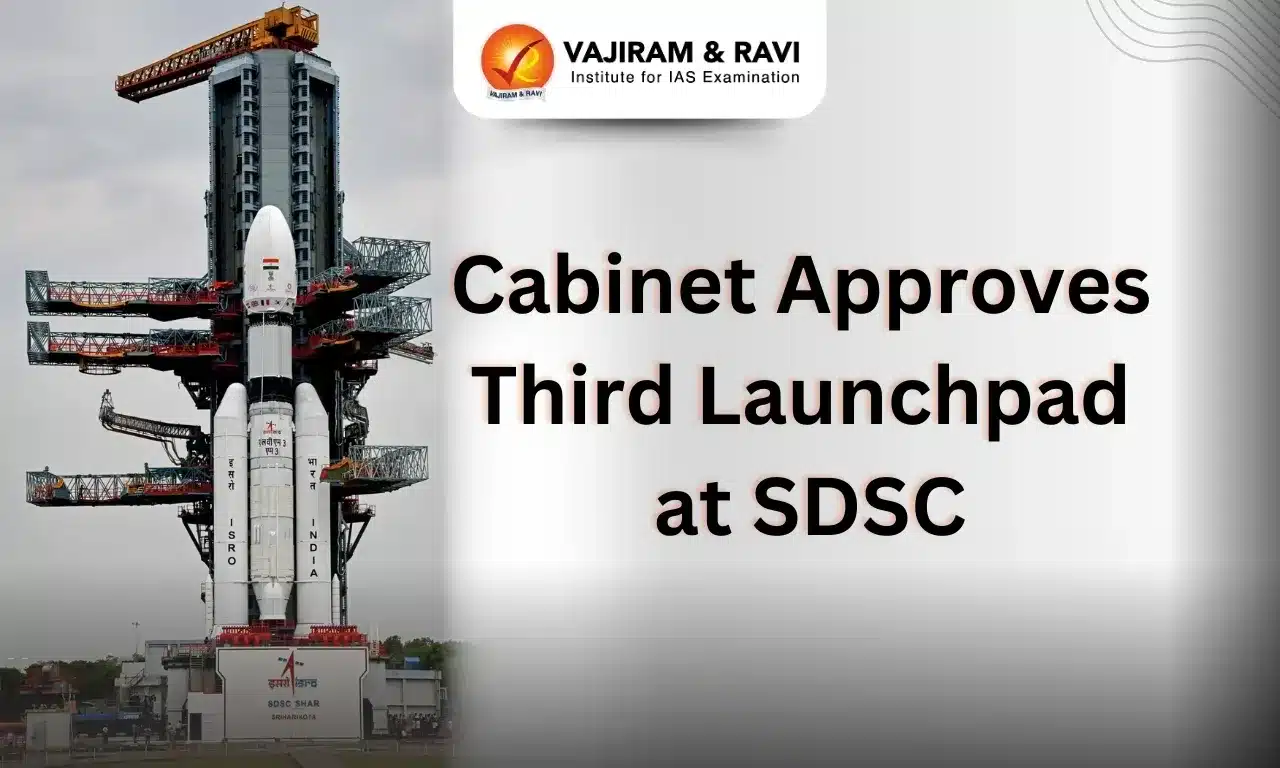
Cabinet Approves Third Launchpad at Satish Dhawan Space Center for Next Generation Launch Vehicles

Cabinet Approves Third Launchpad at Satish Dhawan Space Center for Next Generation Launch Vehicles

What’s in today’s article?

  • Why in News?
  • Satish Dhawan: A Pioneer in Indian Space Science
  • The Search for India's Ideal Satellite Launch Site
  • Why Sriharikota Was Chosen as the Launch Site?
  • ISRO to Get a Third Launch Pad: Key Highlights

Why in News?

The Union Cabinet approved the establishment of a third launchpad at the Satish Dhawan Space Centre (SDSC) in Sriharikota, Andhra Pradesh, to support ISRO's future use of the heavier Next Generation Launch Vehicle (NGLV). 

SDSC, India's sole spaceport, became operational in 1971 with the launch of the 'Rohini-125' rocket and was renamed in 2002 to honor former ISRO Chairman Satish Dhawan.

Satish Dhawan: A Pioneer in Indian Space Science

  • Early Life and Achievements
    • Born in Srinagar, Satish Dhawan was an eminent rocket scientist, hailed as the 'Father of Experimental Fluid Dynamics research' in India. 
    • He made significant contributions to the study of turbulence and boundary layers.
  • Leadership at ISRO
    • In 1972, Dhawan succeeded Vikram Sarabhai as the Chairman of ISRO. 
    • Under his leadership, India’s space program witnessed remarkable growth, including the development of operational systems like:
      • INSAT: A telecommunications satellite.
      • IRS: The Indian Remote Sensing satellite.
      • PSLV: A launch vehicle that elevated India to a spacefaring nation.
  • Legacy and Recognition
    • After his passing in 2002, the space center at Sriharikota was renamed the Satish Dhawan Space Center to honor his transformative contributions to India’s space journey.

The Search for India's Ideal Satellite Launch Site

  • Search begins
    • In the 1960s, India embarked on a mission to indigenously develop satellites and launch vehicles under the leadership of Vikram Sarabhai, the founder of the Indian space program. 
    • He tasked scientist EV Chitnis with finding a suitable launch site on the country’s east coast.
  • Survey and Selection of Sriharikota
    • In March 1968, information and maps of potential sites, including Sriharikota, were gathered.
  • Quick Execution and Acquisition
    • By August 1968, Sarabhai conducted a survey of Sriharikota. 
    • In October 1968, approximately 40,000 acres of land in Sriharikota were acquired, showcasing the remarkable speed and efficiency of the process.

Why Sriharikota Was Chosen as the Launch Site?

  • Ideal Location on the East Coast
    • Sriharikota’s position on the east coast allows rockets to be launched eastwards, leveraging Earth’s rotation for additional velocity. 
    • This provides a significant boost of about 450 m/s, increasing payload capacity.
  • Proximity to the Equator
    • Being close to the equator is advantageous for launching geostationary satellites, as they need to be in the equatorial plane. 
    • The closer the launch site to the equator, the more efficient the launch.
  • Uninhabited and Sea Proximity
    • Sriharikota's sparsely populated area and proximity to the sea ensure a safe flight path over the ocean, where separated rocket hardware can fall without risks or constraints.

ISRO to Get a Third Launch Pad: Key Highlights

  • Purpose of the Third Launch Pad (TLP)
    • Designed to support Next Generation Launch Vehicles (NGLVs) and serve as a standby for the Second Launch Pad at Sriharikota, Andhra Pradesh.
    • Will enhance India's capacity for human spaceflight missions and space exploration.
  • Timeline and Importance
    • The project is of national importance and aims to be completed within four years (48 months).
    • Expected to meet India's evolving space transportation needs for the next 25-30 years.
  • Versatile Configuration
    • The TLP will have a universal and adaptable design to support NGLVs, Launch Vehicle Mark-3 (LVM3), and vehicles with semicryogenic stages.
    • Capable of accommodating scaled-up configurations of launch vehicles.
  • Boost to India's Space Ecosystem
    • The TLP will enable higher launch frequencies, strengthening the national space ecosystem.
    • It will significantly enhance India’s capacity to undertake human spaceflight and exploration missions.
  • Existing Launch Pads
    • India currently operates two launch pads at Sriharikota:
      • First Launch Pad (FLP): Supports PSL and SSL vehicles.
      • Second Launch Pad (SLP): Functions as a standby for PSLVs and is being prepared for human-rated LVM3 for Gaganyaan missions.
  • Future Scope
    • The TLP project will ensure ISRO’s readiness for future demands, solidifying its role in advancing India’s space transportation capabilities.

Q.1. Why was Sriharikota chosen as the launch site for ISRO? 

Sriharikota's ideal location on the east coast provides a significant velocity boost due to Earth’s rotation. It’s close to the equator, making it efficient for launching satellites. Additionally, its sparsely populated area and proximity to the sea ensure a safe flight path for rockets.

Q.2. What will the third launchpad at Sriharikota support? 

The third launchpad will support ISRO’s Next Generation Launch Vehicles (NGLVs) and human spaceflight missions. It will enhance the nation’s space transportation capacity, ensure higher launch frequencies, and serve as a backup for the existing launch pads at Sriharikota.

Source: IE | MSN

India’s Automotive Industry Shines at Bharat Mobility Global Expo 2025

India’s Automotive Industry Shines at Bharat Mobility Global Expo 2025

What’s in today’s article?

  • Introduction
  • Prime Minister Modi’s Vision for the Automotive Industry
  • Expo Highlights and Global Participation
  • Driving Factors for India’s Automotive Growth
  • Conclusion

Introduction

  • The Bharat Mobility Global Expo 2025, inaugurated by Prime Minister Narendra Modi on January 17, 2025, at Bharat Mandapam, Delhi, showcased India’s rising stature in the global automotive sector.
  • Touted as the largest mobility expo in the country, the event is a platform for over 100 launches across automobiles, components, and cutting-edge technologies, with 5,100 international participants and an expected footfall of over 5 lakh visitors.

Prime Minister Modi’s Vision for the Automotive Industry

  • In his keynote address, PM Modi underscored the vital role of India’s automotive industry in driving the country’s aspirations and economic growth.
  • Highlighting India’s position as the world’s third-largest passenger vehicle market and the fifth-largest economy, he expressed optimism about the sector’s future as India transitions into one of the top three economies globally.
  • Growth and Infrastructure Investments:
    • The automotive sector grew by 12% last year, selling approximately 2.5 crore vehicles, outpacing the population of several countries.
    • The government allocated ₹11 lakh crore in infrastructure spending in the previous year, fostering a network of multi-lane highways, expressways, and multi-modal connectivity under the PM Gati Shakti initiative. This is expected to lower logistics costs, making India a competitive global player.
    • Seven Cs of Mobility: PM Modi outlined his vision for mobility solutions, emphasizing common, connected, convenient, congestion-free, charged, clean, and cutting-edge approaches. These principles align with India’s goals for sustainable and accessible transportation.
  • Innovation in Green Mobility:
    • India’s focus on reducing fossil fuel imports has driven advancements in electric vehicles (EVs), hydrogen fuel, and biofuels under initiatives like the National Electric Mobility Mission and Green Hydrogen Mission.
    • EV sales have surged 640% in the last decade, with over 16.8 lakh EVs sold in 2024, a significant leap from 2,600 annual sales a decade ago. By 2030, EV sales are expected to grow eightfold.
  • Tributes to Pioneers:
    • The Prime Minister paid homage to the late Ratan Tata, Chairman Emeritus of Tata Sons, and Osamu Suzuki, former Chairman of Suzuki Motor Corporation, for their invaluable contributions to India’s automotive growth and middle-class aspirations.

Expo Highlights and Global Participation

  • The five-day expo, spanning three venues—Bharat Mandapam, Yashobhoomi, and the India Expo Center & Mart, Greater Noida—is a showcase of India’s progress in mobility innovation:
  • Launches and Participation:
    • Over 40 product launches at the main event and 60 launches at the components show.
    • Participation from global leaders in the automotive and mobility industries.
  • Focus Areas:
    • Emphasis on EVs, sustainable technologies, and next-gen mobility solutions.
    • A platform for innovation and collaboration among industry stakeholders.

Driving Factors for India’s Automotive Growth

  • Demographics and Demand:
    • A large youth population, a growing middle class, and rapid urbanization are key drivers.
    • Modern infrastructure has addressed past barriers, such as inadequate roads, making vehicle ownership more accessible.
  • Policy Support:
    • The Production Linked Incentive (PLI) scheme has created 1.5 lakh direct jobs and generated sales worth over ₹2.25 lakh crore in the auto sector.
  • Future Prospects:
    • The automotive sector is poised to benefit from India's innovation-driven ecosystem, robust demand, and increasing investments in technology and skill development.

Conclusion

  • The Bharat Mobility Global Expo 2025 reflects India’s rising prominence in the global automotive landscape.
  • With a forward-looking approach emphasizing sustainability, technology, and infrastructure, India is well-positioned to lead the future of mobility.
  • Under PM Modi’s vision, the automotive sector continues to evolve as a key driver of economic growth and global competitiveness.

Q1. What is the size of the Automobile Industry in India?

India's annual production of automobiles in FY23 was 25.9 million vehicles. The automobile industry in India is the third largest in the world in terms of sales.

Q2. What do you mean by BS6 engine?

A BS6 engine is an engine that meets the Bharat Stage 6 (BS6) emission standards for vehicles in India. The BS6 standards were introduced in April 2020 to reduce the amount of pollutants emitted by vehicles. 

Source :TH , IE

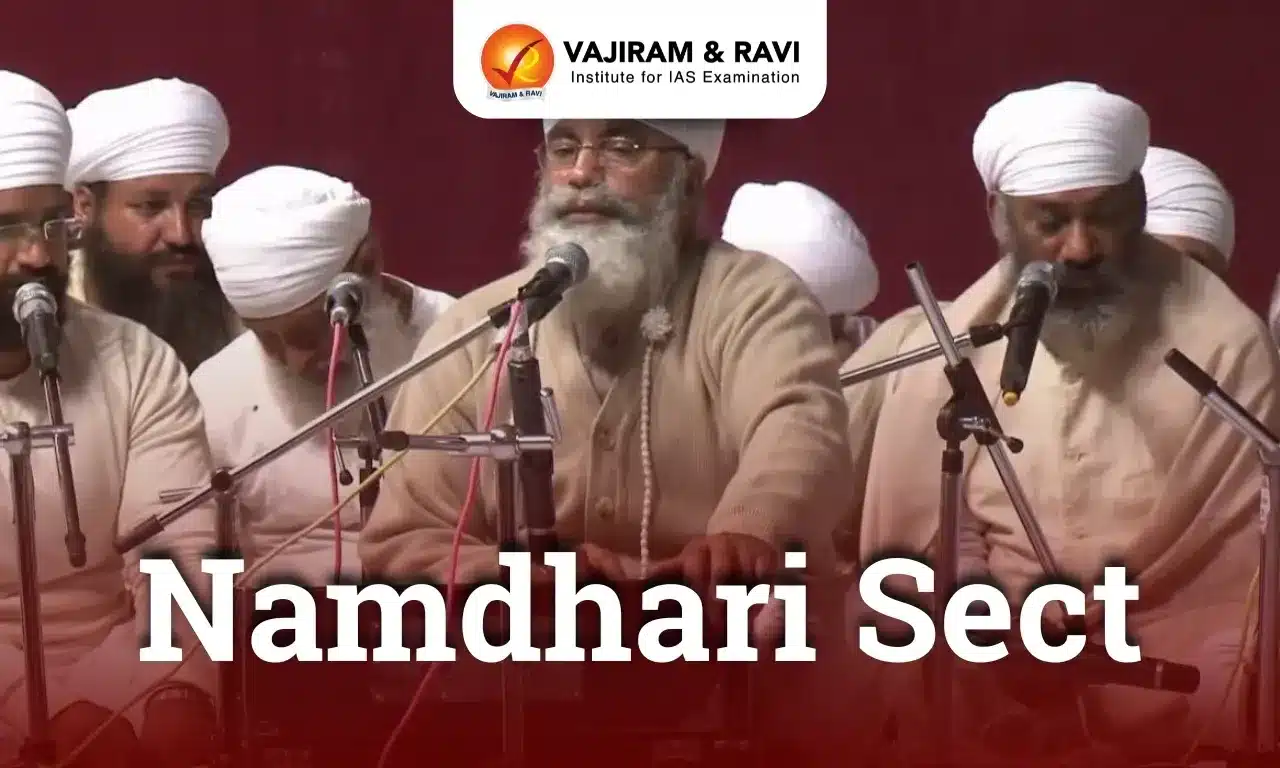
Namdhari sect

Namdhari sect

About Namdhari Sect: 

  • It was founded by Satguru Ram Singh of Baisakhi in 1857. He challenged the status quo, advocated social reform, and resisted the Raj in various ways.
  • The Namdharis were also known as “Kukas” because of their trademark style of reciting the “Gurbani” (Sayings/Teachings of the Guru).
  • This style was in a high-pitched voice called “Kook” in Punjabi. Thus, the Namdharis were also called “Kukas”.
  • Namdhari Sikhs consider the Guru Granth Sahib as the Supreme Gurbani, but they also believe in a living human Guru.
  • The Namdharis consider the cow to be sacred, they are teetotallers, and avoid even tea and coffee.
  • The sect’s headquarters is located in Ludhiana’s Bhaini Sahib near village Raiyaan, where Ram Singh was born. 

History of the Kuka martyrs’ day

  • On January 13, 1872, a group of some 200 Namdharis led by Kuka Hira Singh and Lehna Singh reached Malerkotla following an incident of cow slaughter in the town. The Namdharis had long been agitating for a ban on cow slaughter.
  • On January 15, the Kukas clashed with government officials. On the very same day, a 150-strong Kuka contingent also attacked the Malaudh Fort in Ludhiana, which was under the jurisdiction of a local ruler who was loyal to the British.
  • The British retribution to the Kuka raids was brutal. John Lambert Cowan, the Deputy Commissioner of Ludhiana district, ordered the execution of 49 Kukas on January 17, and another 17 on January 18. 

Q1: What is the Guru Granth Sahib?

It is the primary Holy Book of the Sikhs and is consulted for religious guidance in all aspects of life. It was composed during the period of Sikh Gurus, from 1469 to 1708, It is a voluminous text of 1430 pages that was compiled by the fifth Sikh Guru, Guru Arjan Dev (1563-1606), from hymns of the previous Sikh Gurus and other great saints of the Hindu and Muslim traditions.

Source: IE

What is Lokpal?

What is Lokpal?

About Lokpal:

  • It is a statutory body established under the Lokpal and Lokayuktas Act 2013.
  • Mandate: To inquire into allegations of corruption against certain public functionaries and for related matters.
  • Organisational Structure:
    • It consists of a chair person and eight Members, out of whom four are Judicial Members.
    • The Chairperson should be either the former Chief Justice of India,or a former Judge of the Supreme Court, or an eminent person who fulfills the eligibility criteria as specified. 
    • The judicial member of the Lokpal should be either a former Judge of the Supreme Court or a former Chief Justice of a High Court
    • A minimum of fifty percent of the Members will be from SC/ST/OBC/Minorities and women. 
  • How are members appointed?
    • The Chairperson and the Members are appointed by the President of India on the recommendation of a selection committee composed of the Prime Minister as the Chairperson, the Speaker of Lok Sabha, the Leader of Opposition in Lok Sabha, the Chief Justice of India or a Judge nominated by him/her, and one eminent jurist.
    • They hold office for a term of five years from the date on which they enter upon the office or until they attain the age of 70 years, whichever is earlier. 
    • The salary, allowances, and other conditions of services of the Chairperson are the same as that of the Chief Justice of India.
    • The salary, allowances, and other conditions of services of the members are the same as that of a Judge of the Supreme Court.
  • Jurisdiction:
    • It has jurisdiction to inquire into allegations of corruption against anyone who is or has been Prime Minister, a Minister in the Union government, or a Member of Parliament, as well as officials of the Union Government under Groups A, B, C, and D. 
    • It covers chairpersons, members, officers, and directors of any board, corporation, society, trust, or autonomous body either established by an Act of Parliament or wholly or partly funded by the Union or State government.
    • It also covers any society, trust, or body that receives a foreign contribution above Rs 10 lakh.
  • A complaint under the Lokpal Act should be in the prescribed form and must pertain to an offence under the Prevention of Corruption Act, 1988, against a public servant. 
  • There is no restriction on who can make such a complaint.
  • When a complaint is received, the Lokpal may order a preliminary inquiry by its Inquiry Wing or any other agency or refer it for investigation by any agency, including the CBI, if there is a prima facie case. 
  • The Lokpal, with respect to Central government servants, shall refer the complaints to the Central Vigilance Commission (CVC). 
  • Exceptions for Prime Minister:
    • Lokpal cannot inquire into allegations against the PM relating to international relations, external and internal security, public order, atomic energy, and space
    • Also, complaints against the PM are not to be probed unless the full Lokpal bench considers the initiation of the inquiry and at least 2/3rds of the members approve it. 
  • Powers of Lokpal:
    • It has powers to superintendence over and to give direction to the CBI.
    • If it has referred a case to the CBI, the investigating officer in such a case cannot be transferred without the approval of Lokpal.
    • Powers to authorize CBI for search and seizure operations connected to such cases.
    • The Inquiry Wing of the Lokpal has been vested with the powers of a civil court.
    • Lokpal has powers of confiscation of assets, proceeds, receipts, and benefits arisen or procured by means of corruption in special circumstances.
    • Lokpal has the power to recommend the transfer or suspension of public servants connected with the allegation of corruption.
    • Lokpal has the power to give directions to prevent the destruction of records during the preliminary inquiry.
    • In terms of Section 48 of the said Act, the Lokpal is required to present annually to the President a report on the work done by it, which is caused to be laid in both the Houses of the Parliament. 

Q1: Who was the first Lokpal in India?

The first Lokpal of India was Justice Pinaki Chandra Ghose. He was appointed as the Chairperson of Lokpal on March 19, 2019. Justice Ghose was a former Judge of the Supreme Court of India and also served as a member of the National Human Rights Commission (NHRC) before his appointment as Lokpal.

Source: PIB

Abd-al-Kuri Island

Abd-al-Kuri Island

About Abd-al-Kuri Island:

  • It is an island located about 65 miles southwest of Socotra in the Indian Ocean and is part of the Socotra Archipelago.
  • Although the island belongs to Yemen (the mainland of which is situated more than 320 km to the north), geographically the island is closer to the Horn of Africa—it is about 110 km) east-northeast of Cape Gwardafuy (Guardafui), Somalia.
  • The rocky island, about 35 km long and about 5 km wide, reaches an altitude of more than 700 metres) at Mount Jebel Saleh, its highest point
  • With less than 500 residents, Abd al Kuri is sparsely populated with a handful of small settlements extending across the island, all connected by a dirt road.
  • Most of the island’s inhabitants subsist on fishing.
  • One of the main features of Abd al Kuri is the endemic and massive Euphorbia abdalkuri, a unique plant with a toxic and caustic sap

Q1: Which all countries border Yemen?

Yemen borders Saudi Arabia in the north and Oman in the east. The country also shares maritime borders with the African nations of Djibouti, Eritrea, and Somalia.

Source: ET

Hyperspectral Imaging Satellite

Hyperspectral Imaging Satellite

About Hyperspectral Imaging Satellite:

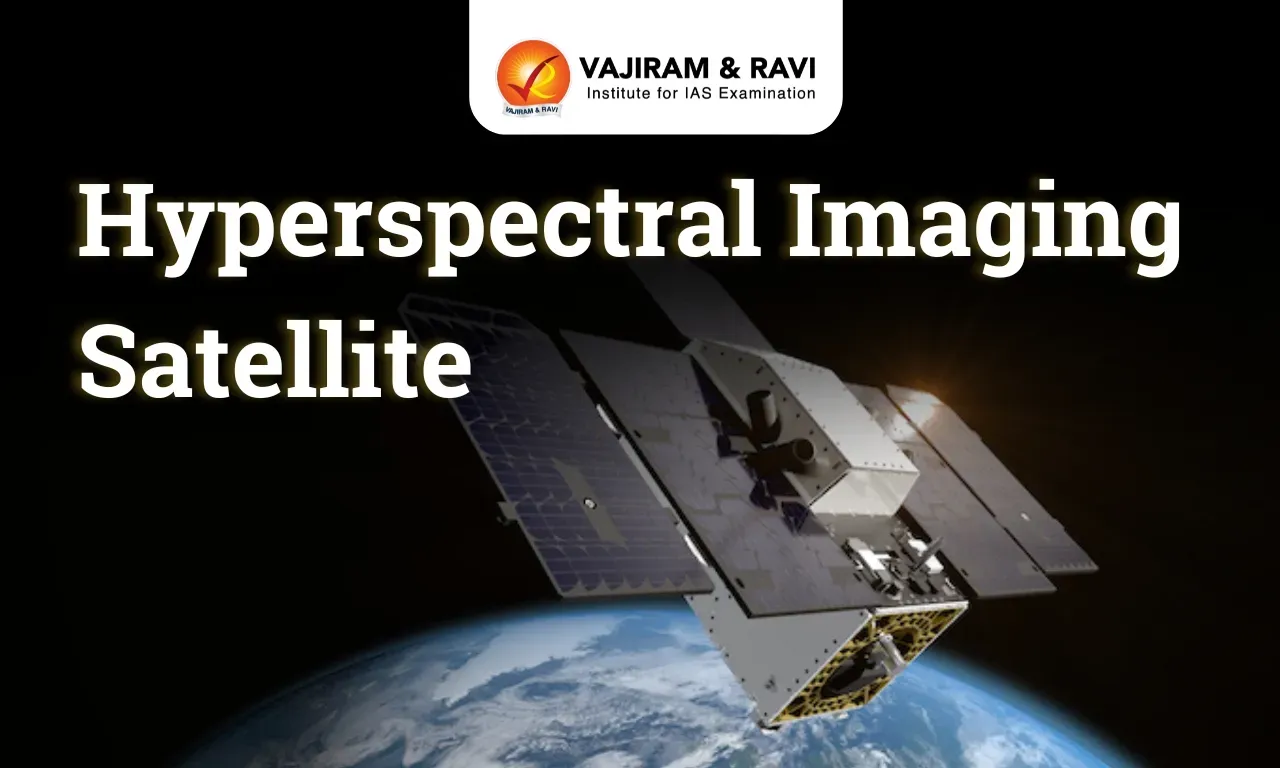
  • These satellites are uniquely designed to beam down data in hundreds of wavelengths to detect problems that are invisible to today's satellites.
  • The constellation is designed to provide global coverage at a revisit of every 24 hours.
    • Hyperspectral imaging (HSI) is a technique that analyses a wide spectrum of light instead of just assigning primary colours (red, green, blue) to each pixel, effectively spectrally fingerprinting the Earth to provide more information on what is imaged.
    • The collected spectra are used to form an image in a way that each image pixel includes a complete spectrum.

What is Firefly’ constellation?

  • It is India’s first commercial satellite constellation.
  • It offers six times sharper resolution than the standard 30-meter resolution of existing hyperspectral satellites, achieving an unprecedented five-meter resolution.
  • This capability allows it to capture intricate details previously invisible to conventional systems.
  • The satellites’ advanced sensors, capable of capturing data across more than 150 spectral bands, enable the detection of subtle changes in chemical compositions, vegetation health, water quality, and atmospheric conditions.

Q1: What is the difference between hyperspectral and multispectral satellites?

Multispectral satellites orbit in a sun-synchronous, Low-Earth Orbit. On the other hand, a hyperspectral satellite can detect thousands of different bands within the light spectrum. This can be extremely helpful in detecting certain minerals or objects if you are familiar with their spectral properties.

Source: IE

Cabinet Approves Refarming of 687 MHz Spectrum for Mobile Services in India

Cabinet Approves Refarming of 687 MHz Spectrum for Mobile Services in India

What’s in today’s article?

  • Why in News?
  • Airwaves/Spectrum – About, types of spectrum band, bands useful for telecom companies
  • Refarming of spectrum

Why in News?

The Union Cabinet has approved the refarming of 687 MHz of spectrum for mobile services, increasing the total available spectrum to 1,587 MHz, with 320 MHz to be released immediately and the rest by 2028-29. The re-farmed spectrum primarily comes from the Ministry of Defence and ISRO.

Union Telecom Minister stated that mobile services will require 2,000 MHz of spectrum by 2030. Currently, 900 MHz is available, leaving a gap of 1,100 MHz.

The refarming aligns with industry demands for efficient use of mid-band spectrum (1,000–6,000 MHz) and prepares for future needs.

Airwaves/Spectrum 

  • About
    • Airwaves are radio frequencies within the electromagnetic spectrum that can carry information wirelessly for a range of services including telecommunications. 
    • The government manages and allocates airwaves to companies or sectors for their use.
    • The government auctions a fixed amount of spectrum within specified band/s to be utilised by operators for providing communication services to consumers.
  • Types of spectrum band
    • Low band spectrum 
      • Less than 1 GHz (600 MHz,700 MHz, 800 MHz, 900 MHz)
      • Offers blanket coverage suitable to serve thousands of customers over long distances with fewer towers. 
      • Ideal for wide and in-building coverage.
      • When bundled with high-spectrum bands, it can be used for commercial mobile and broadcasting services.
    • The mid-band spectrum
      • Ranges from 1 GHz to 6 GHz (1800 MHz, 2100 MHz, and 2300 MHz).
      • Provides coverage as well as the capacity to carry more data while traveling significant distances.
    • The high band spectrum 
      • Ranges from 24 GHz to 40 GHz and are also known as the millimetre wave spectrum.
      • Ideal for speedy networks over short ranges. 
      • However, this range is subject to interference from dense objects.
  • What spectrum do telecom companies require?
    • Optimal Spectrum Range for Telecom Services
      • The 400 MHz to 4 GHz range is considered the most suitable for telecom services, as per the GSM Association.
      • Sufficient spectrum allows operators to provide 2G, 3G, 4G, and 5G services using a single frequency band.
    • Frequency Bands for Mobile Technology in India
      • 2G Services: 900 MHz and 1800 MHz.
      • 3G Services: 900 MHz and 2100 MHz.
      • 4G Services: 850 MHz, 1800 MHz, 2300 MHz, and 2500 MHz.
      • 5G Services: 700 MHz and 3.5 GHz bands.
    • Significance of the 900 MHz Band
      • Offers a well-developed commercial ecosystem with superior technology standards.
      • Supports GSM-based voice calls and 4G broadband services.
    • Role of the 1800 MHz Band
      • The 1800 MHz band is a key spectrum for GSM services and is globally used as the core band for LTE (4G).
    • 5G Spectrum Classification
      • 5G spectrum is categorized into low, mid, and high-frequency bands for efficient deployment and operations.

Refarming of spectrum

  • About
    • Spectrum refarming is the process of repurposing spectrum bands for more efficient technologies or new services. 
      • For example, a provider using the 900 MHz band for 2G services may reallocate part of it for LTE to meet increasing data demand.
    • The GSMA defines spectrum refarming as reallocating frequency bands traditionally used for 2G (GSM technology) to newer mobile technologies like 3G (UMTS) and 4G (LTE).
  • Why is Spectrum Refarming important?
    • To maximize the capacity and efficiency of a network by moving older, less demanding services to a smaller portion of the spectrum, freeing up space for newer, more data-intensive technologies.
    • Spectrum is a scarce resource and with growing demand for mobile broadband and advanced technologies like LTE and 5G, spectrum must be utilized efficiently.
    • It enables Communications Service Providers (CSPs) to upgrade from legacy networks to 4G or 5G based on consumer demand and market growth.
  • Benefits
    • Increased network capacity 
    • Improved network performance 
    • Cost-effective way to upgrade networks without buying new spectrum 
  • Challenges
    • Service Continuity:
      • CSPs must ensure there are no interruptions or degradation in services during the refarming process.
    • Device Compatibility:
      • Some devices only support specific frequency bands, so they must continue operating on legacy networks.
    • Thorough Analysis:
      • CSPs must analyze device types and user behavior to determine the appropriate spectrum allocation for different technologies without compromising service quality.
    • Channel Interference:
      • Ensuring no interference between channels is crucial during spectrum refarming.
    • Contiguous Spectrum:
      • A sufficient, contiguous spectrum is needed to support the simultaneous operation of multiple technologies within a frequency band.

Q.1. What is spectrum refarming? 

Spectrum refarming is the process of reallocating older spectrum bands, traditionally used for 2G, to newer technologies like 4G and 5G. This maximizes network capacity and allows more efficient use of limited resources, enabling better mobile services.

Q.2. Why is the 900 MHz spectrum important for telecom services? 

The 900 MHz band supports well-developed technology standards for GSM-based voice calls and 4G broadband services. It is a crucial spectrum for providing extensive coverage, supporting mobile networks effectively over long distances.

Source: IE | SUBEX | BS

Impact of Proposed US Sanctions on Russian Oil and India’s Energy Landscape

Impact of Proposed US Sanctions on Russian Oil and India’s Energy Landscape

What’s in Today’s Article?

  • New Sanctions on Russian Oil
  • Implications of Proposed US Sanctions on Russian Oil on India and India’s Response
  • Analysing Rupee Internationalisation Bid Amid Proposed US Sanctions on Russian Oil
  • Conclusion

Why in News?

  • Scott Bessent, United States President-elect Donald Trump’s nominee for Treasury Secretary, outlined plans to intensify sanctions on Russia’s oil sector during his Senate confirmation hearing.
  • His remarks highlight the incoming administration’s strategy to address the Ukraine war and its broader implications, including significant effects on global oil prices and India’s energy trade.

New Sanctions on Russian Oil:

  • Tightened restrictions:
    • On January 10, the Biden administration imposed new sanctions aimed at curbing the nation’s oil trade.
    • The upcoming Trump administration may enforce these sanctions more stringently, especially targeting Russian oil majors.
  • Scope of sanctions:
    • Targeted entities: Russian oil producers Gazprom Neft and Surgutneftegas.
    • Affected vessels: 183 tankers associated with Russia’s “shadow fleet.”
    • Impacted services: Russia-based oilfield service providers.
    • Objective: Disrupt revenue streams fueling Russia’s war efforts.
    • Deadline for compliance: The US Office of Foreign Assets Control has set February 27 as the deadline for the delivery of crude loaded before January 10, under the new sanctions.

Implications of Proposed US Sanctions on Russian Oil on India and India’s Response:

  • Impact on India:
    • Bilateral trade between India and Russia surged to $65.7 billion in 2023-24.
    • Russia has become India’s largest crude oil supplier, constituting nearly 38% of its imports in 2024, a significant increase from pre-Ukraine war levels.
    • The imposition of a $60-per-barrel price cap by G7 nations redirected Russian oil exports from Europe to Asia, with India and China being key consumers.
    • India, dependent on imports for over 85% of its crude oil needs, faces challenges due to the cost-efficiency and reliability of Russian oil.
  • India’s response:
    • Commitment to energy security:
      • India’s oil imports, including those from Russia, are guided by energy security needs and global market conditions.
      • External Affairs Ministry spokesperson Randhir Jaiswal stated that India has no plans to reduce its oil purchases from Russia despite the sanctions.
    • Rush to pay for Russian oil:
      • Indian refiners are expediting payments for Russian crude to circumvent potential US penalties.
      • Transactions for Gazprom Neft crude, a Russian oil giant, are being processed in Rubles instead of dollars to bypass the $60-a-barrel price cap set in 2022.

Analysing Rupee Internationalisation Bid Amid Proposed US Sanctions on Russian Oil:

  • Challenges ahead:
    • Efforts to settle India-Russia oil trade in rupees face hurdles as tighter sanctions could disrupt these negotiations.
    • In contrast, Russia-China trade in non-dollar currencies has bolstered the yuan's global footprint.
  • Global reserve currency dynamics:
    • The US dollar remains dominant, but efforts by BRICS nations to develop alternatives, such as a potential BRICS currency, have intensified since 2022.
    • The attempts to move away from the dollar began after the US threw Russia out of the Society for Worldwide Interbank Financial Telecommunication (SWIFT), the key to international financial transactions, in 2022.
  • US stance:
    • During his hearing, Bessent reaffirmed the importance of maintaining the US dollar’s status as the world’s reserve currency.
    • Former President Trump previously threatened BRICS nations with tariffs if they pursued a rival reserve currency.

Conclusion:

  • India’s proactive engagement with the US reflects its commitment to maintaining energy security while navigating the complexities of international sanctions.
  • As one of Russia’s top oil buyers, India continues to prioritize its economic and strategic interests amidst evolving global dynamics.

Q.1. What is rupee internationalization and its significance?

The internationalization of the rupee is the process of increasing the use of the Indian rupee in cross-border transactions. It is important for India's economic growth by reducing costs, improving competitiveness, and making India less vulnerable to external shocks.

Q.2. What is the Society for Worldwide Interbank Financial Telecommunication (SWIFT)?

SWIFT is a messaging system that allows banks to securely exchange information and send money internationally. It's a vital part of the global financial infrastructure.

Source: IE | HT

Enquire Now