AI Basics: CPU, GPU and TPU

AI Basics

AI Basics: CPU, GPU and TPU Latest News

How TPU is Different from CPU and GPU

About Processing Units

  • Processing units are the core hardware components that act as the brain of a computer. They perform tasks such as calculations, processing images, and transmitting data, similar to how the human brain executes complex tasks.

What is a CPU (Central Processing Unit)?

  • The CPU is a general-purpose processor that was developed in the 1950s and can handle a wide variety of tasks.
  • It functions like a conductor in an orchestra, coordinating the operations of all other computer parts like GPUs, disk drives, and memory units.
  • A CPU contains cores — individual units that execute instructions. Early CPUs had only one core, but modern CPUs may contain 2 to 16 cores.
  • Each core can handle one task at a time, so a CPU’s multitasking capacity depends on the number of cores.
  • For everyday users, 2 to 8 cores are usually sufficient, and CPUs are so efficient that users rarely notice that tasks are completed sequentially, not simultaneously.

What is a GPU (Graphics Processing Unit)?

  • A GPU is a specialised processor designed to perform many tasks simultaneously, using a technique called parallel processing.
  • Unlike CPUs, which process tasks sequentially, GPUs break down complex tasks into thousands or millions of smaller problems, solving them in parallel.
  • Modern GPUs contain thousands of cores, making them far more suitable for intensive computational tasks.
  • Initially developed for rendering graphics in gaming and animation, GPUs are now widely used in machine learning and artificial intelligence.
  • GPUs have evolved into general-purpose parallel processors, making them a key tool in running AI models and handling large data operations.
  • However, GPUs have not replaced CPUs, because certain operations are better handled sequentially, which is the strength of CPUs.

What is a TPU (Tensor Processing Unit)?

  • A TPU is also a type of ASIC (Application-Specific Integrated Circuit), meaning it is built for a specific function — in this case, AI tasks.
  • First introduced by Google in 2015, TPUs are specially designed hardware units built from the ground up to handle machine learning operations.
  • TPUs focus on processing tensors — the multidimensional data arrays used in AI model computations.
  • They are optimised to run neural networks efficiently, enabling faster training and execution of AI models than GPUs or CPUs.
  • For example, training an AI model that may take weeks on a GPU can often be completed in hours using a TPU.
  • TPUs are used at the core of Google's major AI services, such as Search, YouTube, and DeepMind's large language models, illustrating their real-world application in high-scale AI infrastructure.

Source: IE

AI Basics: CPU, GPU and TPU FAQs

Q1: What is the role of a CPU in Artificial Intelligence?

Ans: A CPU (Central Processing Unit) handles general-purpose computations and task scheduling but is less optimized for large-scale AI training.

Q2: What makes a GPU important for AI tasks?

Ans: A GPU (Graphics Processing Unit) excels at parallel processing, making it ideal for training deep learning models.

Q3: What is a TPU in AI computing?

Ans: A TPU (Tensor Processing Unit) is an AI-specific processor developed by Google designed to accelerate machine learning workloads.

Miniature Laser Grown on Silicon Chip

Miniature Laser Grown on Silicon Chip

Miniature Laser Grown on Silicon Chip Latest News

Scientists from the US and Europe have successfully fabricated miniature lasers directly on silicon wafers, as published in a recent study in Nature.

About Miniature Laser Grown on Silicon Chip 

  • This is a major advancement in the field of silicon photonics, as integrating a light source (laser) directly on the chip has long been a technological challenge.
  • Traditionally, lasers are manufactured separately and then attached to chips, which results in slower operation, higher costs, and manufacturing mismatches.
  • The new research resolves this issue by growing the laser directly on a silicon chip using a scalable process and compatible with standard CMOS (Complementary Metal-Oxide-Semiconductor) technology, which is the backbone of current semiconductor manufacturing.
  • Initially, electrons carried data within silicon chips. However, modern advancements are replacing electrons with photons, leading to the rise of silicon photonics.
  • Photons carry information faster, with higher bandwidth and lower energy loss than electrons, making them ideal for next-generation computing, especially in data centres, sensors, and quantum computing.

Photonic Chip Components and Laser Physics

  • A photonic silicon chip consists of four key parts:
    • A light source (laser),
    • Waveguides to channel the photons,
    • Modulators to encode or decode data onto light signals, and
    • Photodetectors convert light into electrical signals.
  • The laser functions on the principle of stimulated emission, where electrons drop to a lower energy level, releasing coherent photons to form a laser beam.
  • However, silicon has an indirect bandgap, making it inefficient at light emission. Therefore, materials like gallium arsenide (GaAs) with a direct bandgap are preferred for laser construction.
  • The setup was completed with a protective layer of indium gallium phosphide and electrical contacts to power the laser.

Source: TH

Miniature Laser Grown on Silicon Chip FAQs

Q1: What is the significance of a Miniature Laser grown on a Silicon Chip?

Ans: It represents a breakthrough in integrated photonics, enabling faster and more efficient optical communication on microchips.

Q2: How does a Miniature Laser benefit electronic devices?

Ans: It allows data to be transferred using light instead of electrical signals, reducing power consumption and increasing speed in computing systems.

Q3: Which field benefits most from this technology?

Ans: Industries involving telecommunications, high-performance computing, and artificial intelligence benefit from this innovation.

Thangjing Hills

Thangjing Hills

Thangjing Hills Latest News

Tension prevailed near the buffer zone in Manipur's Thangjing Hill range, which separates Kuki and Meitei inhabited areas in Churachandpur district, recently.

About Thangjing Hills

  • Thangjing Hill (also called Thangching Hill and Thangting Hill), is a mountain peak in the Indian state of Manipur
  • It is in the Churachandpur district, to the west of Moirang.
  • The north-south-running mountain range on which it sits is also called Thangjing range or Thangjing Hills. 
  • The range forms part of the western border of the Imphal Valley.
  • It is believed by Manipuris to be the abode of Thangching, the ancestral deity of Moirang.
  • It is considered a sacred site by the Meitei community, who traditionally visit it throughout the Manipur month of 'Sajibu' which generally falls in April.
  • In the Meitei cosmology, the "body" of Manipur is represented with various natural features of the land, including the Thangjing hill as its right leg.

Source: TOI

Thangjing Hills FAQs

Q1: In which Indian state is Thangjing Hill located?

Ans: Manipur

Q2: Which town lies to the east of Thangjing Hill?

Ans: Moirang

Q3: The Thangjing Hills form part of the western border of which valley?

Ans: Imphal Valley

Clinidium lalitae

Clinidium lalitae

Clinidium lalitae Latest News

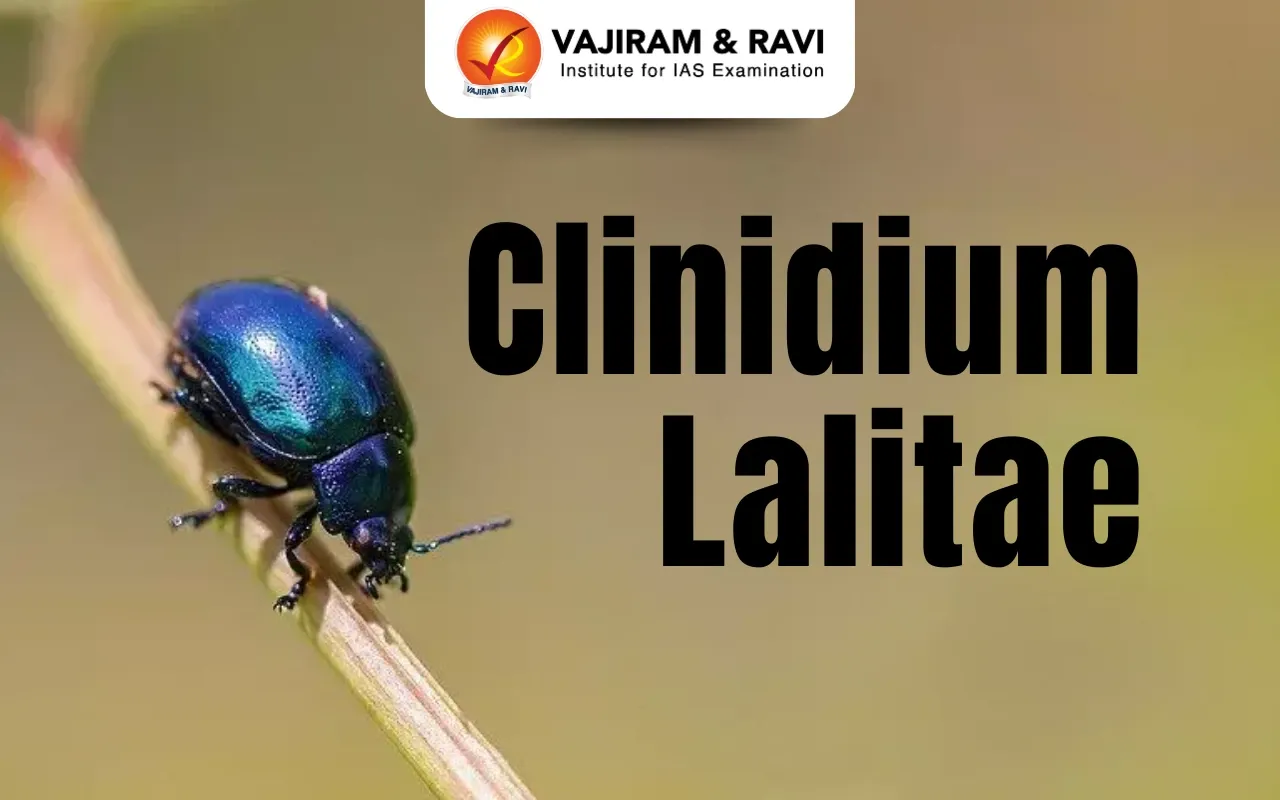
Scientists from the Zoological Survey of India (ZSI) recently identified a new species of beetle named, Clinidium lalitae, from the northeast.

About Clinidium lalitae

  • It is a newly found species of beetle.
  • It was discovered in the Talle Valley Wildlife Sanctuary in Arunachal Pradesh.
  • It has been named 'Clinidium lalitae', in tribute to the late Dr. Lalita Ray Chaudhury, a respected coleopterologist and former scientist at Zoological Survey of India (ZSI) .
  • The 'Clinidium lalitae' beetle is characterised by its unique morphology and belongs to a rare group of ground beetles that inhabit forest floors.
  • These beetles play a significant ecological role in nutrient cycling and soil health.

Key Facts about Talle Valley Wildlife Sanctuary 

  • It is located in the Lower Subansiri district of Arunachal Pradesh.
  • Situated at an elevation range of 1,200 to 3,000 meters above sea level, it spans an area of approximately 337 sq.km.
  • It contains 20 percent of the floral and faunal species in India.
  • Rivers like Pange, Sipu, Karing, and Subansiri flow through the sanctuary.
  • The sanctuary is home to the Apatani tribe, known for their unique customs, traditions, and handicrafts.
  • Flora:
    • It has a stunning spectrum of subtropical and alpine forests like silver fir trees, ferns, orchids, bamboo, and rhododendron.
    • Pleioblastus simone is a bamboo variety only found in Talley Valley.
    • It is also home to several medicinal plants and herbs used by the local tribes for traditional medicine.
  • Fauna: It is home to a variety of animal species such as elephants, barking deer, giant squirrels, porcupines, leopards, clouded leopards, wild boars, etc.

Source: AT

Clinidium lalitae FAQs

Q1: Where was the beetle species Clinidium lalitae discovered?

Ans: Talle Valley Wildlife Sanctuary

Q2: What type of beetle is Clinidium lalitae classified as?

Ans: Ground beetle

Q3: The species Clinidium lalitae is named in tribute to which scientist?

Ans: Dr. Lalita Ray Chaudhury

Leptobrachium Aryatium

Leptobrachium Aryatium

Leptobrachium aryatium Latest News

New Frog Species ‘Leptobrachium aryatium’ Discovered in Assam

Why in the News?

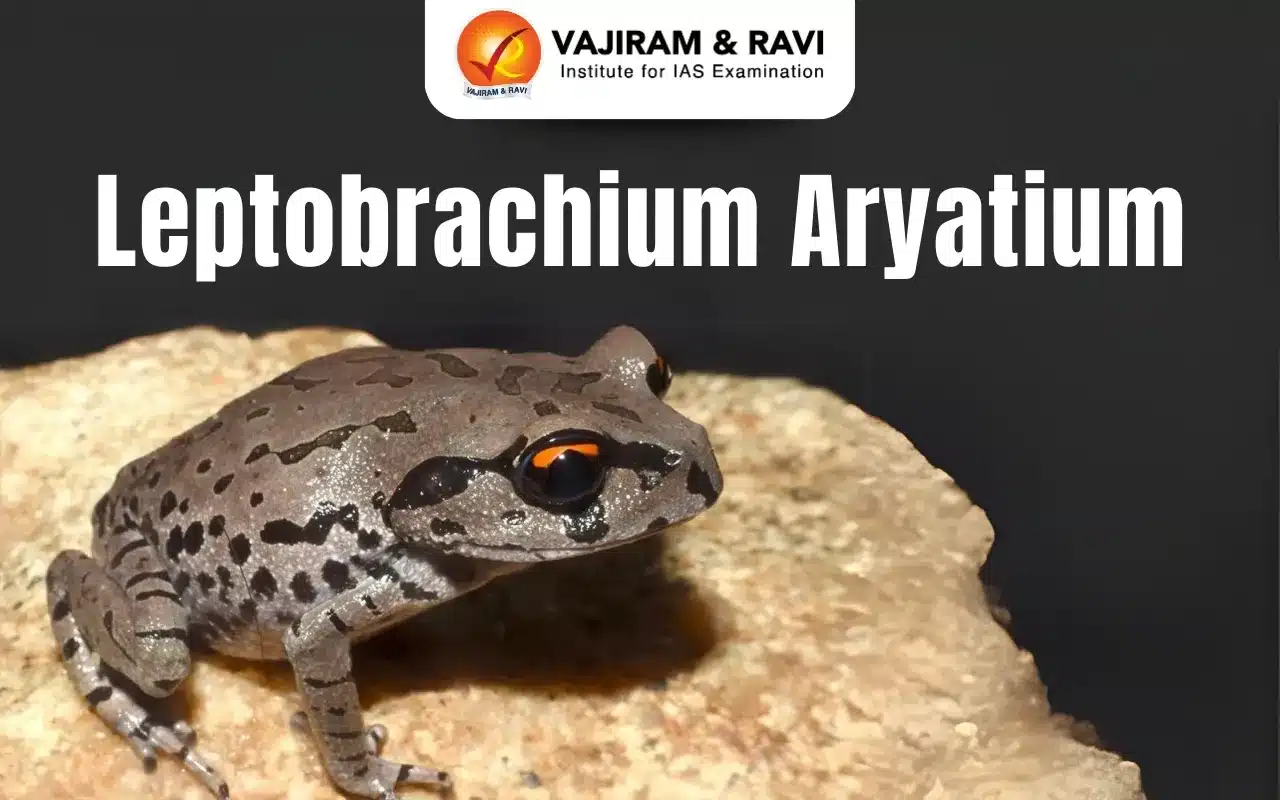
  • A new species of frog, named Leptobrachium aryatium, has been officially identified after a 21-year-long study.
  • The frog was first studied in 2004 but was originally misidentified as Leptobrachium smithi.
  • This species was found in the Garbhanga Reserve Forest, located on the southwestern edge of Guwahati, Assam, bordering Meghalaya.
  • It lies adjacent to Deepor Beel, a Ramsar site, and forms a crucial part of the Garbhanga-Rani-Deepar Beel elephant corridor, highlighting its importance in regional wildlife movement.
  • The frog has been named after Arya Vidyapeeth College, a prominent educational institution in Guwahati, in recognition of its role in transforming the local area from a liquor brewing hub to an educationally respected zone.

Key Biological Features of Leptobrachium aryatium

  • Leptobrachium aryatium belongs to the Leptobrachium genus, which includes stocky frogs with broad heads, short hind limbs, and distinctively coloured eyes.
  • This new species is notable for its fiery orange-and-black eyes, a reticulated throat pattern, and a rhythmic dusk-time call.
  • Scientific confirmation of its status as a new species was done through morphological examination, DNA analysis, and bioacoustic studies (study of call patterns).

Source: TH

Leptobrachium aryatium FAQs

Q1: What is Leptobrachium aryatium?

Ans: Leptobrachium aryatium is a newly discovered species of frog belonging to the family Megophryidae, known for their distinctive broad heads and camouflaged appearance.

Q2: Where was Leptobrachium aryatium discovered?

Ans: This frog species was discovered in the forests of Arunachal Pradesh, India, highlighting the rich amphibian biodiversity of the Eastern Himalayas.

Q3: Why is Leptobrachium aryatium ecologically significant?

Ans: Amphibians like Leptobrachium aryatium serve as bioindicators, meaning their health reflects the health of their ecosystems.

Tuti Island

Tuti Island

Tuti Island Latest News

Since the outbreak of civil war on April 15, 2023, between the Sudanese Army and the Rapid Support Forces (RSF), Tuti Island has been devastated by violence and occupation.

About Tuti Island

  • Tuti Island, located at the confluence of the Blue and White Nile rivers in Khartoum, Sudan, is one of the city’s oldest settlements, known for its lush greenery and agriculture.
  • The island spans 8 square kilometres and was traditionally dependent on farming and fishing, earning the nickname “Khartoum’s garden.”
  • It holds deep cultural significance for the Mahas community, who settled there in the 15th century, making the island a symbol of indigenous identity and sustainability in the region.
  • As per UN estimates, the war has displaced 13 million people, killed tens of thousands, and pushed 100,000 into famine conditions in Khartoum alone.
  • Climate change has worsened Tuti Island’s vulnerability by disrupting the Nile’s natural flooding cycle, causing flooding, droughts, and desertification.
  • Due to the dual threats of conflict and climate change, the HEART Project (Heritage Empowered Action for Risk in Tuti) was initiated to preserve the Taya system and document community knowledge.

Source: F24

Tuti Island FAQs

Q1: Where is Tuti Island located?

Ans: Tuti Island is situated at the confluence of the Blue Nile and White Nile Rivers in Khartoum, Sudan.

Q2: Why is Tuti Island geopolitically significant?

Ans: Tuti Island holds importance as a strategic agricultural and urban area within the capital city Khartoum, especially during conflicts.

Q3: How is Tuti Island connected to Khartoum?

Ans: The island is connected via the Tuti Bridge, the first suspension bridge in Sudan, linking it to central Khartoum.

PM-Vidyalaxmi Scheme

PM Vidyalaxmi Scheme

PM Vidyalaxmi Scheme Latest News

Amid a slow uptake of the PM Vidyalaxmi scheme, public sector banks (PSBs) recently raised several concerns regarding its implementation.

About PM Vidyalaxmi Scheme

  • It is a Central Sector Scheme to provide financial support to meritorious students in their pursuit of higher education.
  • Eligibility
    • The scheme targets students who have secured admission to any of India’s top 860 Quality Higher Education Institutions (QHEIs), both private and government, as ranked by the National Institutional Ranking Framework (NIRF).
    • Students who receive any other Central/State Government Scholarship, interest subvention plan, or fee reimbursement are not eligible for benefits under the PM Vidyalakshmi scheme. 
    • Students who stop their studies in between or are dismissed from the institution on disciplinary or academic grounds are not eligible for interest subvention or credit guarantee under this scheme.
    • Students can apply for the loans through the PM-Vidyalakshmi portal, which integrates with multiple banks for a seamless and digital application experience.
  • How much loan can you avail under the PM Vidyalakshmi scheme?
    • There is no upper limit on the amount of education loan you can get under the PM Vidyalakshmi scheme. 
    • It will depend on course fees and other fees charged by the QHEI and other associated expenses like mess, hostel fees, other refundable and non-refundable fees of the institution, the cost of a reasonable-quality laptop, and a reasonable amount of living expenses required by the student during the course period.
  • Interest subvention:
    • A student whose annual family income is up to Rs 8 lakhs and who is pursuing any course from QHEIs will be eligible to get 3% interest subvention for education loans up to Rs 10 lakhs. 
    • If the education loan amount is more than Rs 10 lakhs, interest subvention will be provided for the disbursed total principal amount of loan up to Rs 10 lakhs.
  • Credit Guarantee: When the education loan sanction amount is up to Rs 7.5 lakhs, irrespective of family income, the student will be eligible for a credit guarantee where 75% of outstanding default will be covered by the government.

Source: BS

PM Vidyalaxmi Scheme FAQs

Q1: What is the primary objective of the PM Vidyalakshmi Scheme?

Ans: To provide financial support to meritorious students for higher education

Q2: Who is eligible for the 3% interest subvention benefit under PM Vidyalakshmi Scheme?

Ans: Students with annual family income up to ₹8 lakhs

Q3: What is the credit guarantee coverage under the PM Vidyalakshmi Scheme for loans up to ₹7.5 lakhs?

Ans: 75% of the outstanding default

Creutzfeldt-Jakob Disease (CJD)

Creutzfeldt Jakob Disease

Creutzfeldt-Jakob Disease Latest News

Two people are believed to have died from a rare and incurable brain disease called Creutzfeldt-Jakob Disease (CJD) within just a few months of each other in the United States.

About Creutzfeldt-Jakob Disease

  • It is a rare brain disorder that leads to dementia. 
  • It belongs to a group of human and animal diseases known as prion disorders, also known as transmissible spongiform encephalopathies (TSEs). .
  • Symptoms of CJD can be similar to those of Alzheimer's disease. 
  • But CJD usually gets worse much faster and leads to death.
  • All types of CJD are serious but are very rare. 
  • About 1 to 2 cases of CJD are diagnosed per million people around the world each year. 
  • The disease most often affects older adults.

Creutzfeldt-Jakob Disease Cause

  • CJD and other prion diseases are caused by abnormal forms of proteins called prions. 
  • Healthy and harmless prion proteins are found throughout the body but mostly in the nervous system. Their overall role isn’t fully understood. 
  • When abnormal prions form, they can transmit their incorrect and damaging form to nearby healthy prion proteins and cause the healthy prions to change into abnormal prions. 
  • Once they’re formed, prions can clump together and build up in brain tissue, which may lead to the nerve cell loss and other brain damage seen in CJD and other prion diseases.

Creutzfeldt-Jakob Disease Symptoms

  • The main symptoms of CJD are cognitive decline leading to dementia, involuntary muscle jerks (myoclonus), and lack of coordination of movements.
  • Most people with CJD will die within a year of the symptoms starting, usually from infection.
  • This is because the immobility caused by CJD can make people with the condition vulnerable to infection.

Creutzfeldt-Jakob Disease Treatment

  • There's currently no cure for CJD, so treatment aims to relieve symptoms and make the affected person feel as comfortable as possible.
  • This can include using medicine such as antidepressants to help with anxiety and depression, and painkillers to relieve pain.

Source: FP

Creutzfeldt-Jakob Disease FAQs

Q1: What is Creutzfeldt-Jakob Disease (CJD)?

Ans: It is a rare brain disorder that leads to dementia.

Q2: What is the main cause of Creutzfeldt-Jakob disease?

Ans: CJD appears to be caused by an abnormal infectious protein called a prion.

Q3: Q3. Is CJD disease curable?

Ans: Ans. There's currently no cure for CJD.

India’s Prison Conditions May Derail Global Extraditions, Warns Justice Lokur

India’s Prison Conditions May Derail Global Extraditions, Warns Justice Lokur

What’s in Today’s Article?

  • India’s Prison Conditions Latest News
  • Background
  • The UK Court Verdict and Its Implications
  • Troubling Precedents from Indian Jails
  • India Justice Report 2025: Key Findings
  • Challenges to India’s Extradition Strategy
  • Conclusion
  • India’s Prison Conditions FAQs

India’s Prison Conditions Latest News

  • Former Supreme Court Justice Madan B. Lokur warned that extraditions will be difficult until conditions are improved in Indian prisons.

Background

  • India’s ambition to bring back economic fugitives like Mehul Choksi is facing growing scrutiny due to the deteriorating conditions in Indian prisons. 
  • At the release of the India Justice Report 2025, former Supreme Court Judge and current Chair of the UN Internal Justice Council, Justice Madan B. Lokur, expressed grave concern over the impact of poor prison infrastructure on India’s global legal reputation. 
  • Highlighting a recent UK court decision that denied an extradition to India, he underscored the urgent need for systemic reforms in the country’s criminal justice framework.

The UK Court Verdict and Its Implications

  • Justice Lokur referenced the UK appellate court’s denial to extradite Sanjay Bhandari, a defence consultant wanted in India for tax evasion and money laundering. 
  • The rejection was based on India's inability to assure humane conditions in its jails, especially Tihar Jail in Delhi. 
  • The court also highlighted a lack of concrete assurances from the Indian government despite multiple requests. 
  • This ruling, according to Justice Lokur, will have lasting consequences on over 100 pending extradition requests from Indian authorities worldwide.

Troubling Precedents from Indian Jails

  • The UK judgement cited several incidents that question the safety and oversight of Indian prisons:
    • Christian Michel, accused in the AgustaWestland scam, declined bail preferring imprisonment over restrictive bail conditions, shedding light on how even accused individuals perceive the harsh prison environment.
    • Tillu Tajpuria, an inmate at Tihar, was publicly beaten to death in full view of CCTV and passive prison guards.
    • Jagtar Johal and Ankit Gujjar also met tragic ends in custody, adding to the list of custodial deaths that challenge India’s human rights commitments.

India Justice Report 2025: Key Findings

  • Released alongside Justice Lokur’s remarks, the India Justice Report 2025 offers data-driven insights into the systemic issues plaguing India’s judiciary, police, prisons, and legal aid sectors.
  • Police Force
    • There is just one civil police officer for every 831 citizens.
    • 17% of police stations lack CCTV surveillance.
    • 30% of police stations do not have a women's help desk.
    • Reserved quotas for women in police are unmet in all States/UTs.
  • Prisons
    • Uttar Pradesh houses the most overcrowded prisons.
    • Delhi’s jails comprise 91% under-trials, highlighting delayed justice.
    • Gujarat reported the highest vacancies in High Court judges and staff.
  • Judiciary and Legal Aid
    • Bihar’s lower courts have 71% of cases pending for over three years.
    • The per capita spending: ₹182 on judiciary, ₹57 on prisons, and a mere ₹6 on legal aid.
    • No State in India allocates more than 1% of its total budget to the judiciary.

Challenges to India’s Extradition Strategy

  • India’s ability to bring back fugitives like Mehul Choksi is increasingly being challenged not just on legal grounds but on humanitarian concerns. 
  • The European and North American courts, adhering to strict human rights standards, are unlikely to entertain Indian requests unless substantial improvements are made in:
    • Infrastructure (including access to healthcare and hygiene),
    • Monitoring systems (CCTV reliability and oversight),
    • Accountability of prison staff.

Conclusion

  • India’s global image as a democratic and rights-abiding nation hinges not only on the strength of its judiciary but also on the conditions in which its justice is delivered. 
  • As Justice Lokur notes, unless prisons are reformed and humane conditions are guaranteed, India’s extradition goals and its standing in international law forums will continue to suffer.

India’s Prison Conditions FAQs

Q1. Why did the UK deny the extradition of Sanjay Bhandari to India?

Ans. Due to concerns over unsafe prison conditions and risk of torture in Indian jails, particularly Tihar.

Q2. What are some incidents cited against Indian jail safety?

Ans. Custodial deaths of Tillu Tajpuria and Ankit Gujjar, and harsh conditions leading Christian Michel to reject bail.

Q3. What does the India Justice Report 2025 reveal about Indian prisons?

Ans. Overcrowding, high under-trial populations, lack of CCTV, and staff apathy are widespread.

Q4. What impact will this have on future extraditions?

Ans. India risks rejection of over 100 pending extradition requests if it doesn’t improve prison conditions.

Q5. What is the current spending on legal aid and prison infrastructure in India?

Ans. Only ₹6 per capita for legal aid and ₹57 for prisons, showing poor prioritization of justice infrastructure.

Source: TH

China’s Rare Earth Export Curbs Disrupt Global Electronics and Defense Supply Chain

China’s Rare Earth Export Curbs Disrupt Global Electronics and Defense Supply Chain

What’s in Today’s Article?

  • Rare Earth Elements (REEs) Latest News
  • Rare Earth Elements (REEs)
  • Global Supply Crunch Looms
  • Limited Impact on India
  • US Pushes for Deep-Sea Mining to Cut China Dependence
  • Rare Earth Elements (REEs) FAQs

Rare Earth Elements (REEs) Latest News

  • China has effectively halted global exports of key rare earth elements (REEs) and magnets, including yttrium and dysprosium, following its April 4 announcement in retaliation to U.S. tariffs. 
  • While the move targets the U.S., the absence of a licensing regime has disrupted shipments to all countries, impacting industries reliant on REEs like defense, aviation, and electronics.

Rare Earth Elements (REEs)

  • Rare Earth Elements are a group of 17 chemically similar elements, including 15 lanthanides plus scandium and yttrium. 
  • Despite their name, they are relatively abundant in the Earth’s crust but are rarely found in concentrated, economically exploitable forms.

Significance of REEs

  • Critical for Modern Technology
    • REEs are essential in the manufacturing of high-tech devices like smartphones, electric vehicles, wind turbines, LED lights, and flat-screen TVs.
  • Defense and Aerospace Use
    • They are used in precision-guided missiles, jet engines, radar systems, and other military equipment.
  • Green Energy Transition
    • Vital for clean energy technologies such as solar panels, batteries, and permanent magnets in wind turbines and electric vehicles.
  • Strategic Importance
    • Due to their wide applications and limited global suppliers (especially China’s dominance), REEs are considered strategically important for national security and economic stability.

Challenges

  • Mining and refining are environmentally damaging.
  • Global supply is heavily concentrated, with China refining over 85% of REEs, creating vulnerability for other nations.

Global Supply Crunch Looms

  • With China producing the majority of the world’s rare earth elements (REEs), the current export halt is expected to spark a global supply crunch, particularly impacting the U.S., Japan, Vietnam, and Germany. 
  • While some Japanese firms are better prepared with over a year’s inventory, the disruption echoes China's 2010 export ban during a territorial dispute.

China’s History of Weaponizing REEs

  • Experts note that China has repeatedly used REE exports as a geopolitical tool — first in 2010 against Japan, and more recently from 2023 to 2025, restricting exports of key strategic materials like gallium, germanium, graphite, and tungsten to the U.S.

Self-Reliance Still a Distant Goal

  • Countries are working to reduce reliance on China by developing domestic REE capabilities.
  • However, experts caution that breaking free will be difficult due to China’s dominance in refining technologies critical for processing rare earths.

Limited Impact on India

  • India is expected to face minimal disruption from China’s REE export curbs due to its relatively low domestic consumption, despite a gradual rise in demand.

Import Trends and Sources

  • India imported 2,270 tonnes of rare earths in 2023–24, marking a 23% increase from 2019–20. 
  • About 65% of these imports came from China and 10% from Hong Kong.

Domestic Capacity Still Modest

  • India’s domestic REE production is limited, led by state-run IREL Ltd, which operates a facility with an annual capacity of over 10,000 tonnes—significantly lower than China’s 2 lakh tonnes refined in 2023.

US Pushes for Deep-Sea Mining to Cut China Dependence

  • The Trump administration is drafting an executive order to stockpile rare earth metals from the Pacific seabed, aiming to reduce U.S. reliance on China for critical minerals, including battery materials.

China Opposes Seabed Mining Plans

  • China’s foreign ministry has objected to U.S. deep-sea mining initiatives, urging adherence to the UN Convention on the Law of the Sea and oversight by the International Seabed Authority.

India Explores Andaman Seabed for Rare Earths

  • In a parallel move, India launched an auction in November for seven seabed blocks in the Andaman Sea. 
  • These blocks are rich in polymetallic nodules and crusts, which may contain valuable heavy rare earth elements.

Rare Earth Elements (REEs) FAQs

Q1. What are rare earth elements (REEs)?

Ans. Rare earth elements are 17 metals essential for electronics, defense, green energy, and modern technology manufacturing.

Q2. Why has China restricted rare earth exports?

Ans. China imposed curbs in retaliation to US tariffs, disrupting global supply due to the lack of a licensing regime.

Q3. How does the REE export ban affect global industries?

Ans. It impacts electronics, defense, and aviation sectors in countries like the US, Japan, Vietnam, and Germany.

Q4. Will India be affected by the rare earth crisis?

Ans. India faces limited impact due to low REE consumption and modest domestic production through IREL Ltd.

Q5. What are the US and India doing in response?

Ans. Both nations are exploring seabed mining to reduce rare earth dependence on China and boost mineral self-reliance.

Source: IE | PAGI

Enquire Now