
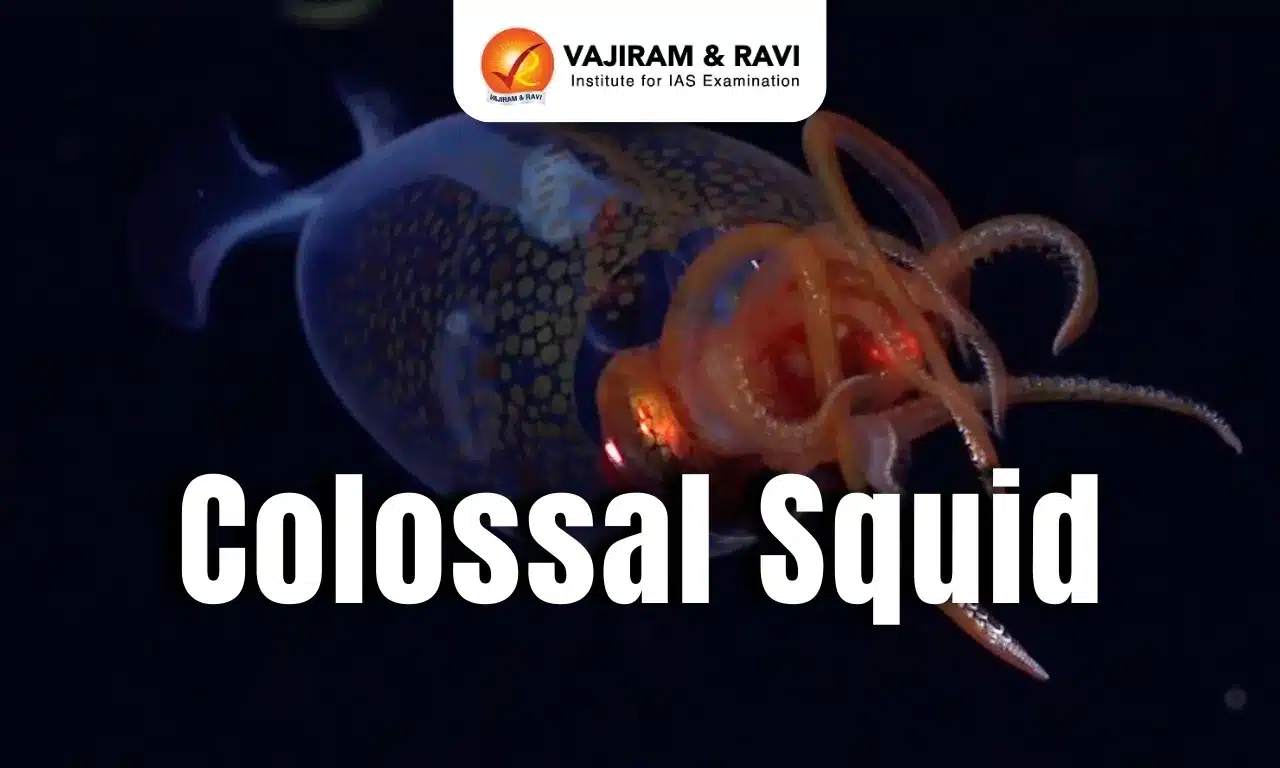
Colossal Squid Latest News
Marine scientists recently captured the world's first footage of a colossal squid swimming freely in its natural habitat - nearly a century after the species was first identified.
About Colossal Squid
- It is one of the largest and most elusive invertebrates on Earth.
- Scientific Name: Mesonychoteuthis hamiltoni
- Distribution: It is found in the icy depths of the Southern Ocean near Antarctica.
Colossal Squid Features
- This soft-bodied marine animal is somewhat like an octopus, but with a much bulkier frame and far greater length.
- It has a tube-shaped body, huge eyes, and arms and tentacles with suckers to grab food.
- It can reach lengths of up to 7 metres (around 23 feet) and weight as much as 500 kilograms.
- When they’re young, these creatures are almost see-through, giving them the glassy, ghost-like look that’s typical of many deep-sea juveniles.
- As they grow, their appearance changes drastically, taking on a deep red or purplish colour and developing thick, muscular arms.
- Fully grown, they are believed to be the largest invertebrates on Earth, meaning they have no bones but can still grow to massive sizes.
- What really sets the colossal squid apart, though, are the sharp, swivelling hooks on its tentacles, something no other squid species has.
- It’s also known for having the largest eyes of any animal ever discovered, believed to help it detect prey and predators in the pitch-black ocean depths.
- Colossal Squid Conservation Status: It is classified as Least Concern under the IUCN Red List.
Source: TH
Colossal Squid FAQs
Q1: Where is the colossal squid primarily found?
Ans: Southern Ocean near Antarctica
Q2: What makes the colossal squid’s eyes remarkable?
Ans: They are the largest eyes of any known animal.
Q3: What is the conservation status of the colossal squid according to the IUCN Red List?
Ans: Least Concern
