
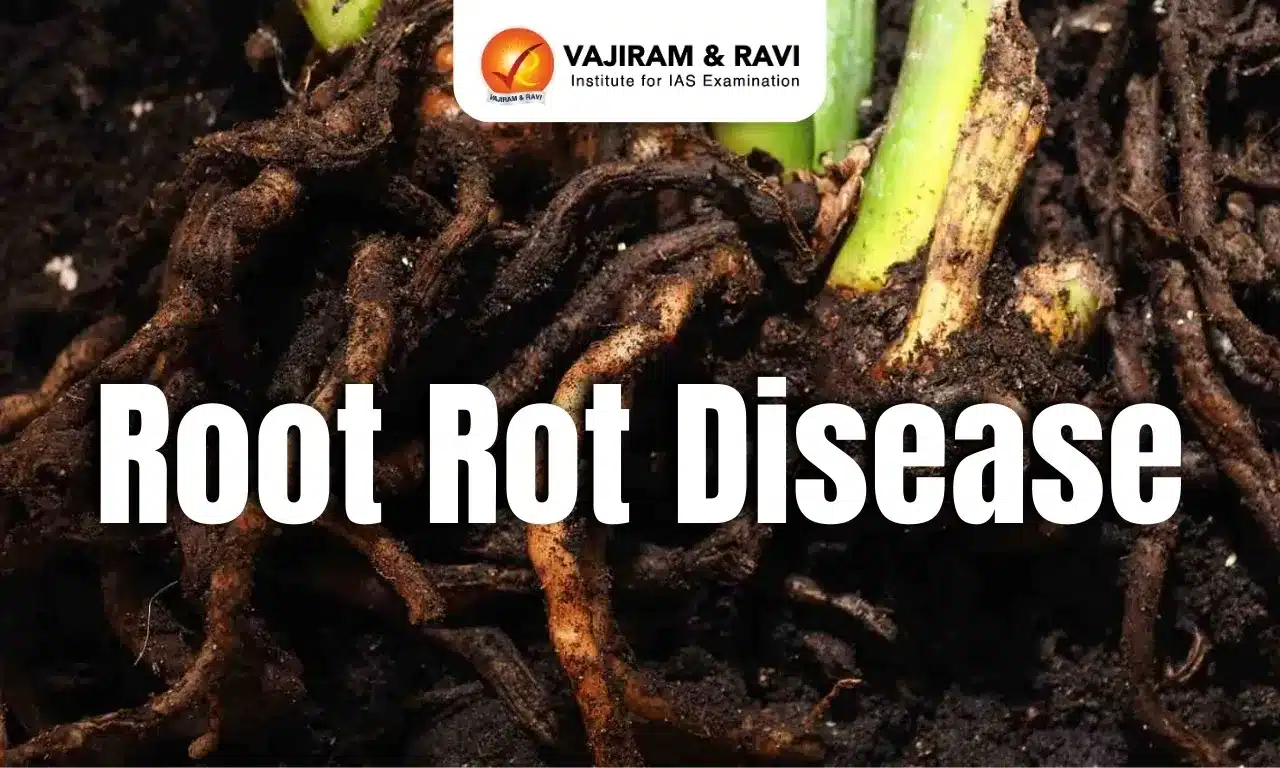
Root Rot Disease Latest News
Farmers cultivating 'pichi poo' (red jasmine) in Tiruchy, Tamil Nadu, say they are staring at huge losses as the crop has been hit by a fungal infection that causes root decay.
About Root Rot Disease
- Root rots, as the name suggests, attack plants from the ground via their roots.
- This can lead to wilting and plant death.
- These rots may also affect the trunk and stems, causing splits or rots above ground.
- Rots may also affect young plants such as seedlings.
- There are two causes of root rot: overwatering and/or the presence of fungal-like pathogens.
- Overwatering depletes oxygen in the soil, and this causes the roots to stop functioning, become softened, and die.
- Pathogens can also invade plants that are affected by inconsistent or overwatering. The range of pathogens that cause root rots affects many different plants.
- It is caused by numerous fungi, especially Armillaria mellea, Clitocybe tabescens, and Fusarium, and many oomycetes, including Pythium, Phytophthora, and Aphanomyces.
- If a root-rot pathogen is present,it may spread through the soil, carried by soil water,to affect nearby plants.
- Prevention:
- Control measures include planting in well-drained soils, including raised beds, planting resistant varieties (such as plants grafted onto resistant rootstock), or selecting plants that naturally cope well with wet or heavy clay soil.
- Where root rot occurs, remove affected plants. Some fungal treatments are available to treat soils.
Source: NIE
Root Rot Disease FAQs
Q1: What is the name of the fungus that causes root rot?
Ans: Root rot is caused by numerous fungi, especially Armillaria mellea, Clitocybe tabescens, and Fusarium.
Q2: How does root rot spread?
Ans: When soil is soggy, fungal spores multiply, and the pathogen that causes root rot starts to spread.
Q3: What is the best treatment for root rot?
Ans: The best treatment for root rot involves a combination of removing affected roots, improving drainage, and treating with a fungicide.

