
Labeo Uru and Labeo Chekida

Labeo Uru and Labeo Chekida

Labeo Uru and Labeo Chekida Latest News

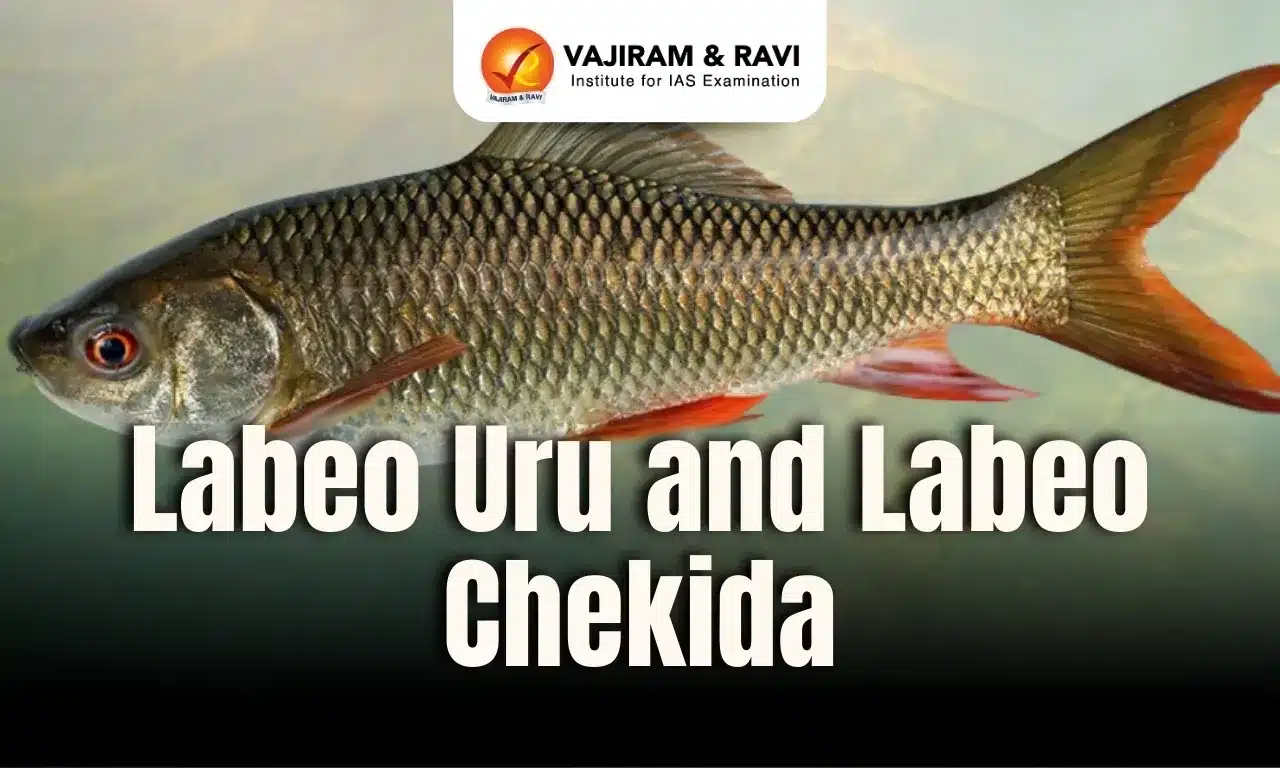
Labeo Uru and Labeo Chekida, two new species of freshwater Rohu fish, have been discovered in the Western Ghats region of India.

About Labeo Uru and Labeo Chekida

  • Labeo uru and Labeo chekida are newly identified freshwater fish species belonging to the Rohu group (genus Labeo), discovered by ICAR-NBFGR scientists in the Western Ghats.
  • Labeo uru was found in the Chandragiri River and is named for its distinctive sail-like dorsal fin.
  • Labeo chekida, locally known as ‘kaka chekida’, is a small, dark-bodied fish discovered in the Chalakkudy River.
  • The discovery resolves the long-standing taxonomic confusion with Labeo nigrescens, first described in 1870, by confirming the distinct identities of all three species based on unique morphological traits.
  • This breakthrough highlights the rich and previously undocumented fish biodiversity of the Western Ghats, a recognised global biodiversity hotspot.

Source: TH

Labeo Uru and Labeo Chekida FAQs

Q1: Where were Labeo uru and Labeo chekida discovered?

Ans: In the rivers of the Western Ghats, specifically the Chandragiri River (Labeo uru) and Chalakkudy River (Labeo chekida).

Q2: Why are these discoveries significant?

Ans: They resolve a 150-year-old confusion with Labeo nigrescens and highlight the rich, undocumented biodiversity of the Western Ghats.

Q3: What are the unique features of Labeo uru and Labeo chekida?

Ans: Labeo uru has a sail-like dorsal fin, while Labeo chekida is a small, dark-bodied fish known locally as ‘kaka chekida’.

Dark Matter

Dark Matter

Dark Matter Latest News

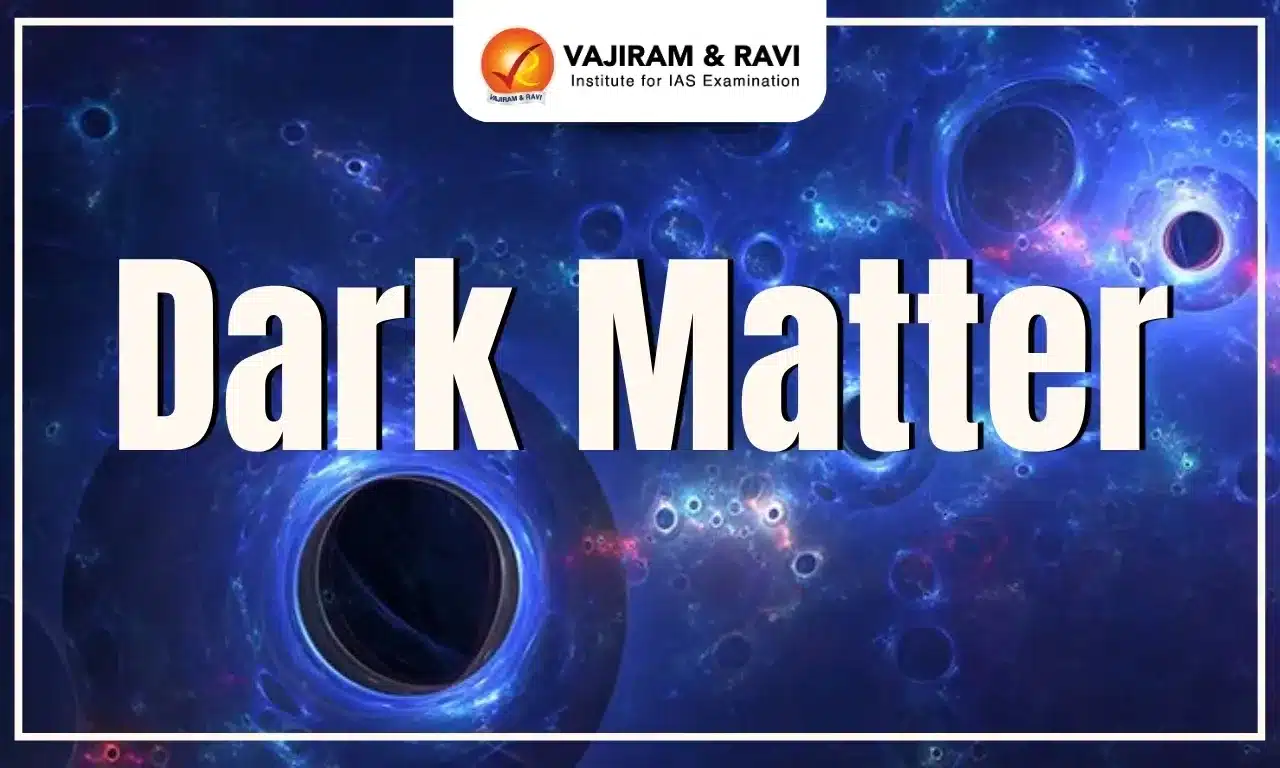
A recent study led by the Indian Institute of Astrophysics (IIA) has focused on the peculiar case of galaxy NGC 1052-DF2, which appears to lack dark matter—a component traditionally considered essential for galaxy formation.

About Dark Matter

  • Dark matter is a hypothetical form of matter that does not emit, absorb, or reflect light, making it invisible and detectable only through its gravitational effects.
  • It constitutes about 27% of the universe’s total mass-energy content, while visible matter accounts for only about 5%.
  • Dark matter is essential for explaining the observed structure and formation of galaxies, galaxy clusters, and the overall large-scale structure of the universe.
  • It acts as a cosmic “scaffolding,” holding galaxies together and influencing their rotation and movement.
  • Unlike ordinary (baryonic) matter, dark matter does not interact with electromagnetic forces, only gravity.
  • The leading candidates for dark matter include:
    • Weakly Interacting Massive Particles (WIMPs)
    • Axions (hypothetical ultralight particles)
    • Massive astrophysical compact halo objects (MACHOs) such as black holes, white dwarfs, and neutron stars.

Dark Energy

  • Dark energy makes up approximately 68% of the universe and appears to be associated with the vacuum in space. It is distributed evenly throughout the universe, not only in space but also in time – in other words, its effect is not diluted as the universe expands. 
  • The even distribution means that dark energy does not have any local gravitational effects, but rather a global effect on the universe as a whole. This leads to a repulsive force, which tends to accelerate the expansion of the universe. 
  • The rate of expansion and its acceleration can be measured by observations based on the Hubble law. 
  • These measurements, together with other scientific data, have confirmed the existence of dark energy and provide an estimate of just how much of this mysterious substance exists.

Source: TH

Dark Matter FAQs

Q1: Why is 95% of the universe invisible?

Ans: Because most of the universe is made up of dark matter and dark energy, which don’t emit light.

Q2: Does dark matter 100% exist?

Ans: Scientists are almost sure it exists due to its effects, but it hasn’t been directly detected yet.

Q3: Is dark matter a real thing?

Ans: Yes, it’s considered real because of the way it affects galaxies and cosmic structures.

ALH Dhruv

ALH Dhruv

ALH Dhruv Latest News

In the wake of the Pahalgam terror attack, the Indian Army has resumed limited operations of the Advanced Light Helicopter (ALH) Dhruv in the Anantnag region.

About ALH Dhruv

  • Advanced Light Helicopter or ALH-DHRUV is an indigenously developed utility aircraft by Hindustan Aeronautics Limited (HAL) with a twin-engine. It has a multi-role, multi-mission dimension to it.
  • Even though its development started in 1984, and was initially designed with Germany's assistance, Messerschmitt-Bolkow-Blohm (MBB), the helicopter was first flown in 1992 but entered service after certification in 2002.
  • According to HAL, the aircraft is “type–certified” for military operations by the Centre for Military Airworthiness Certification and civil operations by the Directorate General of Civil Aviation. The major variants of Dhruv are classified as Dhruv Mk-I, Mk-II, Mk-III & Mk-IV.
  • HAL has bagged orders for 73 ALH in 2017 from the Indian Army, Coast Guard, and Navy for ALH Mk-III & Mk-IV variants. It has also been supplied to the Nepal Army, the Mauritius Police, and the Maldives.
  • Features:
    • Twin-engine configuration
    • Glass cockpit with advanced avionics
    • Crashworthy airframe and landing gear
    • Composite interchangeable main rotor blades
    • Chaff and flare dispenser
    • Helmet Pointing System
    • Integrated self-protection suite
    • On-board inert gas generation system
    • Capability to operate in diverse terrains, including high-altitude regions

Source: TH

ALH Dhruv FAQs

Q1: What is the ALH Dhruv?

Ans: The ALH Dhruv is an indigenously developed multi-role Advanced Light Helicopter (ALH) manufactured by Hindustan Aeronautics Limited (HAL) for the Indian Armed Forces.

Q2: Why were Dhruv helicopters grounded earlier in 2025?

Ans: The entire fleet was grounded in January 2025 following a crash in Porbandar that resulted in the deaths of two Coast Guard pilots and an aircrew diver, prompting safety 

Q3: What are the key features of the ALH Dhruv helicopter?

Ans: The ALH Dhruv helicopter features a twin-engine configuration, advanced avionics, a glass cockpit, and the capability to operate in diverse terrains, including high-altitude regions.

Enquire Now