Rishikesh-Karnaprayag Tunnel T-8

Rishikesh-Karnaprayag Tunnel T-8

Rishikesh-Karnaprayag Tunnel T-8 Latest News

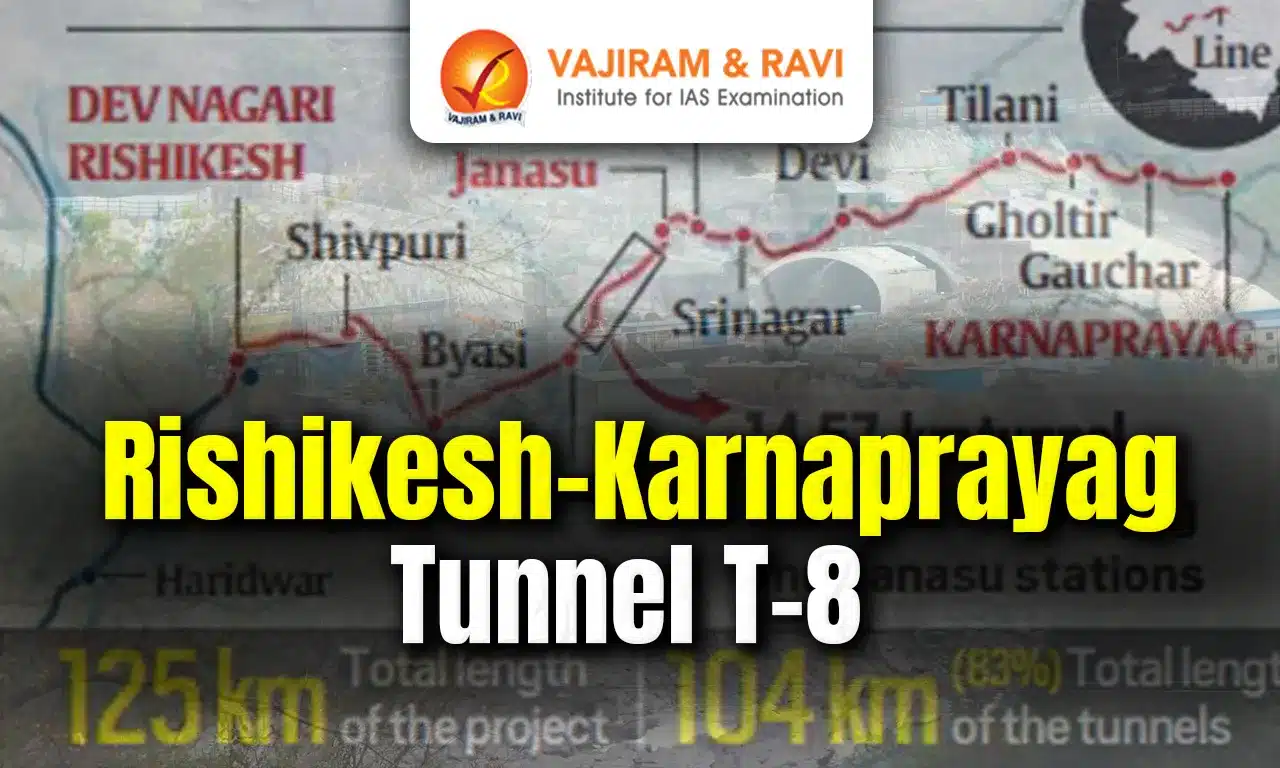
Tunnel No. 8 (T-8) is set to become India’s longest rail transportation tunnel at 14.57 km, surpassing the current longest T-50 (12.77 km) on the Udhampur-Srinagar-Baramulla Railway Link.

About Rishikesh-Karnaprayag Tunnel T-8

  • T-8 is a twin tunnel situated on the Devprayag–Janasu stretch of the 125-km Rishikesh–Karnaprayag Broad Gauge Rail Link Project, in the state of Uttarakhand.
  • The project is being implemented by Rail Vikas Nigam Limited (RVNL), a Navratna PSU under the Ministry of Railways, and executed by Larsen & Toubro (L&T).
  • Over 83% of the 125-km alignment—about 104 km—comprises tunnels, making it one of the most underground-intensive rail projects in India.
  • The rail line will connect Rishikesh to Karnaprayag, cutting travel time from 7 hours to just 2 hours, enhancing connectivity across five districtsDehradun, Tehri Garhwal, Pauri Garhwal, Rudraprayag, and Chamoli.

Engineering and Technological Highlights

  • Tunnel Boring Machines (TBMs) were used for the first time in Himalayan rail projects to excavate 10.4 km of T-8. These 2200-tonne machines were imported from Germany, transported via 17 shipments and assembled on site.
  • The diameter of the TBM used for T-8 was 9.1 metres, larger than the 6-metre TBMs used in the Delhi Metro.
  • The New Austrian Tunnelling Method (NATM) was used to excavate the remaining 4.11 km of the tunnel, especially in non-uniform geological zones.
  • Three advanced technologies were deployed for safety and precision:
    • Tunnel Seismic Prediction (TSP) to detect geological faults.
    • Torque Box for multidirectional boring capability.
    • Void Measurement to detect and fill gaps behind tunnel linings.

Source: IE

Rishikesh-Karnaprayag Tunnel T-8 FAQs

Q1: What is the Rishikesh-Karnaprayag Tunnel T-8 project?

Ans: It is a part of the Rishikesh-Karnaprayag rail line, and Tunnel T-8 is the longest tunnel (6.6 km) being constructed under this broad-gauge railway project in Uttarakhand.

Q2: Which agency is executing the T-8 tunnel construction?

Ans: The Rail Vikas Nigam Limited (RVNL) is the executing agency for the project.

Private Member’s Bill (PMB)

Private Member’s Bill (PMB)

Private Member’s Bill (PMB) Latest News

Vice President and Rajya Sabha Chairman Jagdeep Dhankhar recently emphasised that PMBs are “forward-looking” and a “gold mine” for legislative progress.

About Private Member’s Bill (PMB)

  • Private Member’s Bill (PMB) is a legislative proposal introduced by any Member of Parliament (MP) who is not a Minister, whether elected or nominated.
  • The drafting responsibility of a PMB lies entirely with the MP concerned, not with any Ministry.
  • For introducing a PMB in Parliament, a notice period of one month is required under parliamentary rules.
  • PMBs often reflect the ideological stance, personal convictions, or public interest concerns of the MP, especially those in the Opposition.

Time Allocation for PMBs in Parliament

  • In the Lok Sabha, the last two-and-a-half hours of business on every Friday are earmarked for the introduction and discussion of PMBs.
  • In the Rajya Sabha, PMBs are taken up every alternate Friday for two-and-a-half hours.

Historical Record and Trends

  • Since Independenceonly 14 PMBs have ever been passed and received Presidential assent, with the last one becoming law in 1970.
  • In the 17th Lok Sabha (2019–2024)729 PMBs were introduced in the Lok Sabha and 705 in the Rajya Sabha. Yet, only 2 PMBs were discussed in Lok Sabha, and 14 in the Rajya Sabha.
  • In the 18th Lok Sabha, as of the 2024 Budget Sessiononly 20 MPs introduced PMBs, and not a single one was discussed due to disruptions and prioritisation of other business.

Source: TH

Private Member’s Bill (PMB) FAQs

Q1: What is a Private Member’s Bill in Indian Parliament?

Ans: A Private Member’s Bill is a legislative proposal introduced by an MP who is not a minister, aimed at drawing attention to specific issues or suggesting legal reforms.

Q2: How often are Private Members’ Bills passed in India?

Ans: Very rarely. Only 14 Private Members’ Bills have been passed since Independence, the last one being in 1970.

Q3: On which day are Private Members’ Bills introduced in Parliament?

Ans: They are introduced and discussed usually on Fridays, when Parliament is in session.

Ukraine’s Critical Minerals

Ukraine’s Critical Minerals

Ukraine’s Critical Minerals Latest News

Recently, the U.S. and Ukraine signed a strategic minerals deal granting preferential U.S. access to Ukrainian mineral projects and establishing a joint investment fund for Ukraine’s reconstruction.

What are Critical Minerals and Rare Earths?

  • Rare Earth Elements (REEs) are a group of 17 chemically similar metals essential for making permanent magnets used in electric vehicles (EVs), smartphones, missile systems, and wind turbines.
  • The U.S. Geological Survey (USGS) lists 50 minerals as “critical”, including lithium, nickel, cobalt, and rare earths, due to their vital role in defence, aerospace, green energy, and electronics.
  • These minerals have no commercially viable substitutes, making their supply chain strategically important.

Ukraine’s Mineral Wealth

  • Ukraine has 22 of the 34 minerals classified as critical by the European Union (EU).
  • Major critical minerals in Ukraine include:
    • Rare earth elements such as lanthanum, cerium, neodymium, erbium, yttrium, and scandium.
    • Lithiumnickelmanganeseberylliumgalliumzirconiumgraphiteapatitefluorite, and titanium.
  • Graphite reserves in Ukraine account for approximately 20% of global resources, crucial for EV batteries and nuclear reactors.
  • Lithium reserves are estimated at 500,000 metric tonnes, one of the largest in Europe. Key lithium areas include the central, eastern, and southeastern regions.
  • Titanium is concentrated in the northwestern and central regions and is used in the aerospace and defence sectors.
  • China dominates global rare earth production, making Ukraine a strategically attractive alternative supplier for Western economies.

Source: TH

Ukraine’s Critical Minerals FAQs

Q1: What are Rare Earth Elements (REEs)?

Ans: Rare Earth Elements are a group of 17 chemically similar elements, including the 15 lanthanides plus scandium and yttrium, used extensively in high-tech and defence applications.

Q2: Why are REEs strategically important for India?

Ans: REEs are critical for national security, clean energy, and electronics manufacturing, making their supply crucial for India’s Atmanirbhar Bharat goals.

Q3: Which countries dominate REE production globally?

Ans: China is the largest producer and exporter of REEs, followed by countries like the USA, Australia, and Myanmar.

Understanding SECC 2011 and India’s Caste Census Landscape

Understanding SECC 2011 and India's Caste Census Landscape

What’s in Today’s Article?

  • India’s Caste Census Landscape Latest News
  • Background and Historical Context
  • Socio Economic Caste Census (SECC), 2011
  • Difference Between SECC 2011 and Census 2011
  • Caste and Tribe Specific Data - SECC vs Census 2011 on Caste
  • Conclusion
  • India’s Caste Census Landscape FAQs

India’s Caste Census Landscape Latest News

  • India has not published disaggregated caste data since the 1931 Census, creating a significant gap in understanding caste-based demographics
  • The Socio Economic and Caste Census (SECC) 2011 attempted to bridge this gap but it did not make certain caste-wise population data public.

Background and Historical Context

  • The most recent publicly available data on caste populations at the national level are from the 1931 Census.
    • It will serve as the baseline for the caste data that the government has now decided to collect as part of the upcoming, pandemic-delayed Census 2021.
  • The 1941 Census collected caste data but it was not released due to World War II.
  • Post-independence Censuses have not included disaggregated caste data, except for broad SC/ST figures.

Socio Economic Caste Census (SECC), 2011

  • Overview:
    • Beginning: The Union Ministry of Rural Development began the SECC on June 29, 2011 through a nationwide door-to-door enumeration exercise. 
    • Purpose: 
      • Assess socio-economic status of rural and urban households, and allow the ranking of households based on predefined parameters.
      • The data to be used for policy, research, and the implementation of various development programs.
    • Coverage: Conducted in 24 lakh enumeration blocks, each with ~125 households.
    • Timeline: Mostly in 2011–2012; extended to 2013 in some states.
  • Key features:
    • Joint exercise with Census 2011, but administratively distinct.
    • The caste census was under the administrative control of the Ministry of Home Affairs, through the Registrar General of India (RGI) and Census Commissioner of India.

Difference Between SECC 2011 and Census 2011

  • Confidentiality and accessibility:
    • Census 2011 data: Confidential and used for statistical purposes.
    • SECC 2011 data: Open for government use in identifying beneficiaries for schemes.
  • Common parameters:
    • Demographic and economic data: Gender, age, marital status, religion, literacy, etc.
  • Additional parameters in SECC:
    • Health: Nature of disability (sight, speech, mental illness, etc.) and diseases (cancer, TB, leprosy).
    • Economic status: Asset ownership (mobile, AC, fridge), housing condition, source of lighting, latrines, and kitchens.
    • Employment and income (Urban-specific): Source of income (begging, vending, pension, rent).
    • Rural-specific: Landholding, mechanised equipment, tribal group membership, bonded labour, manual scavenging.

Caste and Tribe Specific Data - SECC vs Census 2011 on Caste

  • Census 2011: Only asked about SC/ST status, not specific caste names or OBC/general category.
  • SECC 2011:
    • Collected disaggregated caste data.
    • Categories: SC (Code 1), ST (Code 2), Other (Code 3), No Caste/Tribe (Code 4).
    • Captured name of caste/tribe if applicable.
  • Government order on SC classification:
    • As per 1990 order, Scheduled Castes must be Hindu, Sikh, or Buddhist.
    • Scheduled Tribes can be from any religion.

Conclusion

  • The upcoming Census 2021, delayed by the pandemic, is expected to include comprehensive caste data, potentially reshaping socio-economic policy frameworks. 
  • Accurate and transparent caste data remains critical for targeted welfare measures, inclusive governance, and evidence-based policymaking.

India’s Caste Census Landscape FAQs

Q1. What was the key difference in data confidentiality between Census 2011 and SECC 2011?

Ans. While data from Census 2011 is confidential and used only for statistical purposes, SECC 2011 data is accessible to government departments for welfare scheme implementation.

Q2. Why is the 1931 Census significant in the context of caste-based data in India?

Ans. The 1931 Census is the last publicly available source of disaggregated caste data at the national level, serving as a historical baseline.

Q3. Under which ministry was the caste component of the SECC 2011 conducted, and who executed it?

Ans. The caste component of SECC 2011 was under the Ministry of Home Affairs and conducted by the Registrar General of India (RGI).

Q4. What additional socio-economic indicators were included in SECC 2011 but not in Census 2011?

Ans. SECC 2011 included detailed information on disabilities, household assets, housing conditions, and occupation/income sources, especially in rural areas.

Q5. According to the 1990 Government Order, who is eligible to be classified under Scheduled Castes?

Ans. Only individuals professing Hinduism, Sikhism, or Buddhism can be classified as Scheduled Castes under the 1990 Government Order.

Source: IE

US–Ukraine Minerals Deal Secures Strategic Access to Rare Resources

US–Ukraine Minerals Deal Secures Strategic Access to Rare Resources

What’s in Today’s Article?

  • US-Ukraine Minerals Deal Latest News
  • Ukraine’s Strategic Mineral Wealth
  • Key Highlights of the US–Ukraine Minerals Deal
  • US-Ukraine Minerals Deal and Security Guarantees
  • US-Ukraine Minerals Deal FAQs

US-Ukraine Minerals Deal Latest News

  • The US and Ukraine have finalized a major minerals deal after months of tense negotiations, including a heated Oval Office meeting between Presidents Trump and Zelenskyy. 
  • Under the agreement, the US gains preferential access to Ukrainian mineral and resource licenses, while Ukraine receives financial and military aid for post-war reconstruction. 
  • Trump called the deal "payback" for the $350 billion he claims the US has spent supporting Ukraine, though official figures show $182.8 billion.

Ukraine’s Strategic Mineral Wealth

image4.webp
  • Ukraine holds approximately 5% of the world’s critical raw materials, giving it a strategic edge in the global supply of essential minerals.
  • Ukraine has deposits of 22 out of the 34 minerals identified as critical by the European Union. 
  • These include: Industrial and construction materials; Ferro alloys and non-ferrous metals; Precious metals and rare earth elements.

Key Mineral Reserves

  • Graphite: 19 million tonnes of proven reserves; among the top five global suppliers. Crucial for EV batteries.
  • Titanium: Holds 7% of Europe's supply; used in aerospace and infrastructure.
  • Lithium: Contains one-third of Europe’s deposits; essential for modern batteries.
  • Other Crucial Elements: Includes beryllium and uranium, important for nuclear technology.
  • Additional Metals: Ukraine has significant reserves of copper, lead, zinc, silver, nickel, cobalt, and manganese.
  • Rare Earth Elements: Hosts deposits of all 17 rare earths used in electronics, defense, and green energy.

Geographic Distribution of Major Resources

  • Titanium: Found mostly in northwestern and central Ukraine
  • Lithium: Located in central, eastern, and southeastern regions
  • Graphite: Found in central and western Ukraine; represents 20% of global reserves
  • Coal: Reserves remain significant, though most are now in Russian-occupied territory

Russian Occupation and Economic Loss

  • An estimated $350 billion worth of mineral resources lie in territories occupied by Russia.
  • As of 2022, Russia controls:
    • 63% of Ukrainian coal mines
    • 50% of manganese, caesium, tantalum, and rare earth deposits.
  • Russia has seized at least two lithium sites:
    • One in Donetsk
    • One in Zaporizhzhia
  • Ukraine still retains control of lithium reserves in the central Kyrovohrad region.

Key Highlights of the US–Ukraine Minerals Deal

  • The agreement was signed by US Treasury Secretary Scott Bessent and Ukraine’s Vice Prime Minister Yulia Svyrydenko.

Oil and gas included alongside minerals

  • While the deal focuses on Ukraine's mineral wealth, it also covers oil, natural gas, and other hydrocarbons. 
  • In all cases, Ukraine retains full ownership of the resources, though the US will have joint access.

United States–Ukraine Reinvestment Fund

  • A new fund will be created and jointly managed by both countries on an equal partnership basis.
  • For the first ten years, all profits and revenues from the fund are expected to be reinvested into Ukraine’s development.

Resource Ownership and Control

  • Ukraine will retain full ownership and control over its natural resources, with the right to decide where and what to extract.

Contributions to the Fund

  • The US will contribute via direct funding or new military assistance.
  • Ukraine will contribute 50% of revenues from new licenses for critical materials, oil, and gas extraction.

Use of Military Assistance

  • The agreement emphasizes future military support—potentially including air defence systems—and confirms Ukraine will not owe any debt to the US for past aid.

US-Ukraine Minerals Deal and Security Guarantees

  • No Formal Security Guarantees Included
    • The minerals deal does not contain explicit security guarantees for Ukraine.
    • President Zelenskyy has refused peace talks with Russia unless future security assurances are provided.
  • Military Assistance Still Possible
    • While not a guarantee, the deal revives the prospect of continued US military aid.
    • Analysts view this as a strategic signal of US interest in Ukraine’s future.
  • US Troop Involvement Ruled Out
    • Trump has not committed to sending US troops or backing European military involvement in Ukraine.
    • The deal is economic and strategic, not a defense pact.
  • Potential Deterrence Against Russia
    • According to analysts, the agreement creates US investment and strategic interest in Ukraine.
    • This could deter future Russian aggression, as the US would likely respond with sanctions and military support.

US-Ukraine Minerals Deal FAQs

Q1. What is the US–Ukraine minerals deal?

Ans. A strategic agreement giving the US access to Ukraine’s critical mineral and energy resources.

Q2. Which minerals are involved?

Ans. Lithium, titanium, graphite, rare earth elements, and other critical raw materials.

Q3. Does Ukraine retain resource control?

Ans. Yes, Ukraine maintains full ownership and decides extraction rights.

Q4. Are security guarantees included?

Ans. No formal guarantees, but military aid and US interest signal potential deterrence.

Q5. What is the Reinvestment Fund?

Ans. A joint fund where all profits are reinvested in Ukraine’s development for ten years.

Source: TH | BBC | ALjazeera

India’s Natural Hydrogen Potential: A Strategic Energy Opportunity

India’s Natural Hydrogen Potential: A Strategic Energy Opportunity

What’s in Today’s Article?

  • India’s Hydrogen Potential Latest News
  • Introduction
  • India’s Hydrogen Demand and Resource Potential
  • Geological Factors and Exploration Needs
  • Technological and Safety Challenges
  • International Approaches and India’s Opportunity
  • Kickstarting Commercialization and Policy Support
  • Conclusion
  • India Natural Hydrogen Potential FAQs

India’s Hydrogen Potential Latest News

  • Recently, a study has arrived at a value of 3,475 million tonnes of natural hydrogen potential in India.

Introduction

  • As India pursues its ambitious target of achieving net-zero emissions by 2070, the search for cleaner, cost-effective, and scalable energy alternatives has intensified. 
  • Among emerging options, naturally occurring geological hydrogen, also known as white or gold hydrogen, has attracted significant attention for its potential to decarbonize the economy without the high energy input required for conventional hydrogen production. 
  • With early signs of significant reserves and increasing global momentum in exploration technology, natural hydrogen may play a pivotal role in securing India's energy future.

India’s Hydrogen Demand and Resource Potential

  • India's annual hydrogen demand is expected to grow from 6 million tonnes in 2020 to over 50 million tonnes by 2070 to align with its net-zero goals. 
  • A preliminary academic estimate places India’s natural hydrogen potential at approximately 3,475 million tonnes, which could substantially offset the need for manufacturing hydrogen via energy-intensive methods like electrolysis.
  • Recent findings of underground hydrogen in the Andaman Islands and analogous geological formations across India suggest untapped reserves. 
  • However, these possibilities remain theoretical until validated by comprehensive geological surveys.

Geological Factors and Exploration Needs

  • Tapping natural hydrogen requires a robust understanding of India’s diverse geophysical landscape. Regions like the Dharwar and Singhbhum cratons, Vindhyan and Gondwana basins, and ophiolite complexes in the Himalayas and Andamans show promising characteristics such as:
    • Presence of hydrogen-generating rocks
    • Adequate seals and traps to contain the gas
    • Subsurface features suitable for large accumulations
  • India needs a nationwide geological mapping initiative, similar to those undertaken by Australia (AusLAMP) and the U.S. (USArray), to build a 3D model of subsurface resistivity and identify potential hydrogen zones. 
  • Such efforts would require public-private partnerships and the deployment of advanced magnetotelluric and petrophysical survey techniques.

Technological and Safety Challenges

  • Despite its promise, natural hydrogen exploration is fraught with challenges:
    • Detection Difficulty: Unlike oil and natural gas, hydrogen lacks established discovery methods, making detection complex and uncertain.
    • Extraction Limitations: Hydrogen’s small molecular size and high diffusivity demand specialized extraction technologies and infrastructure.
    • Safety Risks: Hydrogen’s reactivity necessitates innovations in well design and materials. Hydrogen-resistant coatings, modified cement additives, and upgraded rubber linings are essential to ensure safety in storage and transport.
  • Technological research is underway to retrofit existing gas infrastructure and develop cost-effective extraction and storage methods.

International Approaches and India’s Opportunity

  • Countries like the United States are already advancing beyond mere extraction. The U.S. Advanced Research Projects Agency-Energy (ARPA-E) is investing in:
    • Inducing hydrogen generation by injecting water into iron-rich rocks
    • Combining carbon sequestration with hydrogen production
    • Developing intentional geological hydrogen reactors
  • India can adopt a similar vision by leveraging its existing oil and gas exploration network, particularly under the Directorate General of Hydrocarbons. 
  • Reviewing rock cores from previously drilled wells could offer a low-cost starting point for exploration. 
  • Some existing natural gas pipelines may also be repurposed for hydrogen transport, subject to modifications.

Kickstarting Commercialization and Policy Support

  • While the long-term cost of natural hydrogen production may be lower than green or grey hydrogen, initial exploration and infrastructure costs are substantial. Commercial viability hinges on:
    • Discovery of large, accessible reserves
    • Development of low-cost extraction techniques
    • Transparent and enabling regulatory frameworks
    • Targeted government support through grants and incentives
  • India can replicate the success of its National Solar Mission, which benefited from early investment in solar resource mapping and public-private coordination. 
  • A Natural Hydrogen Mapping Mission could serve a similar catalytic role.

Conclusion

  • India stands at a promising threshold in the global energy transition. Natural hydrogen offers a clean, indigenous energy source with strategic and economic advantages. 
  • However, unlocking this potential will require coordinated scientific exploration, technology development, safety infrastructure, and policy vision. 
  • As global energy systems evolve, natural hydrogen may well become the silent revolution that powers India toward a secure and sustainable future.

India Natural Hydrogen Potential FAQs

Q1. How much natural hydrogen potential is estimated in India?

Ans. Preliminary estimates suggest India could have up to 3,475 million tonnes of natural hydrogen reserves.

Q2. Which regions in India show geological promise for natural hydrogen exploration?

Ans. Regions include the Dharwar and Singhbhum cratons, Andaman ophiolites, and Vindhyan and Gondwana basins.

Q3. What are the major challenges in tapping natural hydrogen?

Ans. Challenges include detection difficulty, extraction technology gaps, and safety risks due to hydrogen’s properties.

Q4. How can India replicate international hydrogen exploration models?

Ans. By adopting techniques like magnetotelluric surveys and leveraging existing oil and gas infrastructure.

Q5. Why is natural hydrogen important for India’s energy future?

Ans. It offers a clean, cost-effective, and scalable solution to meet India’s growing hydrogen demand and net-zero targets.


Source: TH

Orange Economy

Orange Economy

Orange Economy Latest News

At the World Audio Visual Entertainment Summit (WAVES) Summit in Mumbai recently, the Prime Minister spotlighted India’s booming orange economy—powered by content, creativity, and culture.

About Orange Economy

  • The Orange Economy, also known as the ‘creative economy,’ is a concept that includes sectors related to creativity and cultural industries. 
  • According to the United Nations Economic Network, the creative economy is an evolving idea that focuses on the contribution and potential of creative assets to drive economic growth and development.
  • This economy integrates economic, cultural, and social aspectsinteracting with technology, intellectual property, and tourismobjectives
  • It consists of knowledge-based economic activities with a development dimension, featuring cross-cutting linkages at macro and micro levels to the overall economy.
  • These are industries based on individual creativity, skill, and talent, with the potential to create jobs, wealth, and cultural value.
  • Industries within this economy include advertising, architecture, arts and crafts, design, fashion, film, video, photography, music,performing arts, publishing, research and development, software, computer games, electronic publishing, and TV/radio.
  • Popularised by Colombian economists Felipe Buitrago and Iván Duque, the term “orange” symbolises creativity and cultural identity.
  • According to the United Nations Educational, Scientific and Cultural Organization (UNESCO), the Orange Economy accounts for 3% of global gross domestic product (GDP) and 30 million jobs worldwide. 
  • Inspired by ideas, it’s known for constant innovation, singular products (not mass production) and digitized processes.

Source: BT

Orange Economy FAQs

Q1: What is the concept of orange economy?

Ans: The Orange Economy, also known as the ‘creative economy,’ is a concept that includes sectors related to creativity and cultural industries.

Q2: What is another name for the Orange Economy?

Ans: Creative Economy

Q3: According to UNESCO, the Orange Economy contributes approximately what percentage to global GDP?

Ans: 3%

SEBI Cautions Investors Against Opinion Trading Platforms in India

SEBI Cautions Investors Against Opinion Trading Platforms in India

What’s in Today’s Article?

  • Opinion Trading Platforms Latest News
  • Opinion Trading Platforms
  • How Opinion Trading Platforms Operate
  • SEBI’s Key Concerns on Opinion Trading Platforms
  • Opinion Trading Platforms FAQs

Opinion Trading Platforms Latest News

  • SEBI has warned investors against 'opinion trading platforms,' a new form of online betting in India that allows users to wager on real-life events. 
  • Although these platforms have operated without much oversight until now, authorities are beginning to scrutinize them due to their rapid growth. 
  • The sector has attracted over ₹4,200 crore in funding from major investors like Sequoia Capital and Y Combinator, with annual transaction volumes exceeding ₹50,000 crore and a user base of over 5 crores. Revenue for the industry is expected to cross ₹1,000 crore in FY 2024-25. 

Opinion Trading Platforms

  • Opinion trading platforms allow users to place bets or trade on the outcome of yes/no propositions related to real-world events. 
  • The payout is determined by whether the predicted event occurs. 
  • These platforms often mimic investment platforms by using financial terms like “profits,” “stop loss,” and “trading.”

Imitating Investment Platforms

  • To appear legitimate or investment-oriented, some of these platforms use language typically associated with securities trading, which may mislead users into believing they are making genuine investments rather than bets.

Key Players in India

  • Prominent Indian companies in this space include:
    • Probo (Gurugram-based): Offers prediction markets across diverse topics like sports, elections, and cryptocurrency.
    • MPL Opinio: Focuses solely on cricket-related predictions.

How Opinion Trading Platforms Operate

  • Betting on Real-Life Events
    • These platforms let users earn money by predicting the outcomes of real-world events such as sports matches, elections, weather changes, or cryptocurrency trends. 
    • Users place bets on “yes” or “no” type questions.
    • For instance, users may be asked: “Will political party X win the election by a margin of N?” 
    • If their answer is correct, they win money; if incorrect, they lose their stake.
  • Varied Themes and Topics
    • Popular themes include:
      • Outcomes of cricket and other sports matches
      • Individual athlete performances (e.g., runs scored or goals made)
      • Financial predictions like whether Bitcoin will reach a specific value
  • These platforms blend elements of gambling with the structure of trading, offering financial incentives for accurate predictions.

SEBI’s Key Concerns on Opinion Trading Platforms

  • Outside SEBI’s Regulatory Scope
    • SEBI clarified that opinion trading platforms generally fall outside its jurisdiction, as the activities conducted do not involve trading in recognized securities. 
    • Therefore, these platforms are not regulated or registered with SEBI.
  • Unrecognized and Illegal Trading
    • If any opinion traded on these platforms qualifies as a security, such trading becomes illegal since these platforms are not authorized stock exchanges. 
    • SEBI emphasized that no investor protection mechanisms will apply in such cases.
  • Risk of Regulatory Action
    • SEBI warned that these platforms could face legal consequences for violations. 
    • It also directed recognized stock exchanges to act against any such infractions.
  • Global Regulatory Landscape
    • Countries like the US, UK, and Australia regulate opinion trading platforms. 
    • In the US, Kalshi operates under CFTC oversight. 
    • However, platforms like Polymarket have faced legal issues for not being registered with regulators, indicating the complexities involved.
  • India’s Regulatory Vacuum
    • India's IT Ministry has proposed amendments to regulate online gaming, potentially covering platforms like Probo. 
    • However, these rules lack enforceability at present, leaving a significant legal gap in the oversight of opinion trading platforms.
       

Opinion Trading Platforms FAQs

Q1. What are opinion trading platforms?

Ans. Platforms where users bet on real-life events with yes/no outcomes for monetary gain.

Q2. Why did SEBI issue a warning?

Ans. Because these platforms aren’t regulated and may operate illegally if trading securities.

Q3. Who are key players in India?

Ans. Probo and MPL Opinio are major platforms offering event-based prediction markets.

Q4. Are these platforms legal in India?

Ans. They operate in a legal grey area and face possible regulatory action.

Q5. How are global markets handling them?

Ans. Countries like the US regulate them under agencies like the CFTC.


Source: IE | IE

Chandola Lake

Chandola Lake

Chandola Lake Latest News

The Gujarat High Court upheld a demolition drive undertaken by state authorities in Ahmedabad's Chandola lake area recently.

About Chandola Lake

  • It is an artificial lake located in AhmedabadGujarat.
  • It was established by the wife of a Mughal Sultan of Ahmedabad named Tajn Khan Nari Ali.
  • The lake covers a land area of around 1200 hectares and is a major source of water for nearby industrial and residential areas.
  • It is in circular form.
  • The Kharicut Canal Scheme which is one of the oldest irrigation schemes of Gujarat was constructed with the main purpose of providing irrigation to 1,200 acres of rice land near Chandola lake in Ahmedabad.
  • The lake is separated into the parts called the Chota Chandola and the Bada Chandola lake. 
  • It is also home for cormorants, painted storks and spoonbill birds.
  • There is a tomb of Shah Aalam next to the lake. 
    • He was one of the most revered of Muslim religious teachers of Ahmedabad. 
    • The tomb was built in the period between 1475 and 1483.
    • The tomb is decorated with precious gold and stones.

Source: LL

Chandola Lake FAQs

Q1: Where is Chandola Lake located?

Ans: Ahmedabad, Gujarat

Q2: Who is credited with establishing Chandola Lake?

Ans: It was established by the wife of a Mughal Sultan of Ahmedabad named Tajn Khan Nari Ali.

Q3: Which irrigation scheme is associated with Chandola Lake?

Ans: Kharicut Canal Scheme

Vizhinjam Port

Vizhinjam Port

Vizhinjam Port Latest News

The Prime Minister will formally open the Vizhinjam International Seaport in Kerala, marking a major step in putting the southern state on the global maritime map.

About Vizhinjam Port

  • Location: It is located at Vizhinjam, a coastal town in Thiruvananthapuram District, Kerala.
  • It is India's first dedicated transshipment port and also the country's first semi-automated port.
  • Built at a cost of around Rs 8,900 crore under public-private partnership (PPP) modethe transshipment port is operated by the Adani Group, with the Kerala government holding the majority stake.
  • Features:
    • The breakwater at Vizhinjam is the deepest in India and stretches nearly three kilometres. It has a natural draft of around 20 metres. 
    • It also features India's first home-built, AI-powered Vessel Traffic Management System,developed with IIT Madras.
    • It is equipped with fully automated yard cranes and remotely operated ship-to-shore cranes for faster and safer operations. 
    • Unlike most Indian ports, Vizhinjam experiences minimal sand movement along the coast (littoral drift), which reduces maintenance costs.
  • Importance:
    • Vizhinjam’s strategic location—just 10 nautical miles from a key international shipping route—and naturally deep waters make it ideal for accommodating large container vessels. 
    • Until now, 75% of India’s transshipment traffic was handled abroad, leading to foreign exchange losses. Vizhinjam aims to change that by reclaiming a substantial share of this traffic.
    • The port now shares routes with global hubs like Shanghai, Singapore, and Busan.
    • Plans are also underway to turn Vizhinjam into a multi-modal logistics hub, with direct highway connectivity via NH-66, Kerala’s first cloverleaf interchange, and an upcoming railway link to the national network.

Source: NDTV

Vizhinjam Port FAQs

Q1: Where is Vizhinjam Port located?

Ans: Vizhinjam, Thiruvananthapuram District, Kerala

Q2: What is the major distinction of Vizhinjam Port in the context of Indian ports?

Ans: India’s first dedicated transshipment port and semi-automated port

Q3: Who operates the Vizhinjam Port under the Public-Private Partnership (PPP) model?

Ans: Adani Group

Green Hydrogen Certification Scheme of India (GHCI)

Green Hydrogen Certification Scheme of India

Green Hydrogen Certification Scheme of India Latest News

India's government recently initiated a green hydrogen certification scheme to promote transparency and credibility in production.

About Green Hydrogen Certification Scheme of India 

  • It was launched by the Ministry of New and Renewable Energy (MNRE), Government of India, under the National Green Hydrogen Mission, aiming to establish India as a global hub for green hydrogen production and export. 
  • The scheme emphasizes accuracy in emissions data, strict monitoring, and international compatibility, aiming to boost investor confidence and support the growth of a credible green hydrogen market in India.

Features of Green Hydrogen Certification Scheme of India

  • Hydrogen can be officially recognized as “green” only if its non-biogenic greenhouse gas emissions do not exceed 2 kg of CO₂ equivalent (CO₂e)/kg of hydrogen, averaged over 12 months, under the GHCI. 
  • The scheme outlines a comprehensive certification processfor producers to verify that the hydrogen is produced using renewable energy and that the greenhouse gas emissions do not exceed 2 kg of CO₂ equivalent (CO₂e)/kg of hydrogen. 
    • This threshold is measured across the production stages within a defined system boundary. 
    • The certification framework includes clear definitions, objectives, roles of stakeholders, eligible production pathways (electrolysis and biomass conversion), and emissions quantification methods. 
    • Producers must appoint Accredited Carbon Verification (ACV) agencies,recognized by the Bureau of Energy Efficiency,for independent verification.
  • The GHCI operates with four types of certificatesConcept Certificate, Facility-Level Certificate, Provisional Certificate, and Final Certificate. 
    • Concept and Facility-Level certificates focus on design and operational readiness, while Provisional and Final certificates evaluate actual emissions based on production data. 
    • Final certificates are mandatory for facilities benefiting from government incentives or intending to sell hydrogen domestically.
  • Data monitoring plays a crucial role. Producers are required to maintain detailed production and emissions records for at least five years. 
    • A standardized MRV (Monitoring, Reporting, Verification) framework guides this process, enhancing transparency and enabling traceability. 
    • The scheme also aligns with international standards like ISO 19870:2023 for lifecycle GHG assessments, helping ensure global comparability and investor confidence.
  • The certification also enables producers to access carbon credits under the Carbon Credit Trading Scheme (CCTS), subject to additional compliance requirements. 
    • Certificates are issued in multiples of 100 kg of hydrogen and include detailed information on emission intensity and production attributes. 
    • A nominal fee is applicable only for the final certificate.
  • To ensure compliance, the MNRE or its designated agency may withdraw certificates if verified emissions exceed the allowed thresholdor if producers fail to complete the certification process on time.
    • Repeat non-compliance can lead to penalties, including ineligibility for future certification cycles.

Source: ET

Green Hydrogen Certification Scheme of India FAQs

Q1: Which ministry launched the Green Hydrogen Certification Scheme (GHCI) in India?

Ans: Ministry of New and Renewable Energy

Q2: What role does the Final Certificate play in the GHCI framework?

Ans: Final certificates are mandatory for facilities benefiting from government incentives or intending to sell hydrogen domestically.

Q3: What type of agencies must producers appoint for independent emissions verification under GHCI?

Ans: Accredited Carbon Verification (ACV) agencies

Indo-Pacific Maritime Domain Awareness (IPMDA)

Indo-Pacific Maritime Domain Awareness (IPMDA)

Indo-Pacific Maritime Domain Awareness (IPMDA) Latest News

Recently, the U.S. Defence Security Cooperation Agency (DSCA) delivered the certification to the U.S. Congress, confirming the possible Foreign Military Sale (FMS) to India.

About Indo-Pacific Maritime Domain Awareness (IPMDA)

  • The Indo-Pacific Maritime Domain Awareness (IPMDA) is a Quad-led initiative launched during the Quad Leaders’ Summit in Tokyo in May 2022.
  • The initiative was introduced to track "dark shipping", vessels that switch off tracking systems to evade detection, and to build a faster, broader, and more accurate maritime surveillance network across the Indo-Pacific region.
  • Three strategic sub-regions of the Indo-Pacific are targeted under this initiative: the Pacific IslandsSoutheast Asia, and the Indian Ocean Region (IOR).

Purpose and Functions of IPMDA

  • The primary objective of IPMDA is to enhance maritime domain awareness and bring greater transparency to critical sea lanes of the Indo-Pacific region.
  • It is a technology and training initiative that uses advanced tools like commercial satellite radio frequency (RF) data to monitor and detect maritime activity in near real-time.
  • Through this, IPMDA aims to provide partner countries in Southeast Asia, Pacific, and IOR with timely and actionable maritime intelligence to protect their exclusive economic zones (EEZs).

Details of the U.S. Approval to India

  • The United States has approved a potential sale of maritime surveillance technology worth $131 million to India. The deal includes:
    • SeaVision software and its enhancements,
    • Technical Assistance Field Team (TAFT) for training,
    • Remote software and analytics support, and
    • Program documentation and logistics assistance.
  • SeaVision is a key maritime situational awareness tool widely used for vessel tracking and coastal surveillance.

Source: TH

Indo-Pacific Maritime Domain Awareness (IPMDA) FAQs

Q1: What is the Indo-Pacific Maritime Domain Awareness (IPMDA) initiative?

Ans: The IPMDA is a Quad initiative to provide real-time maritime surveillance to Indo-Pacific nations using satellite-based technology.

Q2: When was the IPMDA announced?

Ans: It was announced in the Quad Leaders' Summit in May 2022 held in Tokyo, Japan.

Enquire Now