
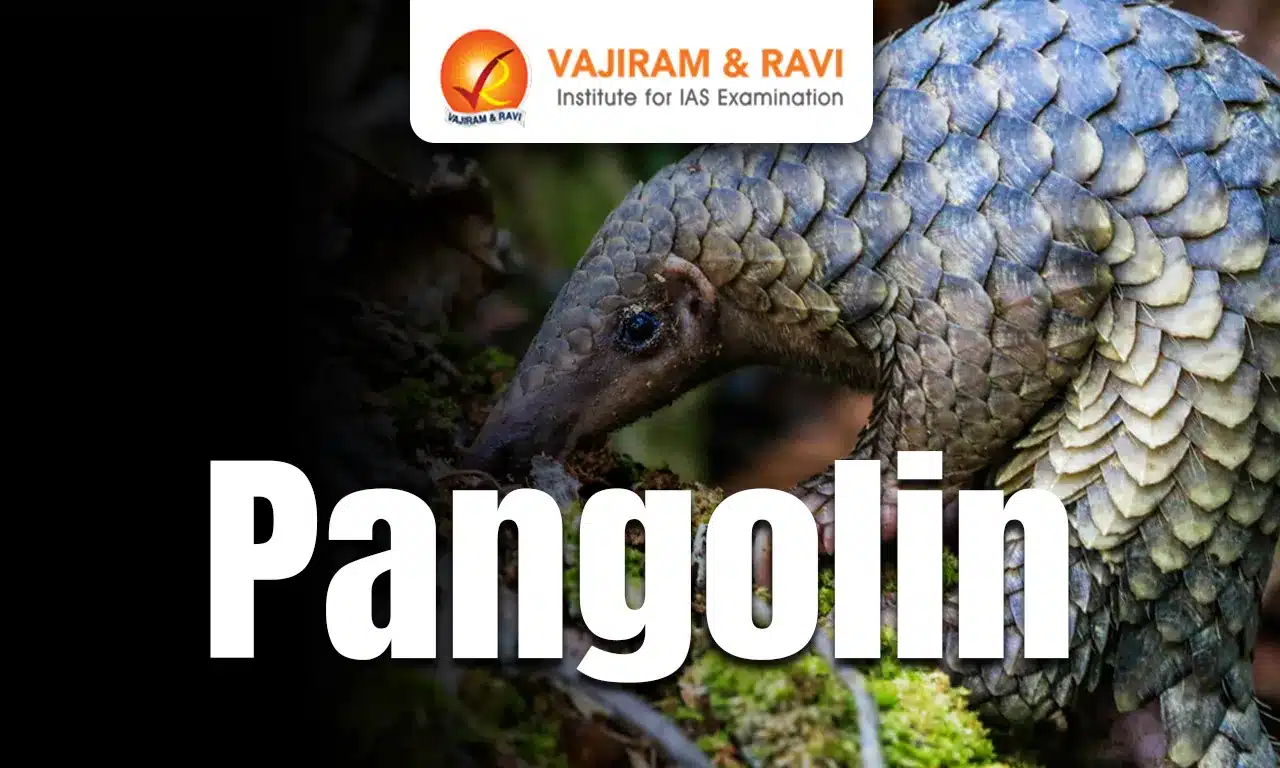
Pangolin Latest News
Global trafficking of pangolin scales has sharply declined since 2020, primarily due to COVID-19-related disruptions, sustained law enforcement actions, and evolving smuggling tactics, according to the Wildlife Justice Commission (WJC) report.
About Pangolin
- Species: There are 8 species of pangolins: 4 in Africa (Black-bellied, White-bellied, Giant Ground, Temminck’s Ground) and 4 in Asia (Indian, Chinese, Sunda, Philippine pangolins).
- Physical and Behavioural Traits
- Habitat: Pangolins live in tropical forests, grasslands, and agricultural areas, and are found close to human settlements. The Indian pangolin is common across India, Nepal, Sri Lanka, and Bangladesh.
- Diet and Ecosystem Role: They feed primarily on ants and termites, contributing to pest control and soil aeration, making them crucial for ecosystem balance.
- Threats: They are heavily targeted for illegal trade in Asia, where their scales are used in traditional medicine and meat is considered a delicacy. Additionally, habitat loss has worsened their decline.
- Conservation Status:
- Indian pangolin is Endangered on the IUCN Red List.
- The Chinese pangolin is listed as Critically Endangered.
- Both are protected under Schedule I of India’s Wildlife (Protection) Act, 1972.
- All 8 species are listed in CITES Appendix I, prohibiting international commercial trade.
Source: DTE
Pangolin FAQs
Q1: What type of animal is a pangolin?
Ans: Pangolins are scaly, insectivorous mammals known for their unique keratin scales.
Q2: How many species of pangolin are found in India?
Ans: India hosts two species — the Indian pangolin (Manis crassicaudata) and the Chinese pangolin (Manis pentadactyla).
Q3: What is the IUCN status of Indian pangolins?
Ans: Indian pangolin is listed as ‘Endangered’, while the Chinese pangolin is listed as ‘Critically Endangered’ on the IUCN Red List.
