GRAIL Mission Latest News
NASA's GRAIL mission recently unveiled significant differences between the moon's nearside and farside, attributing them to tidal deformation and varied volcanic activity.
About GRAIL Mission
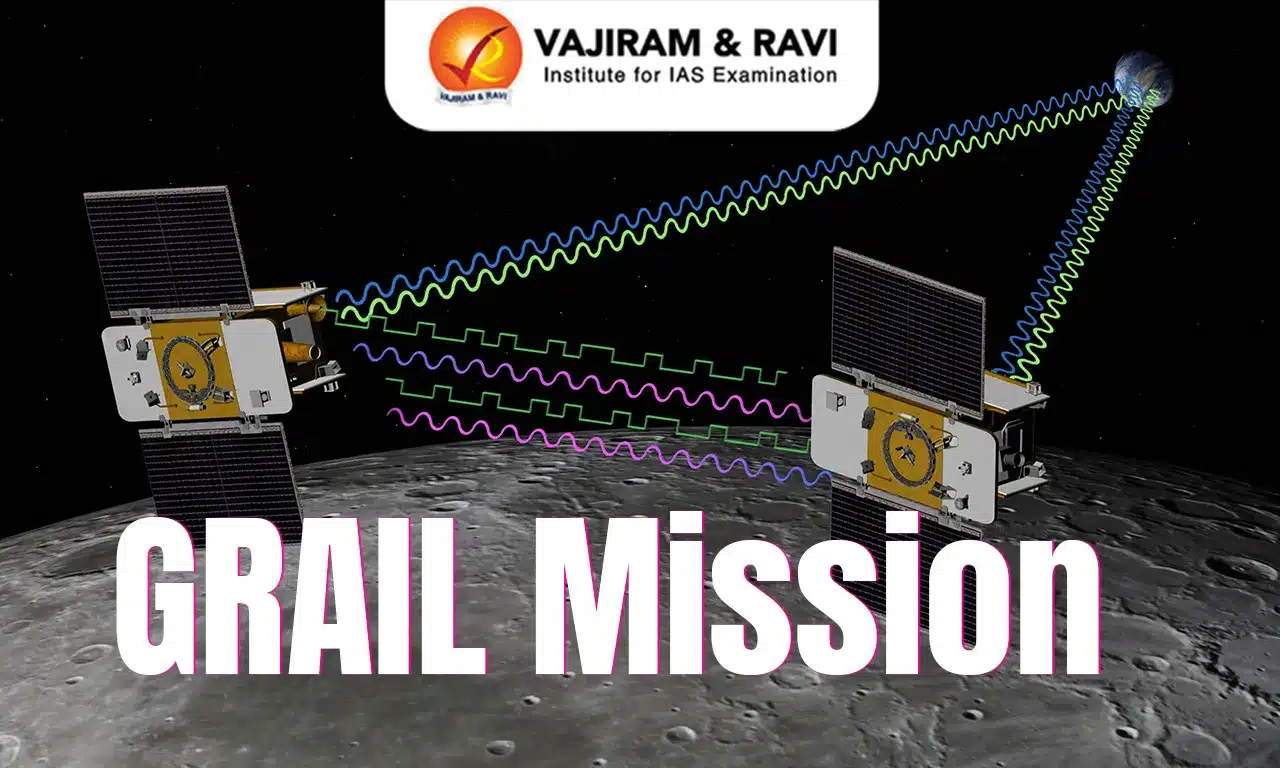
- Gravity Recovery and Interior Laboratory (GRAIL) is a NASA lunar mission launched in 2011.
- It consisted of two robotic spacecraft, Ebb and Flow, which orbited the moon to create the most detailed gravitational map of the lunar surface to date.
- The mission's primary goal was to measure variations in the moon’s gravitational field, providing critical insights into its internal structure and geological history.
- The GRAIL mission achieved this by precisely measuring the distance between the two spacecraft as they orbited the moon.
- Even tiny changes in this distance, caused by variations in the moon’s gravitational pull, provided data about the moon’s interior composition, crust thickness, and subsurface anomalies.
- This approach has proven crucial for understanding the forces that shaped the moon’s contrasting hemispheres.
- GRAIL discovered that the Moon’s crust was more porous and not as thick as previously supposed.
- It also discovered long linear features called “dikes” that were evidence of the Moon’s expansion by a few kilometres early in its history.
- Recent Findings: It unveiled significant differences between the moon's nearside and farside, attributing them to
- Tidal deformation and gravitational asymmetry:
- The lunar nearside flexes slightly more than the farside during its elliptical orbit around Earth, a phenomenon known as tidal deformation.
- This difference in flexibility is primarily driven by Earth’s gravitational pull, which exerts a greater influence on the side facing our planet.
- Volcanic activity and heat distribution:
- The moon’s nearside was once more volcanically active than the farside with vast plains of basaltic rock known as "mare."
- This volcanic activity concentrated heat-producing, radioactive elements like thorium and titanium in the nearside mantle, resulting in a significant temperature difference between the two hemispheres, creating a long-term thermal imbalance that has shaped the moon’s geology over billions of years.
- Crustal thickness and surface composition: The nearside crust is significantly thinner than the farside crust, allowing magma from the moon’s interior to more easily reach the surface in the past, leading to extensive lava flows.
- Tidal deformation and gravitational asymmetry:
GRAIL Mission FAQs
Q1. What was the primary objective of the GRAIL mission?
Ans. To measure variations in the Moon’s gravitational field.
Q2. Why does the Moon’s nearside have more volcanic activity than the farside?
Ans. Its crust is thinner, allowing magma to escape.
Q3. What were the names of the two robotic spacecraft used in the GRAIL mission?
Ans. Ebb and Flow
Source: TOI

