Decline in Government School Enrollment: A Wake-Up Call for Indian States

Sharp Decline in Government School Enrolment and PM-POSHAN Coverage Raises Alarm

Government School Enrollment in India Latest News

  • The Union Ministry of Education (MoE) has asked multiple States to take “remedial steps” to reverse the trend of students choosing private schools over government schools.

Introduction

  • The Union Ministry of Education has flagged a concerning trend in several Indian states where students are increasingly opting for private schools over government-run institutions. 
  • This shift, highlighted during recent Project Approval Board (PAB) meetings for the Samagra Shiksha scheme (2025-26), has prompted the Centre to urge states to identify the root causes and implement corrective measures. 
  • The issue underscores a growing challenge in India's public education system, where aspirations for quality learning environments are prompting a move away from government institutions.

The Enrollment Decline: States and Figures

  • According to UDISE+ (Unified District Information System for Education Plus) 2023-24 data, the enrollment gap between government and private schools has widened across numerous states.
  • Telangana:
    • Out of 42,901 schools, 70% are government schools, but they account for only 38.11% of enrollments, compared to 60.75% in private schools.
  • Uttarakhand:
    • While 71.84% of schools are government-run, only 36.68% of students are enrolled in them, with unaided schools accounting for 54.39%.
  • Andhra Pradesh:
    • The state has 73.32% government schools but only 46.33% enrollment in them. Private schools, with just 24.82% of the institutions, attract over 52% of the enrollment.
  • Tamil Nadu:
    • Government schools comprise 64% of all schools but see only 37% enrollment. Private schools, despite being 21% of the total, account for 46% of student enrollment.
  • Kerala and Maharashtra:
    • Both states reported declining enrollments in government and aided schools. 
    • Maharashtra’s enrollment dropped from 1.63 crore in 2018-19 to 1.50 crore in 2023-24, while Kerala saw a drop from 46.37 lakh in 2022-23 to 45.50 lakh in 2023-24.
  • Other Territories:
    • Similar patterns were observed in Delhi, Ladakh, Puducherry, Andaman & Nicobar Islands, and Dadra & Nagar Haveli & Daman and Diu.

Government’s Concerns and Response

  • The Ministry of Education termed the trend “disturbing,” especially in light of the significant financial investment made in government schools. 
  • School Education Secretary Sanjay Kumar emphasized that such enrollment shifts are occurring despite substantial expenditure under schemes like Samagra Shiksha and PM POSHAN.
  • The ministry urged states to conduct a sincere and data-driven analysis to understand the reasons behind the exodus from government schools. Suggestions included:
  • Identifying Structural Gaps:
    • Many government schools lack competitive infrastructure, digital resources, and sufficient teaching staff, pushing parents toward private alternatives.
  • Improving Public Perception:
    • States were advised to focus on “government school branding” to enhance public trust and reverse enrollment trends.
  • Using Data Smartly:
    • While Kerala and Maharashtra defended their numbers by citing verification-led clean-ups, the Ministry wants better distinction between technical data corrections and actual educational shifts.
  • Junior Class enrollment Dip:
    • A senior education official noted that the preference for private schools is particularly strong in early education stages, signalling the need for improving foundational literacy in government schools.

A Bigger Picture: Education Aspirations and Private School Surge

  • The growing popularity of private schools highlights broader societal aspirations. 
  • Many families, even from low-income groups, believe private schools offer better English instruction, discipline, and exam preparedness. 
  • According to UDISE+ data, private school enrollment rose to over 9 crore (36%) of India’s total 24.80 crore student population in 2023-24, up from 33% in 2022-23.
  • Even though the pandemic disrupted traditional schooling, the preference for private education has bounced back. 
  • In fact, the share of private school enrollment in the pre-pandemic year 2019-20 was 37%, showing that the trend is not new but now gaining sharper momentum.

Way Forward: Recommendations for States

  • To counter the drift toward private education and restore faith in public schooling, the following steps are being emphasized:
  • Upgrading Infrastructure: Providing basic facilities such as clean toilets, digital classrooms, and safe campuses.
  • Teacher Training and Recruitment: Investing in quality teacher education and reducing pupil-teacher ratios.
  • Outreach and Awareness Campaigns: Building a positive narrative around government schools and highlighting success stories.
  • Leveraging Technology and Data: Using tools like APAAR IDs for better tracking of student movement and ensuring accurate enrollment figures.
  • Community Participation: Encouraging school management committees (SMCs) to engage more with parents and local bodies for holistic development.

Government School Enrollment in India FAQs

Q1. What trend has the Centre observed in school enrollments recently?

Ans. The Centre has observed a steady shift of students from government to private schools in many states.

Q2. Which states are facing the most significant enrollment decline in government schools?

Ans. States like Andhra Pradesh, Telangana, Uttarakhand, and Tamil Nadu have reported sharp drops.

Q3. What reasons did some states give for the drop in government school enrollment?

Ans. Kerala and Maharashtra cited Aadhaar-based data cleansing exercises for the decline.

Q4. What has the Ministry of Education recommended to reverse the trend?

Ans. The Ministry urged states to analyse the root causes, brand government schools, and improve infrastructure and teaching quality.

Q5. How has private school enrollment changed over the years?

Ans. Private school enrollment has risen to 36% in 2023–24, up from 33% the previous year.

Source: TH | IE

What is Mayan Civilization?

Maya Civilization

Maya Civilization Latest News

Archaeologists recently unearthed the remains of a Maya city nearly 3,000 years old in northern Guatemala, with pyramids and monuments that point to its significance as an important ceremonial site.

About Maya Civilization

  • The term "Maya" refers to both a modern-day group of people who live across the globe and their ancestors who built an ancient civilization that stretched across much of Central America.
  • The Maya are probably the best-known of the classical civilizations of Mesoamerica. 
  • Before the Spanish conquest of Mexico and Central America, the Maya possessed one of the greatest civilizations of the Western Hemisphere.
  • Originating in the Yucatán peninsula around 2600 B.C., they rose to prominence around A.D. 250 in present-day southern Mexico, Guatemala, northern Belize, and western Honduras.
  • Building on the inherited inventions and ideas of earlier civilizations, the Maya developed astronomy, calendrical systems, and hieroglyphic writing (a system that employs characters in the form of pictures)
    • The Mayans developed precise and sophisticated calendar that followed the movement of the sun, moon, and stars. The Mayan calendar is so precise that it even includes a leap day adjustment to keep the calendar synchronized with the solar year. 
    • The Mayans created a system of hieroglyphic writing that includes more than 800 different glyphs. This writing was used to record the history, astronomy, mathematics, and religion of the Maya culture.
  • The Maya were noted as well for elaborate and highly decorated ceremonial architecture, including temple-pyramids, palaces, and observatories, all built without metal tools.
  • They were also skilled farmers, clearing large sections of tropical rain forest and, where groundwater was scarce, building sizable underground reservoirs for the storage of rainwater. 
  • The Maya were equally skilled as weavers and potters, and cleared routes through jungles and swamps to foster extensive trade networks with distant peoples.
  • The Maya made paper from the inner bark of wild fig trees and wrote their hieroglyphs on books made from this paper. Those books are called codices.
  • The Maya also developed an elaborate and beautiful tradition of sculpture and relief carving.
  • Their society consisted of many independent states, each with a rural farming community and large urban sites built around ceremonial centers. 
  • At its height, Mayan civilization consisted of more than 40 cities, each with a population between 5,000 and 50,000. 
  • The peak Mayan population may have reached two million people, most of whom were settled in the lowlands of what is now Guatemala. 
  • After 900 CE, however, the Classic Maya civilization declined precipitously, leaving the great cities and ceremonial centres vacant and overgrown with jungle vegetation.
  • The Maya peoples never disappeared, neither at the time of the Classic period decline nor with the arrival of the Spanish conquerors and the subsequent Spanish colonization of the Americas. 
  • The Maya remain in contemporary Mesoamerican societies, and maintain a distinctive set of traditions and beliefs, combined with more recent practices such as the almost total adoption of Roman Catholicism.

Maya Civilization FAQs

Q1: Where was the Maya civilization located?

An:. Present-day southern Mexico, Guatemala, northern Belize, and western Honduras.

Q2: Is Mayan still existing today?

Ans: Maya people and many aspects of their culture very much still exist today.

Q3: Around what year did the Maya civilization begin to rise to prominence?

Ans: AD 250

SourceCNN

Why PM2.5 Toxicity May Be More Dangerous Than Air Pollution Levels Show

PM2.5 Toxicity

PM2.5 Toxicity Latest News

  • A new study conducted over Kolkata has revealed that the toxicity of PM2.5 air pollutants significantly increases after a certain concentration threshold is crossed, highlighting a sharper health hazard linked to rising pollution levels in Indian cities.

About the Study

  • TitleContrasting features of winter-time PM2.5 pollution and PM2.5-toxicity based on oxidative potential: A long-term (2016–2023) study over Kolkata megacity at eastern Indo-Gangetic Plain
  • Published inScience of the Total Environment, December 2024

Significance

  • First-of-its-Kind in India: This is the first study to assess how PM2.5 toxicity varies with concentration levels in an Indian city.
  • Public Health Implications: The findings call for urgent pollution control measures, especially in winter when PM2.5 levels peak.
  • Policy Insight: Could guide threshold-based interventions and health advisories in Indian cities facing high air pollution.

Key Findings of the Study

  • Threshold Level Identified: The study found that PM2.5 toxicity sharply increases once the concentration exceeds 70 µg/m³.
  • Peak Toxicity Range: The toxicity continues to rise until the concentration hits 130 µg/m³, after which it stabilises.
  • No Safe Limit: Even at concentrations below 70 µg/m³, PM2.5 poses health risks, though less severe compared to higher levels.
  • Variation Expected: Thresholds for a sharp rise in toxicity are likely to differ across cities.
    • This is because pollution sources vary — for example, vehicular emissions might dominate in one city, while biomass burning could be a bigger factor in another.

Why Toxicity Rises Sharply Beyond a Threshold

  • At lower PM2.5 concentrations, the human body can manage the adverse effects of pollutants more effectively. 
  • However, beyond a certain threshold (~70 µg/m³ for Kolkata), the body’s natural defence mechanisms become overwhelmed, leading to significantly greater cellular damage, especially in the respiratory system.

Role of Reactive Oxygen Species (ROS)

  • Immune Response: When pollutants are inhaled, the immune system releases Reactive Oxygen Species (ROS) to combat foreign particles.
  • Double-Edged Sword: ROS can also harm healthy cells in the body.
  • Antioxidants as Defenders: To counteract ROS, the body generates antioxidants, which neutralize ROS and protect cells.
  • Oxidative Stress: When pollutant levels are high, ROS production exceeds the body’s antioxidant capacity, leading to oxidative stress, which damages internal cells.

Understanding Oxidative Stress and PM2.5

  • The sharp rise in oxidative stress at PM2.5 levels beyond 70 µg/m³ is mainly due to chemical components from biomass or solid waste burning.
  • Vehicular emissions also contribute, but to a lesser extent compared to biomass burning.

Need for Oxidative Stress-Based Standards

  • While India has set air quality standards for PM2.5 and PM10, there are no benchmarks for toxicity or oxidative stress.
  • This study aims to establish toxicity-based threshold values, helping cities adopt more health-focused pollution control policies.

Current Air Quality Standards: Concentration-Based

  • In India, air quality standards for PM2.5 are based only on concentration levels, not on how toxic the air is.

Safe Limits

  • Annual average: 40 µg/m³
  • Daily average: 60 µg/m³

Limitations of Concentration-Based Standards

  • Health risks depend not just on how much PM2.5 is present, but also on its chemical composition and toxicity.
  • The same concentration may be more harmful in one city than another, depending on the pollutant source (e.g., biomass burning vs. vehicular emissions).

Why Toxicity Matters More

  • In Kolkata, PM2.5 levels of 50–60 µg/m³ may not be significantly more harmful than 30–40 µg/m³.
  • But toxicity spikes sharply after 70 µg/m³, indicating a real health emergency.

Need for Toxicity-Based Air Quality Standards

  • This study strengthens the case for incorporating toxicity thresholds into air quality norms.
  • City-specific thresholds should be developed, reflecting local pollutant profiles.
  • Such standards could help trigger early warnings or emergency actions when toxicity crosses a critical level, even if concentrations seem “moderate.”

PM2.5 Toxicity FAQs

Q1. What is PM2.5 toxicity?

Ans. It refers to the harmful effects of fine particulate matter based on its chemical composition, not just concentration.

Q2. Why does PM2.5 become more toxic after 70 µg/m³?

Ans. Because the body’s antioxidant defences are overwhelmed, leading to oxidative stress and increased cellular damage.

Q3. What causes oxidative stress from PM2.5?

Ans. High pollutant levels trigger excessive reactive oxygen species (ROS), which damage cells when antioxidants are insufficient.

Q4. Are India’s air quality standards based on toxicity?

Ans. No, current standards are based only on concentration, ignoring the pollutant’s chemical toxicity and health impact.

Q5. What policy change does the study suggest?

Ans. It recommends city-specific, toxicity-based air quality thresholds to better assess and respond to health risks.

.Source: IE | IE

Battery Aadhaar Initiative

Battery Aadhaar

Battery Aadhaar Initiative Latest News

Tata Elxsi, in collaboration with prominent consortium partners has showcased the innovative Battery Aadhaar concept at the Battery Summit 2025, organised by the World Resources Institute (WRI) India.

About Battery Aadhaar Initiative

  • It aims to provide batteries with secure, digital identities, facilitating traceability and improving lifecycle transparency.
  • This system would assign a unique digital identity to each battery pack, enabling the tracking of manufacturing origin, battery chemistry, safety certifications and lifecycle performance
  • The initiative seeks to prevent unsafe reuse and mitigate environmental risks.
  • This approach ensures compliance with regulatory standards and promotes sustainable practices within the battery industry.
  • It is supported by a UNEP-led programme named 'Electrifying Mobility in Cities', coordinated by NITI Aayog and the Department of Science & Technology, Government of India.
  • Key features include Digital Product Passport creation, lifecycle mapping, public and private data access, role-based dashboards, and real-time battery analytics such as health prediction and residual life estimation.
  • It is built on blockchain, MOBIUS+ ensures transparent data flows and tamper-proof audit trails.
  • This support highlights the initiative's alignment with India's broader sustainable mobility goals and efforts to establish circular energy systems.

Battery Aadhaar Initiative FAQs

Q1: What is electro-mobility?

Ans: E-mobility, or electromobility, refers to the use of electrified vehicles for transportation purposes.

Q2: What is the main purpose of UNEP?

Ans: UNEP's mission is to provide leadership and encourage partnership in caring for the environment by inspiring, informing, and enabling nations and peoples to improve their quality of life without compromising that of future generations.

Source: BL

Ayush Suraksha Portal

Ayush Suraksha Portal

Ayush Suraksha Portal Latest News

Recently, the Union Minister of State (Independent Charge), Ministry of Ayush; and Union Minister of State, Ministry of Health & Family Welfare, Government of India launched the AyushSuraksha Portal at Ayush Bhawan, New Delhi.

About Ayush Suraksha Portal

  • This portal represents a significant advancement in pharmacovigilance and regulatory convergence within the Ayush ecosystem.
  • It is developed with the technical support of the Central Council for Research in Siddha (CCRS).
  • It is aligned with the National Pharmacovigilance Program, allows consumers, healthcare professionals, and regulatory authorities to report and monitor misleading advertisements and adverse drug reactions through a seamless digital process.
  • The system integrates multiple authorities, including the Ayush vertical under CDSCO, MoI&B, CCPA, NCISM, NCH, PCI, FSSAI, and State Licensing Authorities, ensuring coordinated response and enforcement.

Significance of Ayush Suraksha Portal

  • The Ministry of Ayush now has a centralised and accessible dashboard of reported cases, enabling real-time tracking, swift regulatory action, and detailed data analysis.
  • The system also ensures that citizens have a direct channel to voice their concerns, with transparent visibility into the action taken on their reports.
  • By integrating data from State Licensing Authorities, national pharmacovigilance centres, and key regulatory stakeholders, the portal facilitates real-time monitoring, systematic analysis, and coordinated action on misleading advertisements and adverse drug reactions. 
  • It reflects the Ministry’s unwavering commitment to responsible governance, evidence-based practices, and the safety of millions of citizens who trust and rely on India’s traditional systems of medicine.

Ayush Suraksha Portal FAQs

Q1: What is the Ayush Suraksha portal?

Ans: Ayush Suraksha is an Ayush-Vigibase which comprises Ayurveda, Siddha, Unani, and Homoeopathy pharmacovigilance database.

Q2: What is AYUSH full form?

Ans: Ayurveda, Yoga, and Naturopathy, Unani, Siddha and Homoeopathy 

Source: PIB

Ahilyabai Holkar

Who was Ahilya Bai Holkar?

Ahilyabai Holkar Latest News

The Prime Minister will take part in a ‘Mahila Sashaktikaran Maha Sammelan’ event in Bhopal on the occasion of the 300th birth anniversary of legendary queen Ahilyabai Holkar.

About Ahilyabai Holkar

  • Maharani Ahilyabai Holkar (31 May 1725 – 13 August 1795) was a ruler of the Malwa territory, a part of the Maratha Confederacy, from 1767 to 1795. 
  • She served first as regent and then as ruler of the Holkar dynasty with its seats at Maheshwar and Indore in central India, in a period considered the zenith of the Holkar dynasty.
  • Under her rule Malwa enjoyed relative peace, prosperity, and stability, and her capital, Maheshwar, was turned into an oasis of literary, musical, artistic, and industrial pursuits.
  • She passed away on August 13, 1795, at the age of seventy. 
  • Upon her death, Ahilyabai was succeeded by Tukoji Rao Holkar, who abdicated in his son Jaswant Rao’s favor two years later. 
  • Jaswant Rao was the last Holkar ruler to remain independent until his 1804 defeat by and subsequent peace with the British.
  • Titles
    • She is known as Punyashlok (“One as Pure as the Sacred Chants”).
    • John Keay, the British historiangave the queen the title of ‘The Philosopher Queen’.

Ahilyabai Holkar Military Contribution

  • She was military-trained under her father-in-law, Malhar Rao Holkar, and personally led armies into battle. 
  • Ahilyabai appointed Malhar Rao’s adopted son, Tukoji Rao Holkar, the commander of the Holkar army.
  • She engaged the Frenchman Chevelier Dudrenec in 1792 to help modernize her army by raising four battalions. 

Ahilyabai Holkar Administration

  • She earned a reputation for administering justice fairly during her rule, without partiality or partisanship. Ex: She sentenced her only son, found guilty of a capital offense, to death by being crushed by an elephant.
  • She established courts for justice and arbitration in citizens’ disputes.
  • She also made some landmark decisions during her reign, including the removal of traditional law confiscating the property of childless widows.
  • She was known for being accessible to all her subjects and held daily audiences where people could approach her. 
  • Breaking another norm of the time, Ahilyabai did not observe the custom of purdah (seclusion of women). 

Ahilyabai Holkar Cultural Contribution

  • She welcomed stalwarts such as Marathi poet Moropant, Shahir Ananta Gandhi, and Sanskrit scholar Khushali Ram into her capital.
  • She made Maheshwar (literally, “abode of Lord Shiva”) her capital and offered employment to several craftsmen, artists, and sculptors.
  • She was a great pioneer and builder of Hindu temples.
  • She built hundreds of temples and Dharmashalas throughout India.
  • Her most notable contribution was the renovation and repair of the famous Kashi Vishwanath Temple in 1780.
  • Ahilyabai also helped construct multiple forts, roads, wells, and rest houses.
  • Promotion of craft: She established textile industry in Maheshwar, which today is very famous for its Maheshwari sarees. 

Ahilyabai Holkar FAQs

Q1: Which major temple did Ahilyabai Holkar renovate in 1780?

Ans: Kashi Vishwanath Temple

Q2: In which region of India did Ahilyabai Holkar rule?

Ans: Ahilyabai Holkar ruled over the Malwa region of central India, with her capital at Maheshwar (in present-day Madhya Pradesh).

Q3: Who ruled after Ahilyabai Holkar?

Ans: Ahilyabai was succeeded by Tukoji Rao Holkar, who abdicated in his son Jaswant Rao’s favor two years later. 

SourceDH

National Florence Nightingale Award

National Florence Nightingale Awards

National Florence Nightingale Award Latest News

Recently, the President of India presented the National Florence Nightingale Awards for the year 2025 to the nurses at a function held at Rashtrapati Bhavan.

About National Florence Nightingale Awards

  • It was instituted by the Ministry of Health and Family Welfare, Government of India in the year 1973.
  • It is a prestigious award given to outstanding nursing personnel employed in Central, State/UTs and Voluntary Organizations.
  • It was awarded as a mark of recognition for the meritorious services rendered by the nurses and nursing professionals to the society.
  • The nurse in her/his regular job in the hospital or community settings, educational or administrative setting is eligible for the national award.
  • Each award consists of a Certificate of Merit, Cash Award of Rs.1,00,000/- and a medal.

Who is Florence Nightingale?

  • Florence Nightingale was an English social reformer, statistician and the founder of modern nursing.
  • Nightingale came to prominence while serving as a manager and trainer of nurses during the Crimean War, in which she organised care for wounded soldiers at Constantinople.
  • Her efforts to formalize nursing education led her to establish the first scientifically based nursing school—the Nightingale School of Nursing, at St. Thomas’ Hospital in London.

National Florence Nightingale Award FAQs

Q1: What award did Florence Nightingale win?

Ans: In 1883, Nightingale was awarded the Royal Red Cross by Queen Victoria. In 1907, she became the first woman to be awarded the Order of Merit.

Q2: Which ministry has the National Florence Nightingale Award?

Ans: The Ministry of Health and Family Welfare

Source: PIB

Biostimulant

Biostimulant

Biostimulant Latest News

Recently, the central government notified 34 biostimulants to spur manufacturing.

About Biostimulant

  • These are substances or microorganisms applied to plants or soil to stimulate natural processes and alsowork by enhancing the plant’s own physiological abilities.
  • Biostimulants are products that reduce the need for fertilizers and increase plant growth, resistance to water and abiotic stresses.
  • They improve overall plant health and productivity by targeting processes such as root development, nutrient efficiency, stress tolerance (drought, salinity, extreme temperatures), soil microbial activity.
  • In addition, biostimulants applied to plants enhance nutrition efficiency, abiotic stress tolerance and/or plant quality traits, regardless of its nutrient contents.
  • Common types of biostimulants include: Humic and fulvic acids, seaweed extracts, beneficial fungi and bacteria (e.g., mycorrhizae, rhizobacteria).
  • In India Biostimulants are incorporated under the Fertilizer (Control) Order,1985.

Advantages of Biostimulants

  • Improving plant tolerance to abiotic stress on plants, including drought, extreme temperatures (cold, frost, and heat), and salinity
  • Enhancing uptake and efficient use of nutrients, both applied and existing
  • Improving soil health by enhancing beneficial soil microorganisms
  • Enhancing crop quality through plant health and vigor
  • Increasing harvestable yields

Biostimulant FAQs

Q1: What are the most common biostimulants?

Ans: Humic acids, seaweed extracts, liquid manure composting

Q2: What is another name for a bio stimulant?

Ans: Biostimulants also termed as plant conditioners 

Source: BL

Swachh Survekshan Grameen 2025

Swachh Survekshan Grameen 2025

Swachh Survekshan Grameen 2025 Latest News

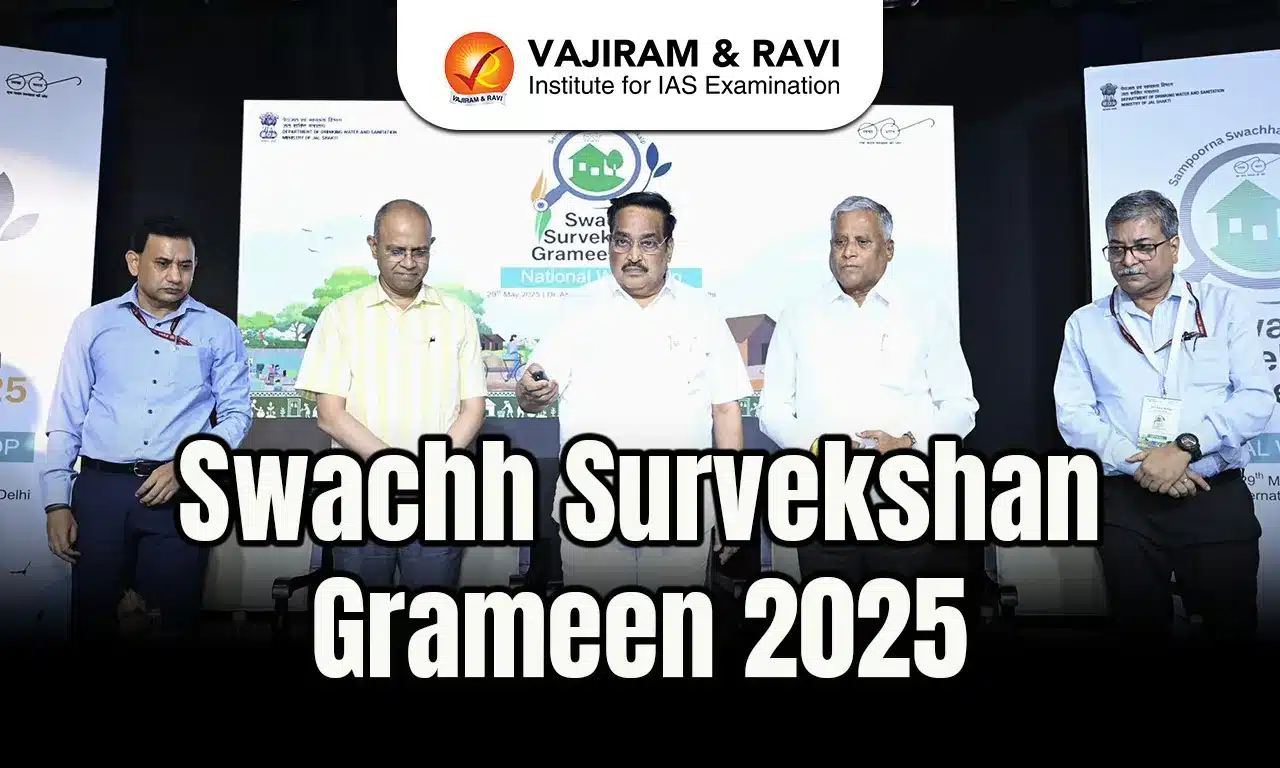
Union Minister of Jal Shakti recently launched Swachh Survekshan Grameen (SSG) 2025, a nationwide rural sanitation survey by the Department of Drinking Water and Sanitation (DDWS).

About Swachh Survekshan Grameen 2025

  • It is a nationwide rural sanitation survey by the Department of Drinking Water and Sanitation (DDWS), Ministry of Jal Shakti.
  • It will measure the impact of India’s flagship cleanliness program, Swachh Bharat Mission (SBM).
  • The survey will rigorously assess the current state of rural sanitation, focusing on sustaining the outcomes achieved under the Open Defecation Free (ODF) Plus Model, as established by the Swachh Bharat Mission-Gramin (SBM-G). 
  • The assessment will include sampling village evaluations, surveying households and public places to gauge their status based on various cleanliness parameters.
  • This includes the functionality of Plastic Waste Management Units (PWMU), Faecal Sludge Management (FSM) plants, GOBARdhan plantscitizen feedback, and Swachhata Green Leaf Rating (SGLR) sites.
  • The main objective of the survey is to provide a national ranking for all States, Union Territories, and Districts of India based on the quantitative and qualitative sanitation parameters outlined under the Swachh Bharat Mission (SBM-II).
  • The survey will verify the status of ODF Plus Model villages, schools, public buildings, Common Service Centers (CSCs), and institutions.
  • The Department of Drinking Water Supply has engaged an independent agency to conduct the survey.
  • A structured approach shall be followed to evaluate the status of States/UTs and Districts on key performance outcomes of SBM Phase-II and they will be ranked across four key components:
    • Service-Level Progress (SLP), based on data from district self-assessment reports and desktop verification of ODF Plus Model Verified villages.
    • Direct Observation of Sanitation Status of Villages, through field-based observation in sampled villages, households, and public places, including schools, CSCs, etc.
    • Direct Observation of Functionality of Sanitation Infrastructure, such as Plastic Waste Management Units, GOBARdhan plants, and Faecal Sludge Management systems.
    • SSG 2025 Citizen Feedback, gathered via a mobile application and one-on-one interactions during the field survey.
  • These elements shall be grouped into sub-components to derive a composite score, ensuring a transparent, technology-driven, and community-led assessment process. 
  • To uphold the data integrity, a geo-fencing feature has been introduced in the Survey and further, to promote public engagement, a dedicated mobile app has been created to gather citizen feedback.

Swachh Survekshan Grameen 2025 FAQs

Q1: Swachh Survekshan Grameen 2025 is conducted by which department?

Ans: Department of Drinking Water and Sanitation (DDWS), Ministry of Jal Shakti

Q2: What is the objective of the Swachh Survekshan Grameen 2025?

Ans: Measure the impact of Swachh Bharat Mission in rural areas and rank States/UTs/Districts based on sanitation parameters

Q3: The survey introduces a technology feature to ensure data integrity. Which feature is it?

Ans: Geo-fencing in the mobile app for field surveys

SourcePIB

Calotes zolaiking

Calotes zolaiking

Calotes zolaiking Latest News

Recently, Calotes zolaiking, a rare lizard species, was recorded for the first time in Meghalaya.

About Calotes zolaiking

  • It is a species of garden lizard, was first described in 2019 from Mizoram’s Aizawl district by a team of scientists.
  • Appearance: These are about 5 inches long and their bodies are various shades of green with dark patches throughout. They are “strongly keeled,” meaning each of the lizard’s long scales has a ridge in the middle, giving it a sharper overall appearance.
  • India is home to 14 species of Calotes, nine of which have been recorded in the Northeast.

What are Calotes?

  • These are arboreal (tree-dwelling) lizards of the family Agamidae and are remarkable for their extreme colour changes when excited.
  • They are diurnal, run fast on the ground and swim in water.
  • Distribution: It is found in gardens and forests of India, Sri Lanka, Southeast Asia, and some Pacific islands.
  • Diet: Their diet is made up of insects and other small invertebrates.

Calotes zolaiking FAQs

Q1: What are Calotes also known as?

Ans: Forest lizards

Q2: What is the respiratory system of Calotes?

Ans: The respiratory tract includes the external nares, nasal chambers, internal nares, glottis, larynx, trachea and bronchi.

Source: TH

Advance Authorisation Scheme (AAS)

Advance Authorisation Scheme

Advance Authorisation Scheme Latest News

Exporters may no longer be denied duty-free import benefits under the Advance Authorisation (AA) scheme simply because their goods were shipped before the licence was issued.

About Advance Authorisation Scheme

  • Advance Authorisation is issued to allow duty-free import of inputwhich is physically incorporated in the export product (making normal allowance for wastage).
  • The inputs imported are exempt from duties like Basic Customs Duty, Additional Customs Duty, Education Cess, Anti-dumping duty, Safeguard Duty and Transition Product-Specific Safeguard duty, Integrated tax, and Compensation Cess, wherever applicable, subject to certain conditions. 
  • An export obligation is usually set as a condition for issuing Advance Authorization.
  • In addition to any inputs, packaging material, fuel, oil and catalysts which are consumed/utilized in the process of production of export products, are also allowed.
  • The quantity of inputs allowed for a given product is based on specific norms defined for that export product, which considers the wastage generated in the manufacturing process. 
  • The Directorate General of Foreign Trade (DGFTprovides a sector-wise list of Standard Input-Output Norms (SION) under which the exporters may choose to apply.
  • Alternatively, exporters may apply for their own ad-hoc norms in cases where the SION does not suit the exporter.
  • It is available to either a manufacturer exporter directly or a merchant exporter tied with a supporting manufacturer. 
  • The authorization is available for the following:
    • Physical exports
    • Intermediate supply
    • Supplies made to specified categories of deemed exports
    • Supply of ‘stores’ on board of a foreign-going vessel/aircraft, provided that there are specific Standard Input Output Norms (SION) in respect of items supplied.
  • Advance Authorization is valid for 12 months from the date of issue of such Authorization. 
  • Export Obligation:
    • Minimum value addition of 15%
    • Period for fulfilment of export obligation: 18 months from the date of issue of authorisation or as notified by DGFT.
  • Recent Changes:
    • Even if goods have already been shipped or have arrived in India, they can still be cleared under an Advance Authorisation granted later by the DGFT, provided the importer files the Bill of Entry after the licence date. 
    • The relevant date for eligibility under the AA scheme is the date of filing the Bill of Entry. This is a legal Customs document submitted to Indian Customs to get the goods cleared, not the date of shipment from the foreign country.
    • However, this relaxation won’t apply to restricted goods or products that can only be imported through designated government agencies, unless the DGFT gives special permission.

Advance Authorisation Scheme FAQs

Q1: What is the purpose of advance Authorisation scheme?

Ans: Advance Authorisation is issued to allow duty free import of input, which is physically incorporated in export product (making normal allowance for wastage)

Q2: Which entities can directly apply for Advance Authorisation?

Ans: Manufacturer-exporters or merchant exporters tied with a supporting manufacturer

Q3: How long is an Advance Authorisation valid from the date of issue?

Ans: 12 months

SourceBS

Enquire Now