
Maya Civilization Latest News
Archaeologists recently unearthed the remains of a Maya city nearly 3,000 years old in northern Guatemala, with pyramids and monuments that point to its significance as an important ceremonial site.
About Maya Civilization
- The term "Maya" refers to both a modern-day group of people who live across the globe and their ancestors who built an ancient civilization that stretched across much of Central America.
- The Maya are probably the best-known of the classical civilizations of Mesoamerica.
- Before the Spanish conquest of Mexico and Central America, the Maya possessed one of the greatest civilizations of the Western Hemisphere.
- Originating in the Yucatán peninsula around 2600 B.C., they rose to prominence around A.D. 250 in present-day southern Mexico, Guatemala, northern Belize, and western Honduras.
- Building on the inherited inventions and ideas of earlier civilizations, the Maya developed astronomy, calendrical systems, and hieroglyphic writing (a system that employs characters in the form of pictures).
- The Mayans developed a precise and sophisticated calendar that followed the movement of the sun, moon, and stars. The Mayan calendar is so precise that it even includes a leap day adjustment to keep the calendar synchronized with the solar year.
- The Mayans created a system of hieroglyphic writing that includes more than 800 different glyphs. This writing was used to record the history, astronomy, mathematics, and religion of the Maya culture.
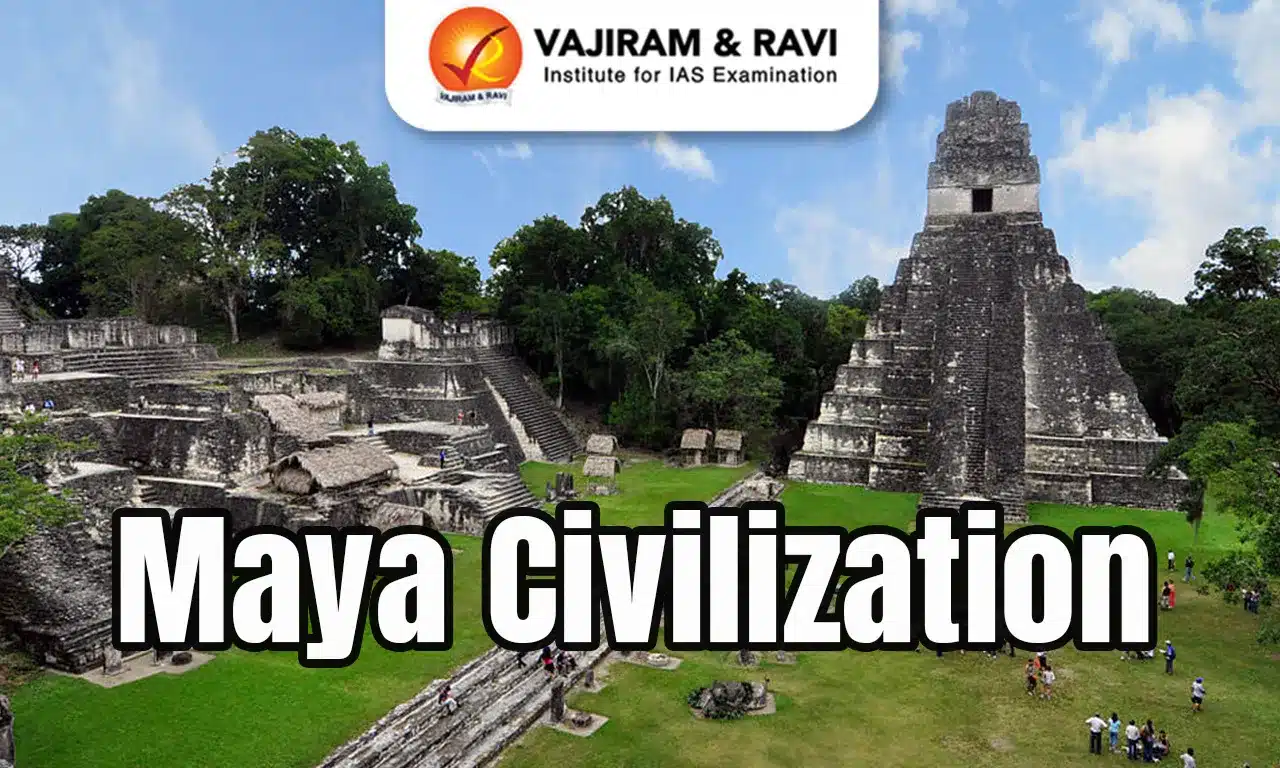
- The Maya were noted as well for elaborate and highly decorated ceremonial architecture, including temple-pyramids, palaces, and observatories, all built without metal tools.
- They were also skilled farmers, clearing large sections of tropical rain forest and, where groundwater was scarce, building sizable underground reservoirs for the storage of rainwater.
- The Maya were equally skilled as weavers and potters, and cleared routes through jungles and swamps to foster extensive trade networks with distant peoples.
- The Maya made paper from the inner bark of wild fig trees and wrote their hieroglyphs on books made from this paper. Those books are called codices.
- The Maya also developed an elaborate and beautiful tradition of sculpture and relief carving.
- Their society consisted of many independent states, each with a rural farming community and large urban sites built around ceremonial centers.
- At its height, Mayan civilization consisted of more than 40 cities, each with a population between 5,000 and 50,000.
- The peak Mayan population may have reached two million people, most of whom were settled in the lowlands of what is now Guatemala.
- After 900 CE, however, the Classic Maya civilization declined precipitously, leaving the great cities and ceremonial centres vacant and overgrown with jungle vegetation.
- The Maya peoples never disappeared, neither at the time of the Classic period decline nor with the arrival of the Spanish conquerors and the subsequent Spanish colonization of the Americas.
- The Maya remain in contemporary Mesoamerican societies, and maintain a distinctive set of traditions and beliefs, combined with more recent practices such as the almost total adoption of Roman Catholicism.
Maya Civilization FAQs
Q1: Where was the Maya civilization located?
An:. Present-day southern Mexico, Guatemala, northern Belize, and western Honduras.
Q2: Is Mayan still existing today?
Ans: Maya people and many aspects of their culture very much still exist today.
Q3: Around what year did the Maya civilization begin to rise to prominence?
Ans: AD 250
Source: CNN
