
Nalsarovar Bird Sanctuary Latest News
A rare Arctic seabird, the Sabine’s Gull, was spotted at Gujarat’s Nalsarovar Wildlife Sanctuary recently — its first recorded sighting in India since 2013, when it was seen in Kerala.
About Nalsarovar Bird Sanctuary
- It is located approximately 64 km west of Ahmedabad in Gujarat.
- It is a natural lake with shallow waters and muddy lagoons, dotted by 360 islets.
- Spread over an area of 120.82 sq km, this sanctuary is a paradise for bird watchers and nature enthusiasts.
- The history of Nalsarovar dates back to the 15th century, when the lake was created as a result of the construction of a check dam across the Sabarmati River.
- The lake was initially used for irrigation and as a source of drinking water for nearby villages.
- Over time, the lake became an important habitat for a variety of bird species, and local communities recognized its ecological significance.
- In the early 20th century, the British colonial administration recognized the importance of Nalsarovar as a wetland ecosystem and established it as a protected area.
- In 1969, the Gujarat government declared Nalsarovar a bird sanctuary to primarily protect its bird population.
- The Ramsar Conventiondesignation of Nalsarovar Bird Sanctuary in 2012 recognized its ecological importance as a wetland habitat for birds and other wildlife.
- Flora:
- The sanctuary area has 48 species of algae and 72 species of flowering plants.
- The common aquatic plants are Cyperus sp., Scirpus sp., Typha ungustata, Eleocharis palustris, Ruppia, Potamogeton, Vallisnaria, Naias, Chara, etc.
- Fauna:
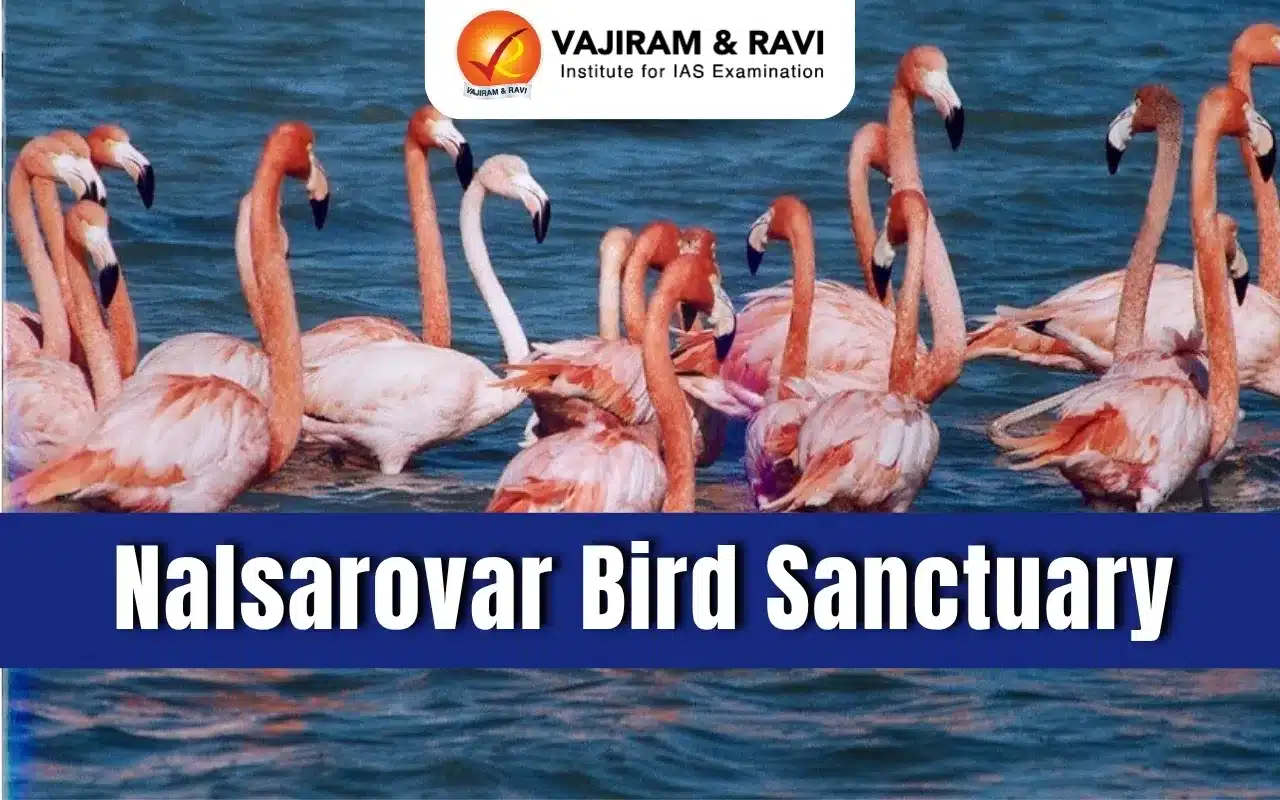
- The sanctuary has about 250 bird species, which include greater and lesser flamingoes, pelicans, ducks & geese, rails, coots, cranes, cormorants, herons, egrets, storks, ibises, spoonbills, teals, sarus cranes, moorhens, and waders, etc.
- Other animals: On southern or southwestern fringes, small herds of wild ass can be seen. Mongoose, jungle cat, Indian fox, jackal, wolf, and hyena are also there.
Key Facts about Sabine’s Gull
- Sabine's gull (Xema sabini), also known as the fork-tailed gull or xeme, is a small gull.
- It breeds in the subarctic and high arctic regions of North America and Russia, as well as on Greenland and in Svalbard.
- This species is easy to identify through its striking wing pattern.
- The adult has a pale grey back and wing coverts, black primary flight feathers, and white secondaries. The white tail is forked.
- IUCN Red List Status: Least Concern
Nalsarovar Bird Sanctuary FAQs
Q1: Where is Nalsarovar Bird Sanctuary located?
Ans: Gujarat
Q2: Which major river was dammed, resulting in the formation of the Nalsarovar lake?
Ans: Sabarmati
Q3: Is Nalsarovar a Ramsar site?
Ans: Yes, Nalsarovar Bird Sanctuary is designated as a Ramsar Site.
Source: HT
