
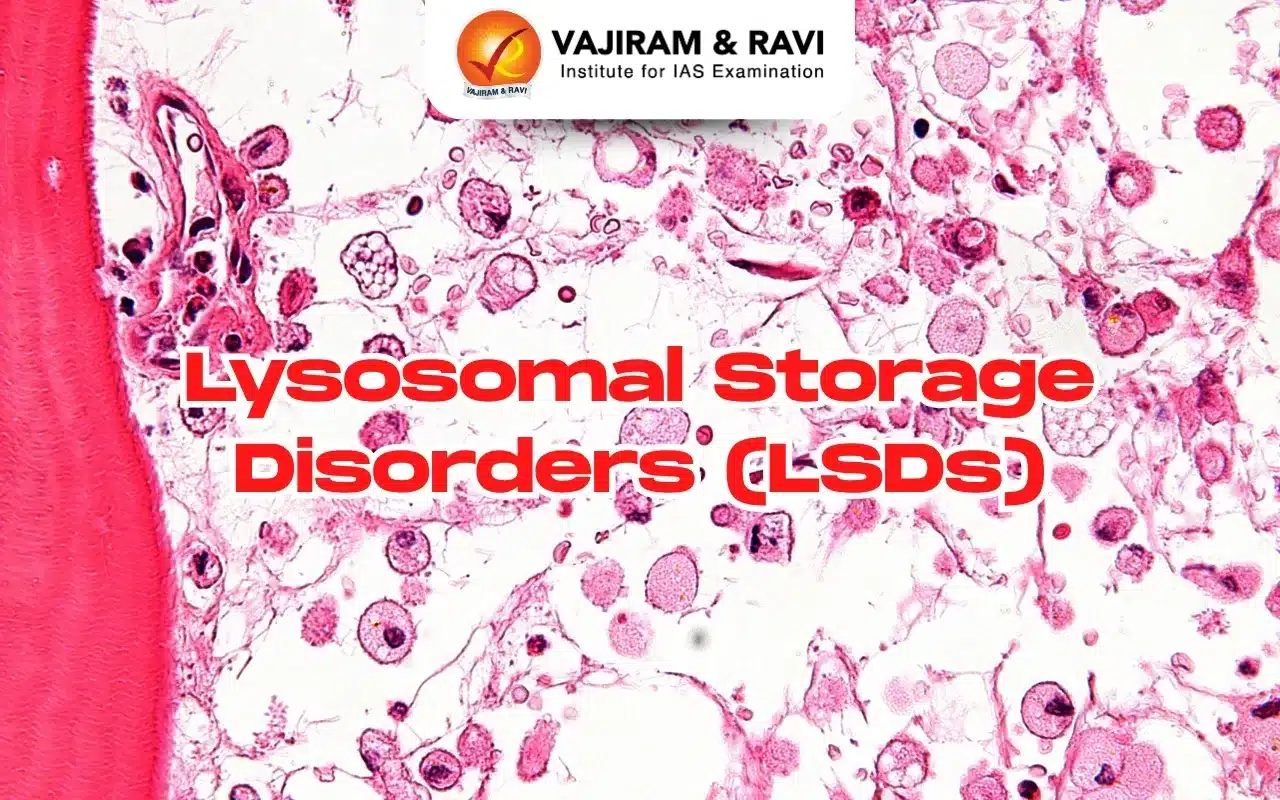
Lysosomal Storage Disorders Latest News
Despite the establishment of the National Policy for Rare Diseases (NPRD) in 2021 and a nationwide financial assistance programme, over 300 patients, predominantly children diagnosed with Lysosomal Storage Disorders (LSDs), are left without essential medical care.
About Lysosomal Storage Disorders
- LSDs are rare genetic conditions that cause a buildup of toxic materials in your body’s cells.
- Examples include Gaucher, Pompe, Fabry, MPS I, MPS II, mucopolysaccharidoses, mucolipidoses, oligosaccharidoses, etc.
- The majority of the LSDs are caused by mutations in the genes encoding a lysosomal enzyme.
- A lysosome is a membrane-bound cell organelle that contains digestive enzymes.
- Lysosomes are involved with various cell processes. They break down excess or worn-out cell parts.
- People with LSDs lack certain enzymesor a substance that helps the enzyme work (enzyme activator or modifier). Enzymes assist your cells’ lysosomes with metabolism.
- Without functioning enzymes, your body can’t break down fats, sugars and other substances.
- If those build up in your body, they can be harmful. They cause dysfunction of those organs where they accumulate and contribute to great morbidity and mortality.
- All LSDs except Hunter syndrome (MPS II) and Fabry disease are autosomal recessive disorders. This means both parents must carry the abnormal gene that prevents the body from making an enzyme with normal activity.
- LSDs usually appear during pregnancy or soon after birth.
- More rarely, adults may develop LSDs.
- People usually have more severe cases when an LSD starts early and more mild cases when an LSD starts later.
- Treatment:
- There are no cures for lysosomal storage diseases.
- But treatments can help you to manage your symptoms and lessen damage to organs and tissues.
Lysosomal Storage Disorders FAQs
Q1: What are the most common lysosomal storage disorders?
Ans: The most common are Gaucher disease, Fabry disease, Hunter syndrome, Hurler syndrome, Tay-Sachs disease, and Pompe disease.
Q2: What is the primary cause of Lysosomal Storage Disorders (LSDs)?
Ans: Mutations in genes encoding lysosomal enzymes
Q3: What is the main function of lysosomes?
Ans: Lysosomes function as the digestive system of the cell, serving both to degrade material taken up from outside the cell and to digest obsolete components of the cell itself.
Source: TOI
