
Mt Etna Latest News
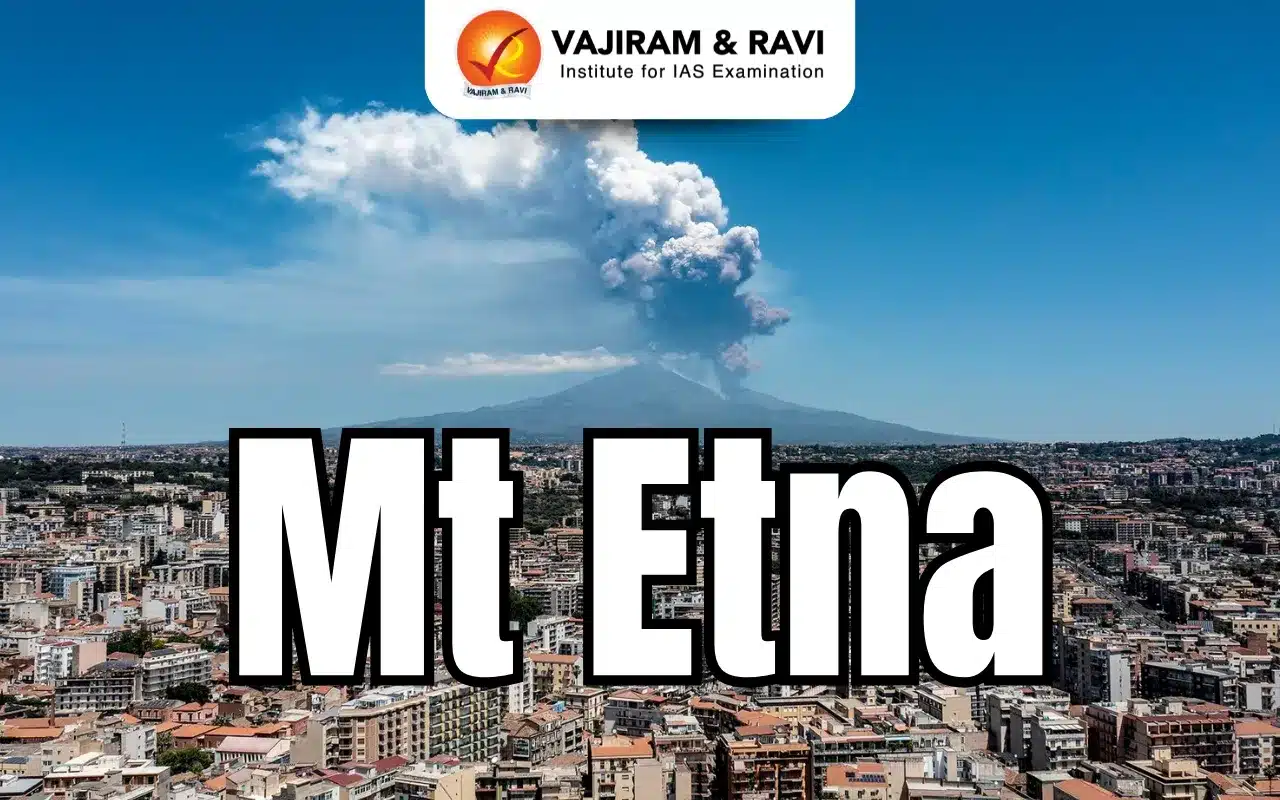
Recently, Mount Etna produced an explosive eruption and sent a huge cloud of ash, smoke and rock fragments several kilometres into the sky.
About Mt Etna
- Location: Mount Etna, sometimes referred to simply as Etna, is an active volcano on the east coast of Sicily, the largest island in the Mediterranean Sea.
- Etna’s peak is the highest in Italy south of the Alps, and it is the largest of Europe’s active volcanoes.
- Etna’s summit has five craters, which are responsible for most of the volcano’s eruptions. “Flank” eruptions also occur at the 300-odd vents of varying sizes along the slopes of the mountain.
- The volcano was witnessing a “Strombolian” eruption.
- This type of eruption is usually characterised as discreet moderately explosive bursts which can eject chunks of rock and cinders that can travel hundreds of metres into the air. It occurs due to the presence of gas in the magma chamber within the volcano.
- The Strombolian eruption is named after another Italian volcano called Stromboli, which produces minor eruptions every 10 to 20 minutes.
- Etna has been a World Heritage Site since 2013, and according to UNESCO, the volcano’s eruptive history can be traced back 500,000 years. At least 2,700 years of this activity have been documented.
Mt Etna FAQs
Q1: Is Mount Etna active, dormant, or extinct?
Ans: Active volcano
Q2: What are Volcanoes?
Ans: These are openings, or vents where lava, tephra (small rocks), and steam erupt onto the Earth's surface. Volcanoes can be on land and in the ocean. They are, in part, a result of their own eruptions but also the general formation of our planet, as tectonic plates move.
Source: IE
