
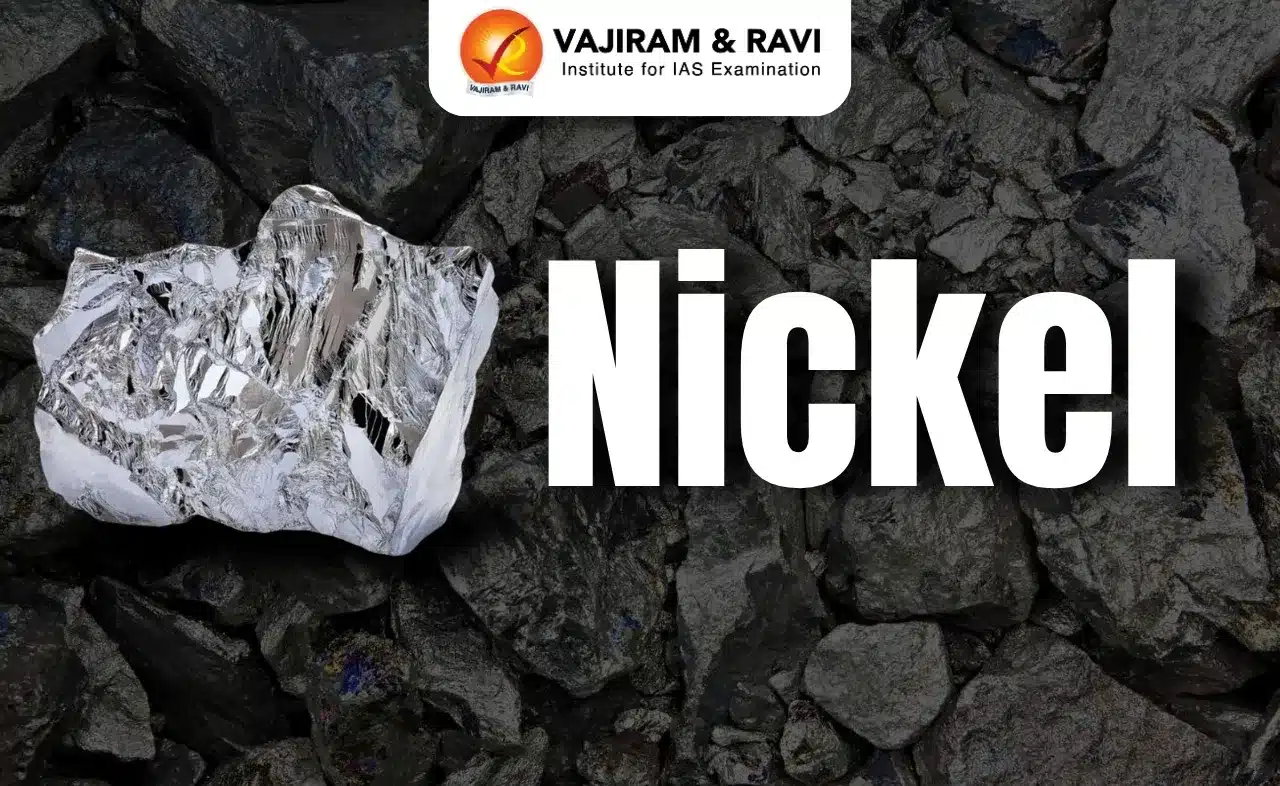
Nickel Latest News
Recent study has revealed that nickel can be extracted from low-grade ores using hydrogen plasma instead of carbon.
About Nickel
- It is a metallic element with a silvery-white, shiny appearance.
- It is the fifth-most common element on earth and occurs extensively in the earth’s crust and core.
- Nickel, along with iron, is also a common element in meteorites.
- It occurs naturally in soil and water. It is also an essential nutrient for plants.
- It has outstanding physical and chemical properties, which make it essential in hundreds of thousands of products.
- Nickel occurs principally as oxides, sulphides and silicates in India.
- India has substantial nickel laterite reserves, particularly in Odisha’s Sukinda region.
- World Distribution: Indonesia (22%), Australia (21%), Brazil (17%), Russia (7%), Cuba (6%) and Philippines (5%) are the major countries having reserves of Nickel.
Applications of Nickel
- Its biggest use is in alloying - particularly with chromium and other metals to produce stainless and heat-resisting steels.
- Nickel is an important metal used in several clean energy technologies, especially Electric Vehicles (EVs).
- It is used in batteries, including rechargeable nickel-cadmium batteries and nickel-metal hydride batteries used in hybrid vehicles.
Nickel FAQs
Q1: What is the formula for nickel?
Ans: Nickel is a chemical element with symbol Ni and atomic number 28.
Q2: What is nickel used for?
Ans: Primarily used in stainless steel production, it supports a wide range of industries and everyday products.
Source: TH
