
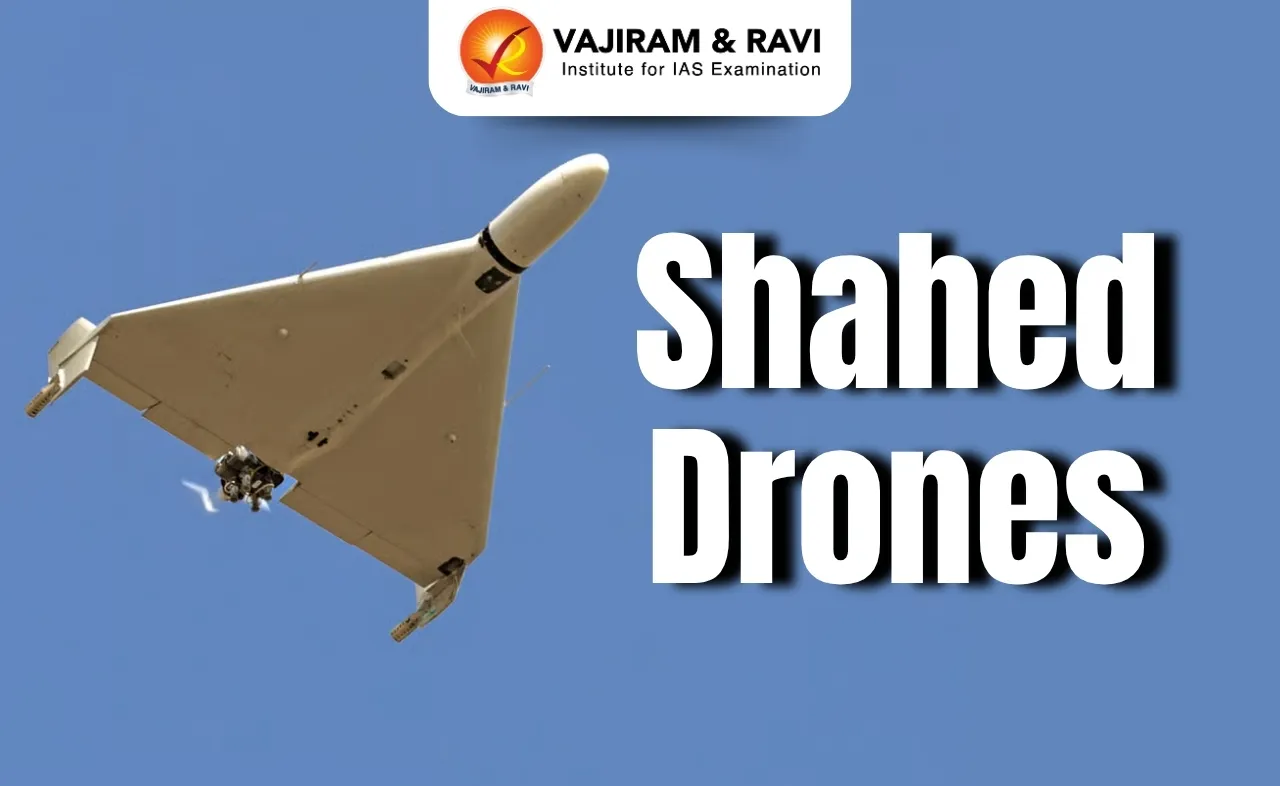
About Shahed Drones
- Shahed drones are Iranian-made unmanned combat aerial vehicles (UCAVs) and loitering munitions, primarily developed by Shahed Aviation Industries. Russia refers to the Shahed-136 as "Geran-2".
- Design and Capabilities: These drones are designed for one-way attack missions, carrying explosive warheads that detonate upon impact.
- The Shahed-136, the most widely used variant, features a delta-wing design, weighs around 200 kg, and has a wingspan of 2.5–3 meters.
- Range and Speed: The Shahed-136 can travel between 1,000 and 2,500 km at speeds up to 185 km/h. It is launched via disposable rocket boosters and then powered by a piston engine, giving it a distinctive "moped-like" sound.
- Guidance: The drones use pre-programmed GPS or GLONASS coordinates, making them resistant to electronic warfare and jamming.
- Recent variants reportedly use advanced algorithms and AI for improved navigation and targeting.
- Warhead Types: Shahed drones can be equipped with various warheads, including high-explosive fragmentation, thermobaric, and shrapnel-filled munitions, maximising damage to both personnel and equipment.
Shahed Drones FAQs
Q1. What is a Shahed drone?
Ans: A Shahed drone is an Iranian-made kamikaze or suicide drone used for one-way explosive attacks.
Q2. What is the difference between Shahed 136 and 131?
Ans: Shahed 136 is larger, has longer range and bigger warhead; Shahed 131 is smaller with shorter range and warhead.
Q3. What engine is in the Shahed drone?
Ans: Shahed 136 uses an MD-550 piston engine; Shahed 131 uses a smaller MDR-208 Wankel engine.
Source: REUTERS
