
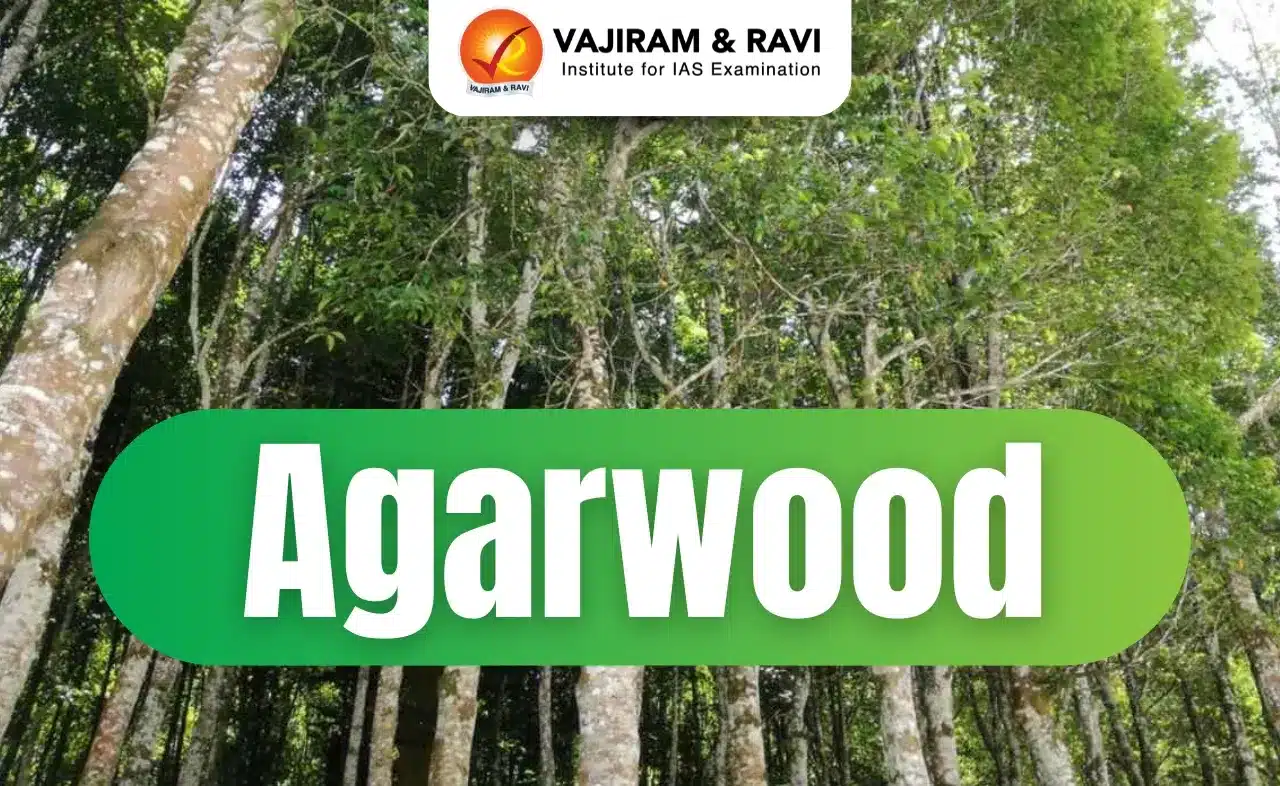
Agarwood Latest News
The soaring market demand has led to widespread overharvesting, pushing wild populations of agarwood to the brink of extinction.
About Agarwood
- Aquilaria malaccensis, commonly known as agarwood, is a species of tree belonging to the Thymelaeaceae family.
- It is well-known for producing a fragrant resinous wood, which is highly valued for its distinct aroma.
- The resin is produced as a defence mechanism due to the intense stress suffered by the trees when they are infected by a type of mold belonging to the Phaeoacremonium species (Phialophora parasitica).
- Agarwood, known as Oud, Gaharu or Agar is prized as the world’s most valuable incense.
- In the wild, it takes nearly a decade for a tree to mature.
- It grows in the wild in the Northeast, especially in Assam, Tripura, Arunachal Pradesh, Nagaland, Mizoram and Manipur. The name of Tripura’s capital, ‘Agartala’ is derived from agarwood trees that were abundant in the past.
- There are references to its therapeutic properties in ancient Ayurvedic texts, including the Charaka Samhita.
- The Government of India submitted a Non-Discretionary Finding (NDF) to prevent inclusion of agarwood in the Review of Significant Trade (RST) of the CITES.
Conservation Status of Agarwood
- IUCN: Critically Endangered
- CITES: Appendix II
- Wildlife (Protection) Act, 1972: Schedule IV
Source: : DTE
Agarwood FAQ's
Q1: What is Convention on International Trade in Endangered Species of Wild Fauna and Flora?
Ans: It is an international agreement between governments that aims to ensure that international trade in wild animals and plants does not threaten their survival.
Q2: What is resin used for?
Ans: Resins are used in varnishes, adhesives, food additives, incenses and perfumes.
Q3: Why is oud so expensive?
Ans: One major factor underlying oud's high costs is the limited availability of Agarwood trees originating in Southeast Asia
