UPSC Daily Quiz 21 June 2025

UPSC Daily Quiz

The Daily UPSC Quiz by Vajiram & Ravi is a thoughtfully curated initiative designed to support UPSC aspirants in strengthening their current affairs knowledge and core conceptual understanding. Aligned with the UPSC Syllabus 2025, this daily quiz serves as a revision resource, helping candidates assess their preparation, revise key topics, and stay updated with relevant issues. Whether you are preparing for Prelims or sharpening your revision for Mains, consistent practice with these Daily UPSC Quiz can significantly enhance accuracy, speed, and confidence in solving exam-level questions.

[WpProQuiz 6]

UPSC Daily Quiz FAQs

Q1: What is the Daily UPSC Quiz?

Ans: The Daily UPSC Quiz is a set of practice questions based on current affairs, static subjects, and PYQs that help aspirants enhance retention and test conceptual clarity regularly.

Q2: How is the Daily Quiz useful for UPSC preparation?

Ans: Daily quizzes support learning, help in revision, improve time management, and boost accuracy for both UPSC Prelims and Mains through consistent practice.

Q3: Are the quiz questions based on the UPSC syllabus?

Ans: Yes, all questions are aligned with the UPSC Syllabus 2025, covering key areas like Polity, Economy, Environment, History, Geography, and Current Affairs.

Q4: Are solutions and explanations provided with the quiz?

Ans: Yes, each quiz includes detailed explanations and source references to enhance conceptual understanding and enable self-assessment.

Q5: Is the Daily UPSC Quiz suitable for both Prelims and Mains?

Ans: Primarily focused on Prelims (MCQ format), but it also indirectly helps in Mains by strengthening subject knowledge and factual clarity.

Battle of Salher, History, Events, Challenges, Aftermath

Battle of Salher

In 1671, Chhatrapati Shivaji launched an initiative to end Mughal rule from the Baglan region, leading to the capture of key forts. Aurangzeb, who was in rage, sent Diler Khan, while Bahadur Khan laid siege to Salher. Shivaji assigned the task to Moropant Pingle and Prataprao Gujar to counter the Mughals. The Marathas, initially retreating, later regrouped and decisively defeated Ikhlas Khan. The victory forced Bahadur Khan to abandon Salher. Sabhasad Bakhar records 10,000 casualties and significant loot.

Battle of Salher

The Battle of Salher (1672) was a significant military engagement between the Marathas and the Mughals, fought near the Salher Fort in present-day Maharashtra. It was a decisive victory for the Marathas under Chhatrapati Shivaji, marking one of their most significant victories over the Mughal Empire.

Battle of Salher History

The Treaty of Purandar (1665) forced Chhatrapati Shivaji to surrender 23 forts, including strategic ones like Sinhagad, Purandar, and Lohagad, to the Mughals. At the time the Maratha Empire in Nashik region, including Salher and Mulher, was under Mughal control. Following Shivaji’s escape from Agra in 1666, tensions remained until Aurangzeb’s renewed anti-Hindu policies gaslighting conflict. Between 1670-1672, Shivaji’s forces reclaimed several forts, raided Baglan, Khandesh, and Surat, and ultimately secured a decisive victory over a 40,000-strong Mughal army near Salher, marking a significant expansion of his power and territorial control.

Battle of Salher Series of Events

In January 1671, Sardar Moropant Pingle led the Maratha War of 15,000 soldiers to capture Mughal forts, including Aundha, Patta, Trimbak, and later launched a battle on Salher and Mulher. In response, Aurangzeb sent generals Ikhlas Khan and Bahlol Khan with 12,000 troops to reclaim Salher. By October 1671, the Mughals had laid siege to the fort, prompting Shivaji to positioned Moropant Pingle and Prataprao Gujar to counter them.

Approaching from different directions, Prataprao launched the first attack but was temporarily forced to withdraw. However, Moropant’s soldiers soon joined him on an open battlefield near Salher. Despite being nearly 2:1, the Marathas defeated the Mughal forces, leading to an intense day-long battle.

The battle resulted in around 10,000 casualties on both sides. The Marathas’ swift cavalry proved superior to the Mughals' heavily equipped military. The Mughal army was completely routed, suffering a humiliating defeat. The victorious Marathas seized 6,000 horses, an equal number of camels, 125 elephants, and an entire Mughal supply train, along with vast treasures, gold, jewels, and luxurious goods.

Battle of Salher Aftermath

In January 1671, Sardar Moropant Pingle led 15,000 Maratha troops to capture Mughal forts, including Aundha, Patta, and Trimbak, before advancing toward Salher and Mulher. In response, Aurangzeb sent Ikhlas Khan and Bahlol Khan with 12,000 cavalry to reclaim Salher. By October, the Mughals laid siege to the fort, prompting Shivaji to send Moropant Pingle and Prataprao Gujar to counter them.

Prataprao attacked first but had to retreat. Moropant’s forces soon reinforced him, and together they launched a counter offensive on the open plains near Salher. The battle lasted an entire day, with over 10,000 casualties. Despite being outnumbered, the Marathas secured a decisive victory.

The Marathas seized 6,000 horses, camels, elephants, and Mughal treasures. Sabhasad Bakhar describes the battlefield as soaked in blood. This victory cemented Shivaji’s military prowess and strengthened the foundation of Hindavi Swaraj.

Battle of Salher Consequences

Historians regard the Battle of Salher as a significant milestone in medieval Indian history, marking the first major victory of a Hindu army over Muslim invaders since the First Battle of Tarain (1191). Unlike Shivaji’s previous successes, which largely relied on guerrilla tactics, this battle demonstrated the effectiveness of the Marathas’ light cavalry against the numerically superior Mughal forces in open warfare.

The triumph was so remarkable that Saint Ramdas addressed Shivaji as Gajpati (Lord of Elephants), Haypati (Lord of Cavalry), Gadpati (Lord of Forts), and Jalpati (Master of the High Seas) in a famous letter. While not a direct outcome of this battle, Shivaji’s growing power and influence eventually led to his coronation as Chhatrapati in 1674, formally establishing him as an emperor and reinforcing the Maratha vision of Hindavi Swaraj.

Battle of Salher FAQs

Q1: In which battle did Shivaji defeat Mughals?

Ans: The Battle of Salher was a battle fought between the Maratha Empire and the Mughal Empire in February 1672 CE.

Q2: Who won battle of basra?

Ans: The Battle of Basra (1986) was fought between Iran and Iraq during the Iran-Iraq War (1980–1988). It was part of Operation Karbala-5, one of the largest and bloodiest offensives launched by Iran to capture the strategic city of Basra in southern Iraq.

Q3: Who won the Battle of Purandar?

Ans: The Mughal forces, led by Jai Singh, won the Battle of Purandar in 1665, forcing Shivaji to sign the Treaty of Purandar, which resulted in the Marathas surrendering 23 forts.

Q4: Who had defeated the Mughal army in Salwar?

Ans: Battle of Salher (1672), the Marathas under Chhatrapati Shivaji decisively defeated the Mughal army in an open-field battle.

Q5: Who defeated Mughals 17 times?

Ans: The Ahoms of Assam defeated the Mughals 17 times in various battles between the early 17th and 18th centuries.

Battle of Pavankhind, History, Composition, Events

Battle of Pavankhind

The Battle of Pavankhind was fought between the Maratha warriors Baji Prabhu Deshpande and Sambu Singh Jadhav against Siddi Masud of Bijapur Sultanate. The war was fought on 13 July 1660, at a mountain pass in the vicinity of Vishalgad fort, near the city of Kolhapur. The war ended with the Maratha forces losing against the Bijapur state. In this article, we are going to cover about the history of Pavankhind battle, battles between Maratha forces and Adilshah. 

Battle of Pavankhind History 

The Chhatrapati Shivaji Maharaj forces defeated the Adilshahi generals and as a rebellion, Adilshah sent Siddi Jauhar to fight against the Marathas. At the same time, Adilshah also took the assistance from Mughals leading to Shaista Khan, attacking from north towards Pune. At the same time, Siddi Jauhar attacked the Panhala Fort but failed to enter it. Instead of fighting back, Shivaji Maharaj planned a safer escape to reach Fort Vishalgad to continue the battle from there. 

Adilshahi Forces Composition 

Siddi Jauhar led the Adilshahi forces, supported by Siddi Masud and Fazal Khan. Meanwhile, Jasvantrao Dalvi of Palavani and Survey of Shringarpur besieged Vishalgad.

Composition of Maratha Forces

Shivaji Maharaj commanded the Maratha army with the support of leaders like Bandal, Jadhavrao, and his trusted Sardar, Bajiprabhu Deshpande. Despite being vastly outnumbered, the Marathas had around 600 skilled light infantry soldiers—experienced mountaineers from the naval zone who had never been conquered before.

Battle of Pavan Khind Events Serial Wise

In the Maratha War the Panhala Fort was tightly surrounded by the Siddi Jauhar army, making it difficult for anyone to escape. In order to create a diversion, Shivaji Maharaj sent his messenger to pretend to be negotiating a peace treaty. Siddi Jauhar got distracted by this negotiation and let his guard down. 

Shivaji Maharaj saw this as an opportunity and along with his army of 600 warriors, headed by Bajiprabhu Deshpande, headed towards Vishalgad. The Adilshahi forces believed one of them to be Shivaji and quickly captured him, only to find out he was a soldier named Shiva Kashid. As the enemy moved forward, Siddi Masood, Jauhar’s son-in-law led the attack. While all this happened, Shivaji reached Ghod Khind, while Bajiprabhu Desh fought the war with only 300 soldiers, while Shivaji raced to Vishalgad.

Battle of Pavan Khind Aftermath

After the end of war, Ghod Khind was renamed as Pavan Khind. The armies of both Adilshahi and Maratha fought their final war here in Pavan Khind where the Marathas won and gained the title of autonomous power. The war proved a sacrifice of BajiPrabhu Deshpande and Shiva Kashid. 

Battle of Pavan Khind: Important Facts 

The table below shows the important facts about the Battle of Pavan Khind.

Events

Battle of Pavan Khind

Date

13 July 1660

Location

Pavan Khind, Vishalgad, Maharashtra, India

Forces Involved

Maratha Empire and Bijapur Sultanate Forces

Result

The Adilshahi forces were strong against the Maratha army.

Battle of Pavankhind FAQs

Q1: Who won the Battle of Pavan Khind?

Ans: The Marathas, led by Bajiprabhu Deshpande, secured Shivaji Maharaj’s safe escape, making it a strategic victory.

Q2: How many Marathas fought in Pavan Khind?

Ans: Around 300 Maratha warriors fought under Bajiprabhu Deshpande to defend the pass.

Q3: Was Baji Prabhu Deshpande against Shivaji?

Ans: No, Bajiprabhu Deshpande was a loyal commander and sacrificed his life for Shivaji Maharaj.

Q4: Is Pavan Khind a true story?

Ans: Yes, the Battle of Pavan Khind is a historical event showcasing Maratha bravery.

Q5: How many hours did Baji Prabhu Deshpande fight?

Ans: He fought relentlessly for about five to six hours to delay the enemy.

Battle of Kolhapur 1659, History, Series of Events, Outcome

Battle of Kolhapur

The Battle of Kolhapur took place in Kolhapur city, Maharashtra on 28 December 1659. Fought in between the Maratha Empire and Adilshahi forces, led by Rustam Zaman. The war is remembered due to its masterful strategy adopted by Shivaji which was similar to Babur’s strategy against Rana Sanga. The Battle of Kolhapur is the second most important war after the Battle of Pratapgarh. In this article, we are going to cover the history of the battle of Kolhapur, the clashes in between the Adilshah and Maratha forces and other important facts related to the exam. 

Battle of Kolhapur History 

The Battle of Kolhapur, fought on December 28, 1659, was a war that took place in between the Maratha empire and the Adil Shahi Dynasty of Bijapur. This war was fought after the completion of the war of Pratapgarh in which Shivaji won and shattered the morale of the Bijapur army. Based on this win, Shivaji launched another campaign, capturing a hilly territory stretching upto 200 km. By December 1659, Shivaji had advanced close to Panhala Fort, a crucial military stronghold, while Rustam Zaman, a seasoned general of the Bijapur army, was dispatched in his direction. On December 27, 1659, Rustam Zaman, along with his troops, arrived near Kolhapur, close to Miraj, setting the stage for a decisive confrontation.

The Battle of Kolhapur: Key Facts for UPSC 

Here are some key facts one must know about the battle of Kolhapur: 

Events

Details

Date

December 28, 1659

Location

Kolhapur, Maharashtra, India

Forces Involved

Maratha Empire vs. Adil Shahi Dynasty

Result

Maratha Victory under Chhatrapati Shivaji Maharaj

The Siege of Panhala, 1660

The Panhala Fort, constructed between 1178 ans 1209 AD by Bhoja II of Shilhara Dynasty. Associated with Raja Bhoj, the fort was also known as Gangu Teli. Over time, it changed hands multiple times, with Singhana of the Yadava dynasty of Devagiri taking control after overthrowing Bhoja Raja. In 1589, the Adil Shahi dynasty fortified Panhala, turning it into a major military stronghold.

Adilshah vs. Marathas Forces

The Bijapur forces were led by Rustam Zaman, supported by experienced commanders such as Fazal Khan, Malik Itbar, Sadat Khan, Yakub Khan, Aankush Khan, Hasan Khan, Mulla Yahya, and Santaji Ghatage. The army primarily consisted of elite cavalry units and war elephants as the first line of defense. Rustam Zaman commanded the center, Fazal Khan led the left flank, and Malik Itbar managed the right flank. Mullah Yahya and Fateh Khan controlled the rear guard, while the total strength of the Bijapur cavalry was around 10,000 troops.

In Maratha War the forces were personally led by Chhatrapati Shivaji, supported by skilled cavalry commanders such as Netaji Palkar, Sardar Godaji Jagtap, Hiroji Ingale, Bhimaji Wagh, Sidhoji Pawar Jadhavrao, Hanmantrao Kharate, Pandhare, Siddi Hilal, and Mahadik. Shivaji himself took charge of the center, Jadhavrao and Siddi Hilal led the left flank, and Ingale and Sidhoji Pawar managed the right flank. Mahadik and Wagh commanded the rear guard, while Netaji Palkar handled an off-center position. The Maratha cavalry numbered only 3,500, significantly fewer than the 10,000-strong Adilshahi army.

Battle of Kolhapur Series of Events

  1. After the Battle of Pratapgarh, Rustam Zaman and Fazal Khan retreated, reorganizing their forces for another attack.
  2. Ali Adil Shah of Bijapur decided to personally lead a campaign against Shivaji, mobilizing a larger army.
  3. Siddi Jauhar, a prominent African military commander in Bijapur, declared his intent to attack Shivaji at Panhala Fort.
  4. Upon hearing of Siddi Jauhar's advance, Shivaji immediately reinforced Panhala Fort to prepare for an upcoming siege.
  5. The Bijapur forces encircled Shivaji’s fort, attempting to cut off supply lines.
  6. The Marathas, faced with a multi-pronged attack, needed a robust defensive strategy.

Challenges Faced by the Maratha Army

  • Siddi Jauhar’s army established communication with the Mughals, who had also besieged Bijapur.
  • Fateh Khan was ordered to attack from Janjira and reclaim Konkan.
  • Sawants of Sawantwadi were instructed to raid Shivaji’s southern and western borders.

Strategic Countermeasures by the Marathas

  • Raghunathpant Korde defended Konkan against Fateh Khan.
  • Abaji Sondev secured Kalyan and Bhiwandi.
  • Baji Pasalkar led a counter-attack against the Sawants.
  • Moropant Pingle managed Sahyadri’s strategic forts, including Purandhar, Sinhagad, and Pratapgad.

Battle of Kolhapur Outcome

On the morning of December 28, 1659, Rustam Zaman’s forces moved toward Panhala Fort, unaware that Shivaji had anticipated their movements. With 3,500 cavalrymen, Shivaji launched a rapid and decisive attack. Using superior battlefield tactics, he divided and weakened the Bijapur army. The Marathas flanked the enemy from both sides, killing 2,000 enemy troops. Rustam Zaman’s forces, disoriented by the surprise attacks, began to disintegrate. Within hours, Shivaji had routed the Bijapur army, forcing Rustam Zaman and Fazal Khan to flee.

The Marathas captured 2,000 horses and 12 elephants from the Bijapur army. This victory significantly expanded Shivaji’s influence in the Deccan and bolstered his territorial acquisitions. The Marathas also renamed the Khelna Fort to Vishalgad after capturing it through a clever infiltration tactic.

Battle of Kolhapur Casualties and Aftermath

The Battle of Kolhapur resulted in approximately 7,000 casualties on the Adilshahi side and 2,000 on the Maratha side. This battle, along with the Battle of Pratapgarh, solidified Shivaji’s reputation as a brilliant military strategist. On September 22, 1660, following a temporary truce between Shivaji and Ali Adil Shah, Panhala and Pawangad forts were surrendered to Bijapur, though Rangna and Vishalgad remained under Shivaji’s control.

The victory at Kolhapur further strengthened Shivaji’s hold over Maharashtra, paving the way for his continued expansion and the eventual establishment of the Maratha Empire as a dominant power in Indian history.

Battle of Kolhapur FAQs

Q1: Who won the Battle of Kolhapur?

Ans: Chhatrapati Shivaji Maharaj won the Battle of Kolhapur.

Q2: Who was Rustam E. Zama?

Ans: Rustam Zaman was a general of the Adil Shahi dynasty of Bijapur who fought against Shivaji Maharaj in the Battle of Kolhapur.

Q3: Which battle was won by Sambhaji Maharaj?

Ans: Sambhaji Maharaj won the Battle of Wai (1687) against the Mughal forces.

Q4: Which is the biggest battle of Shivaji Maharaj?

Ans: The Battle of Pratapgarh (1659) is considered one of the most significant battles of Shivaji Maharaj.

Q5: Which Maratha never lost a battle?

Ans: Bajirao I, the Peshwa of the Maratha Empire, never lost a battle in his lifetime.

Rice Yellow Mottle Virus

Rice Yellow Mottle Virus

Rice Yellow Mottle Virus Latest News

A recent genomic study revealed the outbreak of Rice Yellow Mottle Virus (RYMV) disease across African rice ecosystems.

About Rice Yellow Mottle Virus

  • It emerged in the middle of the 1800s in the Eastern Arc Mountains, a biodiversity hotspot, now part of Tanzania.
  • It is a pathogen that infects rice and a few related grass species, and that poses a major threat to rice production in Africa. 
  • It is endemic and largely restricted to the African continent, where it has been found in most of the rice-growing countries. 
  • This virus is a member of the genus Sobemovirus.
  • It has a high genetic variability and thus can evolve rapidly, which means that it can overcome resistance genes in the rice plant.

Transmission of Rice Yellow Mottle Virus

  • The virus is transmitted by several species of beetles, most of which belong to the genus Chrysomelidae. 
  • It is also transmitted by grasshoppers, Conocephalus merumontanus and Oxya spp., cows, rats, and donkeys. 
  • The virus can also been found on roots of infected plants and can infect plants through injured roots. Although the virus has been detected on seeds, studies show that it is not spread through seed transmission.

Source: DTE

Rice Yellow Mottle Virus FAQs

Q1: What are the symptoms of yellow rice disease?

Ans: Major symptoms of the disease are yellowing of leaves, stunting of affected plants, reduced tillering of the affected plants and sterility of the seed/grain.

Q2: What is a definition of a virus?

Ans: A virus is an infectious microbe consisting of a segment of nucleic acid (either DNA or RNA) surrounded by a protein coat.

Q3: What is special about grasshoppers?

Ans: Grasshoppers usually have large eyes, and are colored to blend into their environment, usually a combination of brown, gray or green.

Vineet Joshi Panel

Vineet Joshi Panel

Vineet Joshi Panel Latest News

The Center recently constituted a panel, headed by Higher Education Secretary Vineet Joshi, to suggest measures to reduce dependency of students on coaching centres and assess the effectiveness and fairness of competitive entrance examinations.

About Vineet Joshi Panel

  • It is a nine-member panel constituted by the Union Education Ministry.
  • Objective: To suggest measures to reduce the dependency of students on coaching centres and assess the effectiveness and fairness of competitive entrance examinations.
  • The panel will also brainstorm on the gaps in the current schooling system that contribute to students’ reliance on coaching centres, particularly the limited focus on critical thinking, logical reasoning, analytical skills, and innovation, and “the prevalence of rote learning practices”.
  • Apart from Mr. Joshi, Chairman of the CBSE, Joint Secretary (Institutions), Department of School Education and Literacy, representatives of IIT Madras, NIT Trichy, IIT Kanpur, and the NCERT, and three school principals (one each from Kendriya Vidyalaya, Navodaya Vidyalaya, and a Private School—to be nominated by the Centre) will be members in the panel. 
  • A joint secretary from the Higher Education Department will be Member Secretary of the panel.
  • The Terms of Reference (ToR) for the panel includes the examination of the reasons behind the emergence of “dummy schools” and their role in encouraging full-time coaching at the cost of formal schooling and suggest ways to mitigate them. 
  • The panel will also “assess the role and impact of formative assessments at school and higher education levels, and how their absence affects students’ conceptual understanding and preparedness for competitive examinations”.
  • The panel will analyse the rising demand for quality higher education, the limited availability of seats in premier institutions, and how this imbalance drives students towards coaching institutes. 
  • It will also evaluate the awareness levels among students and parents regarding multiple career pathways and the “impact of this lack of awareness on the over-dependence on a few elite institutions”.
  • Another brief of the committee is to study the effectiveness and fairness of competitive entrance examinations in the context of the school education system, and their influence on the growth of the coaching industry. 
  • It will also review the advertising practices of coaching centres, including the use of misleading claims and the promotion of selective success stories, and recommend suitable mechanisms.
  • The panel will assess the availability and effectiveness of career counselling services in schools and colleges and suggest measures for strengthening career guidance frameworks.

Source: TH

Vineet Joshi Panel FAQs

Q1: Which ministry constituted the Vineet Joshi Panel?

Ans: Ministry of Education (MoE)

Q2: What is the primary objective of the Vineet Joshi Panel

Ans: To reduce student dependency on coaching centres and review competitive exams.

Q3: Who will act as the Member Secretary of the Vineet Joshi panel?

Ans: Joint Secretary from the Higher Education Department

Q4: What issue does the panel intend to address with regard to “dummy schools”?

Ans: Their encouragement of full-time coaching over formal schooling.

Cluster Bombs

Cluster Bombs

Cluster Bombs Latest News

Iran’s reported use of a cluster bomb during a missile strike on Israel has raised concerns over the nature and dangers of these weapons.

About Cluster Bombs

  • Cluster bombs, also called cluster munitions, are explosive weapons that disperse smaller bombs, known as submunitions or bomblets, over a wide area before impact.
  • These bomblets are designed to explode upon hitting the ground or after a delay. 
  • However, many fail to detonate, remaining live and lethal for months or even years, posing long-term risks to civilians. 
  • Cluster bombs are either air-dropped or ground-launched and can saturate areas as large as several football fields, making them particularly lethal in densely populated areas. 
  • The submunitions, often grenade-sized with fins or streamers for stabilisation, are designed to cause damage to both personnel and unarmoured vehicles
  • Some modern versions, like the US-made DPICM, feature dual-purpose charges for added effect. 
  • But the biggest controversy lies in their high “dud rate”, failure to explode on impact, which turns them into de facto landmines. Estimates of dud rates vary widely, from as low as 2 percent to as high as 40 percent.
  • The explosive bomblets, when deployed over a wide area, cannot distinguish between military targets and civilians. This makes their use in populated regions particularly devastating.
  • The 2008 Convention on Cluster Munitions (CCM), which entered into force in 2010, bans the use, development, production, acquisition, and transfer of cluster munitions. 
    • So far, 111 countries and 12 other entities have signed the treaty. 
    • But key nations, including Israel, Iran, the United States, Russia, China, and India, have not joined. 
    • As per the United Nations, 99% of declared global stockpiles have been destroyed under the treaty.

Cluster Bombs FAQs

Q1: What is a cluster bomb?

Ans: A cluster bomb is a type of explosive weapon that releases or ejects multiple smaller submunitions (called bomblets) over a wide area.

Q2: Why are cluster bombs considered controversial and dangerous long after conflicts end?

Ans: Their bomblets often fail to detonate and remain live for years

Q3: What is the "dud rate" in the context of cluster bombs?

Ans: The percentage of submunitions that fail to explode upon impact.

Q4: What makes cluster bombs particularly lethal in densely populated areas?

Ans: They indiscriminately saturate large areas with explosives.

NAKSHATRA

NAKSHATRA

NAKSHATRA Latest News

Recently, the Indian Council of Medical Research (ICMR) has introduced its first high-performance computing facility NAKSHATRA at its National Institute of Virology (NIV) facility in Pune.

About NAKSHATRA

  • It is the state-of-the-art high performance computing (HPC) cluster for virological research.
  • The NAKSHATRA cluster includes 12 compute nodes, 700 cores, and a total storage capacity of 1 petabyte.
  • It will support advanced bioinformatics workflows such as next-generation sequencing (NGS), transcriptomics, metagenomics, phylogenetics, and structural bioinformatics.
  • It enables enhanced storage and optimises the pipeline for genomic research, which ensures better viral genomic surveillance capacity and national preparedness for any future pandemic. 
  • The facility supports faster analysis of complex genomic data, allowing scientists to detect new disease threats sooner, respond to outbreaks more efficiently, and accelerate AI-driven vaccine and drug development.
  • Developed under the Pradhan Mantri Ayushman Bharat Health Infrastructure Mission (PMABHIM), the facility forms the cornerstone of a new project, called the High Performance Computing Next Generation Sequencing Hub.
  • The facility will also act as a central repository for sequencing data and extend support to Viral Research and Diagnostic Laboratories (VRDLs). Initially, it will cater to five ICMR institutes across the country.

Significance of NAKSHATRA Facility

  • Previously sequence analysis using multiple strains which used to take weeks with the upgrade researchers can do the same work in 24 to 48 hours.
  • It has increased the capability of our country for genomic surveillance, which will help us in pandemic preparedness.

Source: TH

NAKSHATRA FAQs

Q1: What is high performance computing used for?

Ans: HPC is used in academic and scientific research to perform analysis and computation of large datasets, such as astronomical data from satellites and telescopes, creating new materials, discovering new drugs, or modeling proteins.

Q2: What do you mean by virology?

Ans: Virology is the scientific study of viruses, including their molecular biology, structure, interactions with hosts, and the diseases they cause.

Q3: What is the Indian Council of Medical Research (ICMR)?

Ans: It is the apex body in India for the formulation, coordination, and promotion of biomedical research. It is one of the oldest medical research bodies in the world. Its vision is to translate their research into action for improving the health of the population.

What are Hypnic Jerks?

Hypnic Jerks

Hypnic Jerks Latest News

Hypnic Jerk, a common condition that can be found in more than 80% of the population.

 About Hypnic Jerks

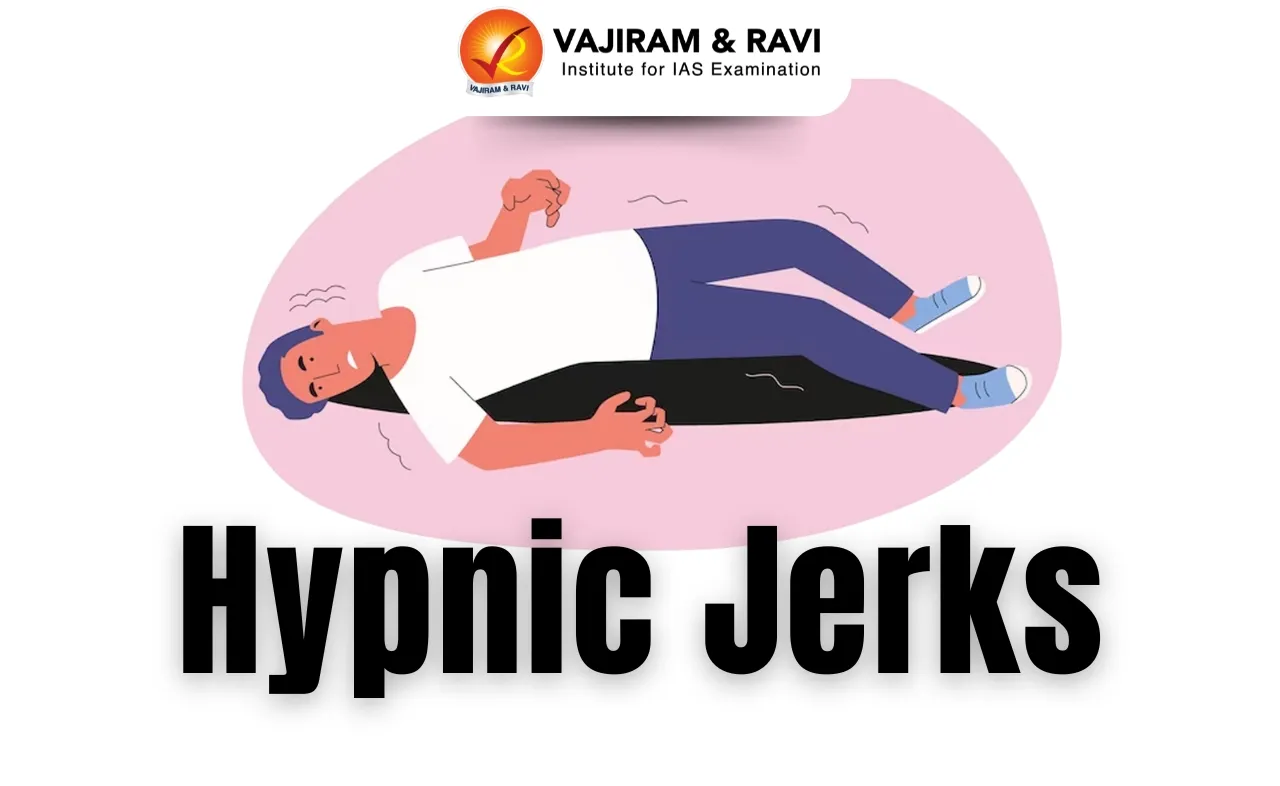
  • It is an involuntary muscle spasm, or twitch, that occurs when someone is in their first or second stage of sleep.
  • It is a common and not harmful condition that can be found in more than 80% of the population.       
  • Some studies suggest that nearly everyone experiences a hypnic jerk at some point in their lives, but the intensity and frequency can vary.
  • It happens during the transition from wakefulness to sleep, particularly when the brain starts to relax but suddenly misinterprets muscle relaxation as “falling.”
  • When going to sleep, muscles tend to relax as the brain slows down. Sometimes, mixed signals from the brain cause a brief muscle contraction.

Causes of Hypnic Jerks

  • High levels of stress and anxiety can increase the frequency and intensity of hypnic jerks.
  • Caffeine and sleep deprivation can also trigger hypnic jerks.
  • If stress is the cause for jerks, then stress management techniques, like breathing exercises, meditation, yoga, etc can help in managing hypnic jerks.
  • Reduction of caffeine, consistent sleep (at least eight hours), and proper exercise are a few other treatments one can take.

Source: : TH

Hypnic Jerks FAQs

Q1: What causes hypnic jerks?

Ans: Fatigue, stress, sleep deprivation, vigorous exercise, and stimulants like caffeine and nicotine causes hypnic jerks.

Q2: What medication is used for hypnic jerks?

Ans: Clonazepam

Q3: What deficiency causes hypnic jerks?

Ans: Magnesium, calcium and/or iron

Battle of Bhupalgarh, History, Events, Challenges, Aftermath

Battle of Bhupalgarh

The Battle of Bhupalgarh (also known as Bhupalgad) took place in 1679 between the Mughal Empire and the Marathas near present-day Khanapur. This conflict was part of the events leading up to the larger Deccan wars. The Maratha forces were commanded by Shivaji, the founder and first ruler of the Maratha Empire. The battle ended with the Mughals, led by General Diler Khan, demolishing the Bhupalgarh fort and securing a significant victory. Shivaji’s son, Sambhaji, who later became the second ruler of the Maratha Empire, fought alongside the Mughals after defecting from his father.

Battle of Bhupalgarh

The Maratha War, Battle of Bhupalgarh was fought in 1679 between the Mughal Empire and the Maratha under Shivaji, was a significant conflict that lasted over 55 days. The fort of Bhupalgarh was ultimately captured by the Mughals, led by General Diler Khan. Following intense battle, the Mughal forces seized the fortress, took control of its supplies, and captured the defending troops. Diler Khan repelled Maratha reinforcements and ordered the complete destruction of the fort. The battle resulted in a decisive Mughal victory, with Shivaji facing defeat. The fort of Bhupalgarh was demolished by the Mughals, marking a crucial setback for the Marathas.

Battle of Bhupalgarh History

During Aurangzeb’s reign (1658–1707), the Mughal Empire expanded rapidly, leading to frequent conflicts with Shivaji’s growing Maratha power. In 1678, Shivaji divided his empire, assigning Maharashtra to his younger son, Rajaram, while Sambhaji was given the unstable Karnataka region. Feeling sidelined, Sambhaji was approached by Mughal general Diler Khan, who offered to help him reclaim Maharashtra in exchange for an alliance. Sambhaji, however, did not consider himself a Mughal subordinate but an independent ruler. Historical records, including English factory letters and Persian sources, suggest that he opposed Diler Khan’s actions, especially the mistreatment of Hindu civilians in Athni and Tikota.

Battle of Bhupalgarh Series of Events

The Mughals began the Battle of Bhupalgarh with heavy artillery fire, targeting the fort’s walls and towers. The following day, they launched a full-scale assault that continued until noon, resulting in the fort’s capture after heavy casualties on both sides. Meanwhile, Shivaji’s cavalry reinforcements, numbering 16,000, arrived late but were intercepted 12 miles away by Ikhlas Khan’s force of 1,500. Despite being surrounded, Ikhlas Khan’s troops held their ground, killing a thousand Maratha soldiers. When Diler Khan’s reinforcements arrived, the Maratha forces were overwhelmed and had no choice but to retreat from the battlefield.

Battle of Bhupalgarh Aftermath

After capturing Bhupalgarh, Diler Khan took large stocks of grain and captured many people, some of whom were sold into slavery. In a brutal act, he released 700 captives but only after cutting off one of their arms. He then ordered the fort to be completely destroyed.

Historian Pandit Shankar Joshi criticizes Sambhaji for joining the Mughals, stating that his actions during the attack on Bhupalgarh showed an unstable character. A month later, with Mughal support, Sambhaji surrounded the Panhala. However, after Shivaji’s death in 1680, he became king and once again turned against the Mughals, leading to the Deccan Wars.

Battle of Bhupalgarh FAQs

Q1: Who won the Battle of Bhupalgarh?

Ans: The Mughal forces, led by General Diler Khan, won the Battle of Bhupalgarh in 1679

Q2: Did Shivaji Maharaj lose any battle?

Ans: While Shivaji Maharaj was a brilliant military leader, he did lose two major battles: the Battle of Kolhapur (1660) and the Battle of Purandar (1665).

Q3: Did Sambhaji Maharaj lose any battle?

Ans: While Chhatrapati Sambhaji Maharaj was a valiant warrior, he was eventually captured and executed by Mughal forces in 1689, not due to losing a battle, but rather a skirmish at Sangameshwar.

Q4: What was the biggest fight of Shivaji Maharaj?

Ans: One of the biggest and most significant battles fought by Chhatrapati Shivaji Maharaj was the Battle of Pavan Khind (1660).

Q5: What Battle did Akbar defeat?

Ans: Mughal Emperor Akbar achieved a major victory in the Second Battle of Panipat (1556), where he defeated Hemu, securing Mughal rule in India.

Ayushman Sahakar Scheme, Objectives, Features, Importance

Default Image

Ayushman Sahakar Scheme aims to improve the healthcare infrastructure of the country through assisting the cooperatives in participating in the same. The scheme covers all dimensions of India’s healthcare system including insurance, infrastructure, technological involvements and health sector on the lines of National Health Policy 2017. 

Ayushman Sahakar Scheme Overview 

The Ayushman Sahakar Program scheme was introduced by the National Cooperative Development Corporation, an agency of the Ministry of Agriculture and Farmer Welfare. The scheme was launched on 19 October,2020 and received the funding for the plan from NDC. The scheme implementation responsibility is with the Ministry of Agriculture and Farmer Welfare and funding and formulation is responsibility of NCDC.

Ayushman Sahakar Scheme Objectives

Ayushman Sahakar Scheme focuses on the promotion and improvement of health infrastructure while aligning it with other government schemes and missions of Government of Inida. The Objectives of this scheme are: 

  • The scheme will aid cooperatives to invest in healthcare facilities to public with facilities. 
  • Motivate the cooperatives to achieve the National Digital Health Missions and create a digital health ecosystem that supports universal health coverage. 
  • The AYUSH facilities of providing six Indian medicines all over India and south Asia will be promoted through cooperatives. 
  • To provide financial aid to cooperatives to contribute in building healthcare infrastructure, education and services. 

Ayushman Sahakar Scheme Features

The features of Ayushman Sahakar Schemes include: 

  • Government Initiatives that can be used to strengthen the cooperative healthcare sector in India. 
  • The Ayushman Sahakar fund has a corpus of Rs. 10,000 crores which could be used for funding the cooperatives. 
  • Support the modernisation of cooperative healthcare facilities.
  • Support the establishment of healthcare infrastructures like clinics, diagnostics centres and hospitals.
  • Adoption of modern healthcare technologies and practices. 
  • Access to quality healthcare, in urban areas and more importantly in rural areas. 
  • Gives more access to cooperatives to participate in government healthcare initiatives leading to healthcare infrastructure development. 

Ayushman Sahakar Scheme Importance

Ayushman Sahakar Scheme is important for the following reasons- 

  • Strengthens the cooperative healthcare sector.
  • Improves access to quality healthcare, especially in rural and underserved areas.
  • Supports modernization of hospitals, clinics, and healthcare centers.
  • Assists cooperatives in upgrading facilities and adopting new technology.
  • Enhances collaboration between cooperative healthcare organizations and government programs.
  • Facilitates the establishment and management of cooperative healthcare facilities.
  • Provides training for healthcare professionals in cooperatives, ensuring better care delivery.
  • Focuses on improving healthcare access in rural regions with limited facilities.
  • Encourages research and innovation in cooperative healthcare.
  • Promotes preventive health measures like exercise and balanced nutrition. 

Activities performed under Ayushman Sahakar Scheme

The Ayushman Sahakar scheme outlines the following activities eligible for NCDC assistance:

  • Upgrading existing cooperative healthcare facilities and constructing new ones.
  • Modernizing medical equipment and incorporating advanced technology in cooperative healthcare institutions.
  • Providing training for healthcare professionals in cooperative organizations.
  • Promoting research and fostering innovation within cooperative healthcare institutions.
  • Enhancing the quality of healthcare services offered by cooperative organizations.
  • Integrating cooperative healthcare setups with government health initiatives.
  • Encouraging the adoption of digital healthcare solutions and telemedicine in cooperatives.
  • Supporting preventive healthcare measures, health awareness campaigns, and community health programs through cooperative organizations.

Ayushman Sahakar Scheme FAQs

Q1: Who launched the Ayushman Sahakar scheme?

Ans: The Ayushman Sahakar scheme was launched by the National Cooperative Development Corporation (NCDC).

Q2: What are the objectives of Ayushman Sahakar scheme?

Ans: The scheme aims to strengthen cooperative healthcare facilities, improve rural healthcare access, and promote preventive health, research, and innovation.

Q3: What is the Sahakar scheme?

Ans: It is an initiative by NCDC to support cooperatives in establishing and upgrading healthcare infrastructure and services.

Q4: Which ministry manages Ayushman Sahakar Scheme?

Ans: The scheme is managed by the Ministry of Cooperation.

Q5: When was the Ayushman Sahakar Scheme launched?

Ans: The Ayushman Sahakar Scheme was launched on October 19, 2020.

QS World University Rankings 2026

QS World University Rankings

QS World University Rankings Latest News

The QS World University Rankings recently released its latest edition of rankings of higher education institutions across the world.

About QS World University Rankings

  • It is published annually by global higher education consultancy Quacquarelli Symonds.
  • The QS rankings evaluate universities on several parameters, including academic reputation, overall score, employer reputation, and employment outcomes.
  • The 2026 edition evaluated 8467 institutions and featured over 1,500 institutions from more than 100 countries, marking shifts in global higher education performance. 
  • This year's rankings introduced a new International Student Diversity (ISD) metric as an unweighted indicator. 

QS World University Rankings 2026 Highlights

  • The Massachusetts Institute of Technology (MIT), United States, holds the top position for the 14th straight year. 
  • It is followed by Imperial College London and Stanford University, which climbed from sixth to third. 
  • Other institutions in the top ten include the University of Oxford, Harvard University, the University of Cambridge, ETH Zurich, the National University of Singapore (NUS), University College London (UCL), and Caltech.
  • The US remains the most represented country overall, with 192 institutions featured in the list, and most showing improved positions.
  • China continues its strong presence, with Peking University at 14th (92.6), and Tsinghua University rising to 17th with a score of 91.2. Fudan University, another university from China, climbed nine spots to reach the 30th position, while the Chinese University of Hong Kong (CUHK) secured the 32nd rank.
  • India has achieved an all-time high in the rankings, with 54 institutions featured in the 2026 list-a significant rise from 46 in 2025 and 45 in 2024. 
  • With this, India has become the fourth most represented nation globally, following the United States, the United Kingdom, and China.
  • Eight Indian universities are new entrants this year, the highest from any country, marking India's position as the fastest-growing G20 nation in the QS rankings, with a remarkable 390% increase in representation over the past decade.
  • Leading the Indian contingent is the Indian Institute of Technology (IIT) Delhi, which has climbed to the 123rd position globally, jointly ranked with the Georgia Institute of Technology, USA. This marks the institute's highest-ever rank, up from 197th in 2024 and 150th in 2025.
  • IIT Bombay, although down from its all-time high of 118 last year, continues to feature in the global top 130, ranking 129th overall. 
  • Meanwhile, IIT Madras recorded a remarkable jump of 47 spots to reach 180th, entering the global top 200 for the first time.
  • Nearly half (48%) of India's ranked institutions improved their positions this year. 
  • Five Indian universities made it to the global top 100 for Employer Reputation, and eight institutions secured a place among the top 100 globally for Citations per Faculty - a research quality metric - achieving an average score of 43.7, ahead of Germany, the UK, and the US.

Top 10 Indian Institutes in QS World University Rankings 2026

  • IIT Delhi - Rank 123
  • IIT Bombay - Rank 129
  • IIT Madras - Rank 180
  • IIT Kharagpur - Rank 215
  • IISc Bangalore - Rank 219
  • IIT Kanpur - Rank 222
  • University of Delhi - Rank 328
  • IIT Guwahati - Rank 334
  • IIT Roorkee - Rank 339
  • Anna University - Rank 465

Source: IE

QS World University Rankings FAQs

Q1: Who publishes the QS World University Rankings annually?

Ans: It is published annually by global higher education consultancy Quacquarelli Symonds.

Q2: Which university topped the QS World University Rankings 2026 for the 14th consecutive year?

Ans: Massachusetts Institute of Technology (MIT)

Q3: Which Indian institution achieved the highest rank in the QS World University Rankings 2026?

Ans: IIT Delhi

Q4: How many Indian institutions were included in the QS World University Rankings 2026?

Ans: 54

Bhashini Platform

What is Bhashini Platform?

Bhashini Platform Latest News

The recent agreement between the Ministry of Panchayati Raj and the Ministry of Electronics and Information Technology’s Bhashini will not only break language barriers but also promote inclusion among states across the country.

About Bhashini Platform

  • BHASHINI, or the BHASHa INterface for India, is an artificial intelligence (AI)-powered language translation platform developed by the Ministry of Electronics and Information Technology (MeitY) under its National Language Translation Mission. 
  • It aims to build a National Public Digital Platform for languages to develop services and products for citizens by leveraging the power of AI and other emerging technologies.
  • It aims to help people translate content into various Indian languages.
  • BHASHINI also aims to increase the content in Indian languages on the Internet substantially in the domains of public interest, particularly governance and policy, science & technology, etc., thus encouraging citizens to use the Internet in their own language.
  • It uses cutting-edge AI and natural language processing (NLP) technologies to bridge the language divide, enabling users to access content and services in their preferred language. 
  • It is implemented by Digital India BHASHINI Division, a division under Digital India Corporation, a Section 8 Company of the MeitY.
  • Bhashini currently supports more than 22 languages, enabling inclusivity for a broad range of linguistic communities.
  • Since its launch, it has enabled features like text-to-text translation in 22 languages, automated speech recognition, text-to-speech synthesis, optical character recognition, video translation, document translation, language detection, and voice-based payments, among others.
  • Bhashini has an app which can be used by people. 
  • It also provides API (application programming interface) integration to startups which want to use Bhashini’s language features on their platforms, such as chatbots, etc.
  • This online platform also has a separate ‘Bhasadaan’ section, which allows individuals to contribute to multiple crowdsourcing initiatives.
  • The National Payment Corporation of India (NPCI) has collaborated with Bhashini to allow users to make conversational payments through UPI in Indian languages.

Source: NOA

Bhashini Platform FAQs

Q1: Under which ministry has the Bhashini platform been developed?

Ans: Ministry of Electronics and Information Technology (MeitY)

Q2: What is the objective of Bhashini platform?

Ans: Bridge the digital, literacy, and language divides by creating innovative, voice-first multilingual solutions that enable seamless communication and access to digital services in multiple Indian languages.

Q3: How many languages are available in Bhashini?

Ans: Bhashini currently supports 22+ languages.

Q4: What does BHASHINI stand for?

Ans: BHASHa INterface for India

Q5: Which organization is implementing the Bhashini platform?

Ans: It is implemented by Digital India BHASHINI Division, a division under Digital India Corporation, a Section 8 Company of the MeitY.

Energy Transition Index by WEF

Energy Transition Index

Energy Transition Index Latest News

India has been ranked 71st on a global Energy Transition Index (ETI) released by the World Economic Forum.

About Energy Transition Index

  • It is released by the World Economic Forum.
  • A country’s final ETI score is a weighted composite of two sub-indices: system performance (60%) and transition readiness (40%).
  • System performance is evenly distributed across equity, security and sustainability dimensions, while transition readiness is divided into two categories: core enablers and enabling factors.
  • Core enablers include regulation and political commitment as well as finance and investment, while enabling factors encompass innovation, infrastructure and education and human capital.

Key Highlights of Energy Transition Index 2025

  • The ETI 2025 offers a comparative framework with which to assess national energy systems and track energy transition progress.
  • Sweden topped the list of 118 countries, followed by Finland, Denmark, Norway and Switzerland in the top five.
  • China was ranked 12th, the US was 17th and Pakistan at 101st place. Congo was ranked lowest.
  • India and China experienced the greatest overall improvement among large economies, especially in increasing access to energy and strengthening transition readiness.
  • The WEF said the top five largest economies China, the US, EU, Japan and India will ultimately determine the pace and direction of the global energy transition due to their sheer size.
  • India also made progress in lowering energy intensity and CH4 emissions, creating more favourable energy regulations and increasing clean energy investments.

Source: BS

Energy Transition Index FAQs

Q1: Who publishes the energy transition index?

Ans: World Economic Forum

Q2: What is meant by energy transition?

Ans: Energy transition is the move by the global energy sector away from fossil fuels such as coal, natural gas and oil towards renewable energy sources such as wind and solar energy.

QR Codes on PMGSY Roads to Boost Transparency and Public Feedback

PMGSY QR Code Tracking

PMGSY QR Code Tracking Latest News

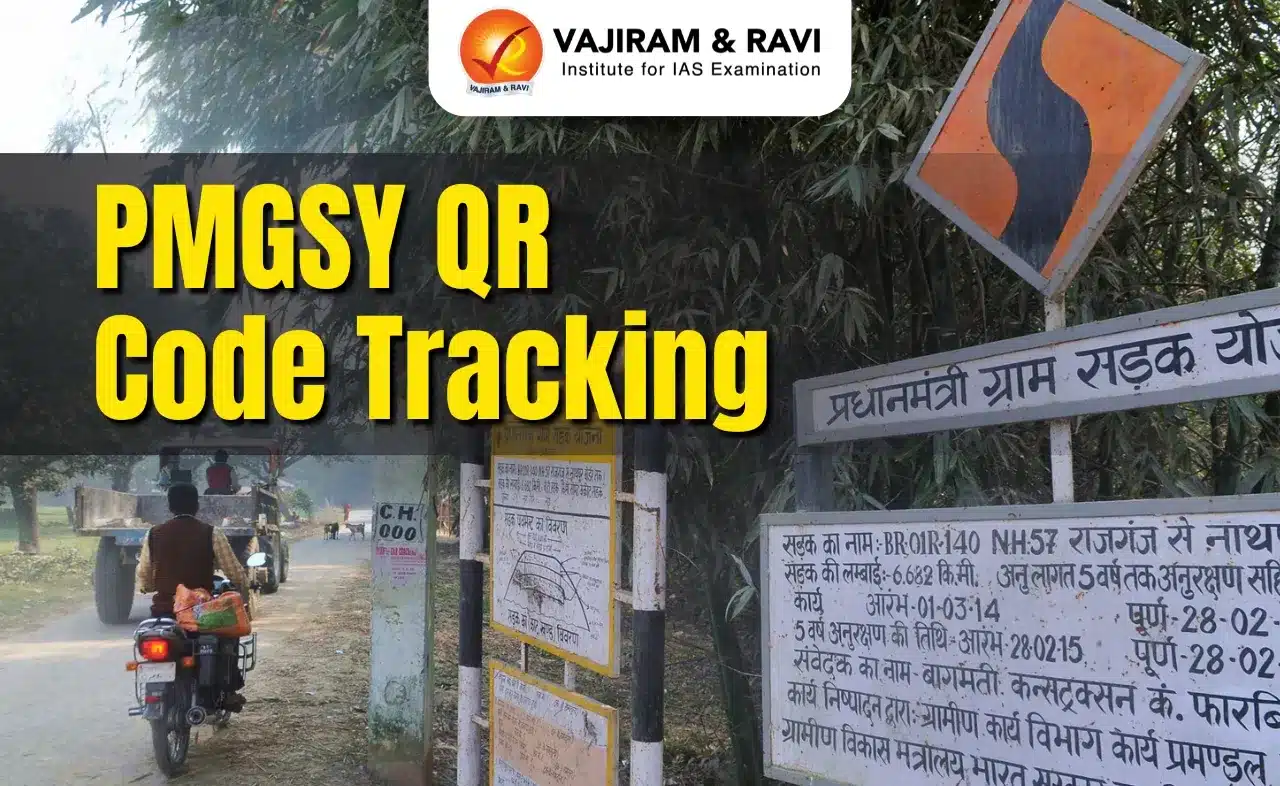
The Union Ministry of Rural Development has directed states to add QR codes to maintenance display boards on all PMGSY roads to enhance transparency and ease of tracking maintenance details.

About Prime Minister Gram Sadak Yojana (PMGSY)

The Pradhan Mantri Gram Sadak Yojana (PMGSY) is a rural road development programme launched on December 25, 2000, under the then government led by Atal Bihari Vajpayee to improve rural connectivity through all-weather roads.

Phases of PMGSY

  • Phase I (2000): Focused on connecting rural habitations with all-weather roads.
  • Phase II (2013): Strengthened existing road networks.
  • RCPLWEA (2016): Special component targeting Left Wing Extremism (LWE)-affected areas.
  • Phase III (2019): Emphasized consolidation of existing networks.
  • Phase IV (2024):
    • Approved on September 11, 2024.
    • Aims to connect 25,000 unconnected habitations based on population criteria: 500+ in plains; 250+ in NE/hill states and special areas; 100+ in LWE-affected areas.
    • Target: 62,500 km of roads
    • Timeline: 2024–25 to 2028–29

Funding Pattern

Initially a Centrally Sponsored Scheme, the cost-sharing was revised in 2015–16 to 60:40 between Centre and states (except NE and Himalayan states, which follow a different ratio).

Achievements So Far (as per the information available on the dashboard)

Since the scheme was launched, a total road length of 8,36,850 km has been sanctioned, of which 7,81,209 km has been completed.

QR Codes on PMGSY Road Maintenance Boards

The National Rural Infrastructure Development Agency (NRIDA), under the MoRD, has directed all states to install QR codes on PMGSY road maintenance boards.

Purpose of QR Codes

The primary objective is to gather public feedback on the quality and upkeep of rural roads, which was previously missing in the monitoring process.

Current Maintenance System: e-MARG

  • e-MARG (electronic Maintenance of Rural Roads) is a mobile-cum-web-based e-governance system for tracking maintenance.

  • After construction, roads are maintained by the contractor for five years.

  • Contractors submit bills on e-MARG for maintenance work.

Monitoring and Evaluation Process

  • Field engineering staff conduct Routine Inspections (RI).
  • Geo-tagged photographs are taken and uploaded.
  • Performance Evaluation (PE) is based on 12 parameters of routine maintenance.
  • State governments are responsible for overall rural road maintenance since it is a state subject.

Role of National Level Monitors (NLMs)

  • NRIDA sends NLMs to inspect road construction quality.
  • Past NLM reports have highlighted substandard work under PMGSY.

Need for Public Feedback

While technical checks exist, no mechanism was in place to capture citizen feedback—a gap that the QR code initiative now aims to fill.

Working of New QR Code System

  • A dedicated utility in the eMARG platform has been created to generate unique QR codes for each PMGSY road, which will be displayed on the maintenance information boards.
  • Citizen Engagement Through QR Codes
    • Any road user can scan the QR code using a smartphone.
    • Upon scanning, users can:
      • Access complete road details
      • Upload photos highlighting maintenance issues
      • Submit feedback through a feedback window
    • Instructions will be available in English and the local language for wider accessibility.

Integration with Inspection and Evaluation

  • Citizens’ photos and feedback will be integrated with the relevant Routine Inspections (RI).
  • These inputs will assist in Performance Evaluation (PE) using AI and Machine Learning.
  • Program implementation units must cross-verify citizen photos before finalising PE marks.

Enhancing Transparency and Accountability

  • The initiative aims to increase public participation in road upkeep.
  • It will support engineering staff in making realistic evaluations.
  • Overall, the system makes eMARG more transparent and participatory, ensuring better maintenance during the mandated 5-year post-construction period.

Source: IE | PIB | PMGSY

PMGSY QR Code Tracking FAQs

Q1: What is the PMGSY scheme?

Ans: A rural road program launched in 2000 to provide all-weather connectivity to unconnected habitations across India.

Q2: Why are QR codes being used on PMGSY roads?

Ans: To gather citizen feedback on road quality and support performance evaluation using digital tools.

Q3: How does eMARG work in road maintenance?

Ans: It is a web-mobile platform used for submitting maintenance bills and conducting performance evaluations with geo-tagged photos.

Q4: What role does AI/ML play in this system?

Ans: AI/ML analyze citizen-submitted images to aid routine maintenance evaluation and improve objectivity in scoring.

Q5: How does this benefit rural infrastructure?

Ans: Increases transparency, accountability, and public participation, ensuring better long-term road quality.

Daily Editorial Analysis 21 June 2025

Daily Editorial Analysis

Lighting the Spark in U.K.-India Cultural Relations

Context

  • In May 2025, a new and promising dimension was added to the strategic partnership between India and the United Kingdom, one that extends beyond trade and diplomacy, delving into the rich and transformative world of culture.
  • While the ratification of the much-anticipated Free Trade Agreement captured economic headlines, the signing of the Programme of Cultural Cooperation (POCC) signalled a cultural renaissance.
  • Amid these developments, it is imperative to explore the deeper implications of the POCC, analysing its role in developing cross-border creativity, empowering cultural industries, and enhancing bilateral ties between two nations connected by shared history and aspirations.

The Programme of Cultural Cooperation and its Key Features

  • The Programme of Cultural Cooperation: A Landmark Agreement
    • On May 2, 2025, the U.K. Secretary of State for Culture, Rt Hon Lisa Nandy, and India’s Minister for Culture, Gajendra Singh Shekhawat, signed the POCC, a landmark cultural agreement aimed at strengthening creative collaboration.
    • Structured around five key programme areas, digital technologies for culture, exhibitions and collections, performances and events, cultural property, and sustainability, the POCC aligns with both nations’ strategic objectives.
    • For the U.K., it complements its creative economy strategy; for India, it provides a framework to amplify its cultural soft power.
    • This agreement also reflects a growing recognition of culture as a driver of economic development and international goodwill.
    • By committing to the POCC, both governments have sent a strong message: cultural diplomacy is not peripheral but central to 21st-century international relations.
  • The Creative Economy: A Global Engine of Growth
    • The POCC arrives at a time when the global creative economy is on the rise, projected to constitute 10% of global GDP by 2030.
    • This sector includes film, music, digital content, heritage tourism, design, and more, industries that not only generate economic value but also foster innovation, inclusion, and identity.
    • At the 2023 G-20 New Delhi Leaders’ Summit, global leaders, including those from the U.K. and India, acknowledged the sector’s potential and emphasised the need for greater investment.
    • India’s hosting of the inaugural World Audio Visual & Entertainment Summit (WAVES) in Mumbai was a tangible step in this direction, and Ms. Nandy’s presence there underlined the U.K.’s interest in co-shaping this global narrative.

India’s Creative Strength and UK-India Synergies

  • India’s Creative Strengths: Cultural Wealth Meets Youthful Innovation
    • India’s creative advantage is rooted in a unique convergence of tradition and technology.
    • With a cultural economy valued at $35 billion and employing nearly 8% of its workforce, India is second only to agriculture in terms of employment generation in this sector.
    • What makes this growth even more significant is its decentralisation: six of India’s top 10 creative hubs lie in non-metro areas, showcasing the country's cultural diversity and grassroots talent.
    • Moreover, with over 300 universities and 3,000 colleges offering degrees in design, arts, and architecture, India is actively building a global-ready creative workforce.
    • When paired with its demographic dividend, the world’s largest youth population, India is poised to emerge as a creative superpower.
  • U.K.-India Synergies: Institutions, Technology, and Storytelling
    • The POCC enables deep institutional engagement, involving not only ministries and councils but also renowned British cultural institutions such as the British Library, British Museum, and the Science Museum Group.
    • With over 1,700 accredited museums in the U.K., the opportunities for partnership in digitisation, exhibitions, and collaborative events are vast.
    • Additionally, the U.K.’s role in India’s G-20 presidency highlighted its support for cultural priorities through events like Wales in India, which culminated at the 2024 Hornbill Festival in Nagaland.
    • These projects are not merely symbolic but are shaping a new cultural infrastructure that links artists, educators, and audiences.
    • One compelling example of this synergy is Royal Enfield’s Himalayan project, which, in partnership with UNESCO, supports artisan communities and conserves intangible heritage.
    • This model demonstrates how private enterprise can be a powerful cultural actor, merging business, sustainability, and storytelling.

Emerging Challenges and the Road Ahead

  • Despite the sector’s momentum, the creative economy faces significant challenges.
  • A shortage of skilled labour, insufficient training infrastructure, and the rapid evolution of technology, including Artificial Intelligence, augmented and virtual reality, demand urgent attention.
  • Reports such as the British Council’s Arts and Technologies in India: Reimagining the Future advocate for integrating emerging technologies into creative education.
  • International cooperation, such as through the POCC, can play a pivotal role in equipping professionals with global competencies and adaptive skills.
  • To realise Prime Minister Modi’s vision of India as a global creative hub, a tri-sectoral approach is essential.
  • Governments must invest in education and policy frameworks, industries must create sustainable business models, and academic institutions must provide interdisciplinary and future-oriented training.

Conclusion

  • The POCC marks more than just a bilateral agreement; it is a cultural compact that reflects the evolving nature of diplomacy in the 21st century, one that values stories, art, and shared heritage as much as strategy and economics.
  • In a world fractured by conflict and uncertainty, cultural collaboration offers a powerful tool for connection and healing.
  • As India and the U.K. move forward in this new chapter of their relationship, the creative spark that unites their people, from artisans in the Himalayas to curators in London, will not only preserve the past but also shape a shared future of innovation, inclusion, and imagination.

Lighting the Spark in U.K.-India Cultural Relations FAQs

Q1. When was the POCC signed?

Ans. The Programme of Cultural Cooperation (POCC) was signed on May 2, 2025.

Q2. Who signed the POCC on behalf of the UK?

Ans. The POCC was signed by Rt Hon Lisa Nandy, the U.K. Secretary of State for Culture.

Q3. What are the key focus areas of the POCC?

Ans. The POCC focuses on digital technologies for culture, exhibitions and collections, performances and events, cultural property, and sustainability.

Q4. What is the value of India’s creative economy?

Ans. India’s creative economy is valued at $35 billion.

Q5. Why is cultural cooperation important?

Ans. Cultural cooperation is important because it promotes innovation, strengthens international relationships, and supports inclusive economic growth.

Source : The Hindu


It Is Still Not Too Late for India’s Voice to Be Heard

Context

  • On June 13, 2025, a unilateral Israeli strike on Iranian territory once again underscored the perils of militarism devoid of accountability or international consensus.
  • This development has not only imperilled regional stability in West Asia but also threatens to unravel ongoing diplomatic overtures between Iran and the United States.
  • As global powers stand at a crossroads between confrontation and conciliation, it becomes vital to examine the motivations behind such aggression, the hypocrisies that often accompany it, and the broader implications for international peace and India’s role on the global stage.

A Dangerous Escalation: The Israeli Strike on Iran

  • The recent Israeli military action on Iranian soil has drawn widespread condemnation, which characterised the strike as unlawful, escalatory, and heedless of civilian lives.
  • Coming at a moment when Iran and the U.S. were making tentative progress in reviving diplomatic ties, with five rounds of negotiations already completed in 2025 and a sixth anticipated, the attack appears especially ill-timed and disruptive.
  • What further compounds the recklessness of this strike is the fact that the U.S. Director of National Intelligence, Tulsi Gabbard, publicly confirmed in March 2025 that Iran was not actively pursuing nuclear weapons.
  • Her testimony reaffirmed that Supreme Leader Ali Khamenei had not authorized any such activity since 2003.
  • Thus, Israel’s military aggression appears to be not only premature but also based on disputed premises, threatening to derail promising diplomatic avenues.

The Politics of Escalation and US Complicity

  • The Netanyahu Government and the Politics of Escalation
    • To understand the Israeli posture, it is essential to examine the ideological and political trajectory of Prime Minister Benjamin Netanyahu’s government.
    • Characterised by alliances with ultra-nationalist factions, aggressive settlement expansion, and a clear departure from the two-state solution, Netanyahu’s leadership has consistently undermined peace in the region.
    • Historically, Netanyahu's role in fanning right-wing extremism is well-documented, with indirect links to the environment of hostility.
    • It led to Prime Minister Yitzhak Rabin’s assassination in 1995, a turning point that derailed hopes for a peaceful resolution to the Israeli-Palestinian conflict.
    • The current attack on Iran is consistent with this broader pattern of choosing escalation over engagement.
  • The Complicity of US Leadership
    • The complicity of U.S. leadership, particularly President Donald Trump, has further exacerbated the situation.
    • Despite past criticism of America’s military interventions and the influence of the military-industrial complex, President Trump’s June 17 statement falsely alleging Iran’s nuclear ambitions contradicts his own intelligence apparatus.
    • This abandonment of factual analysis in favour of alarmist rhetoric mirrors the misinformation that led to the disastrous invasion of Iraq and undermines the credibility of diplomatic engagement.

Nuclear Hypocrisy and Regional Double Standards

  • Israel's preoccupation with Iran’s nuclear potential rests on a core strategic anxiety, but it is also fraught with double standards.
  • As a clandestine nuclear power, Israel has never subjected itself to international non-proliferation treaties, even as it preaches the dangers of nuclearization to others.
  • In contrast, Iran remains a signatory to the Nuclear Non-Proliferation Treaty (NPT) and had committed to the Joint Comprehensive Plan of Action (JCPOA) in 2015, agreeing to verifiable restrictions on its nuclear program in return for sanctions relief.
  • The U.S. withdrawal from the JCPOA in 2018 undid years of patient diplomacy and destabilised not only the region but also vital economic interests for other nations, including India.
  • The reimposition of sanctions has hindered major Indian projects such as the International North-South Transport Corridor and the development of Chabahar Port, critical ventures for regional connectivity and energy security.

The Gaza Catastrophe, India’s Silence, Responsibility and Strategic Interests

  • The Gaza Catastrophe and India’s Silence
    • India’s current diplomatic silence is particularly glaring in the context of Israel’s ongoing campaign in Gaza.
    • The humanitarian situation in Gaza is dire, with famine looming and civilian suffering escalating by the day.
    • New Delhi’s reluctance to voice concern or advocate for the two-state solution marks a troubling departure from India’s principled stand in global affairs.
    • This shift reflects not only a strategic miscalculation but also a moral abdication.
  • India's Diplomatic Responsibility and Strategic Interests
    • Iran is not a distant actor in Indian foreign policy, it is a nation with which India shares deep historical, civilisational, and strategic ties.
    • From backing India on the Kashmir issue in 1994 to developing bilateral trade and energy partnerships, Iran has often stood as a reliable ally.
    • In contrast, the Imperial State of Iran had previously aligned more closely with Pakistan, making the Islamic Republic’s support even more significant.
    • At the same time, India has cultivated strong relations with Israel, especially in the fields of defence and technology.
    • This unique positioning gives India both the moral responsibility and the diplomatic leverage to act as a credible mediator in the region.
    • With lakhs of Indian citizens working in West Asia, regional peace is not merely a matter of foreign policy, it is a national interest.

The Way Forward: A Call for Moral and Diplomatic Leadership

  • The unfolding crisis in West Asia is a critical test of the international community’s commitment to peace, justice, and the rule of law.
  • It is also a moment of reckoning for India’s foreign policy; as a nation historically aligned with non-alignment, peace-building, and global justice, India must reclaim its moral voice and actively work toward de-escalation in the region.
  • India must leverage its unique relationships with both Iran and Israel to promote dialogue, condemn disproportionate violence, and support a return to multilateral diplomacy.
  • The stakes are too high, for the region, for global stability, and for India’s own credibility on the world stage. It is not too late to choose the path of principle, and India must lead the way.

Conclusion

  • Unilateral military actions, like Israel's strike on Irandestabilise diplomatic progress and undermine regional peace efforts, especially when based on disputed or false premises.
  • New Delhi’s current silence erodes its moral credibility; a principled stand promoting de-escalation, humanitarian protection, and the two-state solution is both urgent and necessary.
  • India, with its historical ties to both Iran and Israel, holds a unique position to mediate and must reclaim its traditional role as a voice for peace, balance, and justice in global affairs.

It Is Still Not Too Late for India’s Voice to Be Heard FAQs

Q1. What triggered fresh tensions in West Asia in June 2025?

Ans. The fresh tensions were triggered by a unilateral Israeli military strike on Iranian territory on June 13, 2025.

Q2. What was Iran’s nuclear status according to U.S. intelligence in 2025?

Ans. According to U.S. intelligence, Iran was not pursuing nuclear weapons, and its Supreme Leader had not authorized their development since 2003.

Q3. How has Israel's response in Gaza been described?

Ans. Israel's response in Gaza has been described as brutal, disproportionate, and catastrophic, resulting in severe civilian suffering and massive destruction.

Q4. What diplomatic position has India traditionally supported in the Israel-Palestine conflict?

Ans. India has traditionally supported a peaceful two-state solution, ensuring mutual security and dignity for both Israel and Palestine.

Q5. Why is India uniquely positioned in this conflict?

Ans. India is uniquely positioned because it maintains strategic relations with both Iran and Israel, giving it the diplomatic leverage to act as a mediator for peace and de-escalation.

Source: The Hindu

Daily Editorial Analysis 21 June 2025 FAQs

Q1: What is editorial analysis?

Ans: Editorial analysis is the critical examination and interpretation of newspaper editorials to extract key insights, arguments, and perspectives relevant to UPSC preparation.

Q2: What is an editorial analyst?

Ans: An editorial analyst is someone who studies and breaks down editorials to highlight their relevance, structure, and usefulness for competitive exams like the UPSC.

Q3: What is an editorial for UPSC?

Ans: For UPSC, an editorial refers to opinion-based articles in reputed newspapers that provide analysis on current affairs, governance, policy, and socio-economic issues.

Q4: What are the sources of UPSC Editorial Analysis?

Ans: Key sources include editorials from The Hindu and Indian Express.

Q5: Can Editorial Analysis help in Mains Answer Writing?

Ans: Yes, editorial analysis enhances content quality, analytical depth, and structure in Mains answer writing.

What Iran’s Withdrawal from the NPT Could Mean for Global Nuclear Stability

Iran NPT withdrawal

Iran NPT Withdrawal Latest News

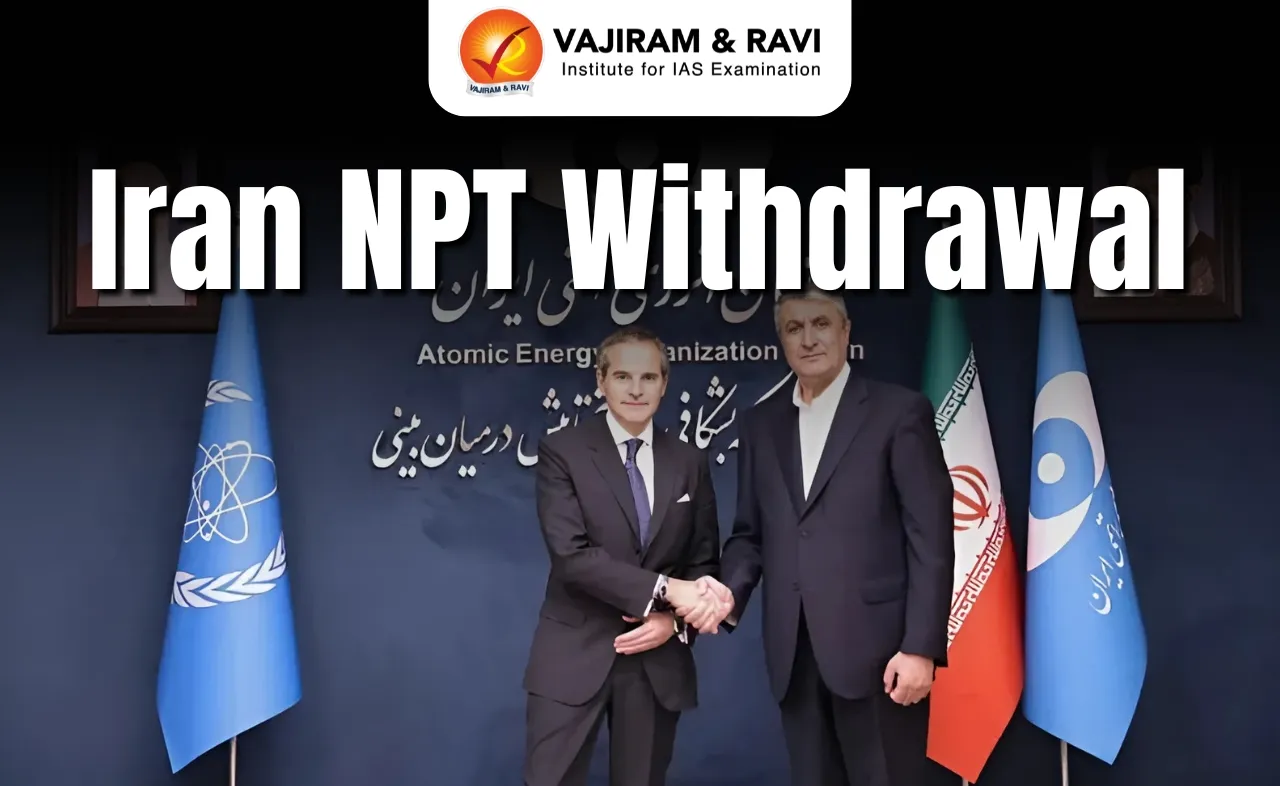
  • In the wake of rising military tensions, Iran's Parliament is drafting a Bill to potentially withdraw from the Nuclear Non-Proliferation Treaty (NPT). 
  • This move follows recent Israeli airstrikes on Iranian nuclear facilities, citing concerns that Iran was nearing weapons-grade uranium enrichment.

About The Nuclear Non-Proliferation Treaty (NPT)

  • The NPT is a global treaty signed in 1968 and entered into force in 1970, aimed at:
    • Preventing the spread of nuclear weapons and technology
    • Promoting peaceful uses of nuclear energy
    • Supporting nuclear disarmament

Background: Post-World War II Nuclear Concerns

  • After the atomic bombings in Japan (1945), nations began a nuclear arms race. 
  • Alongside, efforts emerged to limit the proliferation of nuclear weapons and technology.

Atoms for Peace Initiative (1953)

  • Launched by U.S. President Dwight D. Eisenhower
  • Advocated for the peaceful use of nuclear energy
  • Paved the way for the formation of the International Atomic Energy Agency (IAEA)
  • Introduced a safeguards system to monitor and verify civilian nuclear activities

Safeguards and Verification

  • Non-nuclear weapon states must submit detailed reports on nuclear activities
  • Allow IAEA inspections to prevent diversion of nuclear materials for weapons
  • Part of the “basic bargain”: peaceful nuclear assistance in exchange for oversight

Definition of Nuclear States under the NPT

  • Nuclear states are those that tested nuclear weapons before January 1, 1967.
  • This included:
    • United States
    • United Kingdom
    • France
    • Soviet Union (now Russia)
    • China

Membership and Non-Signatories

  • 191 countries are parties to the treaty
  • Non-signatories include:
    • India: Conducted nuclear tests in 1974; opposes the discriminatory nature of the treaty
    • Pakistan: Not a signatory
    • Israel: Neither confirms nor denies nuclear weapons possession; hasn’t signed
    • North Korea: Signed in 1985, withdrew in 2003, expelled IAEA inspectors

Criticism

  • Viewed as discriminatory for legitimizing nuclear weapons only for the P5 (UNSC permanent members).
  • The 1967 cut-off date is seen as arbitrary, reinforcing a nuclear hierarchy.

How Can a Country Leave the NPT

  • Under Article 10 of the Nuclear Non-Proliferation Treaty (NPT):
    • A country may withdraw if extraordinary events jeopardize its supreme national interests.
    • It must notify all treaty parties and the UN Security Council three months in advance, citing those events.

Iran's NPT Membership and Recent Developments

  • Iran joined the NPT in 1970, prior to its Islamic Revolution (1979).
  • For the first time in nearly 20 years, the IAEA Board of Governors recently censured Iran, citing:
    • Repeated failure since 2019 to cooperate fully with the agency.
    • Discovery of undeclared nuclear material and activities at multiple sites.
  • Iran’s Response
    • Iran denied violations, stating it has adhered to its safeguards obligations under the NPT.
    • However, tensions have grown, particularly after recent Israeli strikes and Iran’s retaliatory missile attacks.

Implications of Iran Withdrawing from the NPT

  • End of IAEA Oversight
    • Iran would no longer be subject to IAEA inspections, which averaged 1.4 site visits per day in 2023.
    • This would reduce international visibility into Iran’s nuclear activities.
  • Risk of Destabilizing the Global Non-Proliferation Regime
    • Iran’s withdrawal could set a precedent for other states to follow.
    • Could lead to a weakening of global cooperation on nuclear non-proliferation.
  • Does Withdrawal Mean Weaponization
    • Leaving the NPT does not automatically imply Iran will build nuclear weapons.
    • However, historical cases (e.g., North Korea) show that withdrawal may precede weapon development.
    • Iran has denied such intentions, but regional instability fuels uncertainty.
  • Scholarly Perspective: The Value of NPT
    • Experts argue that:
      • Even imperfect adherence can significantly slow nuclear proliferation.
      • A global treaty can maintain normative pressure until a tipping point is reached, beyond which violations could undermine the regime altogether.

Source: IE | NYT | MSNBC

Iran NPT Withdrawal FAQs

Q1: What is the NPT’s main objective?

Ans: To prevent nuclear weapons spread, promote peaceful nuclear energy, and encourage disarmament through global cooperation.

Q2: Can countries legally exit the NPT?

Ans: Yes, by citing extraordinary threats to national interests and giving three months’ notice to treaty members and the UNSC.

Q3: Why is Iran considering leaving the NPT?

Ans: Due to IAEA censure and escalating tensions with Israel over alleged nuclear weapons development.

Q4: What happens if Iran exits the treaty?

Ans: Iran would no longer face IAEA inspections, reducing oversight and raising nuclear proliferation concerns.

Q5: Will NPT withdrawal lead to nuclear arms?

Ans: Not necessarily, but history shows it increases the risk and undermines global non-proliferation frameworks.

UK Parliament Passes Assisted Dying Bill

A Step Towards Legalising End-of-Life Choices

A Step Towards Legalising End-of-Life Choices Latest News

  • The UK House of Commons has passed a landmark bill legalising assisted dying for terminally ill adults in England and Wales. 
  • This development marks a significant shift in end-of-life care legislation, amidst heated political and societal debate.

Key Highlights of the Terminally Ill Adults (End of Life) Bill

  • Eligibility criteria: The bill permits assisted dying under strict and clearly defined conditions -
    • Individuals must be 18 years or older.
    • Must be resident in England or Wales and registered with a General Practitioner (GP) for at least 12 months.
    • Must have a terminal illness with an expected life expectancy of six months or less.
    • Must possess the mental capacity to make an informed decision.
    • Must make two formal, witnessed declarations expressing their wish to die.
    • Evaluations are to be done by two independent doctors at least seven days apart.
  • Procedure:
    • After approval, there is a 14-day waiting period.
    • A doctor would prepare the life-ending substance, but the individual must self-administer it.
    • It will be a criminal offence to coerce or pressure someone into assisted dying, punishable by up to 14 years in prison.

Political and Public Reactions

  • Parliamentary division:
      • The bill passed with 314 votes in favour and 291 against, a narrow majority of 23.
      • Prime Minister Keir Starmer supported the bill.
      • Health Secretary Wes Streeting opposed it (practicing ‘free vote’, i.e., not bound by party lines) but affirmed he would respect the decision.
  • Public protests and campaigns:
    • Strong activism was seen both in support of and against the bill.
    • Supporters promoted “Dignity in Dying”, emphasizing compassionate choices.
    • Opponents criticised it as potentially creating a “National Suicide Service”.

Ethical and Legal Debates

  • Proponents’ argument:
      • Empowers patients to die with dignity.
      • Ends the need for terminally ill people to travel to places like Switzerland for assisted suicide.
      • Reduces suffering and upholds patient autonomy.
  • Critics’ concerns:
      • Risk of abuse or coercion of vulnerable individuals.
  • Ethical implications of enabling suicide.
    • Potential for erosion of palliative care standards.

Global Context - Comparative Legal Status

  • Canada: Assisted suicide and euthanasia legal under conditions.
  • Belgium and Netherlands: Both assisted dying and euthanasia legal under strict criteria.
  • Australia: Assisted dying permitted in some states.
  • US (selected states): Assisted suicide legal in states like Oregon and California.
  • Switzerland: Assisted suicide legal, attracts medical tourism.

Conclusion

  • The Assisted Dying Bill’s passage in the UK House of Commons marks a profound ethical and legislative shift that balances autonomy for terminally ill individuals with societal concerns about coercion and care for the vulnerable. 
  • As the bill proceeds to the House of Lords, it will remain a focal point of national debate, with implications for law, morality, and human rights.

Source: TH | IE

A Step Towards Legalising End-of-Life Choices FAQs

Q1: What are the key provisions of the Terminally Ill Adults (End of Life) Bill recently passed by the UK House of Commons?

Ans: The bill allows terminally ill adults in England and Wales with less than six months to live to request assisted dying, subject to approval by two doctors, a psychiatrist, a lawyer, and a social worker.

Q2: How does the concept of a ‘free vote’ in the UK Parliament reflect democratic values?

Ans: A free vote allows lawmakers to vote according to their personal conscience rather than party lines, demonstrating respect for individual moral judgement in sensitive issues.

Q3: What are the major ethical concerns raised by critics of the Assisted Dying Bill in the UK?

Ans: Critics argue that the bill could lead to coercion of vulnerable individuals, undermine palliative care, and impose moral dilemmas on healthcare providers.

Q4: Compare the legal status of assisted dying in the UK with that in other countries.

Ans: While the UK is considering legalisation, assisted dying is already permitted under varying conditions in countries like Switzerland, Canada, Belgium, and several U.S. states.

Q5: Why has the Assisted Dying Bill sparked debate on healthcare infrastructure in the UK?

Ans: Opponents argue that with an overstretched NHS and insufficient palliative care, legalising assisted dying may pressure patients to choose death due to inadequate support services.

India Set to Become World’s Fourth-Largest Electric Car Manufacturer by 2030

India Electric Car Manufacturing

India Electric Car Manufacturing Latest News

India’s planned electric four-wheeler manufacturing capacity is set to rise over tenfold to 2.5 million, according to new research by Rhodium Group.

India’s Rapid Expansion in Electric Vehicle Manufacturing

  • India is poised to make a major leap in the global electric vehicle (EV) manufacturing race. 
  • According to a report by the Rhodium Group, the country is expected to become the fourth-largest electric car manufacturer in the world by 2030, trailing only China, the European Union, and the United States
  • This shift is driven by a significant scale-up in EV production capacity, proactive government policies, and strategic protectionist measures to support domestic players.
  • India’s electric four-wheeler manufacturing capacity is projected to rise over tenfold from the current 0.2 million units to 2.5 million units by 2030. 
  • This makes it one of the fastest-growing EV manufacturing hubs globally.

Projected Supply Surplus and Export Opportunities

  • The Rhodium report estimates that India’s EV production capacity will exceed domestic demand by 1.1 to 2.1 million units between now and 2030
  • While domestic EV demand is expected to grow to between 0.4 to 1.4 million units by the end of the decade, this still falls short of the planned production capacity.
  • This projected surplus opens up potential for India to emerge as a key EV exporter, provided that it can lower manufacturing costs and compete globally, especially against Chinese exports, which currently dominate global EV markets.

Role of Domestic Players and Current Market Share

  • Indian automakers such as Tata Motors, MG Motor, and Mahindra have consolidated their dominance in the domestic market. 
  • These three accounted for nearly 90% of India’s electric car sales in 2024-25, according to the Vahan dashboard.
  • Despite low current EV penetration, just 2% in 2024, the Rhodium report notes that India has outpaced countries like Japan and South Korea in terms of future manufacturing capacity, driven by planned investments and supportive policies.

Policy Framework and Industrial Strategy

  • India’s rise in the EV space is strongly supported by a combination of industrial policy, market incentives, and a protectionist trade strategy. Key elements of this approach include:
    • Consumer Subsidies: Linked to increasing localisation requirements, these subsidies aim to reduce dependency on imports and incentivise domestic manufacturing.
    • Production-Linked Incentives (PLI): Schemes for advanced battery manufacturing and EV component production have catalysed investment.
    • Tariffs: Import duties of 70–100% on fully built electric vehicles have shielded Indian manufacturers from foreign competition, enabling the domestic industry to scale up.
    • Infrastructure Expansion: A concerted push to expand EV charging infrastructure supports long-term adoption goals.
  • While these measures have helped boost local manufacturing, the Rhodium report cautions that they have also raised consumer costs and limited product variety.

Battery Manufacturing: Strengths and Gaps

  • India is rapidly establishing itself as a significant player in the battery manufacturing ecosystem. 
  • According to the report, the country is set to become the largest EV battery module producer outside China, Europe, and the United States, with substantial capacity under construction or newly announced.
  • However, the majority of this projected growth depends on projects that are still in development, making timely execution a critical factor. 
  • On the cell production front, India is expected to surpass countries like South Korea, Malaysia, and Japan by 2030, but it will still lag behind China, the US, Europe, and Canada.
  • China is projected to lead with a cell manufacturing capacity of 4,818 GWh, followed by the US (1,169 GWh), Europe (997 GWh), and India grouped with others at 567 GWh.

Comparative Global Position

  • India's anticipated production capacity of 2.5 million electric cars will be behind:
    • China: 29 million units
    • EU: 9 million units
    • USA: 6 million units
  • However, it is expected to surpass Japan (1.4 million units) and South Korea (1.9 million units), which currently have greater operational capacities but limited future expansion plans.

Conclusion

  • India’s electric car manufacturing ecosystem is undergoing a transformative expansion. 
  • By aligning industrial policy with ambitious localisation and export goals, India is well-positioned to become a global EV hub. 
  • The country’s success in this sector will ultimately depend on its ability to manage production efficiency, meet delivery timelines for battery projects, and remain competitive on the global stage against major players like China.

Source : IE | ET

India Electric Car Manufacturing FAQs

Q1: What is India’s projected electric car manufacturing capacity by 2030?

Ans: India’s EV manufacturing capacity is expected to reach 2.5 million units by 2030.

Q2: How does India rank globally in projected electric vehicle manufacturing?

Ans: India is set to become the fourth-largest electric car manufacturer globally after China, the EU, and the US.

Q3: What challenges must India overcome to become a global EV exporter?

Ans: Indian manufacturers need to reduce production costs to compete with China and access export markets.

Q4: Which Indian companies currently lead in the domestic EV market?

Ans: Tata Motors, MG Motor, and Mahindra hold a combined 90% share of the Indian electric car market.

Q5: How is the Indian government supporting EV manufacturing?

Ans: Through consumer subsidies, production-linked incentives, high import tariffs on fully built EVs, and expanded charging infrastructure.

Enquire Now