
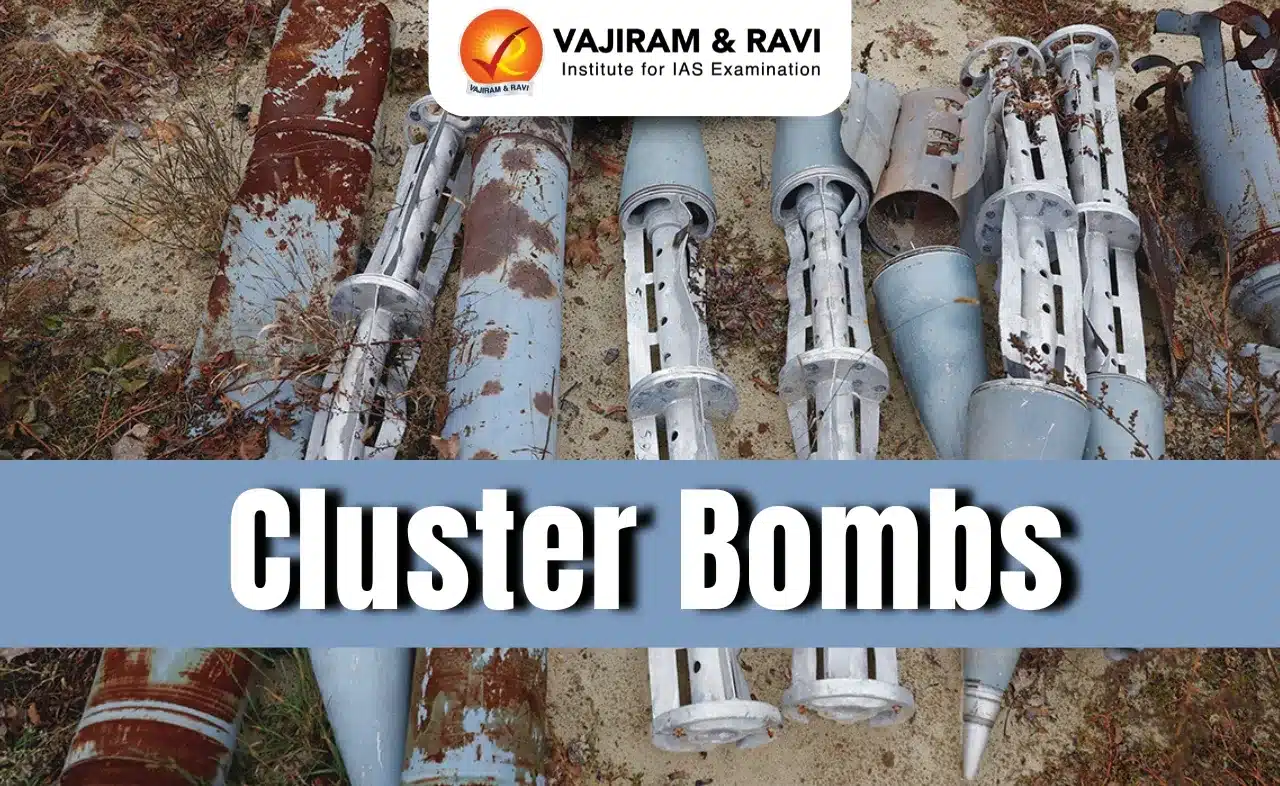
Cluster Bombs Latest News
Iran’s reported use of a cluster bomb during a missile strike on Israel has raised concerns over the nature and dangers of these weapons.
About Cluster Bombs
- Cluster bombs, also called cluster munitions, are explosive weapons that disperse smaller bombs, known as submunitions or bomblets, over a wide area before impact.
- These bomblets are designed to explode upon hitting the ground or after a delay.
- However, many fail to detonate, remaining live and lethal for months or even years, posing long-term risks to civilians.
- Cluster bombs are either air-dropped or ground-launched and can saturate areas as large as several football fields, making them particularly lethal in densely populated areas.
- The submunitions, often grenade-sized with fins or streamers for stabilisation, are designed to cause damage to both personnel and unarmoured vehicles.
- Some modern versions, like the US-made DPICM, feature dual-purpose charges for added effect.
- But the biggest controversy lies in their high “dud rate”, failure to explode on impact, which turns them into de facto landmines. Estimates of dud rates vary widely, from as low as 2 percent to as high as 40 percent.
- The explosive bomblets, when deployed over a wide area, cannot distinguish between military targets and civilians. This makes their use in populated regions particularly devastating.
- The 2008 Convention on Cluster Munitions (CCM), which entered into force in 2010, bans the use, development, production, acquisition, and transfer of cluster munitions.
- So far, 111 countries and 12 other entities have signed the treaty.
- But key nations, including Israel, Iran, the United States, Russia, China, and India, have not joined.
- As per the United Nations, 99% of declared global stockpiles have been destroyed under the treaty.
Cluster Bombs FAQs
Q1: What is a cluster bomb?
Ans: A cluster bomb is a type of explosive weapon that releases or ejects multiple smaller submunitions (called bomblets) over a wide area.
Q2: Why are cluster bombs considered controversial and dangerous long after conflicts end?
Ans: Their bomblets often fail to detonate and remain live for years
Q3: What is the "dud rate" in the context of cluster bombs?
Ans: The percentage of submunitions that fail to explode upon impact.
Q4: What makes cluster bombs particularly lethal in densely populated areas?
Ans: They indiscriminately saturate large areas with explosives.
