
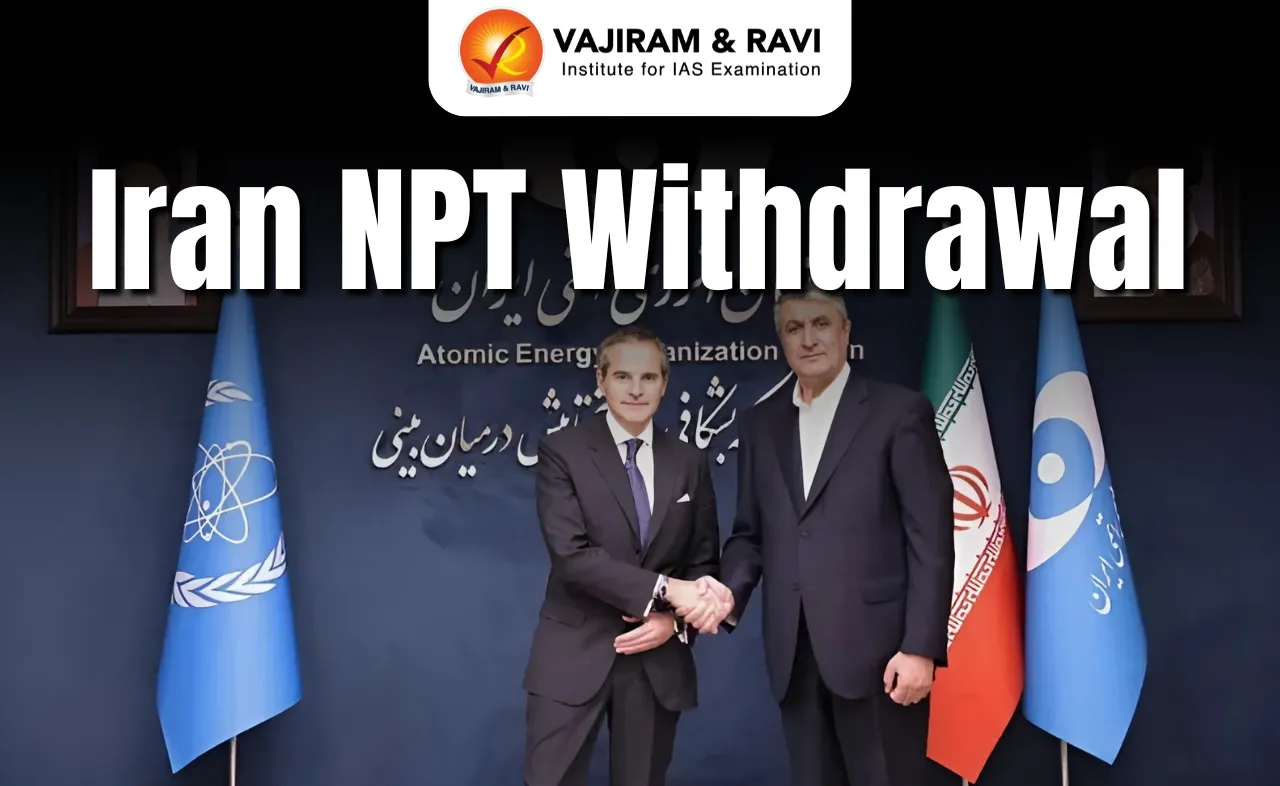
Iran NPT Withdrawal Latest News
- In the wake of rising military tensions, Iran's Parliament is drafting a Bill to potentially withdraw from the Nuclear Non-Proliferation Treaty (NPT).
- This move follows recent Israeli airstrikes on Iranian nuclear facilities, citing concerns that Iran was nearing weapons-grade uranium enrichment.
About The Nuclear Non-Proliferation Treaty (NPT)
- The NPT is a global treaty signed in 1968 and entered into force in 1970, aimed at:
- Preventing the spread of nuclear weapons and technology
- Promoting peaceful uses of nuclear energy
- Supporting nuclear disarmament
Background: Post-World War II Nuclear Concerns
- After the atomic bombings in Japan (1945), nations began a nuclear arms race.
- Alongside, efforts emerged to limit the proliferation of nuclear weapons and technology.
Atoms for Peace Initiative (1953)
- Launched by U.S. President Dwight D. Eisenhower
- Advocated for the peaceful use of nuclear energy
- Paved the way for the formation of the International Atomic Energy Agency (IAEA)
- Introduced a safeguards system to monitor and verify civilian nuclear activities
Safeguards and Verification
- Non-nuclear weapon states must submit detailed reports on nuclear activities
- Allow IAEA inspections to prevent diversion of nuclear materials for weapons
- Part of the “basic bargain”: peaceful nuclear assistance in exchange for oversight
Definition of Nuclear States under the NPT
- Nuclear states are those that tested nuclear weapons before January 1, 1967.
- This included:
- United States
- United Kingdom
- France
- Soviet Union (now Russia)
- China
Membership and Non-Signatories
- 191 countries are parties to the treaty
- Non-signatories include:
- India: Conducted nuclear tests in 1974; opposes the discriminatory nature of the treaty
- Pakistan: Not a signatory
- Israel: Neither confirms nor denies nuclear weapons possession; hasn’t signed
- North Korea: Signed in 1985, withdrew in 2003, expelled IAEA inspectors
Criticism
- Viewed as discriminatory for legitimizing nuclear weapons only for the P5 (UNSC permanent members).
- The 1967 cut-off date is seen as arbitrary, reinforcing a nuclear hierarchy.
How Can a Country Leave the NPT
- Under Article 10 of the Nuclear Non-Proliferation Treaty (NPT):
-
- A country may withdraw if extraordinary events jeopardize its supreme national interests.
- It must notify all treaty parties and the UN Security Council three months in advance, citing those events.
Iran's NPT Membership and Recent Developments
- Iran joined the NPT in 1970, prior to its Islamic Revolution (1979).
- For the first time in nearly 20 years, the IAEA Board of Governors recently censured Iran, citing:
- Repeated failure since 2019 to cooperate fully with the agency.
- Discovery of undeclared nuclear material and activities at multiple sites.
- Iran’s Response
- Iran denied violations, stating it has adhered to its safeguards obligations under the NPT.
- However, tensions have grown, particularly after recent Israeli strikes and Iran’s retaliatory missile attacks.
Implications of Iran Withdrawing from the NPT
- End of IAEA Oversight
- Iran would no longer be subject to IAEA inspections, which averaged 1.4 site visits per day in 2023.
- This would reduce international visibility into Iran’s nuclear activities.
- Risk of Destabilizing the Global Non-Proliferation Regime
- Iran’s withdrawal could set a precedent for other states to follow.
- Could lead to a weakening of global cooperation on nuclear non-proliferation.
- Does Withdrawal Mean Weaponization
- Leaving the NPT does not automatically imply Iran will build nuclear weapons.
- However, historical cases (e.g., North Korea) show that withdrawal may precede weapon development.
- Iran has denied such intentions, but regional instability fuels uncertainty.
- Scholarly Perspective: The Value of NPT
- Experts argue that:
- Even imperfect adherence can significantly slow nuclear proliferation.
- A global treaty can maintain normative pressure until a tipping point is reached, beyond which violations could undermine the regime altogether.
- Experts argue that:
Iran NPT Withdrawal FAQs
Q1: What is the NPT’s main objective?
Ans: To prevent nuclear weapons spread, promote peaceful nuclear energy, and encourage disarmament through global cooperation.
Q2: Can countries legally exit the NPT?
Ans: Yes, by citing extraordinary threats to national interests and giving three months’ notice to treaty members and the UNSC.
Q3: Why is Iran considering leaving the NPT?
Ans: Due to IAEA censure and escalating tensions with Israel over alleged nuclear weapons development.
Q4: What happens if Iran exits the treaty?
Ans: Iran would no longer face IAEA inspections, reducing oversight and raising nuclear proliferation concerns.
Q5: Will NPT withdrawal lead to nuclear arms?
Ans: Not necessarily, but history shows it increases the risk and undermines global non-proliferation frameworks.
