
Quantum Communication Latest News
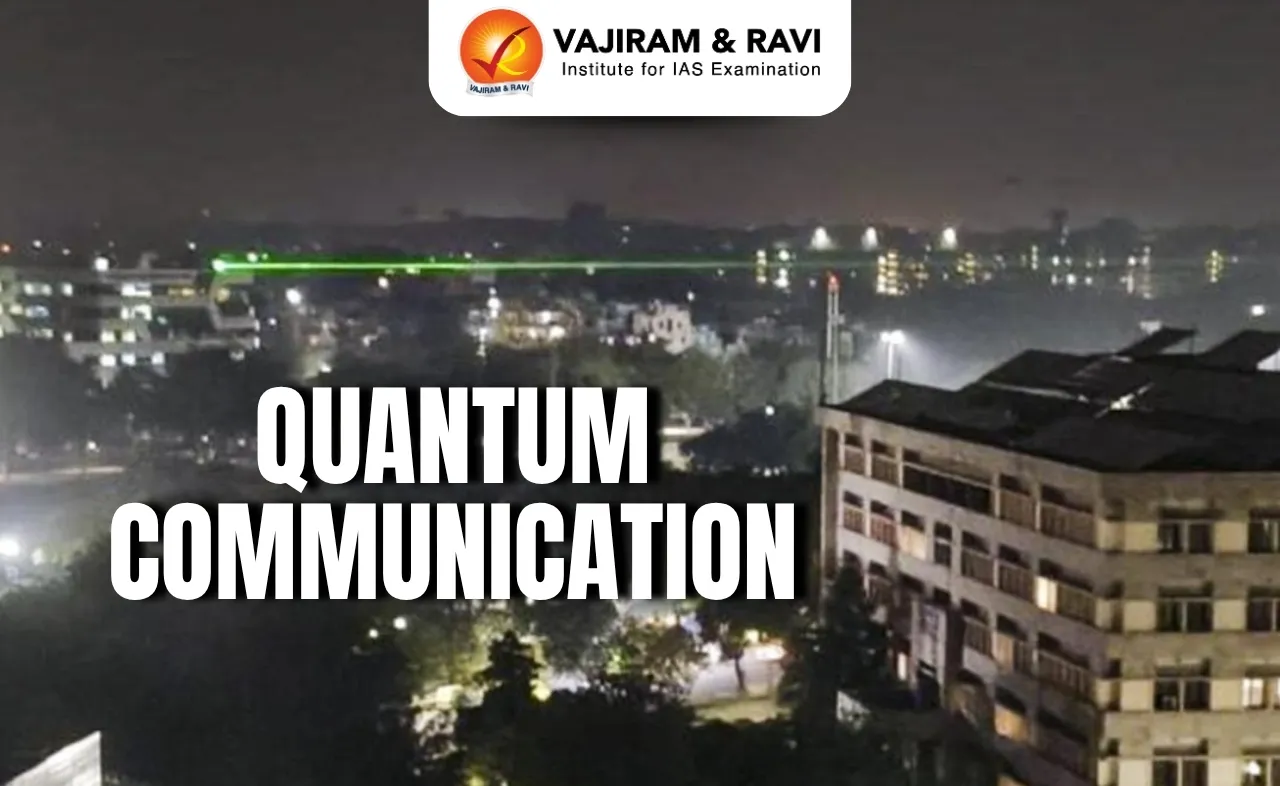
- Recently, the Ministry of Defence announced that IIT-Delhi and DRDO scientists successfully demonstrated quantum communication over a distance of more than 1 km in free space, marking a major breakthrough in quantum cybersecurity.
Understanding Quantum Communication
- About Quantum Communication
- Quantum communication uses principles of quantum physics—especially quantum entanglement—to create highly secure communication channels.
- It ensures that any attempt to intercept the communication is immediately detected.
- The Role of Quantum Entanglement
- Quantum entanglement is a phenomenon where two particles become so closely linked that a change in one instantly affects the other, regardless of the distance between them.
- When two photons are entangled, measuring one instantly determines the state of the other, regardless of distance.
- This makes quantum communication highly resistant to eavesdropping.
- Applications in Defence
- Due to its leak-proof nature, quantum communication is especially valuable in military and national security settings.
- Key Method: Quantum Key Distribution (QKD)
- QKD is a major technique within quantum communication that enables two parties to share encryption keys securely, with any interception attempts being detectable.
Working of Quantum Key Distribution (QKD)
- Purpose of QKD
- QKD enables two parties to securely share a secret encryption key.
- This key is later used to encrypt and decrypt messages using traditional algorithms (e.g., AES).
- QKD Is Not Encryption
- QKD does not encrypt the message itself.
- It only ensures that both parties receive an identical key in a way that cannot be intercepted without detection.
- Just like a letterbox is publicly known but accessible only with a private key, QKD ensures that while the communication channel is known, the key remains private and secure between the sender and receiver.
- Types of QKD
- Prepare-and-Measure QKD
- One person prepares photons in specific quantum states and sends them to another, who measures them to establish a key.
- Entanglement-Based QKD
- A source produces entangled photon pairs—one sent to the first person, the other to the second person.
- The correlated measurements help them derive the same key securely.
- Prepare-and-Measure QKD
- Security Advantage
- Any attempt to intercept the photons in transit disturbs their quantum state, immediately alerting the parties and ensuring tamper detection.
IIT-Delhi’s Quantum Communication Achievement
- Latest Breakthrough: 1 km Free-Space QKD
- The IIT-Delhi team successfully demonstrated entanglement-based Quantum Key Distribution (QKD) over 1 km through open air on the IIT campus.
- This marks progress beyond fibre-based transmission.
- The photons travel through open air, not through cables or fibres.
- This is useful for communicating over long distances, even between buildings or from the ground to satellites.
- Towards Satellite-Based QKD
- The experiment aims to lay the groundwork for ground-to-satellite QKD, where satellites could beam encryption keys securely to any location across India via atmospheric transmission.
- Performance Metrics
- Secure key rate: ~240 bits per second
- Quantum bit error rate (QBER): Less than 7%
- This low error rate is acceptable and shows the system’s viability despite challenges like air turbulence, detector noise, and ambient light.
- How It Works
- Entangled photons were sent to two receivers.
- When both receivers measured their respective photons, results matched over 93% of the time—validating entanglement and secure key distribution.
- Past Milestones by IIT-Delhi Team
- 2022: Quantum link between Vindhyachal and Prayagraj
- 2023: 380 km QKD using telecom fibre (QBER: 1.48%)
- 2024: QKD over 100+ km optical fibre link
- These progressive steps showcase India’s growing capability in quantum-secure communication infrastructure.
What Lies Ahead for Quantum Communication in India
- Building a Quantum Communication Network
- The next step is to establish a multi-node quantum network, enabling secure communication across various locations.
- India aims to join global leaders like China, which already has a 4,600 km hybrid quantum network combining satellite and optical links.
- Civilian Applications
- Quantum communication also holds promise for banking, telecom, and data security—where ultra-secure channels are vital to protect sensitive information.
- Towards a Quantum Internet
- A future quantum internet could revolutionise:
- Distributed quantum computing
- Precision sensing
- Secure time synchronisation
- Highly encrypted communication networks
- The U.S. is targeting such a network by the mid-2030s.
- A future quantum internet could revolutionise:
- Government Support: National Quantum Mission
- To accelerate progress, the Indian government launched the National Quantum Mission in 2023, allocating Rs 6,000 crore for the 2023–2031 period to support research and infrastructure development in quantum technologies.
Quantum Communication FAQs
Q1: What is quantum communication?
Ans: Quantum communication uses entangled particles to ensure ultra-secure data transfer by detecting any eavesdropping attempts instantly.
Q2: How does QKD work?
Ans: Quantum Key Distribution securely shares encryption keys between two parties using photons, ensuring any interception attempt is immediately detected.
Q3: What did IIT-Delhi achieve?
Ans: They demonstrated 1 km entanglement-based QKD in open air with a 93% success rate and minimal quantum bit error.
Q4: Why is quantum communication important?
Ans: It provides leak-proof, tamper-detectable communication vital for defense, banking, telecom, and future quantum internet infrastructure.
Q5: What’s India’s future in quantum tech?
Ans: India launched a ₹6,000 crore National Quantum Mission to build networks, support R&D, and lead in quantum technologies by 2031.
