
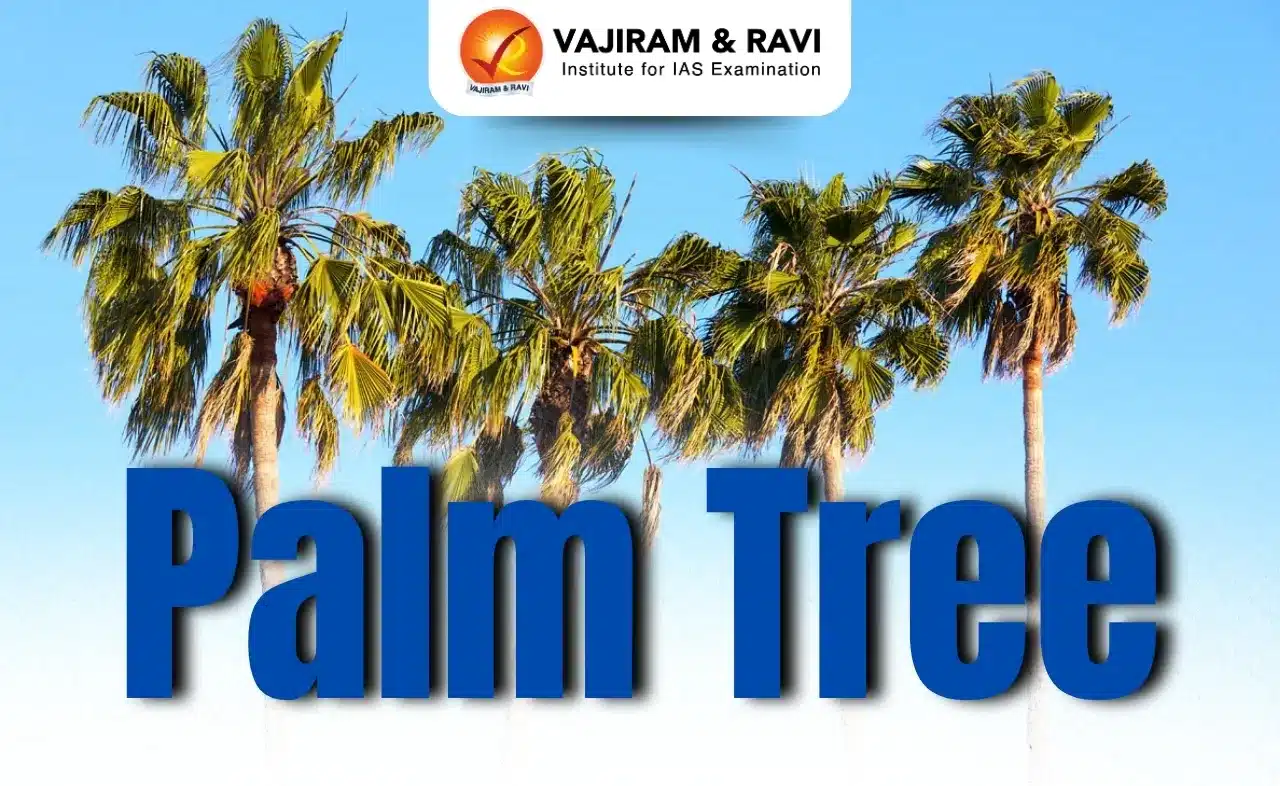
Palm Tree Latest News
The National Green Tribunal (NGT) has sought a response from the Central Pollution Control Board (CPCB) and others in a matter related to the large-scale felling of palm trees in Bihar which is reportedly causing an increase in lightning-related deaths.
About Palm Tree
- Palm is a member of the Arecaceae, or Palmae, a single family of monocotyledonous flowering plants of the order Arecales.
- It is an evergreen plant which can grow in the form of shrubs, trees, or long, woody vines called lianas.
- Distribution: It is distributed in America and in Asia, from India to Japan and south to Australia and the islands of the Pacific and Indian oceans, with Africa and Madagascar as a third but much less important palm region.
Characteristics of Palm Tree
- They are characterized by a tall, unbranched stem or, rarely, by a dichotomous branching stem (Hyphaene), and of the same diameter all along from base to top;
- Palmate leaves, like hands, grow in a bunch at the end of a stem. Pinnate leaves are like feathers, growing all along either side of a stem.
- Though many species of palms are sturdy and plentiful, as many as 100 species are endangered due to deforestation and unsustainable cultivation practices.
- The palms with the greatest importance in world commerce are the coconut and the African oil palm (Elaeis guineensis); both are prime sources of vegetable oil and fat.
Source: TH
Palm Tree FAQs
Q1: What are the uses of palm trees?
Ans: In addition to the fruit, other parts of the palm are used: the fermented sap (palm wine and alcohol), the heart (palm cabbage), the stem (furniture making), the fronds (roofing).
Q2: What is Palm Oil?
Ans: Palm oil is an edible oil that comes from the fruit of the oil palm tree (Elaeis guineensis). Crude palm oil, or “red palm oil,” is high in beta-carotene.
