
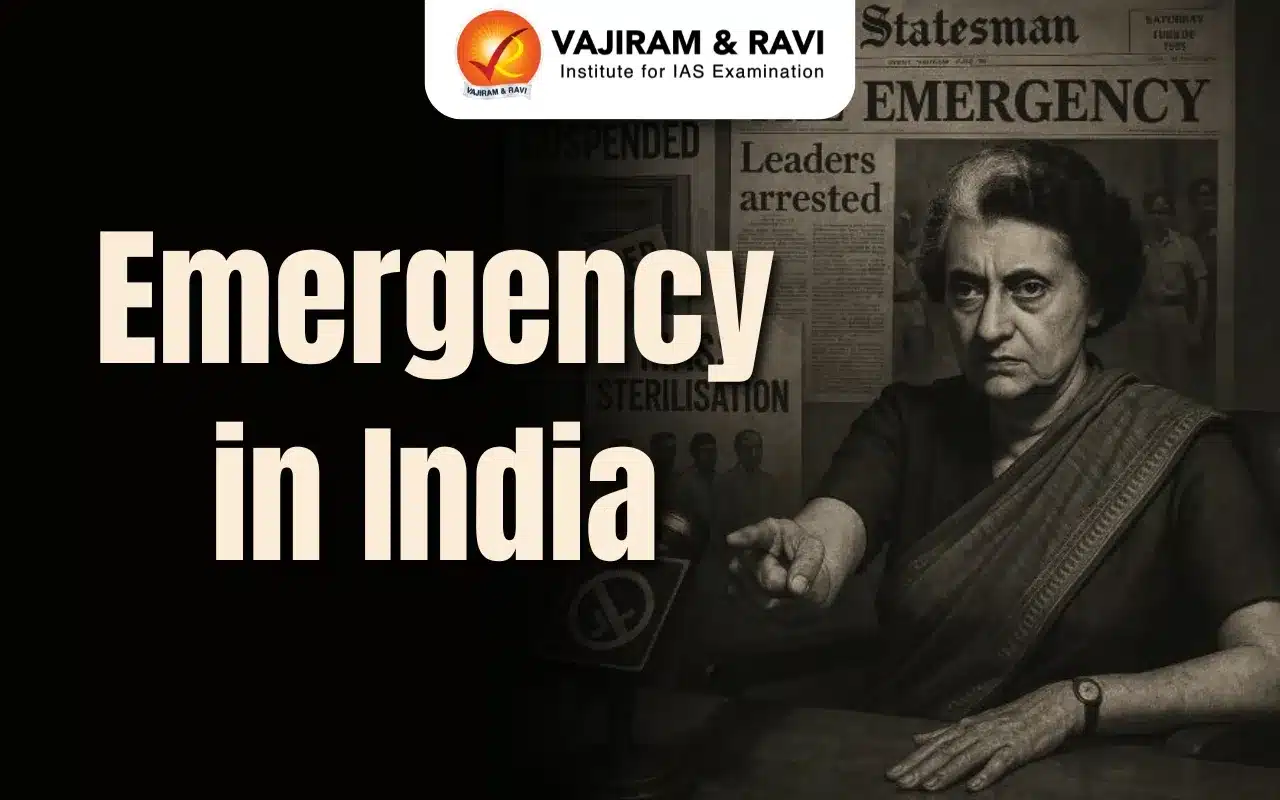
Emergency in India Latest News
- On June 25, 1975, exactly 50 years ago, Emergency was imposed in India — marking a 21-month period widely considered one of the darkest chapters in the country's democratic history.
- During this time: Civil liberties were suspended; Press freedom was curtailed; Mass arrests of opposition leaders occurred; Elections were cancelled.
- The country was governed by rule through decrees, bypassing democratic institutions. This period remains a stark reminder of the fragility of democratic freedoms.
Backdrop to the Emergency
- Indira Gandhi won a landslide victory in 1971, but her government soon faced multiple crises:
- Economic strain from the 1971 India-Pak war, droughts, and the 1973 oil crisis
- Rising corruption, misgovernance, and state excesses
- These factors triggered widespread public dissatisfaction.
The Rise of Student Movements and Jayaprakash Narayan
- In February 1974, Gujarat’s Navnirman Movement led to the resignation of CM Chimanbhai Patel over corruption.
- This inspired a student-led protest in Bihar, uniting socialist and right-wing groups under the Chhatra Sangharsh Samiti.
- Jayaprakash Narayan (JP), a Gandhian and Quit India Movement veteran, took charge of the movement.
- On June 5, 1974, from Patna’s Gandhi Maidan, JP gave the iconic call for “Sampoorna Kranti” (Total Revolution), mobilising mass support across Bihar and beyond.
Nationwide Agitation and the Call for Change
- In May 1974, George Fernandes led a railway workers’ strike, paralysing Indian Railways.
- Through 1974 and early 1975, the JP Movement gained national momentum.
Trigger: Court Verdict Against Indira Gandhi
- On June 12, 1975, the Allahabad High Court convicted Indira Gandhi of electoral malpractice, invalidating her Lok Sabha election from Rae Bareli.
- This intensified calls for her resignation.
Declaration of Emergency: June 25, 1975
As dissent peaked, President Fakhruddin Ali Ahmed signed the Emergency proclamation late on June 25, 1975.
Emergency Rule by Decree (1975–1977)
From June 25, 1975, to March 21, 1977, Indira Gandhi's government exercised extraordinary constitutional powers, drastically altering India’s democratic structure.
Centre Tightens Control: Federalism Undermined
- India’s federal structure became de facto unitary.
- State governments remained in place but were effectively controlled by the Centre.
- Parliament legislated on State List subjects, and constitutional provisions on Union-State financial allocation were altered with parliamentary approval.
Mass Arrests and Suppression of Dissent
- Over 1.12 lakh people were detained under harsh laws:
- MISA (Maintenance of Internal Security Act)
- Conservation of Foreign Exchange and Prevention of Smuggling Activities Act (COFEPOSA)
- Defence of India Act and Rules (DISIR)
42nd Constitutional Amendment: Judicial Powers Curtailed
- Passed in 1976, the 42nd Amendment:
- Stripped the judiciary of the power to hear election petitions
- Expanded Union powers to override state matters
- Gave Parliament absolute authority to amend the Constitution
- Made laws implementing Directive Principles immune to judicial review
Censorship and Attack on the Press
- Article 19(1)(a) — the right to freedom of speech — was curtailed.
- Newspapers were placed under pre-censorship.
Extension of Lok Sabha Tenure
In 1976, when elections were due, Parliament extended its term by one year, delaying democratic restoration.
The Emergency Module
- Though legally framed, these actions led to a dark phase in Indian democracy, marked by the erosion of rights and constitutional norms.
- This decline stemmed from the weaponisation of laws, judicial subversion, and disregard for the rule of law—elements now recognized by scholars as early warning signs of democratic collapse.
Weaponisation of Laws: Targeting Dissent
- The 39th Constitutional Amendment:
- Placed MISA in the Ninth Schedule, shielding it from judicial review.
- Made elections of key constitutional posts non-justiciable, preempting the SC verdict on Indira’s disqualification.
Subversion of Judicial Independence
- The Emergency era witnessed manipulation of judicial appointments to ensure a “committed judiciary”.
- In 1977, Justice M H Beg was appointed Chief Justice, superseding Justice H R Khanna, the senior-most judge.
- Justice Khanna had dissented in the infamous habeas corpus case, opposing the suspension of civil liberties.
- This politicisation of the judiciary severely undermined judicial autonomy and public trust.
Erosion of the Rule of Law
- Courts often sided with the state, offering legal impunity for Emergency excesses.
- Detained citizens were denied due process or the benefit of legal protections.
- Constitutional amendments were passed while Opposition leaders were jailed, making a mockery of democratic lawmaking.
Key Takeaway: Vigilance is the Price of Liberty
- The lessons of the Emergency highlight the need to:
- Recognize early signs of authoritarianism
- Strengthen institutional checks
- Safeguard civil liberties
- Promote constitutional values
- Repeating these lessons is essential to prevent democratic backsliding in any era.
Emergency in India FAQs
Q1: What triggered the 1975 Emergency in India?
Ans: Indira Gandhi was disqualified by the court; unrest and political dissent led to the imposition of Emergency.
Q2: How did Emergency impact civil liberties?
Ans: Civil liberties were suspended; dissent silenced through arrests, press censorship, and harsh preventive detention laws like MISA.
Q3: What was the 42nd Amendment’s role during Emergency?
Ans: It curtailed judicial power, strengthened Parliament, and shielded laws from review, centralizing authority dangerously.
Q4: Who resisted Emergency among journalists and leaders?
Ans: Leaders like JP Narayan and journalists like Kuldip Nayar resisted; The Indian Express famously protested censorship with blank pages.
Q5: What is the key lesson from the Emergency?
Ans: Democratic freedoms require constant vigilance; misuse of legal provisions can rapidly erode constitutional norms and public accountability.
