
Salkhan Fossil Park Latest News
Recently, the Salkhan Fossil Park has been added to UNESCO’s Tentative List for World Heritage Sites.
About Salkhan Fossil Park
- It is also known as Sonbhadra Fossils Park located in the state of Uttar Pradesh.
- It is nestled amidst the verdant embrace of the Kaimoor Wildlife Sanctuary and within the Vindhyan mountain range.
- It is home to a rich repository of fossils dating back approximately 1.4 billion years, making it one of the oldest and most well-preserved fossil sites in the world.
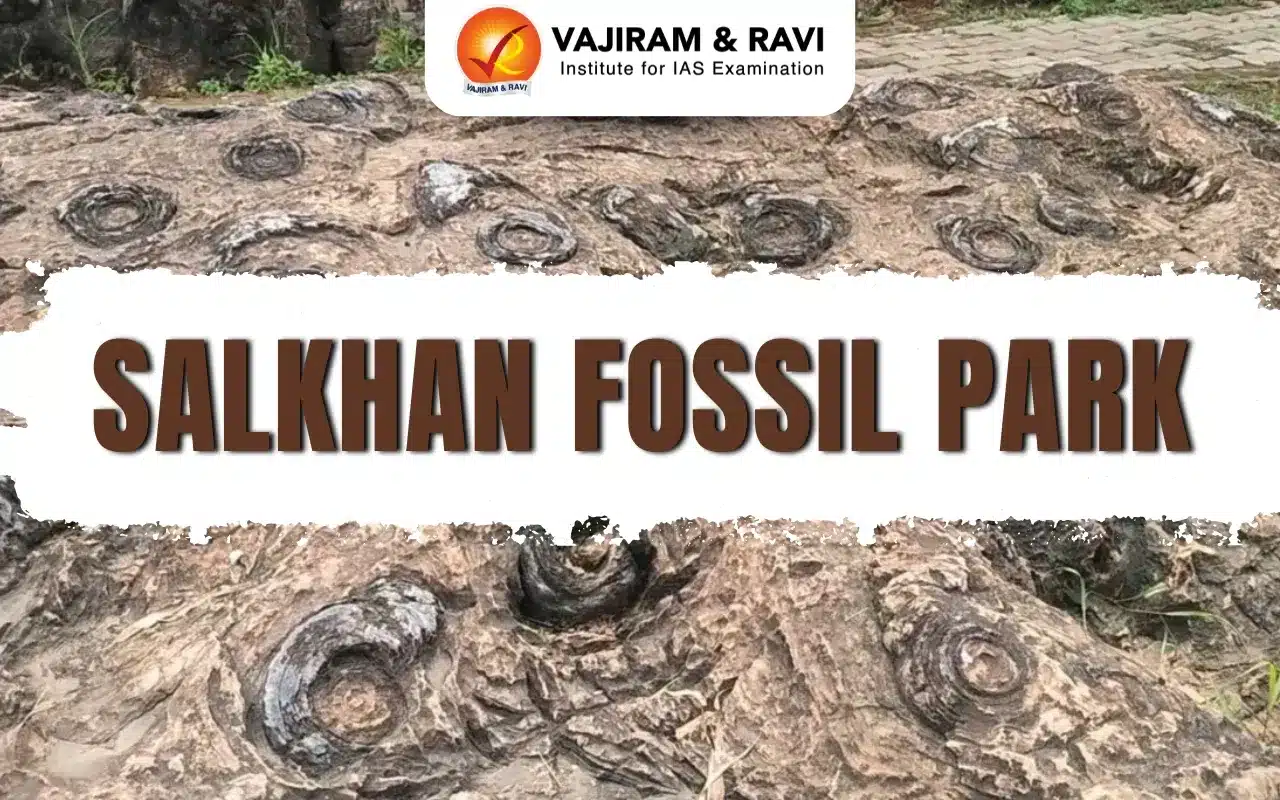
- The site’s fossil assemblage, scattered across various formations, primarily features an exceptional collection of stromatolites, i.e. formations created by communities of cyanobacteria or blue-green algae.
- It is home to Prehistoric stromatolites and living relics of the Mesoproterozoic.
- Salkhan is much older than sites like Shark Bay in Australia and Yellowstone the USA.
- The site’s Proterozoic stromatolites illustrate a critical watershed in the early history of life on Earth: The Great Oxidation Event.
- Salkhan Fossil Park Significance: The diversity of stromatolite morphologies at the park—ranging from domal to columnar structures—reflects dynamic environmental conditions in the Proterozoic, including variations in water depth, sedimentation, and wave activity.
- It falls under one of the key geo-heritage interest categories indicated by IUCN – ‘Evolution of life’ - in the 2020 ‘Guidelines for geoconservation in protected and conserved areas’.
Source: TOI
Salkhan Fossil Park FAQs
Q1: What fossil is Salkhan Fossil Park known for?
Ans: Stromatolites
Q2: Which is Asia's oldest fossil park?
Ans: Shivalik Fossil Park
Q3: What is meant by stromatolites?
Ans: Stromatolites are mineral structures built by microorganisms.
