
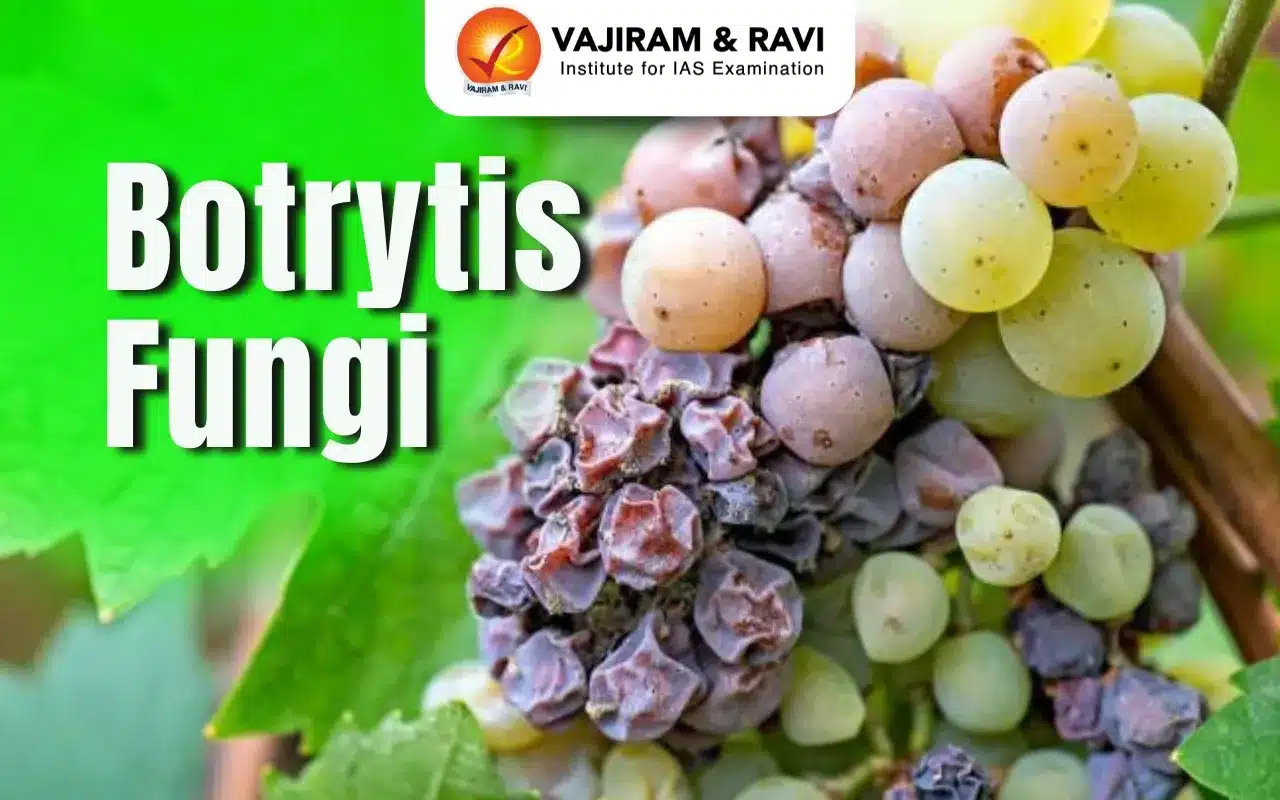
Botrytis Fungi Latest News
Recently, researchers from Sichuan University and the University of British Columbia have found that botrytis fungi (Botrytis cinerea) cannot be cloned.
About Botrytis Fungi
- It is a widespread necrotrophic fungal pathogen.
- Botrytis cinerea needs to obtain nutrients before it can penetrate a plant.
- Dead or damaged plant tissue, such as old flower petals, can provide nutrients that the fungus needs.
- Owing to this feeding source, the infection gains strength and spreads to healthy plant tissues. A brownish rot develops in newly infected tissues, which is how Botrytis cinerea deteriorates plants.
- These fungi usually attack blossoms and fruit, but they can also cause rot and blight on buds, stems, leaves, roots, bulbs, and tubers.
- The fungus typically targets fragile, wounded, aging, or dead plant parts.
- It infects grapes, penetrates the skin, causes the berries to lose water by evaporation and shrivel up, and thus concentrates the sugars and flavours in them.
- It was also found recently that this fungi exhibits an unusual idiosyncrasy.
- In these fungi, no single nucleus contains a complete set of chromosomes. Instead, the chromosome set is distributed across two or more nuclei, and any one nucleus contains only a subset.
- It requires warm temperatures, high humidity, and prolonged wetness which facilitate easy fungus inoculation.
- Additionally, it can release organic acids, such as oxalic acid, which acidify the surrounding environment.
Source: TH
Botrytis Fungi FAQ's
Q1: What type of fungus is Botrytis?
Ans: Botrytis is a genus of anamorphic fungi in the family Sclerotiniaceae.
Q2: What temperature kills Botrytis?
Ans: The results demonstrated that B. cinerea spores can be inactivated by heat treatments using relatively low temperatures (42-46 °C).
