Agriculture Output Report, Fruits Surge, Cereals Decline in India

Agriculture Output Report

Agriculture Output Report Latest News

  • New data from the Ministry of Statistics and Programme Implementation (MoSPI) reveals shifting food habits and consumption patterns, as farmers adapt by producing more high-value crops. 
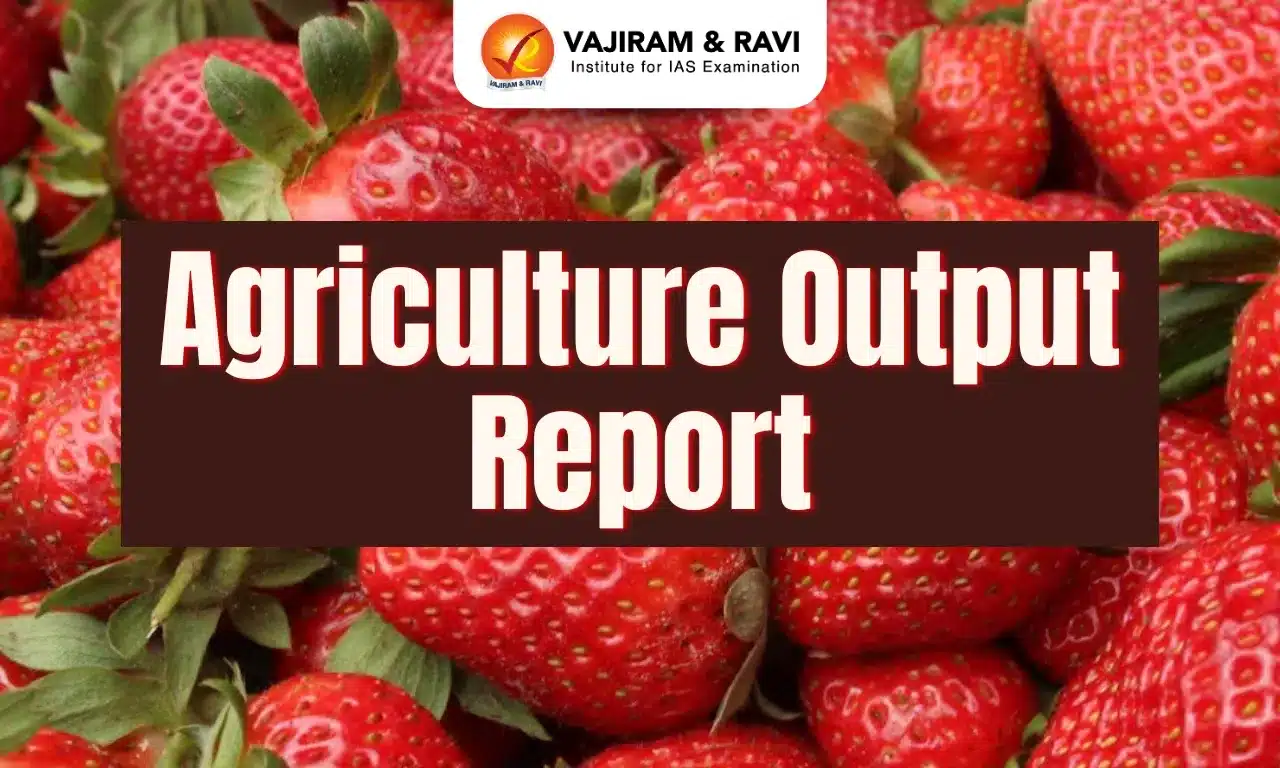
  • Over the past decade, the Gross Value of Output (GVO) has seen the highest rise in fruits like strawberries and pomegranates, and vegetables like parwal and mushrooms. 
    • Gross Value of Output, or GVO, is a measure of production that refers to the total value of the items produced before subtracting the value of inputs used in production.

Agriculture Output Report

  • The National Statistics Office (NSO), under the Ministry of Statistics and Programme Implementation (MoSPI), has released the annual “Statistical Report on Value of Output from Agriculture and Allied Sectors (2011-12 to 2023-24)”. 
  • The report provides comprehensive data on the value of output from crops, livestock, forestry & logging, and fishing & aquaculture, at both current and constant (2011–12) prices.

Key Highlights of the Agriculture Output Report

  • Reflecting evolving food habits, farmers are increasingly shifting from traditional staples to high-value crops. 
  • New data highlights a significant transformation in agricultural output trends over the past decade.

Robust Growth in Agriculture GVA at Current Prices

  • The Gross Value Added (GVA) of agriculture and allied sectors at current prices grew by approximately 225%, rising from ₹1,502 thousand crore in 2011–12 to ₹4,878 thousand crore in 2023–24.

Steady Rise in GVO at Constant Prices

  • The GVO at constant (2011–12) prices increased by about 54.6%, from ₹1,908 thousand crore in 2011–12 to ₹2,949 thousand crore in 2023–24, indicating consistent real growth in the sector.

Sharp Rise in High-Value Fruits and Vegetables

  • Between 2011–12 and 2023–24, the Gross Value of Output (GVO) of certain fruits and vegetables surged dramatically:
    • Strawberries: GVO rose over 40 times to ₹55.4 crore (constant prices), and nearly 80 times to ₹103.27 crore (current prices).
    • Parmal (Parwal): Increased 17-fold to ₹789 crore.
    • Pumpkin: Rose nearly 10 times to ₹2,449 crore.
    • Pomegranate: Grew over 4 times to ₹9,231 crore.
    • Mushrooms: Jumped 3.5 times to ₹1,704 crore.

Meat Gains, Cereals Lose Share in Agri Output

  • Meat: Its share in the GVO of agriculture and allied sectors rose from 5% in 2011–12 to 7.5% in 2023–24.
  • Cereals: Declined from 17.6% to 14.5% over the same period, indicating a diversification away from staple grains.

Spices Also on the Rise

  • Improved processing and growing demand boosted the GVO of spices, especially dry ginger, which surged by 285% to ₹11,004 crore.

Rising Incomes Drive Shift Toward Animal and Fruit-Based Diets

  • As incomes increased, the share of meat in agriculture GVO rose from 5% to 7.5% between 2011–12 and 2023–24. 
  • However, the 131% growth in meat GVO was still lower than that of strawberries and other high-value crops.

Modest Rise in Fruit Consumption Despite Output Growth

  • Despite production growth, fruit consumption as a share of Monthly Per Capita Consumption Expenditure (MPCE) remained low:
    • Rural MPCE: Rose from 2.25% to 2.66%
    • Urban MPCE: Slight dip from 2.64% to 2.61%
  • Yet, more rural households are now consuming fruits: From 63.8% in 2011–12 to 90.3% in 2022–23, especially among the bottom 20% income group.

Cereals See Decline in Consumption and Output Share

  • Reflecting changing dietary patterns:
    • Urban MPCE on cereals fell from 6.61% to 3.74%
    • Rural MPCE on cereals fell from 10.69% to 4.97%
    • GVO share of cereals dropped from 17.6% to 14.5%

Agriculture Output Report - Analysis

  • MoSPI data indicates a shift from cereals to fruits, vegetables, spices, and meat, driven by:
    • Technological advancements
    • Changing consumer preferences
    • Policy focus on nutrition and exports
    • Expanding market opportunities
  • Consistent with Engel’s Law, food’s share in MPCE declined as incomes rose:
    • Rural areas: From 52.90% (2011–12) to 47.04% (2023–24)
    • Urban areas: From 42.62% to 39.68%
      • Engel's Law states that as a household's income increases, the proportion of income spent on food decreases, while the proportion spent on other goods and services, like luxury items, increases. 

Source: IEPIB

Agriculture Output Report FAQs

Q1: Which crops saw highest GVO growth?

Ans: Strawberries, parwal, pumpkin, pomegranate, and mushrooms saw major GVO rise from 2011–12 to 2023–24.

Q2: What is Gross Value of Output (GVO)?

Ans: GVO is the total value of production before subtracting input costs, reflecting agriculture sector output trends.

Q3: How did cereal share in GVO change?

Ans: Cereals' GVO share declined from 17.6% to 14.5%, indicating diversification toward high-value crops.

Q4: Has meat output increased in India?

Ans: Yes, meat's GVO share rose from 5% to 7.5%, showing changing dietary preferences with rising incomes.

Q5: What consumer trend does the report show?

Ans: Shift toward fruits, vegetables, meat and spices with decreasing share of food in monthly expenditure, especially in urban areas.

Factors Behind Monsoon’s Early Nationwide Arrival in 2025

Early Monsoon 2025

Early Monsoon 2025 Latest News

  • The southwest monsoon covered the entire country by June 29, nine days earlier than its usual date of July 8. 
  • This is only the tenth time since 1960 that the monsoon achieved nationwide coverage in June.

Early Onset in Kerala Set the Pace

  • The monsoon arrived in Kerala on May 24, eight days earlier than usual, driven by an active Madden-Julian Oscillation (MJO) phase in mid-May. 
  • This early onset laid the foundation for the monsoon’s rapid progress.
  • Monsoon Progress: Mostly Ahead of Schedule
    • South, East, and Northeast India saw early arrival.
    • Northwest India was near normal.
    • Central India witnessed slight delays.
  •  

Key Drivers of the Monsoon’s Rapid Advance

  • The southwest monsoon covered the entire country by June 29, nine days ahead of its normal schedule of July 8. 
  • This marks only the tenth instance since 1960 that nationwide monsoon coverage occurred in June.

Low Pressure Systems

  • India experienced five low-pressure systems in June. 
  • These act as moisture magnets, drawing in rain-bearing winds and accelerating monsoon movement inland.

Active Madden-Julian Oscillation (MJO)

  • MJO is a moving system of clouds, rainfall, winds, and pressure near the equator that travels eastward. 
  • When active near India, it enhances monsoon by increasing cloud cover and moisture, leading to stronger rainfall. 
  • An active MJO phase significantly boosts monsoon onset and progression.
  • June continued to see an active MJO, enhancing cloud formation and pushing rainfall northwards, aiding monsoon spread.

Favourable Monsoon Trough Position

  • The monsoon trough is an elongated low-pressure area extending from northwest India to the Bay of Bengal. 
  • It plays a key role in determining rainfall distribution during the monsoon. 
  • A favourable monsoon trough position, especially when it shifts south of its normal, helps draw in moisture-laden winds from the oceans, intensifying rainfall over central and northern India. 
  • Its position influences the strength, spread, and duration of monsoon rains.
  • The monsoon trough remained south of its normal position, facilitating increased moisture inflow and early rainfall across regions.

Neutral ENSO (El Niño-Southern Oscillation) Condition

  • ENSO is a climate pattern involving temperature fluctuations in the central and eastern tropical Pacific Ocean, with three phases: El Niño, La Niña, and Neutral.
  • A neutral ENSO phase means sea surface temperatures are close to average. 
  • This phase neither suppresses nor excessively enhances rainfall, allowing the Indian monsoon to progress normally, supporting stable and widespread rainfall patterns.
  • ENSO was in a neutral phase, supporting normal monsoon rainfall.

Neutral IOD (Indian Ocean Dipole) Conditions

  • An is a climate phenomenon marked by differences in sea surface temperatures between the western and eastern Indian Ocean. 
  • It has positive, negative, and neutral phases.
  • A neutral IOD phase means there is little to no temperature difference between the two regions, resulting in minimal influence on the Indian monsoon
  • This allows monsoon rainfall to be primarily driven by other favorable factors like MJO and ENSO.
  • This year, IOD also remained neutral, having minimal impact—neither enhancing nor suppressing rains.

Conclusion

  • This year’s monsoon has been marked by early onset, rapid progression, sudden pauses, and localised weather disasters. 
  • With much of the season still ahead, it remains uncertain whether the pattern will stabilise or intensify further.

Source: IEDTE | IE

Early Monsoon 2025 FAQs

Q1: What caused early monsoon in 2025?

Ans: Active MJO, multiple low-pressure systems, and favorable monsoon trough helped the monsoon advance rapidly across India.

Q2: What is the role of MJO in monsoon?

Ans: MJO brings increased moisture and cloud cover, enhancing monsoon strength and rainfall across India during its active phase.

Q3: How does ENSO affect Indian monsoon?

Ans: Neutral ENSO conditions help maintain stable rainfall, unlike El Niño, which suppresses monsoon activity across India.

Q4: Why is monsoon trough important?

Ans: Its southward position helps pull moisture-laden winds inland, boosting rainfall in central and northern India.

Q5: Did IOD play a role in the 2025 monsoon?

Ans: IOD remained neutral, having minimal influence, allowing MJO and low-pressure systems to dominate monsoon dynamics.

Outcome-Driven Data for Empowering Governance: A Path to Viksit Bharat

Outcome-Driven Data for Empowering Governance

Governance Latest News

  • India is shifting toward outcome-driven monitoring to enhance governance effectiveness, with several states piloting innovative data use frameworks to improve public service delivery.

Introduction: Shaping Viksit Bharat through Better Data Use

  • In the journey toward a "Viksit Bharat" (Developed India), public service delivery must transcend traditional bureaucratic frameworks to become outcome-oriented, citizen-centric, and transparent. 
  • This transformation hinges on the effective use of data, not as a tool for inspection, but as a catalyst for improvement. 
  • While India generates extensive data across sectors, nutrition, education, health, and livelihoods, the current system often focuses on inputs rather than results
  • The call is clear: move from data fatigue to meaningful, informed action that supports better decision-making, empowers frontline workers, and addresses local needs dynamically.

India’s Expansive but Fragmented Data Ecosystem

  • India’s governance ecosystem is replete with data sources:
    • Unified District Information System for Education (UDISE+)
    • Health Management Information System (HMIS)
    • National Family Health Survey (NFHS)
    • National Sample Survey (NSS)
  • Despite these efforts, the emphasis largely remains on input tracking, school enrolments, food distribution, or health supplies, while outcome measures (like literacy, nutrition, or treatment success) receive less attention. 
  • Furthermore, national surveys are often too broad, infrequent, and disconnected from local programs
  • This results in frontline workers feeding data upwards without clarity on its practical relevance.

The 4As Framework: Making Data Actionable

  • To reimagine monitoring, a 4As framework is proposed:
    • Ascertain - Identify the few critical outcomes that matter most.
    • Assess - Embed regular, low-burden assessments to track progress.
    • Assist - Support field workers through mentoring, training, and feedback.
    • Adapt - Modify strategies based on real-time feedback and citizen needs.
  • This shift reorients monitoring from quantity to quality, creating feedback loops that not only track progress but also drive it.

Learning from State-Level Innovations

  • States like Uttar Pradesh, Andhra Pradesh, Telangana, and Odisha are already experimenting with outcome-oriented data systems.
  • Uttar Pradesh launched the NIPUN Bharat Mission, starting with the fundamental question, “What should a child learn by the end of each grade?” Weekly learning goals, termed Lakshyas, were integrated into teacher training and review meetings. No new structures were created, existing ones were streamlined to work in coherence.
  • Andhra Pradesh, under a pilot programme, integrated real-time dashboards with mentoring and field visits. This approach led to a 20% improvement in foundational learning in just one year.
  • Telangana uses its Human Development and Livelihood Survey (HDLS) to track annual citizen outcomes. This has enabled dynamic resource allocation and rapid course correction. Similarly, self-reporting, managerial oversight, and citizen feedback in the rural development department have built a culture of accountability without blame.
  • Odisha’s schools now conduct quarterly block-level teacher meetings, not just for data reporting but for collaborative problem-solving based on that data.

Embedding Analytics for Institutional Capacity

  • To move from episodic to systemic improvements, the authors propose setting up Data Analytics Units (DAUs) within planning departments. 
  • These units can synthesise data from multiple sources, routine programme records, citizen feedback, and real-time surveys, to offer integrated insights that inform policy.
  • This shift enables departments to not only measure impact but also evolve based on what the data reveals. Rather than being passive collectors, these DAUs can become active agents in improving governance outcomes.

Source: IE

Outcome-Driven Data for Empowering Governance FAQs

Q1: What is outcome-driven monitoring?

Ans: Outcome-driven monitoring is a governance approach that uses data to assess and improve citizen-centric results, not just track inputs.

Q2: What is the 4As framework proposed in the article?

Ans: The 4As stand for Ascertain, Assess, Assist, and Adapt—key steps to make data purposeful and actionable.

Q3: How has Uttar Pradesh implemented outcome monitoring in schools?

Ans: Uttar Pradesh’s NIPUN Bharat Mission uses weekly learning goals and training to improve foundational learning through better alignment.

Q4: What role do Data Analytics Units (DAUs) play in public systems?

Ans: DAUs help synthesize diverse data sources to generate actionable insights for better programme design and monitoring.

Q5: How is Telangana using outcome data for citizen benefit?

Ans: Telangana’s HDLS and rural development feedback systems are helping departments identify delivery gaps and act swiftly to improve services.

Employment Linked Incentive Scheme: India’s Bold Push for Jobs in Manufacturing

Employment Linked Incentive Scheme

Employment Linked Incentive Latest News

  • The Union Cabinet on 1st July 2025 approved an Employment-Linked Incentive (ELI) scheme with an allocation of Rs. 99,446 crore to support employment generation.

India Launches ELI Scheme to Boost Job Creation and Formal Workforce

  • The Union Cabinet, chaired by Prime Minister Narendra Modi, has approved the landmark Employment Linked Incentive (ELI) Scheme with a financial outlay of Rs. 99,446 crore. 
  • The scheme is part of the government’s larger vision to generate over 3.5 crore jobs over two years, with special emphasis on integrating first-time employees and promoting employment in the manufacturing sector.
  • This ambitious scheme was announced in the Union Budget 2024-25 as part of a Rs. 2 lakh crore employment and skilling package aimed at supporting 4.1 crore youth through a combination of direct incentives, skilling initiatives, and social security expansion.

Objectives and Scope of the ELI Scheme

  • The Employment Linked Incentive (ELI) Scheme aims to tackle key challenges in India’s labour market, namely low formalisation, slow job growth in manufacturing, and limited incentives for youth entering the workforce. 
  • The dual focus of the scheme, supporting first-time employees and incentivising employers, is structured to make hiring both appealing and sustainable.
  • The scheme is applicable to jobs created between August 1, 2025, and July 31, 2027. It has two core components:
  • Part A: Incentives for First-Time Employees
    • Part A of the scheme is designed for first-time employees registering with the Employees’ Provident Fund Organisation (EPFO). Under this component:
    • Employees with monthly salaries up to Rs. 1 lakh will be eligible.
    • Each eligible employee will receive one month’s EPF wage (up to Rs. 15,000) in two instalments:
      • The first instalment will be disbursed after six months of continuous service.
      • The second instalment will be released after 12 months and the completion of a mandatory financial literacy programme.
    • A portion of the incentive will be held in a savings instrument or deposit account to encourage long-term financial planning.
    • This part of the scheme is expected to benefit 1.92 crore first-time workers, helping them integrate into the formal economy while providing a safety net through social security.
  • Part B: Incentives for Employers to Generate Jobs
    • The second component of the scheme targets employers to boost job creation across sectors, with a significant thrust on manufacturing. 
    • Incentives will be disbursed to employers who create additional employment and retain those employees for at least six months.
    • Key highlights include:
      • Employers will receive monthly incentives for every new employee hired:
        • Rs. 1,000 for salaries up to Rs. 10,000
        • Rs. 2,000 for salaries between Rs. 10,001 and Rs. 20,000
        • Rs. 3,000 for salaries above Rs. 20,000 (up to Rs. 1 lakh)
      • To qualify, employers must add:
        • At least 2 new employees (if total staff <50)
        • At least 5 new employees (if total staff ≥50)
    • Incentives will be provided for 2 years across all sectors, and up to 4 years for the manufacturing sector.
    • This part is projected to support the creation of around 2.60 crore new jobs.

Implementation and Payment Mechanism

  • All disbursements under the ELI Scheme will follow a Direct Benefit Transfer (DBT) model for transparency and efficiency:
    • Payments to employees (Part A) will be routed through the Aadhaar Bridge Payment System (ABPS).
    • Employer incentives (Part B) will be credited directly into PAN-linked accounts.
  • The incentive-linked model encourages sustained employment and minimises misuse, as both employer and employee benefits are tied to continuity and compliance.

Broader Implications for Labour and Industry

  • The scheme is not just a wage-support mechanism but also a labour formalisation and skill-building initiative. 
  • By mandating EPFO registration and financial literacy, the ELI scheme aims to bring informal workers into the social security net and empower them for long-term financial inclusion.
  • Industry bodies have largely welcomed the initiative. Experts from EY India noted that the ELI scheme represents a “milestone” in fostering an inclusive labour market. 
  • However, some trade unions like the Centre of Indian Trade Unions (CITU) have criticised the scheme, alleging it diverts public funds to the employer class without sufficient accountability mechanisms.
  • Despite divergent opinions, the scheme’s design indicates a move toward a more structured, incentive-driven employment landscape, especially in a post-pandemic economy that demands resilience and adaptability in labour markets.

Source: TH | PMO

Employment Linked Incentive Scheme FAQs

Q1: What is the ELI Scheme approved by the Indian government?

Ans: The ELI Scheme is a ₹99,446 crore employment-generation programme focusing on first-time employees and the manufacturing sector.

Q2: Who qualifies as a first-time employee under the ELI Scheme?

Ans: Employees registering with EPFO for the first time with salaries up to ₹1 lakh qualify as first-timers.

Q3: How will employers benefit under the ELI Scheme?

Ans: Employers will receive incentives of up to ₹3,000 per month per additional employee hired and retained for at least six months.

Q4: What is the duration of the ELI Scheme’s benefits?

Ans: The scheme covers jobs created from August 1, 2025, to July 31, 2027, with employer incentives lasting 2 years (4 years for manufacturing).

Q5: How will payments be made under the ELI Scheme?

Ans: Payments to employees will be made via ABPS, while employer benefits will be deposited in PAN-linked accounts through DBT.

Enquire Now