
Microcrystalline Cellulose Latest News
The pharma unit of Sigachi Industries in Hyderabad, which makes microcrystalline cellulose (MCC), was the scene of a lethal accident recently, with the toll rising to 36.
About Microcrystalline Cellulose
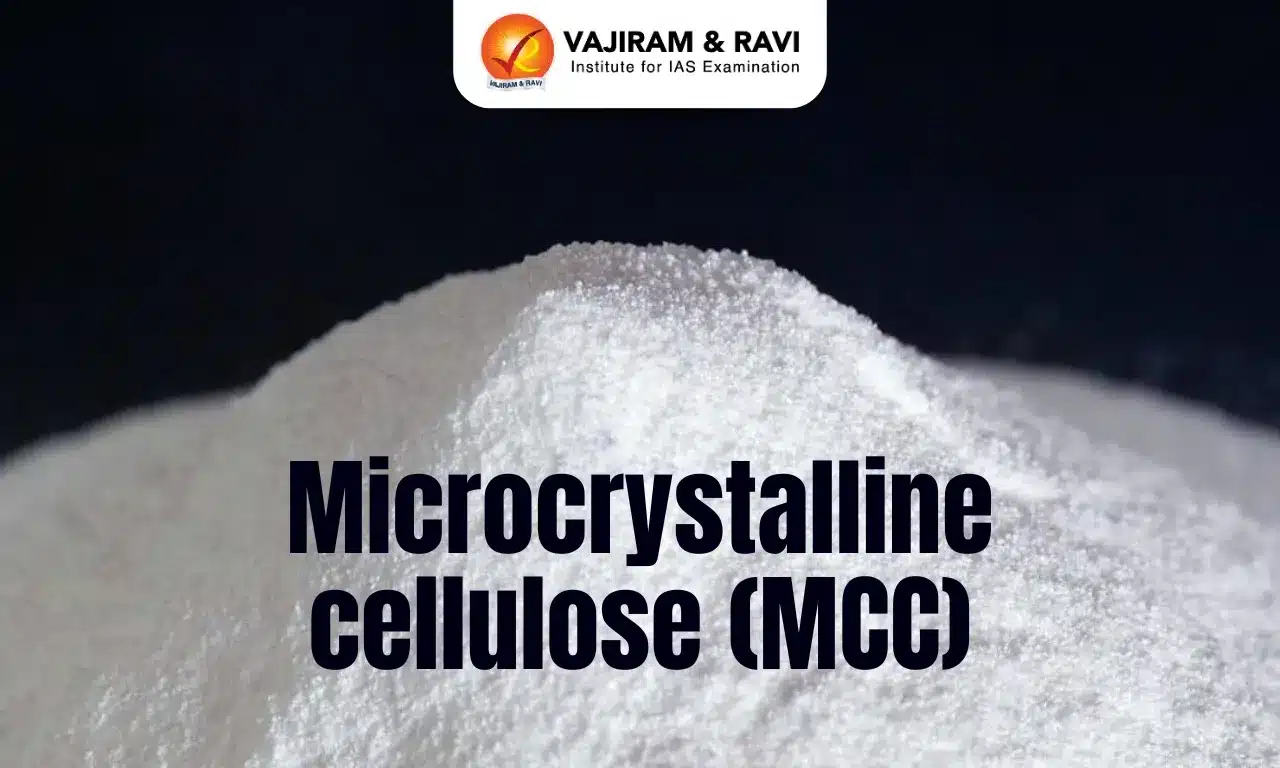
- It is a free-flowing powdery substance extracted as a pulp from fibrous plant material called refined wood pulp.
- It is a purified, partially depolymerized cellulose having the formula (C6H10O5)n.
- Chemically, it is an inert substance, is not degraded during digestion, and has no appreciable absorption.
- As a natural, fiber-rich component, it’s nontoxic and chewable.
- Wood is the most common source of pharmaceutical MCC, in which cellulose chains are closely packed in layered form and are held together by a cross-linking polymer and strong hydrogen bonds.
- Its crystalline structure is due to its microfibres having a high degree of three-dimensional internal bonding.
- During compression, MCC plastically deforms, and therefore, interparticle bonding increases. The plasticity of the MCC is the main reason for its exceptional binding property.
Microcrystalline Cellulose Applications
- It is used as a texturizer, extender, emulsifier, and binder in the pharmaceutical industry and as a bulking agent in food production.
- Its vital use is in the making of vitamin supplements and tablets.
- MCC can add weight to a drug and facilitate the active ingredients to function effectively while making the drug conform to weight specifications.
Source: TH
Microcrystalline Cellulose FAQs
Q1: What is the chemical formula of Microcrystalline Cellulose (MCC)?
Ans: (C6H10O5)n
Q2: What is the primary source material used to extract Microcrystalline Cellulose (MCC)?
Ans: Refined wood pulp.
Q3: What feature of Microcrystalline Cellulose (MCC) contributes most to its crystalline nature?
Ans: Cross-linking polymers and hydrogen bonding.
Q4: What physical form does Microcrystalline Cellulose (MCC) typically have?
Ans: Fine, free-flowing powder.
