
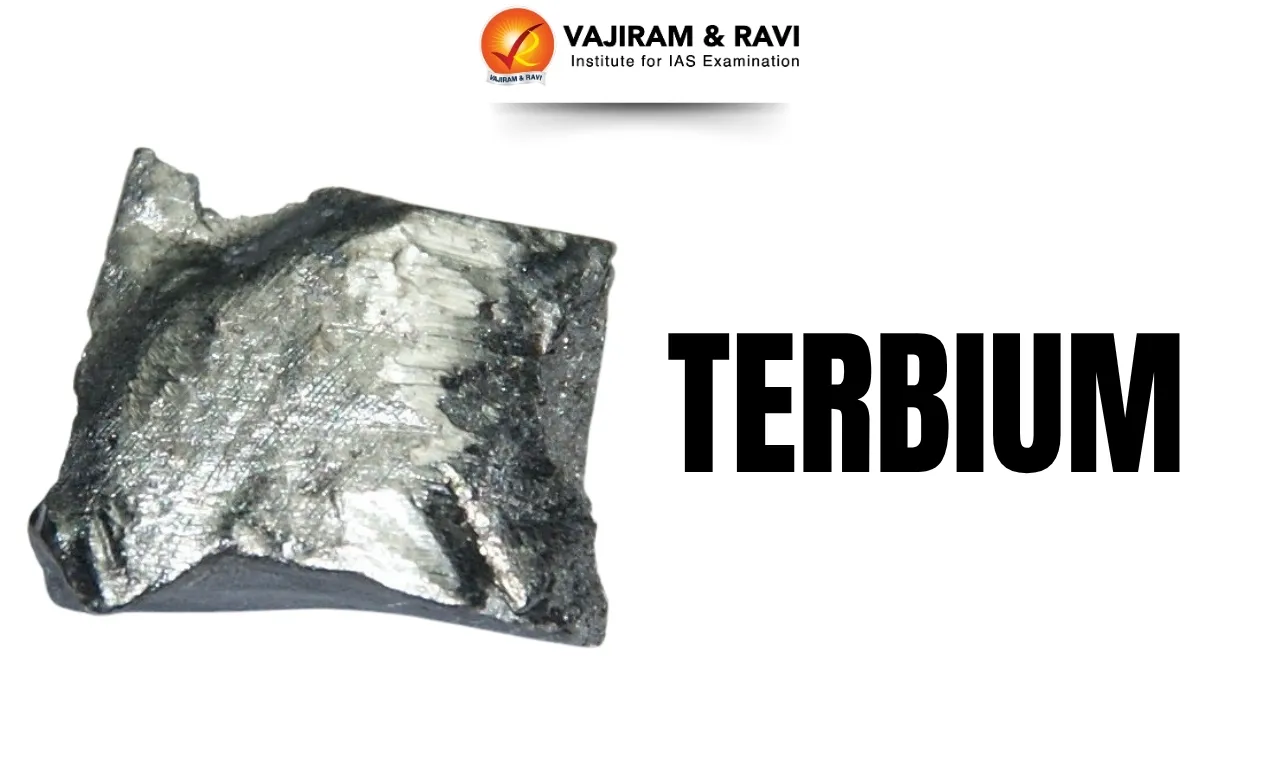
Terbium Latest News
Scientists from Indian Institute of Science (IISc) have developed a simple, glowing paper sensor that could help detect liver cancer early — using the green glow of a rare earth metal called terbium.
About Terbium
- It is a rare-earth metal of the lanthanide series of the periodic table.
- It occurs in many rare-earth minerals but is almost exclusively obtained from bastnasite and from laterite ion-exchange clays. It is also found in the products of nuclear fission.
Properties of Terbium
- It is a moderately hard, silvery white metal that is stable in air when in pure form.
- The metal is relatively stable in air even at high temperatures, because of formation of a tight, dark oxide layer that can be represented as a mixed oxide composed of Tb2O3 and TbO2.
- It readily reacts with diluted acids, but it is insoluble in hydrofluoric acid (HF) because the presence of the fluoride ion protects the metal from further reaction by forming a protective layer of TbF3.
- It exhibits strong paramagnet above 230 K and antiferromagnetic between 220 K and 230 K, and it becomes ferromagnetic below 220 K.
- Uses: Terbium compounds are used as green phosphors in fluorescent lamps, computer monitors, and TV screens that use cathode-ray tubes. Another major use is with dysprosium and iron in the magnetostrictive alloy.
Source: TOI
Terbium FAQs
Q1: What is terbium used for?
Ans: Terbium is used to dope calcium fluoride, calcium tungstate and strontium molybdate,
Q2: Where can I find terbium?
Ans: Terbium is one of the rarer "rare earth" metals; a minor component of major ores monazite and euxenite which are actively mined, especially in China
