
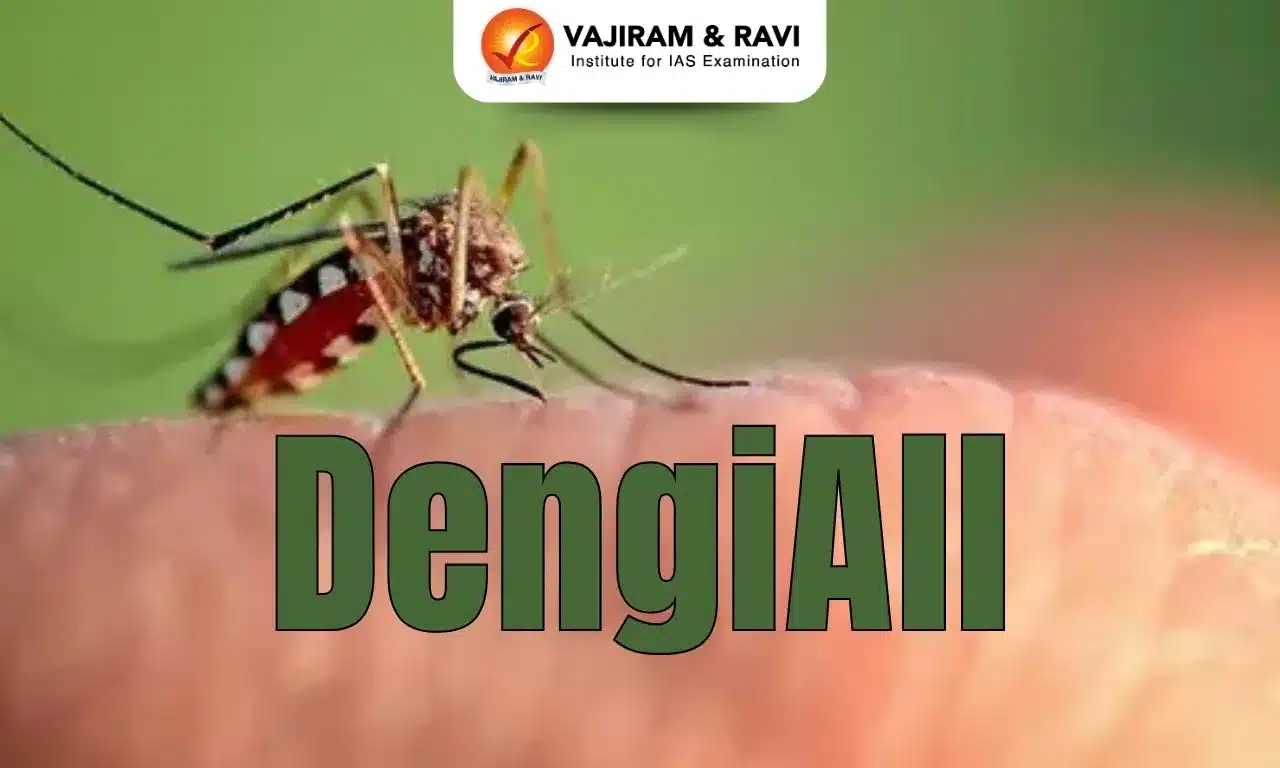
DengiAll Latest News
India has reached the 50 per cent enrolment mark in its first phase III clinical trial for the indigenous tetravalent dengue vaccine, DengiAll.
About DengiAll
- It is developed by Panacea Biotec Limited under a licensing agreement with the National Institutes of Health (NIH).
- has a weakened form of all four dengue virus subtypes and has the same virus composition as the vaccine developed by NIH, except for the inactive ingredients.
- A Phase I and II clinical trial conducted in India revealed a balanced and robust immune response across all four dengue virus types. The vaccine was also found to be safe and well-tolerated.
- Multiple ICMR institutes are involved in the study to evaluate the efficacy, immunogenicity and safety of DengiAll. The ICMR-National Institute of Translational Virology (NITVAR) and AIDS Research (formerly ICMR-NARI) is responsible for overall trial coordination.
Key Facts about Dengue
- It is a mosquito-borne viral infection.
- It is more common in tropical and subtropical climates, mostly in urban and semi-urban areas.
Transmission of Dengue
- It is transmitted to humans through the bite of infected Aedes mosquitos carrying one of four types of dengue virus (DENV).
- Dengue isn’t contagious from person to person except when passed from a pregnant person to their child.
Symptoms of Dengue
- The most common symptoms are high fever, headache, body aches, nausea, and rash. Most will get better in 1–2 weeks.
- A very small portion of people with dengue fever get a severe case. It’s called dengue hemorrhagic fever.
- Treatment: There is no specific medicine to treat dengue. The focus is on treating pain symptoms.
Source: IE
DengiAll FAQs
Q1: What is DengiALL?
Ans: It is a tetravalent dengue vaccine.
Q2: Where is the ICMR National Institute of Virology located?
Ans: Pune, Maharashtra
