
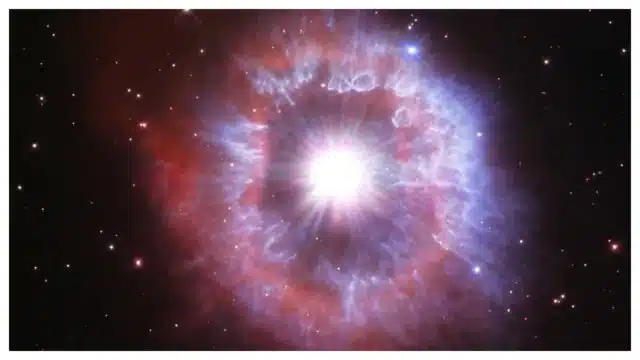
Very Massive Stars Latest News
A new study suggests that ‘Very massive stars’ or ‘very luminous stars’ may be emitting a significantly higher amount of material during their lifespan and the immensity of these materials could be much higher than previously thought.
About Very Massive Stars
- These are those stars that have over 100 times the mass of the Sun.
- They have a much higher mass than the Sun, they use their nuclear fuel at a much higher rate, making their average lifespan only a few million years.
- Once their nuclear fuel is exhausted, very luminous stars collapse to form black holes.
- These stars produce stellar wind that is powerful enough to blow their own outer layer into space.
Importance of Very Massive Stars
- These stars, despite their short lifespan, still influence the region around them.
- Their powerful stellar winds can push newly formed elements into their surroundings. While most form new stars, elements key to life, such as carbon and oxygen, are also emitted.
- In spite of their distance from our Earth, they still bear an influence on it.
- These stars can be considered the predecessor to black holes. This occasionally leads to black hole binaries, where two black holes orbit around each other. These cause gravitational waves, which we then detect on Earth.
Source: IE
Very Massive Stars FAQs
Q1: What are the very large stars called?
Ans: Supergiants
Q2: What is a very massive star?
Ans: A massive star can be defined as a star with a mass above about 10 times that of our Sun,
