
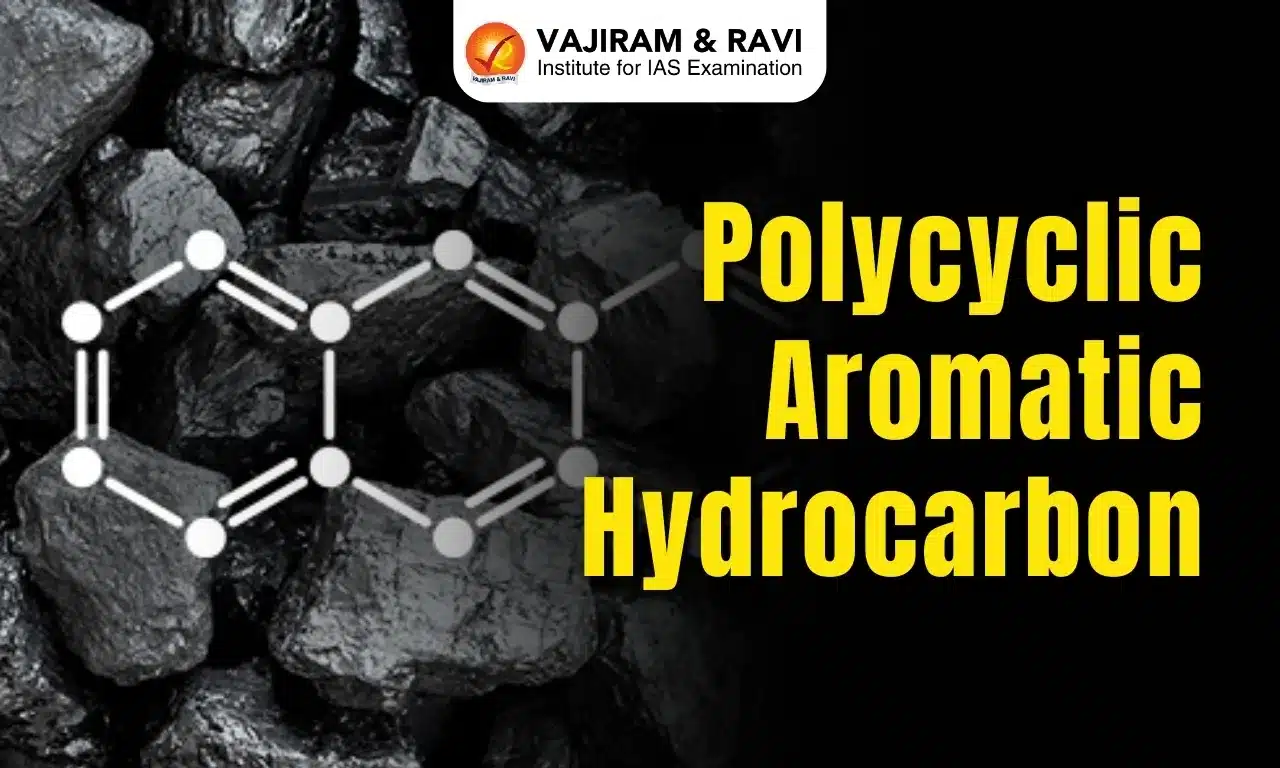
Polycyclic Aromatic Hydrocarbon Latest News
Recently, researchers from Australia, Sweden, and the UK studied the indenyl cation, C9H7+ and revealed how Polycyclic aromatic hydrocarbons molecules survival in Taurus Molecular Cloud 1 (TMC1).
About Polycyclic Aromatic Hydrocarbon
- Polycyclic aromatic hydrocarbons (PAHs) are flat, ring-shaped molecules of carbon and hydrogen.
- Astronomers think they make up a fifth of all carbon in interstellar space.
- There is a hypothesis that meteors brought PAHs from space to young earth and created the first building blocks of life, attaching important value to their ability to survive in space.
- They have a relatively low solubility in water but are highly lipophilic and are soluble in most organic solvents.
- These hydrocarbons, on earth, are formed through incomplete combustion or pyrolysis of organic materials, such as fossil fuels and biomass
- When PAHs collide with other particles or absorb high-energy radiation, they can have more internal energy than their weakest chemical bond can handle.
Key Facts about Taurus Molecular Cloud 1
- It is a molecular cloud located in the constellation Taurus about 430 lightyears away from Earth.
- It is a collection of gas, dust, and plasma.
- It is known for its cold and dense conditions, which are favorable for the formation of complex molecules.
- The cloud is primarily composed of molecular hydrogen (H2), with other molecules such as carbon monoxide (CO), ammonia (NH3), and various organic compounds also present.
- In Taurus Molecular Cloud 1 (TMC1), small closed-shell PAHs — molecules whose electrons are in pairs — appear in greater quantities even though they are constantly exposed to starlight that should have destroyed them.
- The team found that the PAHs have a mechanism to cool rapidly, letting them accumulate in TMC1 over time.
Source: TH
Polycyclic Aromatic Hydrocarbon FAQs
Q1: What is an example of a PAHs?
Ans: PAHs comprise a group of over 100 different chemicals that are produced during the incomplete burning of fuels, garbage or other organic substances such as tobacco, plant material or meats.
Q2: What is the most toxic polycyclic aromatic hydrocarbon?
Ans: Benzo[a]pyrene (BaP)
