
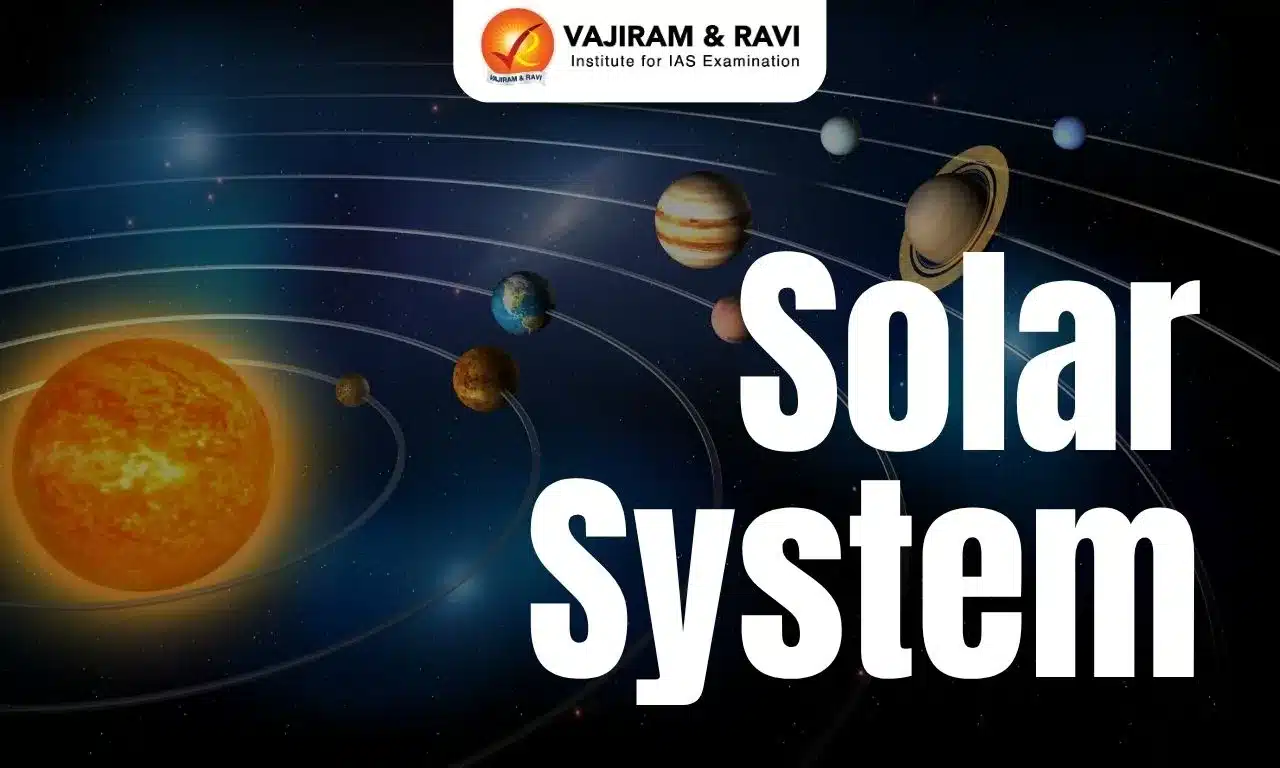
The universe consists of numerous planetary systems, each with planets rotating/revolving around a central star. Our planetary system is called the Solar System because the Sun is named "Sol," derived from the Latin word “sols.” As a result, anything related to the Sun is referred to as "solar." The Solar System comprises our star, the Sun, along with all celestial bodies bound to it by gravity. The Solar System includes eight planets, multiple asteroids, comets, meteoroids, dwarf planets like Pluto, and various moons. Located in one of the outer spiral arms of the Milky Way galaxy, the Solar System is a fascinating and dynamic system that continues to be a subject of extensive scientific exploration.
The Solar System
The Solar System consists of the Sun, eight planets (Mercury, Venus, Earth, Mars, Jupiter, Saturn, Uranus, and Neptune), their satellites, asteroids, comets, meteoroids, and interplanetary dust. Pluto, once a part of the Solar System, is now classified as a dwarf planet.
The Sun makes up 99.85% of the Solar System’s mass and is primarily composed of hydrogen and helium. The Photosphere is the Sun’s visible surface, surrounded by the Chromosphere and the Corona (visible during eclipses). The Sun's surface is dynamic, with bright plages and dark sunspots that frequently form and disappear.
Sun
The Sun is a 4.5 billion-year-old star which is the center of the Solar System, located 93 million miles from Earth. It is composed mainly of hydrogen and helium, making life on Earth possible. Being the largest object in the solar system, it could fit 1.3 million Earths inside it. The Sun's gravitational pull keeps all celestial bodies in orbit, while its eruptions and charged particles influence the solar system. The core is the hottest part, reaching 15 million degrees Celsius. Space agencies like NASA study the Sun using spacecraft like Solar Orbiter, Parker Solar Probe, and STEREO.
Planets In Order
The Solar System contains more planets than stars. The solar system has eight planets after Pluto's exclusion. Mercury, Venus, Earth, and Mars are rocky inner planets, while Jupiter and Saturn are gas giants. Uranus and Neptune are ice giants. Beyond Neptune, dwarf planets like Pluto exist.
Mercury
Mercury is the closest planet to the Sun, and is also the smallest in the solar system. Its close proximity makes it hard to see due to the Sun’s glare. It completes one revolution in 88 days and has no satellites or atmosphere. One day on Mercury equals 90 Earth days, and its mass is 1/18 of Earth's mass. Mariner-10 was the only artificial satellite to survey its surface.
Venus
Venus is the closest planet to Earth, and is often called its twin planet due to their similar sizes. It is the brightest planet in the sky and is known as the "morning star" and "evening star" because it is visible just before sunrise and after sunset. Venus completes one revolution in 225 days and rotates in 243 days, making it the only planet with a rotation period longer than its revolution. It has no moons and, like Uranus, rotates from east to west, opposite to Earth's rotation. Venus is also the hottest planet in the solar system.
Earth
Earth is the only known planet that supports life due to its optimal distance from the Sun, moderate temperature, presence of water, life-supporting atmosphere, and ozone layer. About 71% of Earth’s surface is covered in water, giving it a blue-green appearance from space. The Moon is Earth's only satellite.
Earth’s 23.5° axial tilt causes seasonal changes. It is the 5th largest planet in the solar system. Its equatorial radius is 6,378 km, polar radius is 6,356 km, and its perimeter is approximately 40,000 km. The exoplanet Kepler-452b is considered Earth's closest cousin.
Mars
Mars, the first planet discovered outside Earth’s orbit, is known as the “Red Planet” due to its reddish appearance, caused by iron oxide (rust). It takes 687 days to complete one revolution around the Sun.
Mars has two small natural satellites, Phobos and Deimos, with Deimos being the smallest satellite in the universe. The highest point on Mars is Olympus Mons, the tallest volcano in the solar system.
India's ISRO launched Mangalyaan (Mars Orbiter Mission) on November 5, 2013, and it successfully entered Mars' orbit on September 24, 2014. India became the first nation to reach Mars on its first attempt.
Jupiter
Jupiter is the largest planet in the solar system, 1300 Earths could fit inside it. It rotates rapidly on its axis and is surrounded by faint rings. Jupiter takes 11.9 years to complete one revolution around the Sun and has 92 known satellites. Ganymede, the largest of them, is also the biggest satellite in the solar system. The planet's atmospheric pressure is 10 million times higher than Earth's. Jupiter's Great Red Spot is a continuous high-pressure storm, creating asymmetric storms on the planet.
Saturn
Saturn is considered the most beautiful planet in the Solar System and is the second-largest after Jupiter. It takes 29.5 years to complete one revolution around the Sun and has a yellowish appearance. Saturn is famous for its four stunning rings, which are not visible to the naked eye. It has 147 natural satellites, with Titan being the largest, nearly the size of Mercury. Saturn is the least dense planet in the solar system, with a density lower than water, meaning it would float if placed in a large enough water body.
Uranus
Uranus was discovered in 1791 by William Herschel. It is the third-largest planet in the solar system and is named after the Greek god of the sky.
Uranus takes 84 years to complete one revolution around the Sun and, like Venus, it rotates from East to West. Its bluish-green color is due to the presence of methane in its atmosphere. Through a telescope, it appears greenish. Uranus has five rings named Alpha, Beta, Gamma, Delta, and Epsilon and 27 known satellites.
Neptune
Neptune is named after the Roman God of the Sea and was discovered by German astronomer Johann Galle. It takes 165 years to complete one revolution around the Sun, making it the planet with the longest year in the solar system. Neptune is the 8th and farthest planet from the Sun and the 4th largest planet in the solar system. It has 14 known natural satellites, with Triton being the largest.
Moons
Moons are also known as natural satellites, are celestial bodies that orbit planets and asteroids. Our Solar System hosts over 200 moons, each varying in size, shape, and composition. While Mercury and Venus lack moons, other planets, including Earth, have one or more. Some moons, like Jupiter’s Ganymede and Saturn’s Titan, are larger than Mercury, while others are tiny, irregularly shaped bodies.
| Moons of Each Planets | |
|
Planets |
Moons |
|
Mercury |
0 |
|
Venus |
0 |
|
Earth |
1 |
|
Mars |
2 |
|
Jupiter |
79 (53 confirmed, 26 provisional) |
|
Saturn |
82 (53 confirmed, 29 provisional) |
|
Uranus |
27 |
|
Neptune |
14 |
Asteroids, Comets, and Meteors
These leftover celestial bodies, including asteroids, comets, and meteors, are remains of the early solar system. While planets formed through accretion, billions of smaller fragments never merged into large planetary bodies.
Asteroids, primarily found in the asteroid belt between Mars and Jupiter, are rocky objects that vary in size. Comets, composed of ice, dust, and rock, originate from the Kuiper Belt and Oort Cloud, developing bright tails when approaching the Sun.
As of now, there are 1,113,527 known asteroids and 3,743 identified comets in our solar system, continuously providing insights into its formation and evolution.
Solar System Types
The Solar System refers to the Sun and its orbiting celestial bodies, including planets, moons, asteroids, and comets. However, the universe contains multiple other star systems, each with unique characteristics:
- Single Star Systems: A single star with orbiting celestial bodies (e.g., our solar system).
- Binary Star Systems: Two stars orbiting a common center, classified as:
- Visual Binaries (visibly separate stars),
- Spectroscopic Binaries (detected through spectra), and
- Eclipsing Binaries (stars that eclipse each other).
- Multiple Star Systems: Three or more stars orbiting together.
- Stellar Clusters: Groups of stars formed from the same molecular cloud (open for young stars, globular for older stars).
- Planetary Systems: Stars with one or more orbiting planets (exoplanetary systems exist beyond our solar system).
- Pulsar Systems: Neutron stars emitting radiation, sometimes in binaries.
- White Dwarf Systems: A white dwarf with a companion star, possibly causing periodic outbursts.
- Black Hole Systems: A black hole with orbiting stars or objects.
- Young Stellar Objects (YSOs): Newly forming stars with surrounding gas and dust, potentially forming planetary systems.
Solar System Interesting Facts
| Solar System Interesting Facts | |
| Feature | Name |
|
Biggest Planet |
Jupiter |
|
Biggest Satellite |
Ganymede (Jupiter's moon) |
|
Blue Planet |
Earth |
|
Green Planet |
Uranus |
|
Brightest Planet |
Venus |
|
Brightest Star outside the Solar System |
Sirius |
|
Closest Star to the Solar System |
Proxima Centauri |
|
Coldest Planet |
Neptune |
|
Evening Star |
Venus |
|
Farthest Planet from the Sun |
Neptune |
|
Planet with Maximum Satellites |
Saturn |
|
Fastest Revolution in the Solar System |
Mercury |
|
Hottest Planet |
Venus |
|
Densest Planet |
Earth |
|
Fastest Rotation in the Solar System |
Jupiter |
|
Morning Star |
Venus |
|
Nearest Planet to Earth |
Venus |
|
Nearest Planet to the Sun |
Mercury |
|
Red Planet |
Mars |
|
Slowest Revolution in the Solar System |
Neptune |
|
Slowest Rotation in the Solar System |
Venus |
|
Smallest Planet |
Mercury |
|
Smallest Satellite |
Deimos (Mars' moon) |
|
Earth's Twin |
Venus |
|
Only Moon with an Atmosphere Similar to Earth |
Titan (Saturn’s moon) |
Solar System FAQs
Q1: What are 9 planets in order?
Ans: Mercury, Venus, Earth, Mars, Jupiter, Saturn, Uranus, and Neptune.
Q2: Are there 8 or 9 planets in the solar system?
Ans: The solar system has eight planets.
Q3: Why is Pluto no longer a planet?
Ans: Pluto is now classified as a dwarf planet because, while it is large enough to have become spherical, it is not big enough to exert its orbital dominance and clear the neighborhood surrounding its orbit.
Q4: Which is the hottest planet?
Ans: Venus is the hottest planet.
Q5: Which planet is the biggest?
Ans: Jupiter is the largest planet in the solar system.

