List of Top 10 Countries Of Production And Reserves of Cobalt

List of Top 10 Countries Of Production And Reserves of Cobalt

In 2025, cobalt stands as one of the most critical minerals powering the global shift towards clean energy. As the world races toward electric mobility and large-scale renewable energy adoption, cobalt has become indispensable especially for its role in lithium-ion batteries used in electric vehicles (EVs), portable electronics, and energy storage systems.

With global demand surging, nations are keenly focused on securing cobalt supplies, both through partnerships and by tapping into reserves. Understanding which countries lead in cobalt production and reserves is key to predicting future market stability, trade routes, and technological growth.

Why Is Cobalt Important?

Cobalt is a transition metal vital in high-performance batteries due to its thermal stability and energy density. While substitutes are being explored, it remains a non-negotiable element in battery chemistry, aerospace alloys, and strategic military technologies. As clean energy transitions accelerate, the spotlight on cobalt-producing nations grows stronger.

Top 10 Countries by Cobalt Production and Reserves (2025)

The list below is based on 2024 data published in the Statistical Review of World Energy 2025, outlining both production figures (in thousand tonnes) and estimated reserves.

Top 10 Countries by Cobalt Production and Reserves (2025)
Rank Country Global Share (%) Reserves (tonnes) Key Highlights

1

Democratic Republic of the Congo (DR Congo)

74.1%

6,000,000

Largest global supplier; ethical mining concerns exist

2

Russia

3.2%

250,000

Stable production; key supplier to Europe

3

Canada

1.7%

220,000

Ethically sourced; reliable Western partner

4

Philippines

1.5%

260,000

Output hindered by environmental policies

5

Cuba

1.3%

500,000

State-controlled; limited exports due to sanctions

6

Australia

1.3%

1,700,000

Huge reserves; potential major future supplier

7

Papua New Guinea

1.0%

62,000

Growth driven by foreign investment

8

Madagascar

1.0%

100,000

Declining output but long-term potential

9

New Caledonia

0.7%

54,000

Resource fatigue; contributes via nickel mining

10

China

0.6%

140,000

Leading refiner; imports raw cobalt, dominates battery supply chain

Top 10 Countries by Cobalt Production and Reserves Important Facts

  • Over 74% of production and the highest reserves indicate its centrality in the cobalt value chain.
  • Countries like Australia and Cuba have large reserves but relatively lower production, indicating future potential.
  • Nations such as the Philippines, Australia, and New Caledonia are seeing production declines, either due to regulatory issues, depletion, or market constraints.
  • Despite low mining activity, China’s control over refining and battery production makes it one of the most influential cobalt players globally.

Cobalt Market Challenges

  1. Human rights violations and unsafe labor conditions in certain regions (especially DR Congo) are raising ESG (Environmental, Social, Governance) red flags.
  2. Geopolitical tensions and over-dependence on a single producer threaten global supply security.
  3. Mining often leads to water pollution, deforestation, and habitat loss, calling for more sustainable practices.
  4. Companies are investing in cobalt-free battery technologies, though commercial viability is still evolving.

List of Top 10 Countries Of Production And Reserves of Cobalt FAQs

Q1: Why is cobalt important in 2025?

Ans: Cobalt plays a crucial role in the manufacturing of lithium-ion batteries, which are essential for electric vehicles (EVs), energy storage systems, and consumer electronics. Its demand is rising due to the global push for clean energy.

Q2: Which country is the largest producer of cobalt in 2025?

Ans: The Democratic Republic of the Congo (DR Congo) is the largest producer, accounting for over 74% of global cobalt output in 2024.

Q3: What are the top 3 countries with the largest cobalt reserves?

Ans: As of the end of 2024, the countries with the highest cobalt reserves are: DR Congo - 6,000 thousand tonnes Australia - 1,700 thousand tonnes Cuba - 500 thousand tonnes

Q4: Is China a major cobalt producer?

Ans: China is not among the top cobalt producers by mining output. However, it dominates the refining and processing sector, making it a key player in the global cobalt supply chain.

Q5: Which countries have declining cobalt production trends?

Ans: In recent years, countries like the Philippines, Australia, and New Caledonia have seen a decline in cobalt output, due to factors like resource depletion, regulatory changes, or reduced investment.


Pradhan Mantri Shram Yogi Maan Dhan Yojana, Launch Date, Eligibility

Pradhan Mantri Shram Yogi Maan Dhan Yojana

The Pradhan Mantri Shram Yogi Maan-Dhan Yojana (PM-SYM) is a government initiative introduced to provide social security benefits to unorganised workers in India. Launched on February 15, 2019, under the Ministry of Labour and Employment, the scheme aims to provide the financial benefits to the workers in the unorganised sector by offering a pension after the age of 60. The scheme is targeted at around 42 crore workers in India’s unorganised sector, which includes street vendors, home-based workers, mid-day meal workers, and others who do not have access to social security.

Pradhan Mantri Shram Yogi Maan-Dhan Yojana Features

  1. The beneficiaries will receive a minimum assured pension of ₹3000 per month upon reaching 60 years of age.
  2. In the death situation, the spouse is eligible to receive 50% of the pension amount as a family pension. 
  3. The scheme operates on a 50:50 basis, where the beneficiary contributes a portion and the government matches the contribution.
  4. Contributions are made using an auto-debit facility from the beneficiary’s savings or Jan-Dhan account.
  5. LIC of India (Life Insurance Corporation) serves as the Pension Fund Manager, responsible for managing the funds and ensuring pension payouts.

Pradhan Mantri Shram Yogi Maan-Dhan Yojana Eligibility Criteria

  1. The scheme is an initiative introduced for unorganised sector workers.
  2. The workers should not be part of the organised sector (i.e., they should not be members of EPFO, NPS, or ESIC) or income taxpayers.
  3. The age of the workers should be between 18 and 40 years at the time of registration.
  4. Their monthly income should be Rs. 15,000 or less.

Pradhan Mantri Shram Yogi Maan-Dhan Yojana Significance

  1. The scheme ensures economic security for workers in their retirement years.
  2. The scheme aims to improve social security for unorganised sector workers, who often lack access to formal retirement benefits.
  3. The scheme is expected to contribute to overall economic growth by supporting the welfare of a major section of the workforce.

Other Government Schemes for Unorganised Workers

  1. Rashtriya Swasthya Bima Yojana (RSBY): Health insurance scheme for unorganised sector workers.
  2. NPS Swavalamban: A pension scheme aimed at unorganised sector workers to provide financial security in their old age.

Pradhan Mantri Shram Yogi Maan-Dhan Yojana FAQs

Q1: What is Pradhan Mantri Shram Yogi Maan-Dhan Yojana?

Ans: Pradhan Mantri Shram Yogi Maan-Dhan Yojana aims to provide social security benefits to unorganised workers in India.

Q2: Which ministry launched the Pradhan Mantri Shram Yogi Maan-Dhan Yojana?

Ans: The Ministry of Labour and Employment has launched the Pradhan Mantri Shram Yogi Maan-Dhan Yojana (PM-SYM).

Q3: What is the main objective of Pradhan Mantri Shram Yogi Maan-Dhan Yojana?

Ans: The main objective of Pradhan Mantri Shram Yogi Maan-Dhan Yojana is to provide the financial benefits to the workers in the unorganised sector by offering a pension after the age of 60.

Unnat Bharat Abhiyan, Objectives, Implementation, Roles

Unnat Bharat Abhiyan

The Ministry of Human Resource Development (MHRD), in collaboration with the Ministries of Rural Development and Panchayati Raj, has launched the Unnat Bharat Abhiyan (UBA), which aims to link Higher Education Institutions (HEIs) with rural development processes. This initiative was introduced to engage HEIs in improving rural infrastructure, governance, and livelihoods through collaboration with rural communities to develop sustainable solutions that can create employment opportunities and enhance economic growth.

Unnat Bharat Abhiyan Objectives

The Unnat Bharat Abhiyan aims to improve rural livelihood by engaging HEIs with the rural population. Below mentioned are the Unnat Bharat Abhiyan Objectives that were discussed during the cabinet session:

  1. HEIs are tasked with adopting the group of nearby Gram Panchayats (GPs), especially those in rural and backward areas. The institutions provide technical, managerial, and advisory support to help these GPs overcome challenges and develop sustainable solutions for local issues.
  2. Institutions will contribute to community-level planning and solutions for issues like energy security, livelihood opportunities, and basic infrastructure (e.g., water supply, sanitation, and healthcare) to contribute to sustainable rural development, ensuring better livelihoods for rural populations and improving their standard of living.

Unnat Bharat Abhiyan Implementation

On 12th January 2017, a Tripartite Agreement was signed between MHRD, Ministry of Rural Development, and Ministry of Panchayati Raj. The agreement includes the roles and responsibilities of each Ministry in contributing to the scheme’s success.

  1. IIT Delhi has been designated as the coordinating institution for Unnat Bharat Abhiyan.
  2. The initial budget allocation for Unnat Bharat Abhiyan in 2016-17 was ₹10 crore.

Unnat Bharat Abhiyan Ministry Roles and Responsibilities

The roles of various ministries in the Unnat Bharat Abhiyan (UBA) are essential for the success of the initiative. Below Mentioned are the Unnat Bharat Abhiyan Ministry Roles and Responsibilities: 

Ministry of Human Resource Development (MHRD)

  1. MHRD ensures that each Higher Education Institution (HEI) adopts at least five Gram Panchayats to contribute to the development of rural areas.
  2. The Ministry ensures that HEIs provide the academic knowledge, research, and technical expertise to resolve the key challenges in rural areas, focusing on improving livelihoods and basic infrastructure.

Ministry of Rural Development

  1. The Ministry coordinates with District Collectors, District Collectors, District Rural Development Agencies (DRDA), and local bodies to actively involve them in the preparation of the Gram Panchayat Development Plan (GPDP), ensuring that the development plans are synced with local needs and resources.
  2. The Ministry works to bring together various available resources (financial, technical, and human) to ensure effective implementation of the development plans created with the support of HEIs and local bodies.

Ministry of Panchayati Raj

The Ministry provides guidelines and frameworks to state governments and local bodies to ensure that the collaboration of HEIs into the Gram Panchayat Development Plan (GPDP) process is efficient, and impactful.

Unnat Bharat Abhiyan FAQs

Q1: What is Unnat Bharat Abhiyan?

Ans: Unnat Bharat Abhiyan aims to link Higher Education Institutions (HEIs) with rural development processes. 

Q2: Which ministries collaborated together to launch Unnat Bharat Abhiyan?

Ans: The Ministry of Human Resource Development (MHRD), in collaboration with the Ministries of Rural Development and Panchayati Raj, has launched the Unnat Bharat Abhiyan (UBA).

National Recruitment Agency, Features, Impact, Challenges

National Recruitment Agency

National Recruitment Agency (NRA), approved by the Union Cabinet under Prime Minister Shri Narendra Modi in August 2020 where the National Recruitment Agency (NRA), through its Common Eligibility Test (CET), aims to simplify the recruitment process for central government jobs for non-gazetted Group B and C posts across multiple agencies, such as SSC, RRB, and IBPS. The establishment of the National Recruitment Agency (NRA) helped in aligning with the government’s vision of “Ease of Living for Aspirants.” 

National Recruitment Agency Features

  1. The NRA maintains exam integrity with algorithms by generating unique question papers for each candidate which reduces risks of cheating and paper leakage.
  2. Speeds up the recruitment process by generating quick results, valid for three years.
  3. Exam centers in every district remove urban bias and improve access, particularly for rural candidates.
  4. Reduces logistical costs for recruiting agencies.
  5. A single CET score allows candidates to apply for multiple recruitments within its validity and reduces the need for multiple applications and fees.

National Recruitment Agency Overview

The National Recruitment Agency (NRA) establishment is a transformative shift in India’s recruitment process, aligning with the government’s vision of “Ease of Living for Aspirants.” Below in the table we have provided which includes the National Recruitment Agency Overview:

National Recruitment Agency Overview

Exams Covered

SSC, RRB, IBPS (initially)

Frequency

Twice a year

Validity

Three years

Attempts

Unlimited, within age limits

Languages

12 major Indian languages

Centres

1,000+ centres, with at least one per district

Age Relaxation

As per existing rules for SC/ST/OBC

National Recruitment Agency Implementation

  1. NRA is registered under the Societies Registration Act, 1860.
  2. The government has sanctioned ₹1517.57 crore for the NRA’s establishment, with a focus on developing examination infrastructure in aspirational districts.
  3. Headed by a Chairman of Secretary rank, it will include representatives from SSC, RRB, IBPS, and key ministries.

National Recruitment Agency Impact

By conducting a Common Eligibility Test (CET) for multiple recruiting agencies, the NRA addresses various challenges faced by applicants. Below in the table we have shared the National Recruitment Agency Impact which includes the Pre-NRA Scenario as well as Post-NRA Scenario.

National Recruitment Agency Impact
Pre-NRA Scenario Post-NRA Scenario

Multiple exams by different agencies

One CET for multiple recruitment agencies

Separate fees for every exam

Single registration and fee

Urban-centric test centres

Test centres in every district

Long recruitment cycles

Faster hiring process

Exams only in English and Hindi

CET is conducted in 12 regional languages

National Recruitment Agency Challenges

  1. The NRA is limited to central government posts currently. State-level reforms are required for wider impact.
  2. The increasing shift towards privatization may reduce the number of government job opportunities.

National Recruitment Agency FAQs

Q1: Is nra cet confirmed?

Ans: The Central Government approved the setting up of the National Recruitment Agency (NRA) on 19th of August 2020.

Q2: Is the National Recruitment Agency constitutional or not?

Ans: It was granted Constitutional status in 2021.

Q3: Where is the headquarters of the National Recruitment Agency?

Ans: The headquarters of the National Recruitment Agency is in New Delhi.

Q4: Is the CET exam tough?

Ans: The CET exam is a moderately challenging exam.

Q5: What is the full form of the NRA?

Ans: National Recruitment Agency

National Educational Alliance for Technology (NEAT) Scheme, Objectives

National Educational Alliance for Technology (NEAT) Scheme

The National Educational Alliance for Technology Scheme was launched in September 2019 by the Ministry of Education to utilise advanced and modern technology such as artificial intelligence to address the gap in access to educational resources to overcome gaps between certain groups, particularly in disadvantaged or rural areas where there is lack of access to technology or internet services. NEAT 3.0 is based on a Public-Private Partnership (PPP) model which collaborates between the Government and Ed-Tech companies to bring advanced technological solutions in education through a medium of centralized platform for easy access by students.

National Educational Alliance for Technology Scheme Implementing Organisation

  1. The All India Council for Technical Education (AICTE), is responsible for implementing NEAT. The AICTE also ensures the quality of courses and their alignment with national educational standards. 
  2. Established in November 1945, AICTE's primary purpose is to enhance and promote technical education in India.
  3. It plays a significant role in planning, funding, quality assurance, and maintaining certification  which are equivalent and meet uniform standards. 

National Educational Alliance for Technology Scheme Objectives

The primary aim of the National Educational Alliance for Technology Scheme is to enhance the learning experience. The scheme focuses on the following key objectives:

  1. Using the advancement of AI to create a personalised learning content according to the needs and pace of learning of the student.
  2. Recognizing the development of adaptive learning technologies such as software that adjusts difficulty levels or content based on a learner’s progress and understanding and bringing them to a common platform for easy access.
  3. The platform will provide high-quality learning resources that aim to upskill students in marketable skills which result in improving their employability.
  4. NEAT bridges the gaps by providing access to quality e-resources, high-quality digital learning tools and courses to students who face difficulties with traditional educational resources.
  5. By integrating Artificial Intelligence (AI) technologies, NEAT offers learning experiences according to the pace/level of the student and builds skills relevant to job markets.

National Educational Alliance for Technology Scheme Significances

  1. The National Educational Alliance for Technology Scheme ensures that education is financially affordable, widely accessible, regardless of socio-economic background promoting the inclusivity in education.
  2. By offering AI-driven courses such as data science, AI, machine learning and other technologies, it prepares students for the future job market in a knowledge-based economy where economic growth uses knowledge and information, rather than physical goods.
  3. Promotion of Regional Languages: NEAT encourages the use of regional languages in education, enhancing critical thinking and better understanding of complex concepts which promotes inclusivity in education.

National Educational Alliance for Technology Scheme Challenges

  1. Despite the rapid growth of Ed-Tech, only 42% of urban households and 15% of rural households have internet access, making digital education inaccessible to many.
  2. Not all students can afford the technology (e.g., smartphones, computers, internet) required to attend online classes. 
  3. Shifting entirely to online education could deprive many students of their right to education, particularly those without access to the necessary technology. 

National Educational Alliance for Technology Scheme FAQs

Q1: What is the National Education Alliance for technology?

Ans: National Education Alliance for technology is based on a Public-Private Partnership (PPP) model which collaborates between the Government and Ed-Tech companies to bring advanced technological solutions in education through a medium of centralized platform for easy access by students.

Q2: What is the objective of neat?

Ans: The primary aim of the National Educational Alliance for Technology Scheme is to enhance the learning experience.

Q3: What is a neat scheme?

Ans: The neat scheme collaborates between the Government and Ed-Tech companies to bring advanced technological solutions in education through a medium of centralized platform for easy access by students.

Q4: What is neat an MHRD scheme aimed at?

Ans: Using the advancement of AI to create a personalised learning content according to the needs and pace of learning of the student.

Q5: When was neat launched?

Ans: NEAT was launched in September 2019.

Pradhan Mantri Vaya Vandana Yojana, Launch Date, Eligibility, Benefits

Pradhan Mantri Vaya Vandana Yojana

The Pradhan Mantri Vaya Vandana Yojana (PMVVY) is a government pension scheme launched on May 4, 2017 by the Department of Financial Services, Government of India, providing social security for senior citizens aged 60 years and above. The scheme is operated by the Life Insurance Corporation (LIC) of India which assures the financial stability of the elderly by providing them a pension with assured return of 7.4% per annum for a policy tenure of 10 years which is also exempted from Goods and Service Tax (GST).

Pradhan Mantri Vaya Vandana Yojana Benefits

  1. Enrolling for this scheme provides the beneficiary a stable income ensuring financial stability.
  2. The loan facility allows beneficiaries to borrow up to 75% of the policy's value after three years. Any interest on the loan is deducted directly from your future pension payments, making repayment manageable.
  3. Premature exit from the Pradhan Mantri Vaya Vandana Yojana is allowed in cases of critical or terminal illness (self or spouse).
  4. If the policyholder survives, they receive the purchase price along with the final pension installment and in another case, the purchase price is refunded to the nominee.

Pradhan Mantri Vaya Vandana Yojana Eligibility Criteria

  1. Applicants must be 60 years or above to be eligible for the scheme.
  2. Policy term duration is fixed at 10 years.
  3. The Maximum investment can be ₹15 lakh per senior citizen.
  4. The beneficiary will receive the monthly pension between ₹1,000 to ₹10,000.

Pradhan Mantri Vaya Vandana Yojana VS Senior Citizens Savings Scheme

Below in the table we have shared a comparative analysis between two different government schemes which provide financial support to the senior citizens: the Pradhan Mantri Vaya Vandana Yojana and Senior Citizens Savings Scheme.

Pradhan Mantri Vaya Vandana Yojana VS Senior Citizens Savings Scheme
Feature PMVVY SCSS

Eligibility

60 years and above

60 years and above (55 for VRS retirees)

Policy Term

10 years

5 years (extendable by 3 years)

Maximum Investment Limit

15 Lakhs

15 Lakhs

Interest/Pension Rate

Assured (7.40% reset annually)

Fixed (e.g., 8.3% for Q1 2018)

Tax Benefits

GST Exempt

Exempt under Section 80C (interest taxable)

Premature Withdrawal

Allowed for critical/terminal illness

Allowed with penalty

Role of Government in Pradhan Mantri Vaya Vandana Yojana

  1. The government’s liability is capped and only covers the difference between the market return generated by LIC and the assured rate of return. For the year 2020-21, this assured rate of return was set at 7.4%. This means that if the market return is lower than 7.4%, the government will cover the shortfall, ensuring the senior citizens receive their guaranteed return.
  2. The pension under PMVVY is calculated based on this assured rate of return (7.4%), which is fixed for a given period (e.g., the year 2020-21).
  3. The scheme ensures that elderly persons aged 60 years and above do not suffer from unpredictable market conditions that could potentially lower their interest income. 

Pradhan Mantri Vaya Vandana Yojana FAQs

Q1: What is Pradhan Mantri Vaya Vandana Yojana for UPSC?

Ans: The Pradhan Mantri Vaya Vandana Yojana (PMVVY), launched on May 4, 2017, offers financial security to senior citizens (60+) by providing a pension with 7.4% annual returns for 10 years. Managed by LIC, the scheme is GST-exempt.

Q2: What is Pradhan Mantri Vaya Vandana Yojana?

Ans: The Pradhan Mantri Vaya Vandana Yojana (PMVVY), introduced on May 4, 2017, is a government pension scheme for senior citizens aged 60 and above. Administered by LIC, it guarantees an 8% annual return on pensions for a 10-year tenure, with GST exemption.

Q3: who is eligible for Vaya Vandana Yojana?

Ans: The Pradhan Mantri Vaya Vandana Yojana (PMVVY) is a pension scheme designed specifically for senior citizens aged 60 years and above.

Q4: What is Pradhan Mantri Vaya Vandana Yojana and senior citizen saving scheme?

Ans: Senior citizens can invest up to ₹15 lakhs in the Pradhan Mantri Vaya Vandana Yojana (PMVVY), but this option is available only until March 31, 2023, after which the scheme will be gradually phased out.

Q5: Is PM Vaya Vandana Yojana tax free?

Ans: The deposits made in the scheme are exempt from income tax under section 80C of Income Tax Act, 1961.

National Pension Scheme for Traders and Self-Employed Persons, Features

National Pension Scheme for Traders and Self-Employed Person

The National Pension Scheme for Traders and Self-Employed Persons popularly known as Pradhan Mantri Laghu Vyapari Man-dhan Yojana is an initiative introduced by the Ministry of Labour and Employment on July 22, 2019 to provide old age protection and social security for small traders, shopkeepers, and self-employed individuals by providing a minimum monthly pension of ₹3,000 upon reaching 60 years of age and enhance financial stability for India’s informal sector.

National Pension Scheme for Traders and Self-Employed Persons Features

  1. The scheme targets over 3 crore small retailers, traders, and self-employed individuals.
  2. Participation of the target population is voluntary, where it requires shared financial contribution from the beneficiary and the government, managed by the Central Government.
  3. The pension service will be provided of ₹3,000 per month after attaining the age of 60 years.
  4. Beneficiaries contribute 50% of the monthly premium and the central government contributes the remaining 50%.
  5. The scheme is managed by the Life Insurance Corporation of India (LIC).

National Pension Scheme for Traders and Self-Employed Persons Objectives

The scheme aims to ensure old-age financial security and stability for small traders and self-employed individuals by providing a minimum monthly pension of ₹3,000 after attaining 60 years of age.

National Pension Scheme for Traders and Self-Employed Persons Eligibility Criteria

  1. People who are Retail traders, shop owners, rice mill owners, commission agents, and other self-employed individuals.
  2. Beneficiaries must be between the age of 18 to 40 years.
  3. Annual turnover of the applicant should not exceed ₹1.5 crore.
  4. Exclusions includes:
    1. Members of EPFO/NPS/ESIC.
    2. Income taxpayers.
    3. Individuals enrolled under other pension schemes like Pradhan Mantri Shram Yogi Maandhan Yojana or Pradhan Mantri Kisan Maandhan Yojana.

National Pension Scheme for Traders and Self-Employed Persons Significance

  1. Acknowledges the contribution of small traders who account for nearly 50% of India’s GDP.
  2. Reduces old-age financial dependence on others and ensures dignified living.
  3. Simplified enrollment process, government subsidies, and active Common Service Centers network make the scheme accessible to beneficiaries across the country.

National Pension Scheme for Traders and Self-Employed Persons Application Process

People who are eligible for the National Pension Scheme for Traders and Self-Employed Persons Scheme has to follow the below mentioned steps to apply for the scheme:

Step 1: Visit the nearest CSC.

Step 2: Provide the Aadhaar card, bank details, and IFSC code.

Step 3: Pay the initial contribution amount in cash.

Step 4: The Village Level Entrepreneur (VLE) will authenticate the Aadhaar details and fill out the online registration form.

Step 5: Details such as nominee information, GSTIN (if applicable), and turnover income will be entered.

Step 6: The system will calculate the monthly contribution based on the applicant’s age.

Step 7: The Vyapari Pension Account Number (VPAN) will be generated, and a Vyapari Card will be issued.

National Pension Scheme for Traders and Self-Employed Persons FAQs

Q1: What is the national pension scheme for traders and self-employed people?

Ans: A national pension scheme offers ₹3,000 monthly pension at 60, ensuring old-age security and financial stability for small traders, shopkeepers, and self-employed individuals in India’s informal sector.

Q2: Can a self-employed person open an NPS account?

Ans: Any retail trader, shopkeepers and self-employed person with annual turn-over not exceeding Rs. 1.5 crore, in the age group of 18-40 years can apply for this Scheme.

Q3: What is the best pension scheme for the self-employed?

Ans: National Pension System (NPS), Atal Pension Yojana (APY), Public Provident Fund (PPF), Mutual Funds and SIPs and Unit Linked Insurance Plans (ULIPs)

Q4: What is the interest rate for NPS?

Ans: The current NPS interest rate ranges between 9% and 12% per annum (as of 2024).

Daily Editorial Analysis 14 July 2025

Daily Editorial Analysis

Assessing India's Carbon Credit Trading Scheme Targets

Context:

  • The Indian government has set greenhouse gas emissions intensity targets for nine heavy industrial sectors under the Carbon Credit Trading Scheme (CCTS).
    • The eight sectors are aluminium, cement, paper and pulp, chlor-alkali, iron and steel, textile, Fertiliser, petrochemicals and petro refineries.
  • To assess how ambitious these targets are, the analysis suggests that they should not be evaluated at the level of individual entities or sectors.
  • Instead, ambition should be measured at the aggregate, economy-wide level.

Background: India’s Emerging Role in Global Carbon Pricing

  • India is positioning itself as a key player in global carbon pricing alongside Brazil and Türkiye.
  • With the launch of the Carbon Credit Trading Scheme (CCTS) in July 2024, India is moving towards a rate-based Emissions Trading System (ETS) covering nine energy-intensive industrial sectors.
  • The scheme targets emissions intensity reduction rather than absolute emissions caps.
  • Facilities that perform better than benchmark emissions intensity levels earn Credit Certificates.
  • CCTS has two components:
    • compliance mechanism for obligated industrial entities.
    • An offset mechanism for voluntary participants.
  • This initiative lays the groundwork for India’s national carbon market by providing an institutional framework aimed at decarbonizing the economy through market-based incentives.

Aggregate Economy-Level Assessment Matters for Evaluating Emission Targets

  • India’s experience with the Perform, Achieve and Trade (PAT) scheme shows that while energy intensity may vary across individual entities or sectors, overall economy-wide energy efficiency can still improve.
  • This highlights that the true measure of ambition in schemes like the Carbon Credit Trading Scheme (CCTS) lies at the aggregate, economy-wide level—not at the entity or sector level.
  • Entity- or sector-level targets mainly determine financial transfers through market mechanisms but do not reflect overall emission intensity reduction.
  • Historical sector-level performance under PAT is not a reliable benchmark for future ambition, as climate action needs to progressively align with India’s Nationally Determined Contributions (NDCs) and its 2070 net-zero goal.
  • Therefore, assessing CCTS targets requires comparing them against future economy-wide pathways rather than past industry-level outcomes.

Assessing the Ambition of India’s Industrial Emissions Targets

  • Result of a recent modelling
    • Recent modelling shows that for India to meet its 2030 NDC, the carbon dioxide emissions intensity of the energy sector (emissions per unit of GDP) needs to decline at an average rate of 3.44% per year between 2025 and 2030.
    • For the manufacturing sector, emissions intensity of value added (EIVA) is projected to decline by at least 2.53% annually over the same period.
  • Analysing India’s new Carbon Credit Trading Scheme (CCTS) targets
    • When analysing India’s new Carbon Credit Trading Scheme (CCTS) targets, the average annual EIVA reduction across the eight covered industrial sectors is estimated at only 1.68% per year between 2023–24 and 2026–27.
    • This is notably slower than both the economy-wide target and the manufacturing sector projection, suggesting that industrial targets under CCTS may not be ambitious enough.
    • Although the CCTS covers only a subset of India’s manufacturing base, this estimate offers the closest available benchmark until more comprehensive sectoral modelling is done.

Conclusion

  • Ultimately, the key measure of ambition lies in the overall aggregate emissions intensity decline, not just in isolated sectoral or entity-level targets.
  • This aggregate perspective is critical to judging whether India’s industrial decarbonisation is keeping pace with its broader climate commitments.

Bridging the Skills Gap - India’s Employment Challenge and the Path to Workforce Readiness

Context:

  • Despite being one of the largest producers of graduates globally, India faces a persistent challenge of integrating its educated youth into the formal workforce.
  • Recent data from Employees’ Provident Fund Organisation (EPFO) and key employment reports underline the urgency of skilling, reskilling, and policy interventions to make India’s workforce future-ready.

Understanding the Formal Employment Landscape:

  • EPFO as an employment indicator: A key indicator of formal employment trends in India, EPFO manages retirement savings for over 7 crore workers, making it one of the largest global social security agencies.
  • Post-pandemic recovery (March 2025 data): Youth (18–25 years), especially the 18–21 age group, constitute 18%-22% of new subscribers, indicating a steady rise in net new EPFO enrollments and increased formalisation.

Youth Unemployment and Unemployability Crisis:

  • Findings from India Employment Report 2024:
    • Published by the International Labour Organization (ILO) and the Institute for Human Development (IHD), the report highlights that youth comprise 83% of India's unemployed population.
    • Unemployment is highest among the educated, particularly those with secondary or higher education.
  • Economic Survey 2023–24:
    • Unemployability among the educated is the core issue, as only 50% of graduates are job-ready.
    • There is a high deficit in digital and professional skills, and AI and automation threaten existing jobs, especially in the tech sector.

Skills Deficit in the Digital Age:

  • Alarming statistics on digital literacy (India Employment Report 2024):
    • 75% struggle to send an email with attachments.
    • Over 60% cannot perform basic file operations.
    • 90% lack spreadsheet skills (e.g., using formulas).
    • Highlights a severe skills mismatch in a tech-driven job market.
  • Future of Jobs Report 2025 (World Economic Forum):
    • By 2030, 170 million new jobs will be created (14% of total employment), and 92 million jobs to be displaced (8%).
    • Net growth will be 78 million jobs (or a 7% increase in total employment).
    • India must act urgently to close the skill gap and avoid losing this opportunity.

Structural and Policy Reforms Needed:

  • Educational reforms and industry collaboration:
    • Mandatory industry-academia partnerships for all higher education institutions.
    • Educational institutions must be made accountable for job placements.
    • Establish accreditation linked to placement outcomes.
  • Curriculum and pedagogical reforms:
    • Make Idea Labs and Tinker Labs mandatory in schools and colleges.
    • Ensure compulsory training in soft skills, foreign languages, and humanities.
  • Global perspective in skilling:
    • Train youth for international labour markets, especially ageing Western nations.
    • Example: India-EU Link4Skills project via the International Institute of Migration and Development.
  • Institutional overhaul in education governance:
    • Propose creation of Indian Education Services akin to IAS to attract top talent in education policy and management.
    • Encourage industry professionals to teach in academia, bridging theory-practice gaps.

Way Forward - From Degree to Deployment:

  • India's demographic advantage risks becoming a liability unless it is matched by skill-readiness, job-linkages, and futuristic policy-making.
  • Coordinated action is needed to strengthen education-employment linkages, expand digital and vocational training, promote cross-border employment readiness, and ensure accountability in both public and private education systems.

Bridging the Skills Gap - India’s Employment Challenge and the Path to Workforce Readiness FAQs

Q1. How does EPFO data serve as a proxy for formal employment trends in India?

Ans. EPFO enrolment data reflects the scale and trajectory of formal workforce integration, especially among youth, and serves as a key indicator of post-pandemic employment recovery.

Q2. Why is the problem of unemployability more concerning than unemployment in India?

Ans. Unemployability highlights the mismatch between educational outcomes and industry demands, with nearly half of graduates lacking essential digital and professional skills.

Q3. What are the key structural reforms suggested to align India's education system with future job markets?

Ans. Mandatory industry-academia partnerships, accountability for placements, curriculum reforms, and the proposed Indian Education Services are critical structural reforms.

Q4. What is the significance of international labour mobility in India’s skilling strategy?

Ans. Preparing Indian youth for global employment, especially in ageing Western economies, aligns with projects like Link4Skills and enhances India’s human capital export potential.

Q5. What do recent employment reports suggest about the digital skills of Indian youth, and why is it alarming?

Ans. Reports indicate that a majority of Indian youth lack basic digital competencies, which is alarming in a rapidly digitising economy and amid impending AI-led job disruptions.

Source: IE


Secularism — Implicit from Day One, Explicit in 1976

Context

  • Nietzsche’s provocative declaration of God's demise serves not just as a philosophical provocation but also as a metaphor for the transformation of societies from theocracy to secular democracies.
  • This tension between the sacred and the secular, between faith and rational governance, is particularly visible in the Indian experiment with secularism.
  • Even though India is home to deeply entrenched religious traditions, its modern Constitution chose the path of secular governance.
  • Yet, secularism remains among the most contested political ideas in contemporary India, caught in a crossfire between historical legacy, constitutional ideals, and majoritarian impulses.

Nehru, Organised Religion, and the Moral Foundations of Secularism and the Idea of Indian Secularism

  • Nehru, Organised Religion, and the Moral Foundations of Secularism
    • Jawaharlal Nehru, a key architect of Indian secularism, was deeply critical of organised religion.
    • He regarded it as a source of dogma, bigotry, and superstition, sentiments he expressed candidly in his autobiography.
    • Unlike many modern politicians who mobilise religious identity for electoral gain, Nehru envisioned a polity where religion remained outside the realm of statecraft.
    • His vision of secularism was not atheistic but rationalistic, grounded in Enlightenment values and ethical governance.
  • Indian Secularism: Neither French nor American, But Distinctively Indian
    • The Supreme Court of India has repeatedly clarified that Indian secularism does not mirror the French model of laïcité (strict separation) nor the American model of non-establishment.
    • Instead, it has crafted a unique path accommodating religious pluralism while maintaining state neutrality.
    • Contrary to some conservative narratives that see secularism as privileging minorities, true secularism actually ensures the autonomy of all religions, including Hinduism.
    • When a religion becomes state religion, it ceases to be autonomous.
    • Historical examples, from the collapse of Islamic autonomy in medieval India to the political instrumentalization of Christianity in Europe, attest to the dangers of state appropriation of religion.
    • Philosophers such as John Locke and Roger Williams had already argued centuries ago that the state’s jurisdiction lies in civil interests, not the salvation of souls.
    • Secularism, then, is not anti-religion but pro-religious freedom, a necessary precondition for the flourishing of diverse beliefs. 

India’s Indigenous Model of Religious Pluralism and Constitutional Legacy

  • Ashokan Dhamma: India’s Indigenous Model of Religious Pluralism
    • Indian secularism has indigenous roots far deeper than often acknowledged.
    • Emperor Ashoka’s edicts, issued over two millennia ago, provide a philosophical template.
    • Rock Edict 7 promoted equal respect for all religions; Rock Edict 12 warned against glorifying one’s religion while condemning others.
    • Ashoka’s Dhamma was not a theology but an ethical code of governance rooted in compassion, tolerance, and civic coexistence, what modern theorists would now call constitutional morality.
    • Political theorist Rajeev Bhargava has highlighted Ashoka’s influence on modern Indian secularism.
    • Far from being a Western transplant, the Indian model of secular governance is embedded in its ancient civilizational ethos.
  • Constitutional Legacy
    • The assertion that secularism entered Indian constitutionalism only in 1976 is not just misleading, it is historically dishonest.
    • The 1928 Motilal Nehru Committee Report, the 1931 Karachi Resolution, and even the 1944 Hindu Mahasabha draft constitution all called for a secular state with no official religion.
    • The Constituent Assembly debates further reinforce this trajectory. When H.V. Kamath proposed starting the Preamble with in the name of God, the proposal was democratically defeated.
    • While the word secular was not included in the original Constitution, the ideal was embedded in its spirit.

International Models: Comparative Constitutionalism

  • The United Kingdom has an established church (Anglican) yet guarantees religious freedom and equality under law.
  • Ireland and Greece mention God and Christianity in their preambles but constitutionally forbid religious discrimination.
  • Even Pakistan and Sri Lanka, despite officially endorsing a state religion, constitutionally acknowledge minority rights and religious freedom.

The Path Forward: Between Identity and Ethics

  • The fundamental question India must face is not whether it should retain secularism, but what kind of secularism it wants to practice.
  • If modernity is fatiguing, as some cultural nationalists argue, the alternative cannot be regression into theocratic nationalism.
  • Should India emulate Saudi Arabia or Iran, or build on its Ashokan heritage?
  • Even the BJP, historically critical of Nehruvian secularism, once spoke of positive secularism, not its abolition.
  • The real danger lies not in critiquing past models, but in replacing them with majoritarian impositions that violate both the Constitution and civilizational ethics.

Conclusion

  • Nietzsche’s God may be dead, but his shadow, the desire for transcendence, identity, and belonging, looms over every secular state.
  • The Indian Constitution did not deny religion but restrained it within ethical and legal boundaries.
  • The silence of the Constitution on the word secular was never a silence on the spirit of secularism.

Secularism — Implicit from Day One, Explicit in 1976 FAQs

Q1. Who played a key role in shaping India's secularism?

Ans. Jawaharlal Nehru played a key role in shaping India's secularism through his strong opposition to organized religion and his commitment to rational, inclusive governance.

Q2. Is Indian secularism the same as the Western model?

Ans. No, Indian secularism is distinct from the Western model as it does not enforce strict separation but instead promotes equal respect and autonomy for all religions.

Q3. Was secularism introduced only in 1976?

Ans. No, secularism was not introduced only in 1976; it was always an implicit part of the Constitution and was declared a basic feature by the Supreme Court in 1973.

Q4. What ancient ruler inspired India's idea of secularism?

Ans. Emperor Ashoka inspired India’s idea of secularism through his edicts that emphasized religious tolerance, coexistence, and ethical governance.

Q5. Does secularism protect religions or suppress them?

Ans. Secularism protects religions by ensuring they remain free from state control and interference, thereby preserving their autonomy and diversity.

Source: The Hindu

Daily Editorial Analysis 14 July 2025 FAQs

Q1: What is editorial analysis?

Ans: Editorial analysis is the critical examination and interpretation of newspaper editorials to extract key insights, arguments, and perspectives relevant to UPSC preparation.

Q2: What is an editorial analyst?

Ans: An editorial analyst is someone who studies and breaks down editorials to highlight their relevance, structure, and usefulness for competitive exams like the UPSC.

Q3: What is an editorial for UPSC?

Ans: For UPSC, an editorial refers to opinion-based articles in reputed newspapers that provide analysis on current affairs, governance, policy, and socio-economic issues.

Q4: What are the sources of UPSC Editorial Analysis?

Ans: Key sources include editorials from The Hindu and Indian Express.

Q5: Can Editorial Analysis help in Mains Answer Writing?

Ans: Yes, editorial analysis enhances content quality, analytical depth, and structure in Mains answer writing.

National Digital Health Mission, Launch Date, Objectives, Achievements

National Digital Health Mission

The National Digital Health Mission (NDHM) was launched by Prime Minister Narendra Modi on August 15, 2020. This initiative aims to establish an integrated digital healthcare system, enabling real-time access to health records and connecting doctors with patients. The National Health Authority (NHA), under the Ministry of Health and Family Welfare, is the authority responsible for the implementation of this scheme. Later renamed as Ayushman Bharat Digital Mission (ABDM).

National Digital Health Mission Objectives

  1. Establish a unified platform to maintain the digital Health Records for every individual..
  2. Provide international-standard health records accessible with patient consent.
  3. Facilitate online consultations and diagnosis from anywhere 
  4. Ensure easy access to medicines and digital prescriptions and digital pharma services.

National Digital Health Mission Vision

The Ayushman Bharat Digital Mission reflects the government's commitment to providing efficient, inclusive, affordable, timely, and safe healthcare services for all citizens. It aims to improve accessibility and affordability of healthcare, especially for the underprivileged population. With over 71.16 crore ABHA accounts created and continuous efforts to onboard healthcare professionals and facilities.

National Digital Health Mission Background

The National Digital Health Mission aims for universal health coverage, prioritizing preventive and promotive healthcare. To support this, the Ministry of Health and Family Welfare formed a committee under J. Satyanarayana to develop the National Health Stack framework. 

The committee proposed the National Digital Health Mission Blueprint (NDHMB), recommending the creation of the National Digital Health Mission (NDHM) to establish a digital health ecosystem. This initiative focuses on digitizing health records, improving accessibility, and integrating healthcare services, ensuring efficient and patient-centric healthcare across India.

National Digital Health Mission Achievements

  1. Over 71.16 crore ABHA accounts have been created.
  2. More than 3.54 lakh health facilities registered.
  3. Over 5.37 lakh healthcare professionals onboarded.
  4. More than 45.99 crore health records have been linked to ABHA accounts.

National Digital Health Mission Challenges

  1. Risk of misuse and unauthorized access to sensitive health data.
  2. Addressing technical glitches and ensuring smooth integration.
  3. Drawing lessons from the UK’s National Health Service (NHS) to avoid similar failures.

National Digital Health Mission FAQs

Q1: What is the National Digital Health Mission?

Ans: This initiative aims to establish an integrated digital healthcare system, enabling real-time access to health records and connecting doctors with patients. 

Q2: What is the digital health scheme in India?

Ans: Ayushman Bharat Digital Mission (ABDM) 

Q3: When was the National Digital Health Mission started in year?

Ans: Prime Minister Narendra Modi launched the National Digital Health Mission on 15th August 2020.

Q4: What is the full form of Nha?

Ans: National Health Authority 

Bharat Tex 2025, Theme, Duration, Key Highlights

Bharat Tex 2025

Bharat Tex 2025 is the Largest Global Textile Event in India which was held from February 14 to 17, 2025, at Bharat Mandapam, New Delhi. The event will be spanning 2.2 million sq. ft showcasing Indian textile industry with over 5,000 exhibitors. It drew an impressive 120,000+ trade visitors from 120+ countries, including global CEOs, policymakers, and industry leaders, showcasing India’s position as a key player in the global textile market.

Bharat Tex 2025

Bharat Tex 2025 was the 2nd edition of one of the Largest Global Textile Events, organized by a consortium of 12 Textile Export Promotion Councils with support from the Ministry of Textiles. The event aims to showcase India’s textile industry to the world by bringing together manufacturers, buyers, industry experts, and innovators. The fair highlights various segments, including Apparel, Home Furnishings, Technical Textiles, Sustainable Textiles, and Fashion Accessories.

Bharat Tex 2025 Theme

Bharat Tex 2025 played a crucial role in advancing the government’s “Farm to Fibre, Fabric, Fashion, and Foreign Markets” vision. With India’s textile exports already reaching ₹3 lakh crore, the goal is to triple this to ₹9 lakh crore by 2030 through enhanced domestic manufacturing and expanded global presence. The event showcased India’s leadership in the textile industry, focusing on innovation, sustainability, and international collaboration, strengthening the country’s position as a global textile hub.

Bharat Tex 2025 Overview

The event aims to showcase India’s textile industry, promote global collaborations, and highlight technological advancements in textile production. Check in the table below to know the details about the Bharat Tex 2025:

Bharat Tex 2025 Overview
Aspect Detail

Date

14th February 2025

Duration

February 14 to 17, 2025

Venue

Bharat Mandapam, Delhi

Inaugurated by

Prime Minister Narendra Modi

Objective

Showcase India’s rich textile heritage and promote collaboration within the industry

Participants

Textile manufacturers, artisans, designers, policymakers, stakeholders

Key Features

Exhibitions, seminars, interactive sessions, discussions on emerging trends and market dynamics

Vision

Farm to Fibre, Fabric, Fashion, and Foreign Markets

Bharat Tex 2025 Key Highlights

  1. Bharat Tex 2025 featured representatives from 120+ countries, offering exhibitors extensive international exposure.
  2. Government tried to cover the entire textile value chain, including raw materials, garments, accessories, machinery, chemicals, and dyes.
  3. Event was held at the National Crafts Museum & Hastkala Academy, New Delhi, showcasing 80+ handcrafted and handwoven products by 85 artisans and weavers from various states.
  4. Bharat Tex 2025 was organized by the Office of the Development Commissioner for Handlooms, featuring sustainable and zero-waste handloom-based modern designs.
  5. Hosted 3,000+ textile-related startups, with the “Sutradhar Pitch Fest” providing a platform for startups to pitch to potential investors.
  6. Included 70+ panel discussions, roundtables, and masterclasses on topics like sustainable manufacturing, trade expansion, digital transformation, and startup-driven growth.
  7. The event highlighted key government initiatives such as the PM MITRA Parks Scheme and the Production Linked Incentive (PLI) Scheme to promote manufacturing and strengthen the textile value chain.

Bharat Tex 2025 Significance

  1. Promotion of Indian Textile Heritage, showcasing India’s rich textile traditions, including handloom and handicrafts, to preserve and promote the country’s cultural legacy on the global stage.
  2. Promotes Collaboration by bringing together manufacturers, artisans, designers, and policymakers to facilitate networking, knowledge exchange, and partnerships, driving innovation and sectoral growth.
  3. Enhancing India’s global position by showcasing its diverse textile offerings to international delegates and dignitaries from around the world.
  4. Policy Advocacy by providing a platform for policy discussions, seminars, and interactive sessions to address industry challenges and explore policy interventions for sustainable growth.
  5. Bharat Tex 2025 increased investments, business opportunities, and exports, ultimately driving employment generation and economic growth within the textile sector.

Bharat Tex 2025 FAQs

Q1: Where is the Bharat Tex 2025 venue?

Ans: Bharat Mandapam in New Delhi and the India Expo Centre and Mart in Greater Noida, India.

Q2: Which is the No 1 textile city in India?

Ans: Bhilwara is the No 1 textile city in India.

Q3: Who is the chairman of Bharat Tex?

Ans: Shri Bhadresh Dodhia is the chairman of Bharat Tex.

Q4: What is the time of Bharat Tex 2024?

Ans: Bharat Tex 2024 will be held from 26-29 February 2024 at Bharat Mandapam, Pragati Maidan, New Delhi.

Q5: What is Bharat Export 2025?

Ans: Bharat Tex 2025 advanced India’s "Farm to Fibre, Fabric, Fashion, and Foreign Markets" vision, aiming to triple textile exports to ₹9 lakh crore by 2030 through manufacturing growth.

List of Countries Accepting UPI Payment 2025, Key Highlights

Countries Accepting UPI Payment 2025

India's fintech revolution continues to leave a mark across international borders, and at the heart of this movement lies the Unified Payments Interface (UPI). Developed by the National Payments Corporation of India (NPCI), UPI has evolved into one of the most advanced, secure, and user-friendly digital payment systems in the world. Its seamless real-time fund transfers, QR-code compatibility, and multi-app ecosystem have now become a model for other countries.

As of 2025, UPI has made significant inroads into several foreign nations, expanding India’s digital influence and simplifying cross-border payments for Indian tourists, businesses, and expatriates. This article includes the List of Countries Accepting UPI Payment 2025, recent developments, and how this move benefits India's global outreach.

What is UPI

Unified Payments Interface (UPI) is a real-time payment system that enables users to link multiple bank accounts and initiate instant fund transfers using mobile apps like PhonePe, Google Pay, Paytm, and BHIM. Launched in 2016, UPI has witnessed growth domestically, making over 10 billion transactions monthly by mid-2023. The global push for UPI aims to:

  • Facilitate seamless cross-border transactions
  • Support Indian tourists and businesses abroad
  • Strengthen economic and digital partnerships
  • Reduce remittance costs and promote financial inclusion

NPCI’s international arm, NPCI International Payments Limited (NIPL), has been partnering with foreign governments and banks to make UPI available overseas.

PM Modi's Cyprus Visit

In June 2025, Prime Minister Narendra Modi's historic visit to Cyprus marked a major milestone. Cyprus became the second European nation after France to adopt UPI services. The visit led to the signing of a Memorandum of Understanding (MoU) between NPCI and Eurobank Cyprus, enabling UPI-based cross-border transactions for tourists, businesses, and expatriates.

Cypriot President Nikos Christodoulides described the partnership as “historic,” reinforcing the strategic relationship between India and Cyprus, and positioning Cyprus as a gateway for Indian trade into the European Union and the Mediterranean region.

List of Countries Accepting UPI Payment

Below is the updated List of Countries Accepting UPI Payment are currently live or under various stages of implementation as of 2025.

List of Countries Accepting UPI Payment
Country Year Introduced Key Highlights Major Partners Coverage

France

2024

First European country to accept UPI; launched at Eiffel Tower; expanding to tourist spots.

Worldline, Indian Embassy, NPCI

Retail & tourism

Cyprus

2025

Second European nation; agreement with Eurobank Cyprus; supports tourists and diaspora.

Eurobank, NPCI

To be expanded

UAE

2021

Over 60,000 outlets accept UPI; Indian expats benefit; QR-enabled retail payments.

Mashreq Bank, Lulu Exchange

Airports, malls

Bhutan

2021

First foreign country to adopt UPI through BHIM app.

Royal Monetary Authority, NIPL

Widespread

Nepal

2024

UPI integrated with Nepal’s national system via Fonepay; cross-border payments activated.

Fonepay, Gateway Payments

Retail, tourism

Mauritius

2024

UPI and RuPay launched; supports tourism and remittances.

NPCI, local banks

Select outlets

Sri Lanka

2024

UPI accepted at major tourist centres and airport.

LankaPay, Dialog

Airports, tourist zones

Singapore

2023

Integrated with PayNow; supported by apps like PhonePe and Google Pay.

PayNow, NIPL

8,000+ merchants

Malaysia

Expected 2025

UPI rollout in progress; part of ASEAN strategy.

NPCI, local partners

To be announced

Qatar

Expected 2025

Planned launch for Indian tourists.

NPCI, Qatar fintech

Tourism & retail

Thailand

Expected 2025

Strategic expansion in Southeast Asia; talks underway.

NPCI, Thai partners

Tourist areas

United Kingdom

Ongoing

MoUs signed for phased UPI integration.

Local banks, NIPL

Select outlets

Oman

In discussion

Fintech and remittance focus; early-stage talks.

NIPL, Central Bank

TBD

Maldives

In discussion

UPI for Indian tourists; pilot projects in motion.

Local banks, NIPL

Tourist hubs

How UPI Payments Work Abroad

To use UPI internationally, Indian users must:

Step 1: Download the issuer app and sign in.

Step 2: Verify Documents (Passport and Valid Visa) physically at Issuer Counter.

Step 3: Issuance of UPI One World on international mobile number.

Step 4: Load INR value against the desired amount by either:

  • Exchanging foreign currency at the issuer counter with Forex experts help
  • By the mode of Credit Card or Debit Card.

Step 5: Use the preloaded INR at merchant outlets.

Step 6: Encash any remaining balance loaded by the traveler before departure

UPI Global Expansion Strategic Benefits 

  1. With millions of Indians traveling abroad annually, UPI enables instant payments at retail outlets, hotels, and tourist attractions, eliminating the need for foreign currency exchange.
  2. UPI integration abroad allows small businesses, exporters, and the Indian diaspora to conduct transactions with greater transparency, lower costs, and quicker settlement times.
  3. UPI has become a symbol of India’s digital diplomacy. Partnering nations benefit from low-cost, secure, and interoperable digital payment infrastructure.
  4. NPCI's global partnerships open the door for bilateral fintech agreements, digital innovation, and shared economic growth.

Upcoming Expansions and MoUs

National Payments Corporation of India has signed or is in discussion to sign multiple MoUs to further expand UPI’s global presence. Some notable collaborations include:

  • Buna Payment Platform (Arab Monetary Fund): Enables multi-currency transactions across Arab nations.
  • United Kingdom & EU Discussions: Targeted integration into financial systems through secure gateways.
  • Gulf Cooperation Council (GCC) Initiatives: Focused on Indian expatriate markets and digital banking.

UPI Transaction Growth and Global Impact

UPI has revolutionised India’s domestic payments scene, growing from 92 crore transactions in 2018 to 8,375 crore in 2023. By August 2023, UPI had recorded over 10.5 billion monthly transactions, with total value crossing ₹15.7 lakh crore. Merchant payments alone accounted for $380 billion out of a $1.7 trillion annual transaction volume.

The global adoption of UPI aims to replicate this digital transformation for cross-border commerce, tourism, and remittances.

List of Countries Accepting UPI Payment 2025 FAQs

Q1: Which was the first country to accept UPI outside India?

Ans: The first country to enable UPI payments after India is Bhutan.

Q2: Is UPI available in Europe?

Ans: Yes, France and Cyprus currently accept UPI, with expansion planned to other EU nations.

Q3: Can Indian tourists use UPI in Singapore?

Ans: Yes, UPI is integrated with PayNow in Singapore and accepted at over 8,000 outlets.

Q4: Are forex charges applicable on UPI international transactions?

Ans: Yes, your bank may levy foreign exchange fees, depending on the country and transaction value.

Q5: What is UPI International?

Ans: UPI International is a cross-border payment facility offered via UPI apps for transactions abroad.

Fundamental Duties of an Indian Citizen (Article 51A), Importance

Fundamental Duties of an Indian Citizen

Article 51(A) of the Indian Constitution includes the 11 Fundamental Duties, with the first 10 incorporated through the 42nd Constitutional Amendment Act in 1976 based on the recommendations of the Swaran Singh Committee. Later, the 86th Constitutional Amendment Act of 2002 introduced the 11th duty. These duties, inspired by the Constitution of the USSR, depicted the moral responsibility among citizens, promoting patriotism and reinforcing the unity of the nation.

Fundamental Duties

Fundamental Duties, unlike Fundamental Rights, are non-justiciable, meaning they cannot be legally enforced. The inspiration for incorporating these duties into the Indian Constitution came from the Constitution of the former USSR. Based on the Swaran Singh Committee’s recommendations in 1976, 10 Fundamental Duties were introduced through the 42nd Constitutional Amendment Act. Later, the 86th Constitutional Amendment Act of 2002 added the 11th duty, making a total of 11 duties listed under Article 51A of the Indian Constitution.

List of Fundamental Duties of India

The Fundamental Duties were granted constitutional recognition through the 42nd Constitutional Amendment Act in 1976. The complete List of Fundamental Duties of India  is as follows.

List of Fundamental Duties of India
Article Description

51A (a)

To abide by the Constitution and respect its ideals and institutions, the National Flag, and the National Anthem.

51A (b)

To cherish and follow the noble ideals which inspired our national struggle for freedom.

51A (c)

To uphold and protect the sovereignty, unity, and integrity of India.

51A (d)

To defend the country and render national service when called upon to do so.

51A (e)

To promote harmony and the spirit of common brotherhood amongst all the people of India transcending religious, linguistic, and regional or sectional diversities; to renounce practices derogatory to the dignity of women.

51A (f)

To value and preserve the rich heritage of our composite culture.

51A (g)

To protect and improve the natural environment, including forests, lakes, rivers, and wildlife, and to have compassion for living creatures.

51A (h)

To develop the scientific temper, humanism, and the spirit of inquiry and reform.

51A (i)

To safeguard public property and to abjure violence.

51A (j)

To strive towards excellence in all spheres of individual and collective activity so that the nation constantly rises to higher levels of endeavor and achievement.

51A (k)

If a parent or guardian provides opportunities for education to his child or, as the case may be, wards between the age of six and fourteen years.

Fundamental Duties Importance

For a democracy like India, Fundamental Rights and Fundamental Duties must coexist. Fundamental Duties are often seen as an essential complement to Fundamental Rights, enforcing the responsibilities that come with constitutional freedoms. The significance of these Fundamental Duties are discussed in the following points:

  1. They encourage citizens to be more aware of their responsibilities toward society, fellow citizens, and the nation.
  2. They promote a sense of discipline, dedication, and commitment among the people.
  3. They serve as a safeguard against anti-national and anti-social activities.
  4. They assist judicial bodies in evaluating and upholding the constitutional validity of laws.

Fundamental Duties of India FAQs

Q1: What are the fundamental duties added by the 42nd Amendment?

Ans: The 42nd Amendment discusses required citizens "to promote harmony and the spirit of common brotherhood among all the people of India, transcending religious, linguistic and regional or sectional diversities."

Q2: What is 8th fundamental duty?

Ans: To develop the scientific temper, humanism and the spirit of inquiry and reform.

Q3: How many fundamental duties are there in the Constitution of India?

Ans: There are 11 fundamental duties in the Constitution of India.

Q4: How many articles are in the Indian Constitution in 2024?

Ans: The amended constitution has a preamble and 470 articles, which are grouped into 25 parts.

Q5: What is Article 51A G?

Ans: Article 51A (g) places a duty on the citizens of India to protect and improve the natural environment and have compassion for all living creatures.

Ordinarily Resident

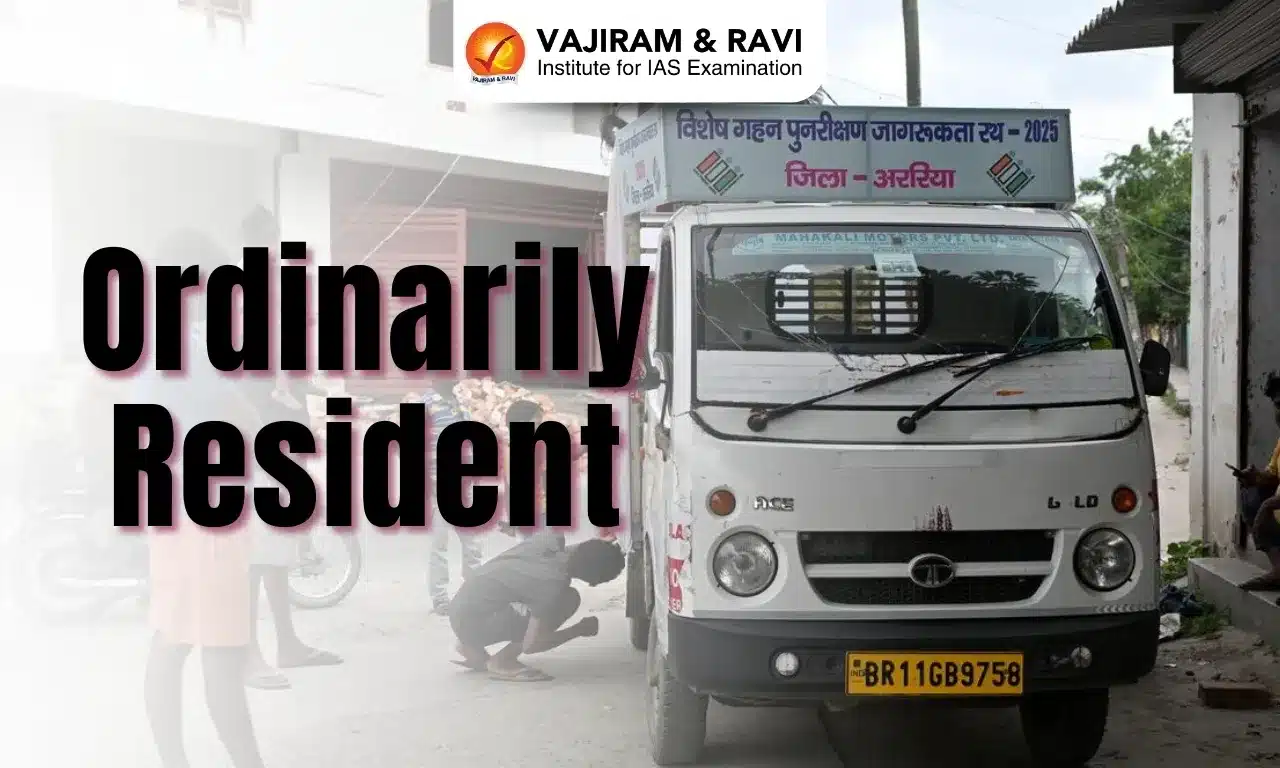
Ordinarily Resident

Ordinarily Resident Latest News

Recently, the Election Commission’s Special Intensive Revision (SIR) in Bihar has sparked discussions on electoral inclusion, particularly for migrant populations, focusing on the balance between electoral roll integrity and inclusive democratic participation.

Who is an ‘Ordinarily Resident’?

  • According to Section 19 of the RP Act, only a person who is an ‘ordinarily resident’ in a constituency can be enrolled in its electoral roll.
  • Section 20 of the RP Act defines the term ‘ordinarily resident’. It states that merely owning or possessing a house in a constituency does not qualify a person as an ordinarily resident.
  • A person temporarily absent from their regular residence (for work, travel, etc.) is still considered ordinarily resident in that location.
  • Specific categories covered under Section 20:
    • Armed forces personnel.
    • Members of the State armed police serving outside the State.
    • Central government employees posted abroad.
    • Persons holding a constitutional office declared by the President in consultation with the EC.
    • Their spouses are also considered ordinarily resident in the original constituency.
  • Section 20A (added in 2010) allows Non-Resident Indians (NRIs) to register and vote from the address mentioned in their passport, even if they live abroad for extended periods.
  • The Election Commission of India (ECI) is responsible for preparing electoral rolls under the Representation of the People Act, 1950 (RP Act).

Rules Governing Electoral Rolls

  • The Registration of Electors Rules, 1960 (RER), framed by the Central Government in consultation with the ECI, govern the:
    • Preparation of electoral rolls.
    • Inclusion and exclusion of names.
    • Process of verification and changes in voter lists.

Why ‘Ordinarily Resident’ Status Matters

  • The requirement ensures that the voter has a genuine and habitual connection with the constituency.
  • It maintains electoral integrity, reduces fraudulent registrations, and ensures accountability in representation.
  • The Gauhati High Court (1999, Manmohan Singh Case) ruled that:
    • The person should be a habitual and permanent resident.
    • There must be an intention to dwell in that place.
    • A reasonable person must accept the individual as a resident.

Source: TH

Ordinarily Resident FAQs

Q1: Who is an Ordinarily Resident in India?

Ans: A person who has resided in India for at least 182 days in the preceding financial year and intends to stay indefinitely.

Q2: Can NRIs become ordinarily resident?

Ans: Yes, if they return and satisfy the stay and intent criteria under Indian law.

Q3: Is citizenship required to be an ordinarily resident?

Ans: No, even non-citizens can be ordinarily residents if they meet the residency criteria.

Carbon Credit Trading Scheme (CCTS)

Carbon Credit Trading Scheme

Carbon Credit Trading Scheme (CCTS) Latest News

Recently, the Indian government announced greenhouse gas emissions intensity targets for entities in eight of the nine heavy industrial sectors participating in the Carbon Credit Trading Scheme's compliance mechanism.

What is CCTS?

  • The Carbon Credit Trading Scheme (CCTS) is a market-based framework developed under the Indian Carbon Market (ICM) to regulate and trade carbon credits.
  • It aims to accelerate India’s transition to a low-carbon economy by assigning a monetary value to greenhouse gas (GHG) emissions.
  • Objective: The primary aim of CCTS is to decarbonise industrial sectors by shifting focus from energy efficiency (PAT Scheme) to GHG emissions intensity reductions.
  • The CCTS is overseen by the Bureau of Energy Efficiency (BEE) and the National Steering Committee for Indian Carbon Market (NSCICM), ensuring transparent and accountable governance.

Transition from PAT to CCTS

  • India’s earlier Perform, Achieve, and Trade (PAT) scheme emphasised energy efficiency improvements in energy-intensive sectors through Energy Saving Certificates (ESCerts).
  • The CCTS supersedes PAT, focusing on direct GHG emissions intensity and issuing Carbon Credit Certificates (CCC), each representing 1 tonne of CO₂ equivalent reduced.
  • Target sectors (Compliance Mechanism): CCTS mandates participation from eight high-emission sectors: aluminium, cement, pulp & paper, chlor-alkali, iron & steel, textiles, petrochemicals, and refineries. These sectors account for ~16% of India’s total GHG emissions.
  • Power sector exclusion: The power sector, which contributes ~40% of India’s total GHG emissions, is currently excluded from the compliance mechanism but may be included in later phases.

Key Mechanisms under CCTS

  • Compliance mechanism: Entities in obligated sectors must meet sector-specific emission intensity targets. Those who exceed targets earn tradable CCCs, while others must buy credits.
  • Offset mechanism: Entities outside the compliance mandate can voluntarily participate by reducing emissions and earning carbon credits, promoting broader climate participation.
  • Under its Nationally Determined Contributions (NDCs), India targets a 45% reduction in emission intensity of its GDP by 2030 (relative to 2005 levels). The CCTS is a key policy instrument toward achieving this goal.
  • The eight sectors include aluminium, cement, paper and pulp, chlor-alkali, iron and steel, textiles, petrochemicals, and petro refineries.

Source: TH

Carbon Credit Trading Scheme (CCTS) FAQs

Q1: What is the Carbon Credit Trading Scheme (CCTS)?

Ans: It is India’s market-based mechanism to reduce GHG emissions by trading carbon credits..

Q2: What is a Carbon Credit Certificate (CCC)?

Ans: It represents a verified reduction of 1 tonne of CO₂ equivalent emissions.

Barak Valley

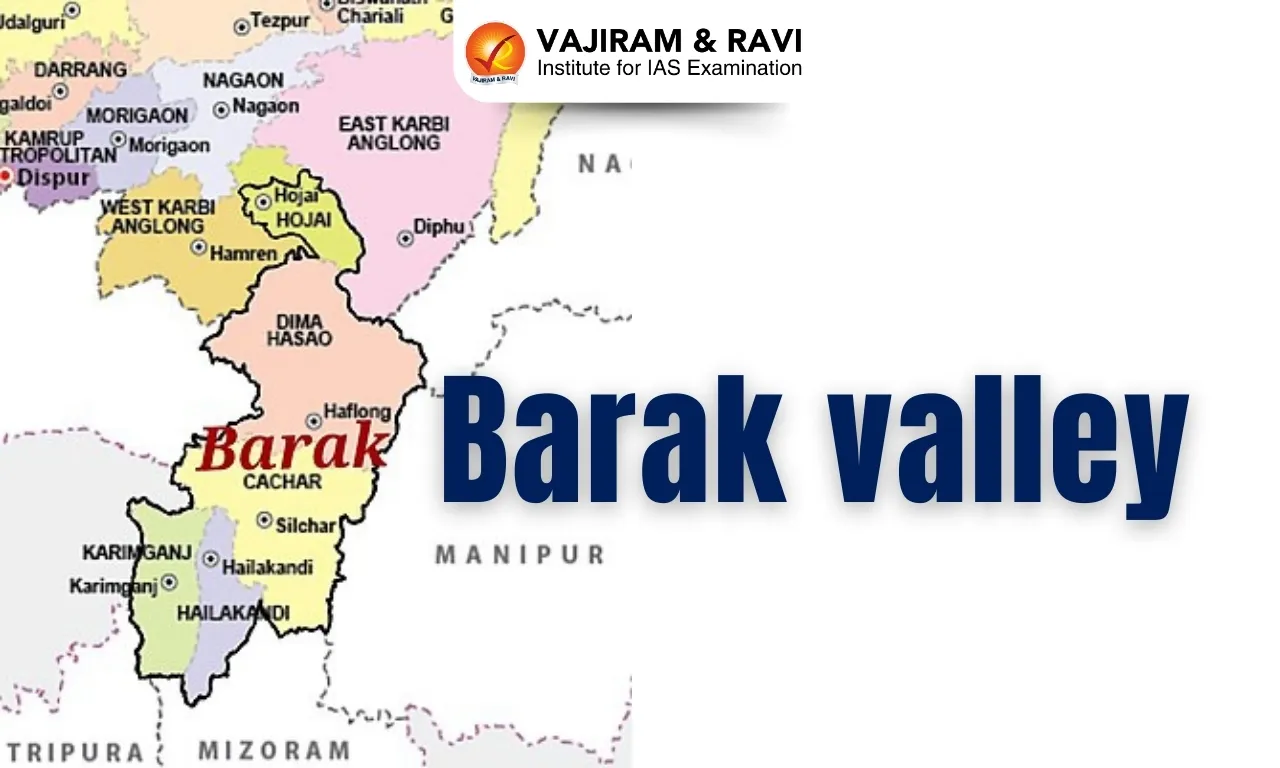
Barak Valley

Barak Valley Latest News

Assam Pradesh Congress Committee (APCC) president and Lok Sabha MP Gaurav Gogoi recently urged the Prime Minister to urgently intervene in the worsening connectivity crisis of the Barak Valley.

About Barak Valley

  • It is the southernmost region of Assam, named after the Barak River that flows through it.
  • It includes the three southernmost districts of Assam, viz., Cachar, Hailakandi, and Karimganj, which together cover about 9% of the geographical area of the state.
  • It shares borders with Meghalaya on its north, Mizoram on its south, Manipur on its east, and Tripura and the Sylhet division of Bangladesh on its west. 
  • The area is known to have fertile lands, making agriculture a major occupation of the region. 
  • Silchar is one of the main cities and also the educational hub of the region. 

Key Facts about Barak River

  • It is the second largest river in Northeast India after the Brahmaputra
  • The river runs through Manipur, Nagaland, Mizoram, Assam in India, and Bangladesh.
  • Course:
    • Origin: It rises from the Manipur hills, south of Mao in the Senapati district of Manipur, at an elevation of 2,331 m.
    • It flows then along the Nagaland-Manipur border through hilly terrains and enters Assam.
    • It further enters Bangladesh, where it is known by the name of the Surma and the Kushiyara and later called the Meghna before receiving the combined flow of the Ganga and the Brahmaputra.
    • It finally outfalls into the Bay of Bengal.
  • Length: Barak has a length of about 900 km, of which 564 km fall in India.
  • Tributaries: The principal tributaries of Barak are the Jiri, the Dhaleswari, the Singla, the Longai, the Sonai, and the Katakhal.

Source: TOI

Barak Valley FAQs

Q1: Where is Barak Valley located?

Ans: It is located in the southern part of the Indian state of Assam.

Q2: Approximately what percentage of Assam's geographical area is covered by the Barak Valley region?

Ans: 9%

Q3: Which major city in Barak Valley is considered the educational hub of the region?

Ans: Silchar

Exercise Talisman Sabre 2025

Exercise Talisman Sabre

Exercise Talisman Sabre Latest News

India, along with 18 other nations, is participating in Talisman Sabre 2025, a major bilateral military drill led by Australia that commenced recently.

About Exercise Talisman Sabre

  • It is the largest bilateral military exercise between Australia and the United States, with multinational participation.
  • It has been conducted between Australia and the United States biennially since 2005. 
  • It is conducted across a number of locations across Australia and offshore, using both Defence and non-Defence training areas. 
  • It is designed to advance a free and open Indo-Pacific by strengthening partnerships and interoperability among key allies.
  • Now in its 11th iteration, Talisman Sabre 2025 is the largest and most sophisticated warfighting exercise ever conducted in Australia.
    • More than 35,000 military personnel are participating.
    • In addition to the United States, forces from Canada, Fiji, France, Germany, India, Indonesia, Japan, the Netherlands, New Zealand, Norway, Papua New Guinea, the Philippines, the Republic of Korea, Singapore, Thailand, Tonga, and the United Kingdom are participating. 
    • Malaysia and Vietnam will also attend as observers.
    • This year’s exercise will consist of live-fire exercises and field training activities, incorporating force preparation activities, amphibious landings, ground force manoeuvres, and air combat and maritime operations.

Source: TH

Exercise Talisman Sabre FAQs

Q1: What is Exercise Talisman Sabre?

Ans: It is the largest bilateral military exercise between Australia and the United States, with multinational participation.

Q2: Since when has Exercise Talisman Sabre been conducted?

Ans: 2005

Q3: What is the main objective of Exercise Talisman Sabre?

Ans: To strengthen partnerships and interoperability for a free and open Indo-Pacific.

Q4: How often is Exercise Talisman Sabre held?

Ans: Biennially

Q5: Is India participating in Exercise Talisman Sabre 2025?

Ans: Yes, India is a participating country in Exercise Talisman Sabre 2025

ADEETIE Scheme

ADEETIE Scheme

ADEETIE Scheme Latest News

In a significant push towards industrial competitiveness, job creation, and climate goals, the Union ministry of power, through the Bureau of Energy Efficiency (BEE), is launching a first-of-its-kind scheme called ADEETIE (Assistance in Deploying Energy Efficient Technologies in Industries & Establishments).

About ADEETIE Scheme

  • ADEETIE (Assistance in Deploying Energy Efficient Technologies in Industries & Establishments) Scheme is a flagship initiative of the Bureau of Energy Efficiency (BEE) under the Ministry of Power, Government of India. 
  • It aims to catalyze the adoption of energy-efficient technologies among Micro, Small, and Medium Enterprises (MSMEs), enhancing their competitiveness and contributing to India’s climate goals. 
  • This Scheme offers comprehensive financial and technical support to Udyam-registered MSMEs, enabling them to implement energy-efficient technologies with a proven potential to save at least 10% of energy. 
  • The scheme is structured to provide targeted assistance in the form of interest subvention on loans, Investment Grade Energy Audits (IGEA), Detailed Project Reports (DPRs), and post-implementation Monitoring and Verification (M&V). 
  • The scheme is envisaged to provide interest subvention of 5% for Micro and Small Enterprises and 3% for Medium Enterprises on loans, ensuring accessibility and affordability for MSMEs seeking financial aid for energy efficiency projects.
  • The scheme also includes provisions for capacity building, with BEE providing assistance through its ADEETIE online platform, designed to facilitate financing for energy-efficient projects in the MSME sector.

Source: DC

ADEETIE Scheme FAQs

Q1: Which organization implements the ADEETIE Scheme?

Ans: Bureau of Energy Efficiency (BEE)

Q2: What is the objective of ADEETIE Scheme?

Ans: It aims to catalyze the adoption of energy-efficient technologies among MSMEs.

Q3: What interest subvention is provided under the ADEETIE Scheme for Micro and Small Enterprises?

Ans: 5%

Q4: What is the minimum energy savings potential a project must demonstrate to be eligible under the ADEETIE Scheme?

Ans: 10%

Biggest Stars in the Universe, Top 10 List, Size, Distance

UY Scuti is known as the Biggest Star in the Universe in the Milky Way and ranks among the most massive ever identified. Its size surpasses the Sun by over 1,700 times, making it an astronomical giant. More than 5 billion Suns could fit inside UY Scuti. However, despite its vast expanse, its mass is only about ten times that of the Sun, while its luminosity is nearly 100,000 times greater. This Biggest Star in the Universe is currently in its final evolutionary stages, having expanded significantly. In the future, it is expected to end its life in a dramatic supernova explosion, potentially giving rise to a neutron star or a black hole.

UY Scuti

UY Scuti is situated in the Scutum constellation, is one of the Biggest Star in the Universe having a radius approximately 1,700 times that of the Sun. Despite its staggering size, its vast distance of about 9,500 light-years makes detailed observations difficult. As a red supergiant, UY Scuti has a relatively cool surface temperature and continues to amaze astronomers due to its immense scale and evolving nature.

Top 10 Biggest Stars in the Universe

The table below includes the Top 10 Biggest Stars in the Universe known stars, along with their respective constellations, estimated radii, and distances from Earth.

Top 10 Biggest Stars in the Universe
Rank Stars Constellation Distance (light year) Diameter (solar radii)

1.

UY Scuti

Scutum

5,900

1,700

2.

VY Canis Majoris

Canis Majoris

3,900

>1,500

3.

RW Cephei

Cepheus

3,500

1,530

4.

V354 Cephei

Cepheus

8,900

1,520

5.

KY Cygni

Cygnus

5,000

1,430

6.

Mu Cephei

Cepheus

2,838

1,200

7.

VV Cephei A

Cepheus

5,000

1,050

8.

KW Sagittarii

Sagittarius

6,200

1,090

9.

Betelgeuse

Orion

640

887

10.

Antares

Scorpius

550

832

Biggest Stars in the Universe

The universe is home to some of the most luminous stars, surpassing our Sun in both size and brightness. These celestial bodies are typically located thousands of light-years away, with some reaching astonishing radii over 2,000 times that of the Sun. Studying these stars provides valuable insights into stellar evolution, supernova events, and the formation of neutron stars or black holes.

UY Scuti – The Largest Known Star

UY Scuti, located in the Scutum constellation, holds the title of the Biggest Stars in the Universe. UY Scuti is about 9,500 light-years away, making it difficult to observe in detail. It is classified as a variable star, meaning its brightness fluctuates over time. Currently, UY Scuti is in the final stages of its life cycle and will eventually explode in a supernova, potentially leaving behind a neutron star or a black hole.

Stephenson 2-18 – The Second Largest Star

Stephenson 2-18 is another red supergiant found in the Scutum constellation, and has an even greater radius of approximately 2,150 times that of the Sun. Located nearly 19,000 light-years away, it is one of the most massive and luminous stars known. Its vast size and brightness contribute to our understanding of the extreme limits of stellar evolution.

VY Canis Majoris

VY Canis Majoris, situated in the Canis Major constellation, is one of the largest and most massive stars ever recorded. With a radius of about 1,420 times that of the Sun, this hypergiant is located 3,900 light-years away. 

Betelgeuse

Betelgeuse, a red supergiant in the Orion constellation, is one of the most easily visible stars in the night sky. It has a radius of approximately 950 times that of the Sun and is relatively close, at 643 light-years away. Its brightness varies, indicating that it is approaching the final stages of its life cycle. Astronomers predict that Betelgeuse may explode in a supernova within the next few thousand years, providing an incredible cosmic spectacle.

Pistol Star

The Pistol Star, located in the Sagittarius constellation, is a blue hypergiant known for its extreme mass and brightness. While its exact dimensions vary, it is among the most massive stars in the universe. Situated 25,000 light-years away, its luminosity makes it an important object of study for understanding the formation of massive stars.

Antares

Antares, a red supergiant in the Scorpius constellation, has a radius of about 680 times that of the Sun. Recognized for its deep red hue, it is located 550 light-years away and is a binary star system, helping astronomers explore stellar life cycles and mass transfer in binary systems.

Rigel

Rigel, another massive star in Orion, is a blue supergiant with a radius 78 times that of the Sun. Despite being 860 light-years away, it remains one of the brightest stars visible in the night sky. Its high luminosity makes it a key object for studying stellar evolution.

Aldebaran

Aldebaran is located in the Taurus constellation, is an orange giant with a radius 44.2 times that of the Sun. At just 65 light-years away, it is one of the closest and most easily visible stars from Earth. Often referred to as the "Eye of the Bull," Aldebaran plays an important role in astronomical navigation and observational studies.

KY Cygni

KY Cygni is found in the Cygnus constellation, is another massive red supergiant, having a radius of approximately 1,420 times that of the Sun. At a distance of 5,000 light-years, it is known for its brightness fluctuations, making it a key target for studying variable stars and their impact on the surrounding space environment.

Westerlund 1 W26

Westerlund 1 W26 is a red supergiant located in the Ara constellation. Though its exact size is uncertain, it is one of the largest stars within the Westerlund 1 cluster, a group of extremely young and massive stars. This star provides insight into how massive stars evolve within dense stellar environments.

Biggest Stars in the Universe FAQs

Q1: Which is bigger, Betelgeuse or UY Scuti?

Ans: UY Scuti is known as the Biggest Star in the Universe.

Q2: What are the stars in order from largest to smallest?

Ans: Supergiants are the largest stars and dwarf stars are the smallest.

Q3: What star is 100x bigger than the sun?

Ans: Eta Carinae, a massive star system located about 7,500 light-years away in the southern constellation of Carina is 100x bigger than the sun.

Q4: Is Stephenson 218 bigger than UY Scuti?

Ans: Stephenson 2-18 took the title of the largest star known from the previous record holders, the red supergiants WOH G64 in the constellation Dorado and UY Scuti in Scutum.

Q5: What is the 2nd largest star?

Ans: Second Biggest Star in the Universe is Stephenson 2-18.

Flue Gas Desulphurisation (FGD)

Flue Gas Desulphurisation

Flue Gas Desulphurisation (FGD) Latest News

Recently, the Environment Ministry has exempted most coal-fired plants in India from installing Flue Gas Desulphurisation (FGD) systems aimed at reducing sulphur dioxide (SO2) emissions.

About Flue Gas Desulphurisation (FGD)

  • Flue Gas Desulphurisation (FGD) is a pollution-control process that removes Sulphur Dioxide (SO₂) from the flue gases produced by the combustion of fossil fuels, especially coal.
  • The key aim of FGD is to reduce SO₂ emissions, which are major contributors to acid rain and particulate matter pollution, harming crops, soil, water bodies, infrastructure, and human health.
  • FGD systems typically use limestone (CaCO₃), lime (CaO), or ammonia (NH₃) to react with and neutralize SO₂ in flue gases.

FGD Technology Types

  • Dry Sorbent Injection (DSI): Injects limestone or lime into the flue gas before it passes through dust collectors.
  • Wet Limestone Scrubbing: Uses a slurry of limestone (CaCO₃) to absorb SO₂ and convert it into gypsum (CaSO₄·2H₂O).
  • Seawater FGD: Uses the alkalinity of seawater to neutralise SO₂, common in coastal plants, with low installation costs but limited applicability.

Recent Policy Changes and Issues

  • In 2015, India’s Environment Ministry mandated that all coal-fired thermal power plants must install FGD systems by 2017 to curb SO₂ pollution. There are about 180 such plants, comprising 600 individual units.
  • This exemption decision was based on scientific studies suggesting:
    • Indian coal has low sulphur content.
    • SO₂ levels near plants with and without FGDs were similar.
    • Sulphates may have a cooling effect, counteracting global warming.
  • As of now, only ~8% of these units have installed FGDs, with most installations by NTPC (public sector). The rest failed due to vendor shortages, high costs, COVID-related delays, and an anticipated rise in power tariffs.

Source: TH

Flue Gas Desulphurisation (FGD) FAQs

Q1: What is Flue Gas Desulphurisation (FGD)?

Ans: It is a process to remove sulphur dioxide (SO₂) from the exhaust gases of fossil fuel-based power plants.

Q2: Which substances are commonly used in FGD systems?

Ans: Limestone (CaCO₃), lime (CaO), and ammonia (NH₃) are typical absorbents.

Q3: What are the main types of FGD technologies?

Ans: Dry sorbent injection, wet limestone-based systems, and seawater-based systems.

Jarawa Tribe

Jarawa Tribe

Jarawa Tribe Latest News

Concerns regarding the enumeration of isolated indigenous tribes, especially the Jarawa Tribe of Andaman Islands, were addressed by experts who said reaching the Jarawas will not be tough due to existing contact and welfare initiatives.

About the Jarawa Tribe

  • The Jarawas are among the world’s oldest surviving indigenous communities.
  • They are recognised as a Particularly Vulnerable Tribal Group (PVTG).
  • Their population is estimated to be between 250 to 400 individuals.
  • They inhabit the Middle and South Andaman Islands, living in nomadic bands of 40–50.
  • Their habitat includes dense tropical forests, mangroves, and coastal zones.

Origin & History

  • The Jarawas are believed to be descendants of the extinct Jangil tribe.
  • Some theories link their ancestry to the first wave of human migration out of Africa, making them part of the earliest human settlers in Asia.
  • They survived British colonization (since 1789) and World War II, despite a massive decline in population.

Cultural & Lifestyle Characteristics

  • The Jarawas are hunter-gatherer-fishermen, relying on forest produce, hunting, and coastal fishing.
  • They are known for their robust physical health, attributed to their nutritional lifestyle.
  • Traditional Jarawa attire is minimal, suited to the humid tropical climate of the Andaman Islands.
  • Known as territorial defenders, the Jarawas historically resisted intrusion into their lands.

About 16th Census of India

  • The Government of India has announced that the 16th Census of India will be conducted in two phases:
    • October 1, 2026 for snow-bound states and A&N Islands.
    • March 1, 2027 for the rest of India.
  • This census will also include nationwide caste enumeration, the first since 1931.

Source: TH

Jarawa Tribe FAQs

Q1: Who are the Jarawas?

Ans: They are one of the indigenous tribes of the Andaman Islands, classified as a Particularly Vulnerable Tribal Group (PVTG).

Q2: Where is the Jarawa tribe located?

Ans: They inhabit the South and Middle Andaman Islands in the Andaman & Nicobar Islands.

Q3: What is the legal protection framework for Jarawas?

Ans: They are protected under the Andaman and Nicobar Protection of Aboriginal Tribes Regulation, 1956.

Dams in India, State Wise List, Longest & Highest Dams in India

Dams in India

India, often referred to as the land of rivers, surrounded the Himalayas in the north, the plateaus in central India, and the Western and Eastern Ghats in the south along the oceanic boundaries. These varied terrains provide an ideal setting for dam construction. With approximately 4,300 large dams already built and several more under development, India continues to expand its water management infrastructure through projects aimed at irrigation, hydroelectric power generation, and flood control.

List of Dams in India

Below in the table is the List of Dams in India as they play a crucial role in water conservation, irrigation, hydroelectric power generation, and flood control. 

List of Dams in India
Name of Dam State Name River Name

Nizam Sagar Dam

Telangana

Manjira River

Somasila Dam

Andhra Pradesh

Pennar River

Srisailam Dam

Andhra Pradesh

Krishna River

Singur dam

Telangana

Manjira River

Ukai Dam

Gujarat

Tapti River

Dharoi Dam

Gujarat

Sabarmati River

Kadana dam

Gujarat

Mahi River

Dantiwada Dam

Gujarat

Banas River

Pandoh Dam

Himachal Pradesh

Beas River

Bhakra Nangal Dam

Himachal Pradesh and Punjab Border

Sutlej River

Nathpa Jhakri Dam

Himachal Pradesh

Satluj River

Chamera Dam

Himachal Pradesh

Ravi River

Baglihar Dam

Jammu and Kashmir

Chenab River

Dumkhar Hydroelectric Dam

Jammu and Kashmir

Indus River

Uri Hydroelectric Dam

Jammu and Kashmir

Jhelum River

Maithon Dam

Jharkhand

Barakar River

Chandil Dam

Jharkhand

Swarnarekha River

Panchet Dam

Jharkhand

Damodar River

Tunga Bhadra Dam

Karnataka

Tungabhadra River

Linganamakki dam

Karnataka

Sharavathi River

Kadra Dam

Karnataka

Kalinadi River

Alamatti Dam

Karnataka

Krishna River

Supa Dam

Karnataka

Kalinadi or Kali river

Krishna Raja Sagara Dam

Karnataka

Kaveri River

Harangi Dam

Karnataka

Harangi River

Narayanpur Dam

Karnataka

Krishna River

Kodasalli Dam

Karnataka

Kali River

Malampuzha Dam

Kerala

Malampuzha River

Peechi Dam

Kerala

Manali River

Idukki Dam

Kerala

Periyar River

Kundala Dam

Kerala

Kundala Lake

Parambikulam Dam

Kerala

Parambikulam River

Walayar Dam

Kerala

Walayar River

Mullaperiyar Dam

Kerala

Periyar River

Neyyar Dam

Kerala

Neyyar River

Rajghat Dam

Uttar Pradesh and Madhya Pradesh Border

Betwa River

Barna Dam

Madhya Pradesh

Barna River

Bargi Dam

Madhya Pradesh

Narmada River

Bansagar Dam

Madhya Pradesh

Sone River

Gandhi Sagar Dam

Madhya Pradesh

Chambal River

Yeldari Dam

Maharashtra

Purna river

Ujani Dam

Maharashtra

Bhima River

Pawna Dam

Maharashtra

Maval River

Mulshi Dam

Maharashtra

Mula River

Koyna Dam

Maharashtra

Koyna River

Jayakwadi Dam

Maharashtra

Godavari River

Bhatsa Dam

Maharashtra

Bhatsa river

Wilson Dam

Maharashtra

Pravara River

Tansa Dam

Maharashtra

Tansa river

Panshet Dam

Maharashtra

Ambi River

Mula Dam

Maharashtra

Mula river

Kolkewadi Dam

Maharashtra

Vashishti River

Girna Dam

Maharashtra

Girana river

Vaitarna Dam

Maharashtra

Vaitarna river

Radhanagari Dam

Telangana

Bhogawati River

Lower Manair Dam

Telangana

Manair River

Mid Manair Dam

Telangana

Manair River and SRSP Flood Flow Canal

Upper Manair Dam

Telangana

Manair River and Kudlair River

Khadakwasla Dam

Maharashtra

Mutha River

Gangapur Dam

Maharashtra

Godavari river

Jalaput Dam

Andhra Pradesh and Odisha Border

Machkund River

Indravati Dam

Odisha

Indravati River

Hirakud Dam

Odisha

Mahanadi River

Vaigai Dam

Tamil Nadu

Vaigai River

Perunchani Dam

Tamil Nadu

Paralayar River

Mettur Dam

Tamil Nadu

Kaveri River

Govind Ballabh Pant Sagar Dam / Rihand dam

Uttar Pradesh

Rihand River

Tehri Dam

Uttarakhand

Bhagirathi River

Dhauli Ganga Dam

Uttarakhand

Dhauli Ganga River

Longest Dam in India

Hirakud Dam, the longest dam in India, stretches over 25.79 km across the Mahanadi River in Sambalpur district, Odisha. Completed in 1953, this composite dam serves multiple purposes, including flood control, irrigation, and hydroelectric power generation. It has a total reservoir capacity of 47,79,965 acre-feet, making it one of the most significant water infrastructure projects in India.

Highest Dam in India

Tehri Dam, standing at 260.5 meters, is the tallest dam in India and ranks 12th among the tallest dams in the world. Constructed on the Bhagirathi River in New Tehri, Tehri Garhwal district, Uttarakhand, this massive structure plays a crucial role in hydroelectric power generation, irrigation, and water supply. The dam has a length of 575 meters, and its first phase was completed in 2006. It operates under THDC India Ltd. and is a key component of the Tehri Hydroelectric Complex.

Oldest Dam in India

The Kallanai Dam, built on the Kaveri River, is the oldest dam in India and one of the oldest water-regulation structures in the world still in use. Located in the Thanjavur district of Tamil Nadu, it was originally constructed between 100 BC and 100 AD by the Chola king Karikalan. The dam continues to serve as a crucial irrigation structure, benefiting agriculture in the region. Today, it is operated by the Government of Tamil Nadu and remains a remarkable testament to ancient Indian engineering expertise.

Uses of Dams in India

  • Water Supply for Domestic and Urban Use – Dams help in storing and supplying water for households, cities, and industries, ensuring a consistent and reliable source of clean water.
  • Irrigation Support – They provide essential water resources for agriculture, helping farmers sustain crop production even in drought-prone areas.
  • Industrial Utility – Many industries rely on a steady water supply from dams for manufacturing, processing, and cooling purposes.
  • Hydroelectric Power Generation – Dams facilitate renewable energy production by controlling the power of flowing water, contributing to sustainable electricity generation.
  • River Navigation – Dams regulate river flow, making inland water transport more feasible and economical, which is the cheapest mode of transportation.
  • Livelihood and Recreation – Reservoirs created by dams support fishing, boating, and tourism, providing employment opportunities to local communities.
  • Flood Control – By regulating river flow, dams help in preventing floods and mitigating damage to life and property.

Dams in India FAQs

Q1: Which is the 5 biggest dam in India?

Ans: Sardar Sarovar Dam, Hirakud Dam, Nagarjuna Sagar Dam, ndira Sagar Dam, Koyna Dam.

Q2: How many dams are there in India?

Ans: India has 5334 dams with 447 being very important.

Q3: Which is the smallest dam in India?

Ans: The smallest dam is Cheruthoni Dam, constructed upon the Periyar River, which is only 138.2 metres tall.

Q4: What is the 7th largest dam?

Ans: Longtan Dam is the 7th largest dam.

Q5: Which is the oldest dam in India?

Ans: Kallanai Dam built across the Kaveri river of Tamil Nadu is the oldest dam (first dam) in India.

UPSC Daily Quiz 14 July 2025

UPSC Daily Quiz

The Daily UPSC Quiz by Vajiram & Ravi is a thoughtfully curated initiative designed to support UPSC aspirants in strengthening their current affairs knowledge and core conceptual understanding. Aligned with the UPSC Syllabus 2025, this daily quiz serves as a revision resource, helping candidates assess their preparation, revise key topics, and stay updated with relevant issues. Whether you are preparing for Prelims or sharpening your revision for Mains, consistent practice with these Daily UPSC Quiz can significantly enhance accuracy, speed, and confidence in solving exam-level questions.

[WpProQuiz 20]  

UPSC Daily Quiz FAQs

Q1: What is the Daily UPSC Quiz?

Ans: The Daily UPSC Quiz is a set of practice questions based on current affairs, static subjects, and PYQs that help aspirants enhance retention and test conceptual clarity regularly.

Q2: How is the Daily Quiz useful for UPSC preparation?

Ans: Daily quizzes support learning, help in revision, improve time management, and boost accuracy for both UPSC Prelims and Mains through consistent practice.

Q3: Are the quiz questions based on the UPSC syllabus?

Ans: Yes, all questions are aligned with the UPSC Syllabus 2025, covering key areas like Polity, Economy, Environment, History, Geography, and Current Affairs.

Q4: Are solutions and explanations provided with the quiz?

Ans: Yes, each quiz includes detailed explanations and source references to enhance conceptual understanding and enable self-assessment.

Q5: Is the Daily UPSC Quiz suitable for both Prelims and Mains?

Ans: Primarily focused on Prelims (MCQ format), but it also indirectly helps in Mains by strengthening subject knowledge and factual clarity.

Patriot Air Defence Missile System

Patriot Air Defence Missile System

Patriot Air Defence Missile System Latest News

The US President recently announced that Washington will send Patriot air defence systems to Ukraine amid mounting Russian aggression.

About Patriot Air Defence Missile System

  • The Patriot (MIM-104), which stands for Phased Array Tracking Radar for Intercept on Target, is an all-altitude, all-weather surface-to-air missile defense system.
  • While initially designed as an antiaircraft system, newer variants of Patriot are capable of engaging ballistic and cruise missiles, loitering munitions, and aircraft. 
  • It is built by Raytheon Technologies Corp. (a US aerospace and defense company).
  • It is the United States Army’s most advanced air defense system.
  • It is a combat-proven air defence system operated by the US and a number of its allies, including Germany, Greece, Israel, Japan, Kuwait, the Netherlands, Saudi Arabia, South Korea, Poland, Sweden, Qatar, the United Arab Emirates, Romania, Spain, and Taiwan.
  • The system was first used in combat during the 1991 Gulf War, with batteries protecting Saudi Arabia, Kuwait, and Israel, and later used during the U.S. invasion of Iraq in 2003.

Patriot Air Defence Missile System Features

  • A Patriot battery (i.e., the basic firing unit) consists of a phased array radar, an engagement control station, computers, power generating equipment, and up to eight launchers, each of which holds four ready-to-fire missiles. 
  • There are about 90 soldiers assigned to a battery, but three soldiers in the engagement control station are the only personnel required to operate the battery in combat. 
  • It is equipped with a track-via-missile (TVM) guidance system. Midcourse correction commands are transmitted to the guidance system from the mobile engagement control centre.
  • The system has different capabilities depending on the type of interceptor used.
  • The PAC-2 interceptor uses a blast-fragmentation warhead, while the newer PAC-3 missile uses more advanced hit-to-kill technology.
  • Depending on the version in use, the interceptor missiles can reach an altitude of more than 24 kilometers and hit targets up to 160 kilometers away.
  • The system’s radar has a range of over 150 km (93 miles).

Source: IT

Patriot Air Defence Missile System FAQs

Q1: Which company manufactures the Patriot Air Defence Missile System?

Ans: It is built by Raytheon Technologies Corp. (a US aerospace and defense company).

Q2: 1991 Gulf War

Ans: What is the range capability of the Patriot system’s radar?

Aircraft Accident Investigation Bureau (AAIB): India’s Air Crash Probe Authority Explained

Aircraft Accident Investigation Bureau

Aircraft Accident Investigation Bureau Latest News

  • A month after the Air India AI 171 crash in Ahmedabad, where 241 of 242 onboard died, the Aircraft Accident Investigation Bureau (AAIB) released its preliminary report. 
  • The report revealed both engine fuel control switches moved from 'RUN' to 'CUTOFF' within seconds of takeoff, raising serious concerns. 
  • One pilot reportedly questioned the other about cutting off fuel, but the latter denied doing so. 
  • Since these switches don’t usually move accidentally, the incident has prompted deeper scrutiny, especially of the cockpit voice recorder (CVR) and flight data recorder (FDR), as part of the AAIB’s ongoing investigation process.

Investigating Aircraft Crashes

  • Under the 1944 Chicago Convention, overseen by the International Civil Aviation Organization (ICAO), aircraft crash investigations are primarily conducted by the ‘State of Occurrence’—the country where the accident takes place.
    • ICAO is a specialized agency of the United Nations that promotes the safe and orderly development of international civil aviation. 
    • Established in 1944, it sets standards and recommends practices for aviation safety, security, efficiency, and environmental protection.
  • Additionally, the State of Registry, State of the Operator, State of Design, and State of Manufacture have formal rights to participate in the investigation process. 
    • State of Registry - where the aircraft is registered,
    • State of the Operator - which operated the flight, 
    • State of Design - The country that regulates and oversees the organization responsible for designing and ensuring the airworthiness of an aircraft.
    • State of Manufacture - the country or jurisdiction that has authority over the organization responsible for the final assembly of an aircraft. 
  • These protocols are detailed in Annex 13 of the Convention.

AAIB: India’s Independent Air Crash Investigation Body

  • The Aircraft Accident Investigation Bureau (AAIB), under India’s Ministry of Civil Aviation, investigates civil aviation accidents and serious incidents. 
  • It was established in 2012 to ensure investigation independence from regulatory bodies like the Directorate General of Civil Aviation (DGCA), following global standards set by the International Civil Aviation Organization (ICAO). 

Legal Framework of the AAIB

  • Under Section 7 of the Aircraft Act, 1934, the Government of India is empowered to make rules for investigating aircraft accidents in India or involving Indian-registered aircraft.
  • Initially, the Air Safety Directorate of DGCA handled these investigations under the Aircraft Rules, 1937, aligned with Article 26 of the Chicago Convention.

Governing Rules

  • The Aircraft (Investigation of Accidents and Incidents) Rules, 2012 were formulated to formalize AAIB’s role.
  • These rules were later amended in 2017 and 2021.
  • AAIB is now designated as an “Attached Office” of the Ministry of Civil Aviation.

Functions and Role of the AAIB

  • AAIB classifies safety occurrences as Accidents, Serious Incidents, and Incidents.
  • It is empowered with immediate and unrestricted access to all relevant evidence from any agency or organisation, without requiring prior approval from judicial or government authorities.
  • It investigates all Accidents and Serious Incidents involving aircraft over 2,250 kg All Up Weight (the total weight of an aircraft with passengers and cargo) and Turbojet aircraft.
  • Investigations focus solely on preventing future accidents, not on assigning blame or liability (as per Rule 3 of Aircraft (Investigation of Accidents and Incidents) Rules, 2017).
  • Investigation Process
    • Immediate site investigation: AAIB sends investigators to collect and preserve perishable evidence, black boxes, wreckage samples, etc.
    • Evidence collection: Includes data from operators, regulators, involved personnel, and unrestricted access to all relevant materials.
    • Expert analysis: AAIB may engage domain experts and collaborate with agencies like Hindustan Aeronautics Limited and DGCA laboratories.
    • Report preparation: After internal review, a final report is published and shared with the ICAO and involved states.
  • Additional Functions
    • Conducting safety studies.
    • Issuing safety recommendations to DGCA India or other international aviation regulatory bodies for implementation and monitoring.

Source: IE | MoCA

Aircraft Accident Investigation Bureau FAQs

Q1: What is AAIB India?

Ans: AAIB is India’s official body investigating civil aviation accidents, ensuring independent, evidence-based probes under global ICAO standards.

Q2: When was AAIB established?

Ans: The AAIB was set up in 2012 under the Ministry of Civil Aviation to separate investigation from regulatory functions.

Q3: What powers does AAIB have?

Ans: AAIB has unrestricted access to crash sites, black boxes, and evidence, focusing solely on accident prevention, not liability.

Q4: Which laws govern AAIB?

Ans: AAIB operates under Aircraft (Investigation of Accidents and Incidents) Rules, 2012, amended in 2017 and 2021, under Aircraft Act 1934.

Q5: How does AAIB investigate crashes?

Ans: AAIB conducts on-site evidence collection, expert analysis, prepares public reports, and issues safety recommendations to DGCA and international bodies.

Why India Must Support CIMMYT and IRRI: Repaying the Green Revolution Debt

Green Revolution Debt

Green Revolution Debt Latest News

  • William S. Gaud of USAID coined the term “Green Revolution” in 1968, highlighting efforts like India’s adoption of high-yield wheat varieties to tackle global food challenges. 
  • USAID, which played a key role in supporting such agricultural advances, was shut down by the Trump administration from July 1. 
  • Its closure has affected institutions like CIMMYT, a major centre for maize and wheat research.
  • CIMMYT, linked to Norman Borlaug, developed key semi-dwarf wheat varieties that sparked India’s Green Revolution. 
  • Initially funded by Mexico and the Rockefeller Foundation, CIMMYT later relied heavily on USAID, which contributed $83 million of its $211 million funding in 2024. 
  • With USAID now shut, CIMMYT is turning to India—one of its biggest beneficiaries—for future support.

CIMMYT

  • Mexico-headquartered International Maize and Wheat Improvement Center or CIMMYT is a major centre for maize and wheat research.
  • CIMMYT is to wheat what the Philippines-based International Rice Research Institute (IRRI) — established by the Ford and Rockefeller foundations in 1960 — has been to the other big cereal grain crop.
  • It developed semi-dwarf wheat varieties like Lerma Rojo 64A and Sonora 63, first sown in India in 1964–65, sparking the Green Revolution.
    • Renowned agricultural scientist Norman Borlaug was closely associated with CIMMYT.
  • It originated from a Mexican government and Rockefeller Foundation initiative in the 1940s–50s.
  • USAID later became CIMMYT’s main funder, contributing $83 million of its $211 million grant revenues in 2024.
  • With USAID dismantled, CIMMYT is now seeking India as a major funding partner.

How Wheat and Rice Research Became Cold War Tools

  • CIMMYT and IRRI, key institutions backed by US foundations, helped expand wheat and rice production globally, especially in developing countries like India. 
  • This was part of US Cold War strategy to prevent food-related political instability and communist influence. 
  • Borlaug’s wheat varieties and IRRI’s semi-dwarf rice strains significantly increased crop yields and reduced growing times. 
    • Borlaug’s wheat varieties boosted Indian wheat yields from 1–1.5 tonnes to 4–4.5 tonnes per hectare, overcoming issues like lodging in traditional tall cultivars.
  • Borlaug received the 1970 Nobel Peace Prize for his contributions to global food security.

How India Benefited from the Green Revolution

  • The Green Revolution in India was driven by wheat and rice varieties from CIMMYT and IRRI. 
  • Indian scientists adapted these into wheat varieties like Kalyan Sona and Sonalika in 1967–68 using CIMMYT breeding material.
  • At IARI New Delhi, scientists led by VS Mathur developed high-yielding wheat varieties such as HD 2285 (1982), HD 2329 (1985), and later HD 2967 (2011), pushing wheat yields to 7+ tonnes per hectare.
  • In rice, V Ramachandra Rao and MV Reddy at Andhra Pradesh Agricultural University created mega varieties like Swarna (1982) and Samba Mahsuri (1986). 
  • IARI scientists developed top-selling basmati varieties like Pusa Basmati 1 (1989), 1121 (2003), and 1509 (2013).
  • India exported 6.1 million tonnes of basmati worth $5.94 billion in 2024–25, with over 90% from IARI varieties.
  • Norman Borlaug credited India’s success to strong institutions like IARI and leadership from MS Swaminathan. 

Why India Still Needs CIMMYT and IRRI

  • In 2024–25, six out of the top 10 wheat varieties in India—covering over 20 million hectares out of 32 million hectares—were developed using CIMMYT germplasm.
  • The only major recent Indian-bred wheat variety, HD 2967, peaked at 12–14 million hectares in 2017–19. Most new varieties since rely on CIMMYT material.
  • CIMMYT and IRRI remain crucial for India’s food security and agricultural growth. 

Conclusion

  • In 2024, India contributed just $0.8 million to CIMMYT and $18.3 million to IRRI, despite being a major beneficiary.
  • India should increase funding for these global institutions, focusing on strategic research in heat and drought tolerance, nitrogen use efficiency, gene editing, and AI tools. 
  • However, this support must complement—not replace—investment in India’s own agricultural research system.

Source: IE | IE

Green Revolution Debt FAQs

Q1: What is CIMMYT’s role in India’s agriculture?

Ans: CIMMYT developed semi-dwarf wheat varieties that kickstarted India’s Green Revolution and still contribute to major wheat production.

Q2: Why did CIMMYT look to India for support?

Ans: After USAID’s closure, CIMMYT seeks Indian funding, as India remains one of its biggest beneficiaries and stakeholders.

Q3: How did India benefit from IRRI and CIMMYT?

Ans: India’s high-yield wheat and rice varieties, including top basmati exports, were developed using CIMMYT and IRRI breeding material.

Q4: Why is continued support for CIMMYT important?

Ans: CIMMYT provides India with vital germplasm and research in heat tolerance, drought resistance, nitrogen efficiency, and crop improvement technologies.

Q5: How much does India contribute to CIMMYT and IRRI?

Ans: In 2024, India contributed $0.8 million to CIMMYT and $18.3 million to IRRI, despite being a key beneficiary.

Recognising India’s Open Ecosystems – A Call for Conservation and Policy Reform

Open Ecosystems

Open Ecosystems Latest News

Experts and environmentalists have raised concerns over India’s continued misclassification of deserts, grasslands, and savannas as “wastelands,” urging policymakers to recognise the ecological and socio-cultural value of these open ecosystems to ensure their protection and sustainable management.

Introduction

  • India’s deserts, grasslands, and savannas, collectively known as open ecosystems, are rich in biodiversity and cultural heritage. 
  • Yet, these landscapes continue to be misunderstood and misclassified as “wastelands,” often targeted for tree plantations or industrial use. 
  • Recent expert commentary emphasises the ecological importance of these open ecosystems and the urgent need to re-evaluate national land-use policies that ignore or erase them.

Understanding Open Ecosystems and Their Importance

  • Open ecosystems such as arid deserts, grasslands, scrublands, and savannas are characterised by sparse tree cover and vast stretches of herbaceous or shrubby vegetation. 
  • Contrary to the common perception of being barren, these landscapes are finely tuned to their environmental extremes and support rich biodiversity.
  • Notably, deserts occupy nearly one-third of Earth’s terrestrial surface and host uniquely adapted flora and fauna
  • Historical evidence also reveals that several ancient civilisations, including those in Mesopotamia, Egypt, and the Indus Valley, emerged in desert climates, underscoring the capacity of these ecosystems to support complex societies.

Misclassification and the Legacy of 'Wastelands'

  • India’s policy and administrative frameworks have long inherited colonial land-use classifications, wherein vast tracts of open natural ecosystems are marked as "wastelands." 
  • This term erroneously implies that such lands are unproductive and in need of transformation, typically through afforestation, agricultural conversion, or urban development.
  • Official government records have classified millions of hectares of grasslands, savannas, and scrublands as wastelands. 
  • This mischaracterisation has led to extensive ecological damage and a weakening of ecosystem services such as carbon sequestration, soil fertility, and water retention.

Ecological and Social Value of Open Landscapes

  • India's open ecosystems are home to several endangered and endemic species such as the Great Indian Bustard, caracal, Indian wolf, and the chinkara. 
  • These species rely on the unique structure and rhythm of open habitats to thrive. 
  • Additionally, while tree-based carbon storage receives most attention, grasslands and savannas store substantial carbon deep in the soil, making them important in combating climate change.
  • Beyond biodiversity, these ecosystems are also vital to human livelihoods. 
  • Millions of pastoralist communities, including the Dhangars of Maharashtra, Rabaris of Gujarat, and Kurubas of Karnataka, depend on these landscapes for grazing. These groups have historically functioned as custodians of ecosystem health through practices like rotational grazing and water conservation.
  • However, policies that promote fencing, tree planting, or repurposing of grasslands often result in displacement, loss of income, and erosion of traditional ecological knowledge among these communities.

Rethinking Land Restoration and Greening Goals

  • The tendency to “green” deserts or grasslands through tree plantations often stems from the flawed belief that tree cover alone equates to ecological health. 
  • Such approaches may lead to monoculture plantations that degrade local biodiversity and disrupt seasonal ecological cycles.
  • Experts advocate for a restoration model that is low-tech, community-driven, and grounded in ecological principles. Strategies include:
    • Protecting native vegetation and enabling natural regeneration.
    • Promoting soil and moisture conservation through water harvesting.
    • Drawing from indigenous land management knowledge.
    • Recognising carbon stored in soil as a climate mitigation metric.
    • Importantly, policies must move away from one-size-fits-all afforestation efforts and instead embrace the diversity of India’s ecosystems.

Policy Recommendations and the Road Ahead

  • To ensure a sustainable future, India needs a paradigm shift in how it understands and manages open ecosystems. Policy recommendations include:
    • Revising land classification systems to eliminate the “wasteland” tag.
    • Formulating ecosystem-specific conservation plans.
    • Recognising the rights and stewardship roles of pastoralist communities.
    • Integrating open ecosystems into national climate and biodiversity strategies.
    • Incentivising the conservation of soil carbon alongside forest carbon.
  • Experts also call for symbolic shifts, such as renaming the World Day to Combat Desertification and Drought to “World Day to Combat Land Degradation”, to acknowledge the ecological legitimacy of deserts and grasslands.

Source: TH

Open Ecosystems FAQs

Q1: Why are open ecosystems like deserts and grasslands important?

Ans: They support unique biodiversity, store deep-soil carbon, and sustain millions of pastoralist livelihoods.

Q2: What is the problem with classifying such areas as ‘wastelands’?

Ans: It leads to ecological degradation by promoting inappropriate land-use changes like afforestation or industrial conversion.

Q3: How do pastoral communities contribute to ecosystem health?

Ans: Through rotational grazing, indigenous knowledge, and biodiversity stewardship practices honed over generations.

Q4: Why is afforestation in grasslands and deserts controversial?

Ans: Planting trees in open ecosystems can disrupt native species, soil systems, and reduce biodiversity.

Q5: What policy reforms are recommended for open ecosystem conservation?

Ans: Reclassifying wastelands, recognizing soil carbon storage, and empowering community-based restoration efforts.

Enquire Now