
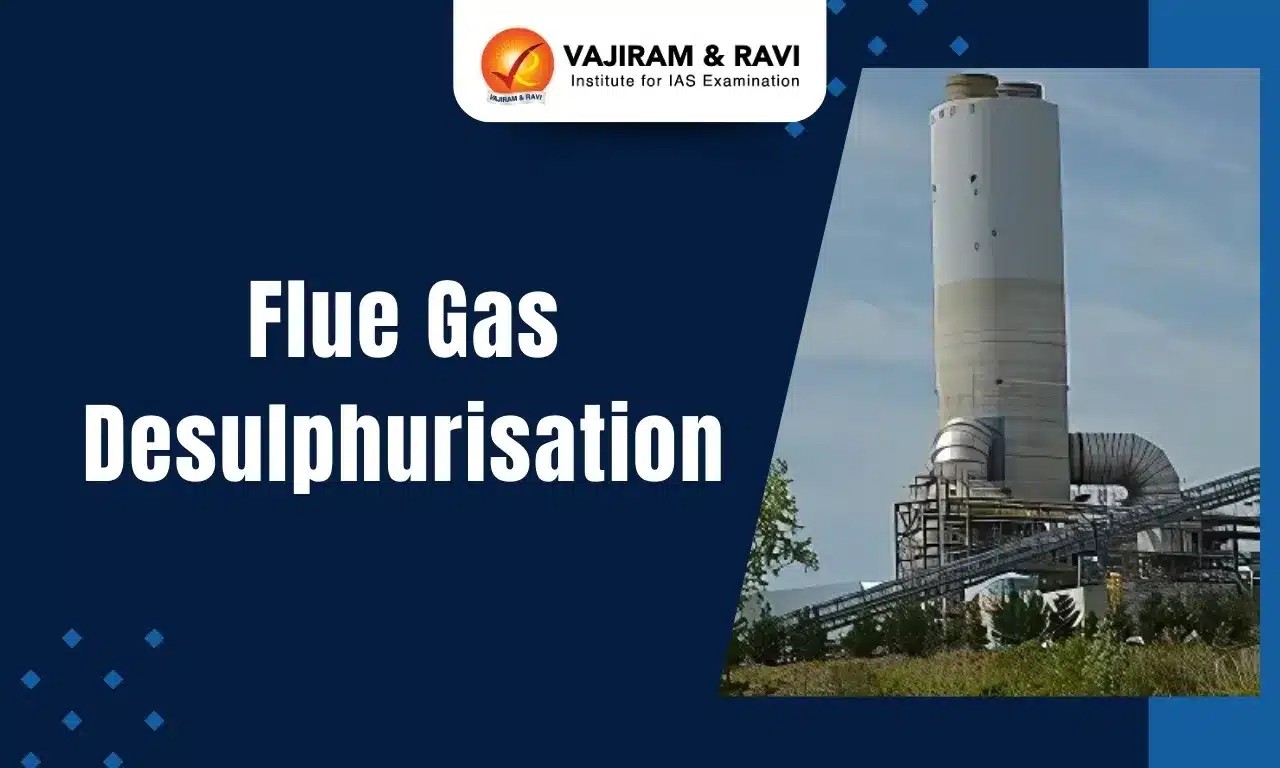
Flue Gas Desulphurisation (FGD) Latest News
Recently, the Environment Ministry has exempted most coal-fired plants in India from installing Flue Gas Desulphurisation (FGD) systems aimed at reducing sulphur dioxide (SO2) emissions.
About Flue Gas Desulphurisation (FGD)
- Flue Gas Desulphurisation (FGD) is a pollution-control process that removes Sulphur Dioxide (SO₂) from the flue gases produced by the combustion of fossil fuels, especially coal.
- The key aim of FGD is to reduce SO₂ emissions, which are major contributors to acid rain and particulate matter pollution, harming crops, soil, water bodies, infrastructure, and human health.
- FGD systems typically use limestone (CaCO₃), lime (CaO), or ammonia (NH₃) to react with and neutralize SO₂ in flue gases.
FGD Technology Types
- Dry Sorbent Injection (DSI): Injects limestone or lime into the flue gas before it passes through dust collectors.
- Wet Limestone Scrubbing: Uses a slurry of limestone (CaCO₃) to absorb SO₂ and convert it into gypsum (CaSO₄·2H₂O).
- Seawater FGD: Uses the alkalinity of seawater to neutralise SO₂, common in coastal plants, with low installation costs but limited applicability.
Recent Policy Changes and Issues
- In 2015, India’s Environment Ministry mandated that all coal-fired thermal power plants must install FGD systems by 2017 to curb SO₂ pollution. There are about 180 such plants, comprising 600 individual units.
- This exemption decision was based on scientific studies suggesting:
- Indian coal has low sulphur content.
- SO₂ levels near plants with and without FGDs were similar.
- Sulphates may have a cooling effect, counteracting global warming.
- As of now, only ~8% of these units have installed FGDs, with most installations by NTPC (public sector). The rest failed due to vendor shortages, high costs, COVID-related delays, and an anticipated rise in power tariffs.
Source: TH
Flue Gas Desulphurisation (FGD) FAQs
Q1: What is Flue Gas Desulphurisation (FGD)?
Ans: It is a process to remove sulphur dioxide (SO₂) from the exhaust gases of fossil fuel-based power plants.
Q2: Which substances are commonly used in FGD systems?
Ans: Limestone (CaCO₃), lime (CaO), and ammonia (NH₃) are typical absorbents.
Q3: What are the main types of FGD technologies?
Ans: Dry sorbent injection, wet limestone-based systems, and seawater-based systems.
