
Pheromone Latest News
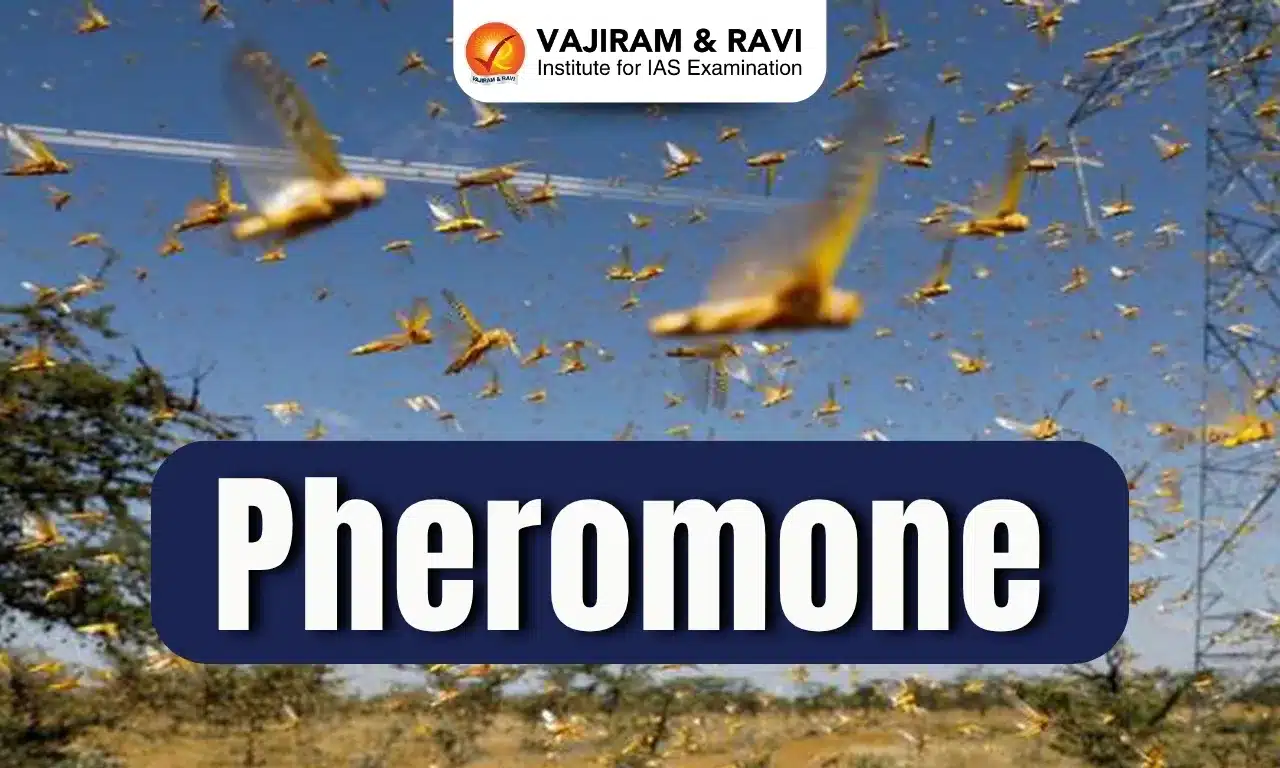
Researchers have shown that it’s possible to manipulate pheromones released by locusts to prevent them from swarming or engaging in group behaviour that leads to the feeding frenzy.
About Pheromone
- Pheromones are chemical substances which are secreted on the outside by an individual, and received by another individual of the same species.
- These are present in all bodily secretions, and especially in the axillary sweat — can be detected by the olfactory system.
- Pheromones are ecto-hormones, meaning they are secreted outside the body.
- Types of Pheromones
- Releaser pheromones: They work right away and elicit a specific response from the other person.
- Signaler pheromones: They give information about the person who releases them. For example, they help a mother tell her own baby apart from other babies.
- Modulator pheromones: They affect mood and emotions.
- Primer pheromones affect hormones, for example during pregnancy or menstrual cycles.
- Animals, with their heightened senses and vomeronasal organ are known to secrete pheromones to trigger many kinds of behaviours like raising an alarm, signalling a food trail, warning another animal to back off, and bonding with an offspring.
- Pheromones are also used by some fungi, slime molds, and algae as attractants in reproduction; organisms of complementary reproductive cell types grow or move toward each other.
Source: TH
Pheromone FAQs
Q1: What do pheromones do for humans?
Ans: Pheromones are chemicals that animals and humans use to communicate. Our bodies release pheromones through sweat, urine, semen, breast milk, and vaginal fluid.
Q2: What is another name for a locust?
Ans: Acridid
