
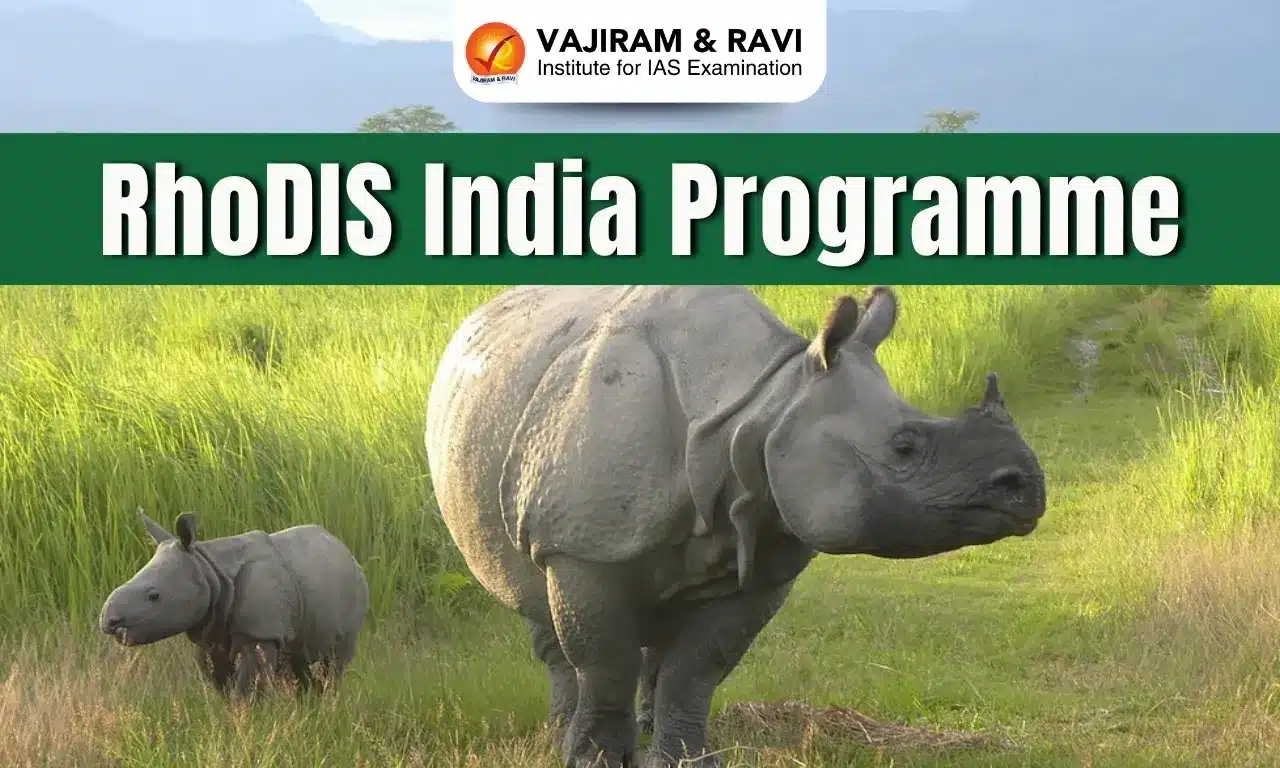
RhoDIS India Programme Latest News
A specialised team has initiated the genetic analysis of samples collected from 2,573 rhino horns and will add them to the RhoDIS India DNA data library.
About RhoDIS India Programme
- In 2016, the Ministry of Environment, Forests and Climate Change (MoEFCC), Government of India in partnership with Wildlife Institute of India (WII), the forest departments of Assam, West Bengal and Uttar Pradesh, and WWF India launched this programme.
- The Rhino DNA Index (RhoDIS) System is a wildlife forensics tool that was specially developed for investigating wildlife crime cases.
- The programme seeks to improve the crime investigations scientifically and provide technical support for the scientific management of India’s rhino population.
- The protocol standardised for the RhoDIS India analysis, approved by the Ministry of Environment, Forest, and Climate Change, will be followed for creating the DNA profiles from these samples.
- RhODIS uses a DNA indexing system whereby genetic sequences are created to get a signature unique to each individual rhino.
- Significance: It has proven to be a successful tool in aiding crime investigation and strengthening legal presentations.
What is a Rhino horn?
- It is made of keratin.
- It is chemically complex and contains large quantities of sulphur-containing amino acids, particularly cysteine, as well as tyrosine, histidine, lysine, and arginine, and the salts calcium carbonate and calcium phosphate.
- Rhino horns are similar in structure to horses’ hooves, turtle beaks, and cockatoo bills.
- Three of the five rhino species have two horns, whilst the others – Greater one-horned rhinos and Javan rhinos – have only one horn.
Source: TH
RhoDIS India Programme FAQs
Q1: Is one horned rhino only found in India?
Ans: The Great one horned rhino is commonly found in Nepal, Bhutan, Pakistan and in Assam, India.
Q2: What is Wildlife Institute of India?
Ans: It is an autonomous institution established in 1982 under the Ministry of Environment, Forests, and Climate Change, Government of India, for nurturing the growth of wildlife science in the country.
