
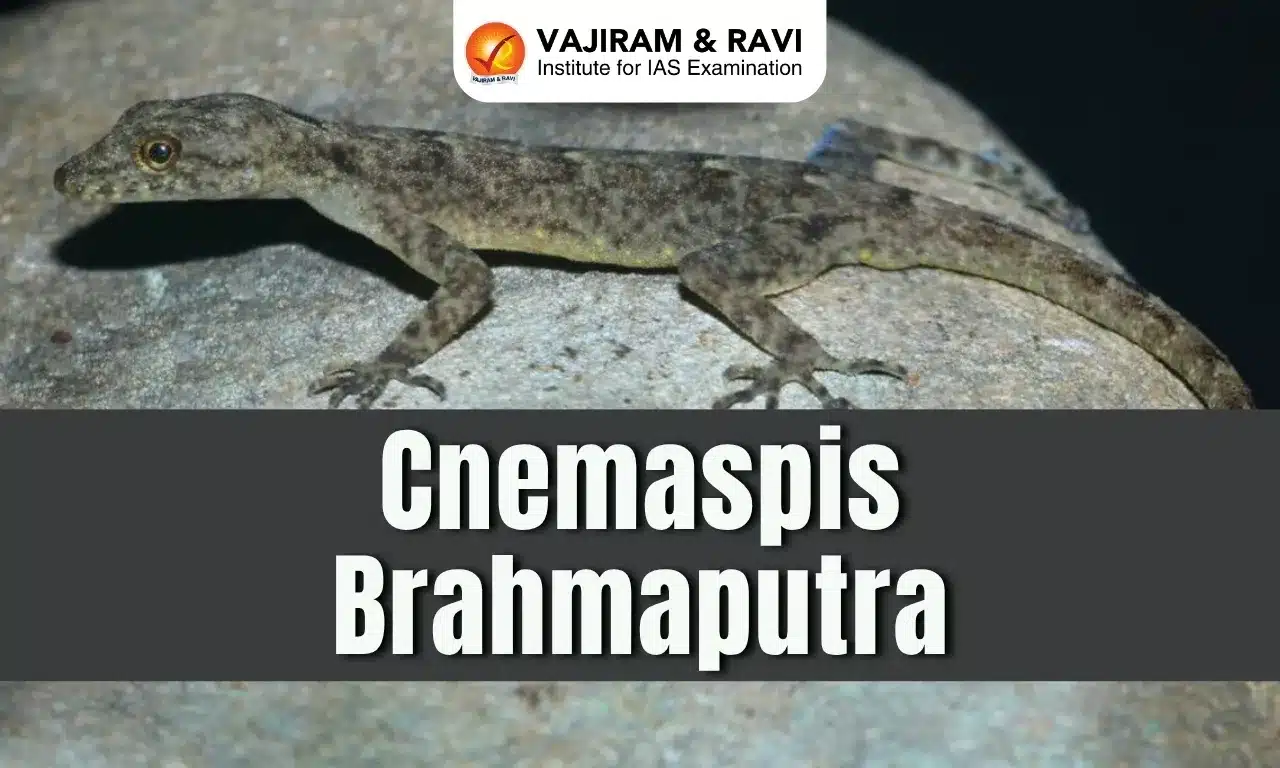
Cnemaspis Brahmaputra Latest News
Recently, a new species of gecko recorded from Assam has been named after the Brahmaputra River.
About Cnemaspis Brahmaputra
- It was found at Dirgheswari Temple on the northern bank of the Brahmaputra river in Assam.
- The new species belongs to the Cnemaspis podihuna clade, a group of small, diurnal geckos previously thought to be largely restricted to Sri Lanka.
- Its discovery in Assam strengthens the evidence for an ancient biogeographic link between Sri Lanka and India’s northeast, reflecting historical faunal exchanges across the Indian subcontinent.
- The new species is genetically and morphologically distinct from its Sri Lankan relatives, showing significant evolutionary divergence.
Features of Cnemaspis Brahmaputra
- It is distinguished by its larger body size but with fewer mid-body scale rows, more ventral scale rows across the belly, no tubercles on lower flanks, and three enlarged rows of thigh scales parallel to the enlarged femoral scale row.
- Cnemaspis brahmaputra is the second species of the genus Cnemaspis known from the northeastern region. The first, Cnemaspis assamensis, was described in 2000.
- Both species are members of the podihuna clade and are restricted to the Brahmaputra River valley.
- They occur on opposite banks of the river and have significant genetic differences.
Source: TH
Cnemaspis brahmaputra FAQs
Q1: What is a gecko known for?
Ans: Geckos have many special abilities. They can climb with their sticky feet and regrow their tails if they lose them.
Q2: What is called Reptilia?
Ans: Reptiles are tetrapod animals in the class Reptilia, comprising today's turtles, crocodilians, snakes, amphisbaenians, lizards, tuatara, and their extinct relatives.
