
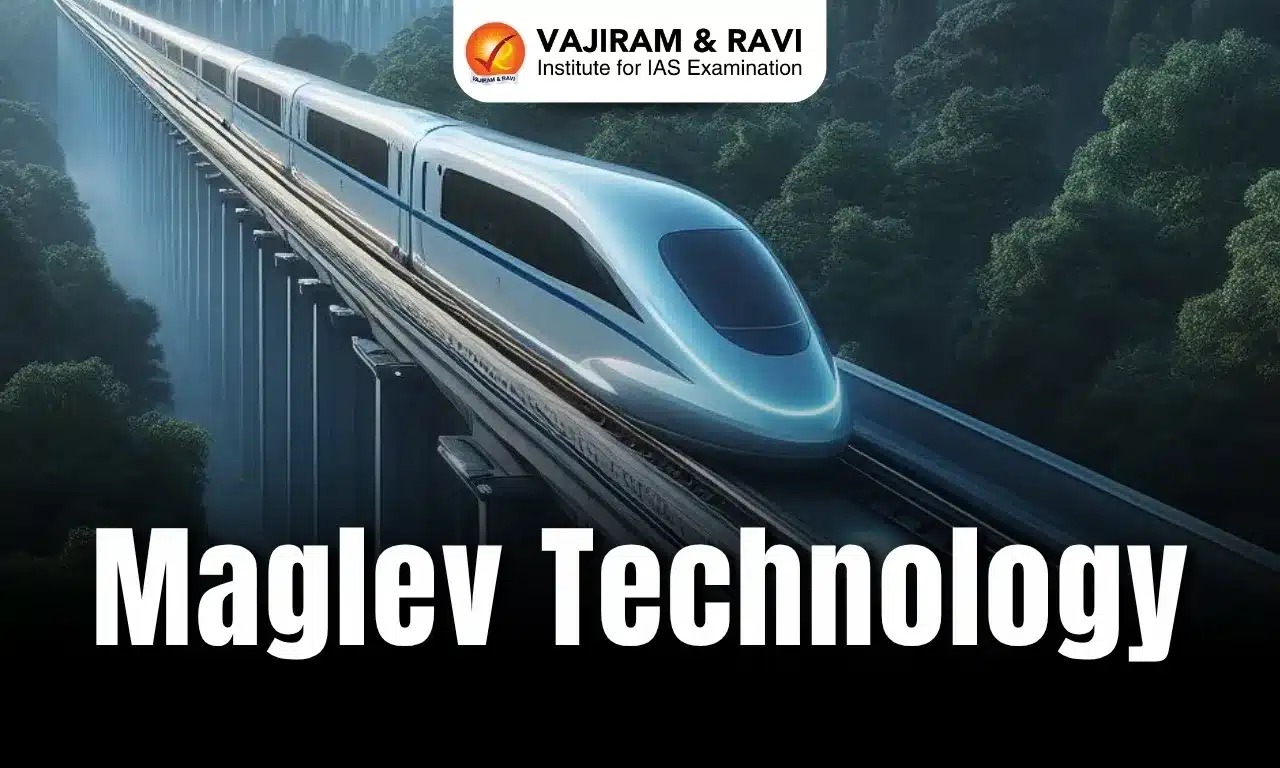
Magnetic Levitation (Maglev) Technology Latest News
China has successfully tested Magnetic Levitation (Maglev) technology, with the potential to make trains even faster than jets.
About Maglev Technology
- Magnetic levitation, or maglev, is an advanced transportation technology that uses the principles of electromagnetism to enable vehicles to float above tracks, eliminating physical contact and significantly reducing friction.
- Maglevs were conceptualized during the early 1900s by American professor and inventor Robert Goddard and French-born American engineer Emile Bachelet and have been in commercial use since 1984.
How Maglev Technology Works?
- Maglev trains operate using two key electromagnetic principles: magnetic attraction and repulsion.
- The system typically consists of three main components:
- Levitation: Magnets lift the train above the track, ensuring there is no physical contact. This minimizes wear and tear while providing a smooth ride.
- Guidance: Electromagnets stabilize the train laterally, keeping it centered on the track.
- Propulsion: Linear motors generate magnetic fields that push and pull the train along the track. This replaces the need for traditional engines or fuel.
- The tracks, known as guideways, are embedded with powerful electromagnets, while the trains themselves contain superconducting magnets or electromagnets.
- By carefully controlling the magnetic fields, maglev trains achieve levitation and propulsion with minimal energy loss.
Benefits of Maglev Technology
- Speed and Efficiency: Maglev trains can reach speeds of over 600 km/h (373 mph), making them faster than conventional trains and competitive with short-haul flights.
- Reduced Friction: With no physical contact between train and track, maglev systems have significantly lower maintenance costs and higher energy efficiency.
- Eco-Friendly: Maglev trains produce zero direct emissions and can be powered by renewable energy sources, making them a sustainable alternative to fossil fuel-based transport.
- Comfort: Passengers experience minimal vibrations and noise, thanks to the absence of wheels and rails.
Source: INDIA
Maglev Technology FAQs
Q1: What does the term Maglev stand for?
Ans: Magnetic Levitation
Q2: Which two scientists are credited with conceptualizing Maglev technology in the early 1900s?
Ans: Robert Goddard and Emile Bachelet
Q3: What speed can Maglev trains typically reach?
Ans: Over 600 km/h
Q4: Why are Maglev trains considered environmentally friendly?
Ans: They produce no direct emissions and can use renewable energy.
