
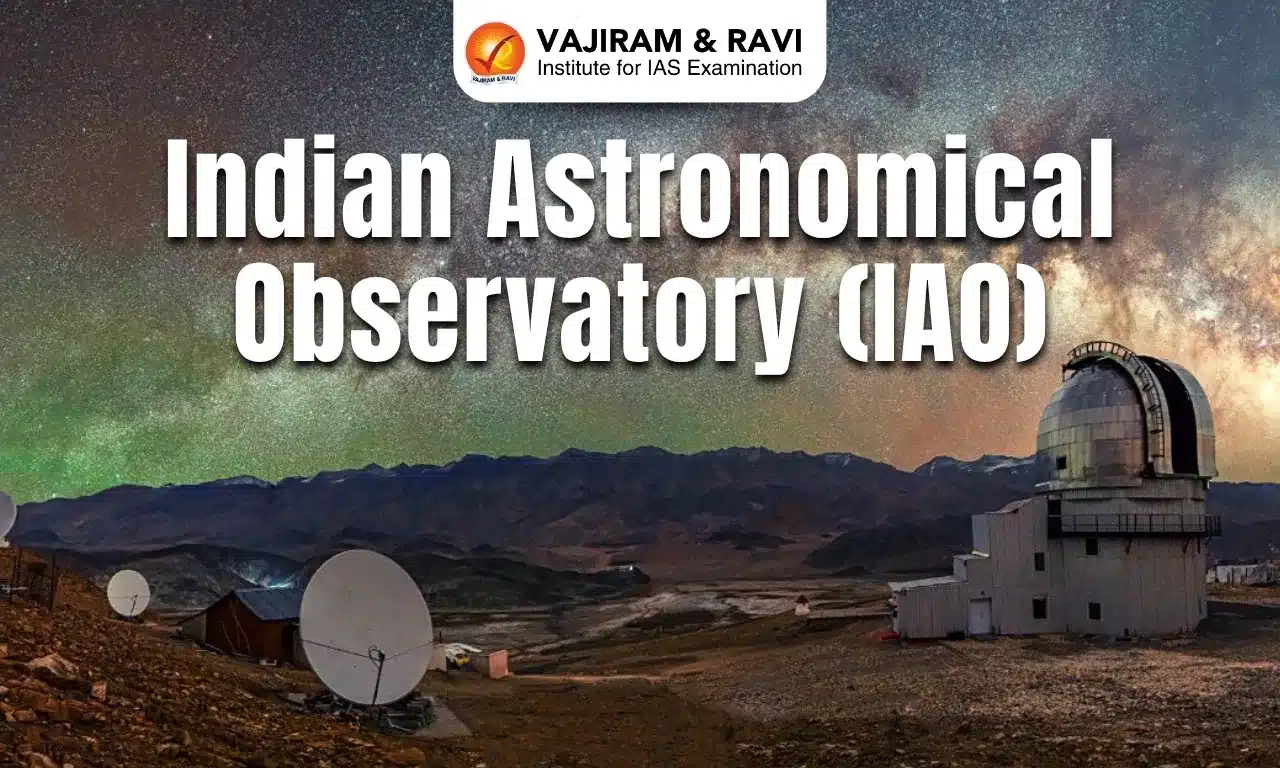
Indian Astronomical Observatory Latest News
Indian astronomers have successfully photographed the interstellar comet C/2025 N1 (ATLAS), also known as 3I/ATLAS, using the Himalayan Chandra Telescope (HCT) of the Indian Astronomical Observatory (IAO) at Hanle, Ladakh.
About Indian Astronomical Observatory
- The Indian Astronomical Observatory, also known as the Hanle Observatory, is located in the Hanle Valley, Ladakh.
- It is situated at an altitude of 4500 metres above mean sea level to the north of Western Himalayas.
- Inaugurated in 2001, the observatory is run by Bengaluru's Indian Institute of Astrophysics (IIA).
- The site is a dry, cold desert with sparse human population and the ancient Hanle monastery as its nearest neighbour.
- The cloudless skies and low atmospheric water vapour make it one of the best sites in the world for optical, infrared, sub-millimetre, and millimetre wavelengths.
- It houses a 2-meter aperture Himalayan Chandra Telescope (HCT), which is remotely operated from the Centre for Research and Education in Science and Technology (CREST) in Bengaluru.
- It also features a solar power plant, satellite-based communication systems, and a liquid nitrogen plant for cooling detectors.
- Hanle is also home to a unique Dark Sky Reserve designated by the International Dark-Sky Association.
- A Dark Sky Reserve is a designated area that aims to preserve and protect the quality of its night skies by minimising light pollution.
- Dark Sky Reserves are typically located in areas with exceptional natural darkness and starry skies.
- And Hanle, with less than 1000 people living in the village, is the perfect area.
Source: ETVB
Indian Astronomical Observatory FAQs
Q1: Where is the Indian Astronomical Observatory (IAO) located?
Ans: Hanle Valley, Ladakh
Q2: Which institute operates the Indian Astronomical Observatory?
Ans: Bengaluru's Indian Institute of Astrophysics (IIA).
Q3: Which telescope is housed at the Indian Astronomical Observatory?
Ans: Himalayan Chandra Telescope
Q4: What unique designation has Hanle received from the International Dark-Sky Association?
Ans: Dark Sky Reserve
Q5: What natural features make Hanle an ideal location for astronomical observation?
Ans: Cloudless skies and low atmospheric water vapour.
