
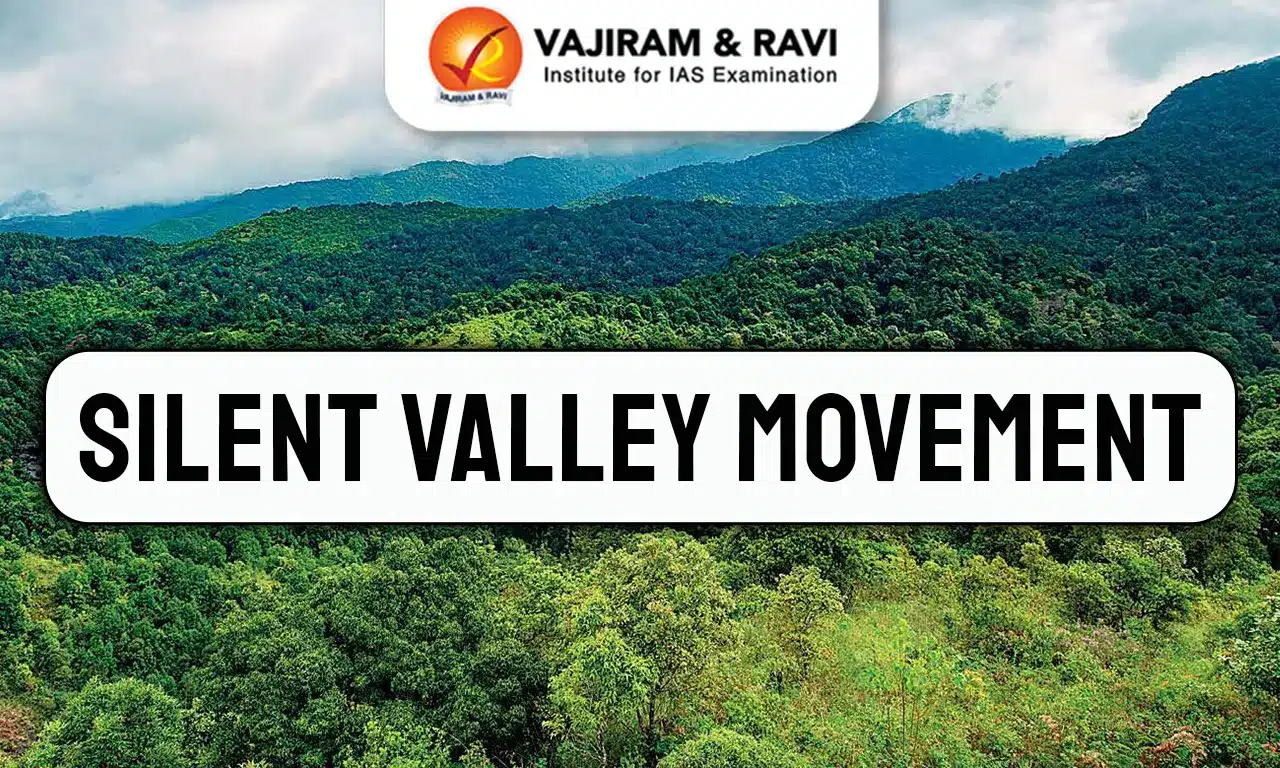
Silent Valley Movement was introduced in late 1970s and early 1980s which was an environmental campaign focusing on protecting the Silent Valley. It focused on protecting the dense, untouched tropical rainforest in Kerala’s Palakkad district from being submerged due to a proposed hydroelectric project. Rich in biodiversity and home to rare species like the lion-tailed macaque, the forest was under threat from development that would have permanently damaged the ecosystem.
The movement began in 1973, when environmentalists, scientists, writers, and local communities came together to oppose the hydroelectric project. Their efforts eventually led to the cancellation of the dam and the declaration of Silent Valley as a national park in 1984.
Silent Valley Movement About
The Silent Valley Movement was an environmental protest launched in 1973 against the proposed hydroelectric dam on the Kunthipuzha River, which flows through the Silent Valley in the Palakkad District of Kerala. The area is part of the Western Ghats, one of the world’s eight "hottest hotspots" of biological diversity. The plan was simple but destructive, to build a dam to generate hydroelectricity by submerging large sections of the forest. But environmentalists, scientists, students, poets, and locals knew the value of the Silent Valley.
Silent Valley Movement History
- The origins of the Silent Valley Movement lie in the 1970s, when the Kerala State Electricity Board (KSEB) proposed a hydroelectric project to meet the state’s rising power demands. The plan involved damming the Kunthipuzha River, which would have submerged over 8 square kilometers of pristine rainforest.
- In 1973, the Kerala Sastra Sahitya Parishad (KSSP), a science and environment advocacy group, raised the alarm. They published a report detailing the ecological destruction the project would cause.
- The momentum grew in 1976, when researchers led by M.K. Prasad documented the presence of the endangered Lion-tailed Macaque in the Silent Valley. The macaque became a symbol of the fragile ecosystem under threat.
- As national and international pressure increased, the Government of India eventually stepped in. In 1980, then Prime Minister Indira Gandhi intervened and ordered a termination of the project. After years of sustained advocacy, Silent Valley was officially declared a National Park in 1984 and inaugurated in 1985.
Silent Valley Movement Participants
The Silent Valley Movement brought together an exceptional coalition of activists, scientists, and organizations. Some of the key contributors were:
| Silent Valley Movement Participants | ||
| S.No | Name | Role/Contribution |
|
1 |
Kerala Sastra Sahitya Parishad (KSSP) |
Led grassroots public education, mobilization, and scientific awareness |
|
2 |
Silent Valley Samrakshana Samithi (SVSS) |
Coordinated local protests and unified activists, students, and villagers |
|
3 |
Kerala Forest Research Institute (KFRI) |
Conducted biodiversity studies and flagged ecological threats of the project |
|
4 |
World Wildlife Fund (WWF) |
Provided global attention, support, and international funding |
|
5 |
Dr. Salim Ali |
Eminent ornithologist; opposed the project and advocated for wildlife conservation |
|
6 |
Dr. Madhav Gadgil |
Ecologist who lent scientific credibility; later led Western Ghats Ecology Panel |
|
7 |
Sugathakumari |
Poet-activist; her poem Marathinu Stuthi became an emotional symbol of the protest |
Silent Valley Movement Significance
- Silent Valley includes over 1000 species of flowering plants, 128 species of butterflies, and many endemic animals like the Lion-tailed macaque. The movement protected this eco system
- The Silent Valley Movement success led to the formation of India’s first National Committee on Environmental Planning and Coordination (NCEPC) and later, the Environmental Protection Act, 1986.
- Silent Valley Movement was one of India’s first movements where common people, especially youth and intellectuals, understood the link between ecology and development.
- Movements like the Narmada Bachao Andolan, Appiko Movement, and Chipko Movement drew inspiration from Silent Valley’s peaceful yet impactful approach.
- It brought attention to the indigenous communities living in harmony with nature and helped prevent their displacement.
Silent Valley Movement Conservation
As a tropical evergreen rainforest Silent Valley, it is home to rare flora and fauna, including the endangered lion-tailed macaque. Recognising its ecological importance, the area was declared a National Park in 1984, ensuring that commercial activities and large-scale development projects are strictly prohibited.
- Conservation of species like the Lion-tailed macaque, Nilgiri tahr, and Malabar civet.
- Active prevention of illegal logging, fire outbreaks, and soil erosion.
- Limited access for eco-tourists with strict guidelines to ensure minimal disruption.
- Continued biodiversity documentation by the Kerala Forest Department and scientific institutes.
- Designated as part of the UNESCO World Heritage Site, the park falls under the protected eco-sensitive zone.
Silent Valley Movement Result
- The Silent Valley Movement successfully stopped the construction of a hydroelectric dam that would have flooded the Silent Valley rainforest.
- Its success led to the declaration of Silent Valley as a National Park in 1984, granting it strong legal protection and making it a vital sanctuary for endangered species and rare plant life.
- The campaign played a key role in shaping India’s early environmental policies. It brought ecological concerns into national discourse and pushed policymakers to consider sustainability in development planning.
- The Silent Valley Movement drew attention both nationally and internationally. It became a model for environmental activism and inspired similar conservation efforts in other parts of the world.
- Beyond ecology, the campaign also safeguarded the rights of indigenous communities living in the region. It prevented their displacement and encouraged sustainable, community-led livelihoods.
- With its rich biodiversity, Silent Valley National Park has become a crucial hotspot for conservation efforts and ecological research in India.
- The movement sparked widespread public engagement with environmental issues, making more people aware of the value of protecting forests and natural habitats.
- It underscored the importance of balancing growth with ecological responsibility, laying the groundwork for India’s shift toward sustainable development.
- The Silent Valley Movement demanded greater transparency and accountability in decisions involving public resources and environmental impact.
- It empowered local communities and grassroots groups to stand up for their environment and actively participate in shaping decisions that affect their land and future.
Silent Valley Movement FAQs
Q1: What was the Silent Valley Movement?
Ans: It was an environmental movement launched in Kerala to prevent the construction of a hydroelectric dam in the Silent Valley rainforest.
Q2: Where is Silent Valley located?
Ans: It is in the Palakkad district of Kerala, in the Nilgiri Hills of the Western Ghats.
Q3: Who led the Silent Valley Movement?
Ans: It involved groups like KSSP, SVSS, scientists like Dr. Salim Ali, and activists like Sugathakumari.
Q4: Why was the Silent Valley important?
Ans: It harbors rich biodiversity, including endemic and endangered species, and is a tropical evergreen rainforest.
Q5: What was the government’s response to the movement?
Ans: In 1980, Indira Gandhi halted the project, and in 1984, the Silent Valley was declared a National Park.
