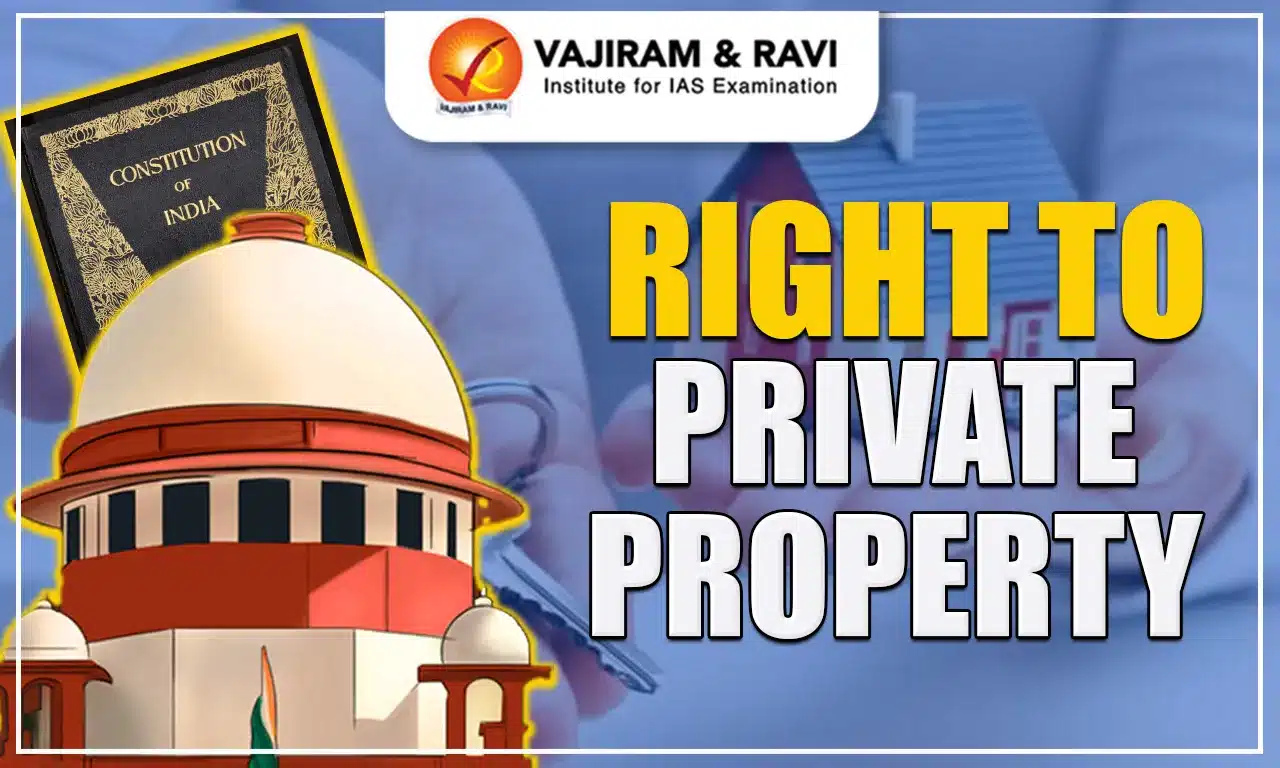
The Right to Private Property was once a fundamental right in India, under Article 31 of the Constitution. Any violation could be directly challenged in the Supreme Court. However, the 44th Constitutional Amendment in 1978 bought changes to the law. The government removed it from the List of Fundamental Rights and made it a constitutional right under Article 300A.
Now, the Right to Private Property still exists, but with less protection. Article 300A says, “No person shall be deprived of his property except by authority of law.” This means the state can take your property, but only through a proper legal process not arbitrarily. However, since it's no longer a fundamental right, you can't directly approach the Supreme Court if it's violated, you have to go through High Courts.
Right to Property
The Constitution (44th Amendment) Act, 1978 removed the Right to Property from the list of fundamental rights. However, it still remains a constitutional right under Article 300A, and is also seen as a human right in a welfare state like India.
Article 300A states that no person shall be deprived of their property except by authority of law. In short, the government can't take away someone’s property unless there’s a legal process backing it. While the Article doesn't mention compensation, courts have interpreted that fair compensation must be provided when property is acquired by the State making it an implied part of the protection under Article 300A.
Right to Private Property History
Before 1978, the Right to Private Property was a fundamental right under Article 19(1)(f) and Article 31 of the Indian Constitution. It gave citizens strong protection against state interference in property matters. After the 44th Constitutional Amendment in 1978, this right was removed from the list of fundamental rights and made a constitutional right under Article 300A, which states: “No person shall be deprived of their property except by authority of law.”
Although no longer a fundamental right, the Supreme Court has upheld the right to property as a human right, emphasizing that the State cannot take away property without following due legal process and providing compensation in justified cases.
Right to Private Property Judgement
On January 8, a Supreme Court Bench of Justices Ajay Rastogi and Indu Malhotra ruled that the Right to Property is a human right. The judgment emphasized that the State cannot take private property without following due legal procedure.
The case involved the Himachal Pradesh Government, which had forcibly acquired 4 acres of private land in 1967 to build a road in Hamirpur district, without compensating the owner, a widowed, illiterate woman for over 50 years.
Justice Indu Malhotra noted that the woman hadn’t pursued legal action earlier due to her rural and uneducated background, which limited her awareness of her rights.
After years of delay, the woman moved to the Supreme Court when lower courts failed to offer relief. The Court observed that when the State seizes land without due process, it acts as an encroacher. The verdict directed the government to pay ₹1 crore in compensation to the 80-year-old woman.
Articles 31 and 31A of 1951
- The First Amendment to the Constitution in 1951 added Article 31A and Article 31B.
- Article 31A was introduced to protect five categories of laws from being invalidated for violating Fundamental Rights under Articles 14 and 19. These include:
- Laws relating to the acquisition of estates by the State.
- Laws concerning the management of property by the State.
- Laws related to amalgamation of corporations.
- Laws that modify or extinguish rights of corporate directors or shareholders.
- Laws modifying or cancelling mining leases or licenses.
- Article 31B gave constitutional protection to laws placed in the Ninth Schedule. Even if these laws violated fundamental rights, they could not be challenged in court.
- Later, the 25th Amendment Act of 1971 introduced Article 31C, which gave further protection to laws enacted to implement certain Directive Principles of State Policy, especially Article 39(b) and 39(c). These laws too could not be struck down for violating fundamental rights.
44th Amendment in 1978
- In 1967, Right to Property was still a Fundamental Right under Article 31.
- Article 31(1) stated that private property could only be taken through a law, not an executive order.
- Article 31(2) allowed the State to acquire private property only for public purposes and with compensation.
- These protections made it hard for the government to carry out land reforms and public projects, as citizens started challenging acquisitions in court.
- To address this, the 44th Amendment Act, 1978 was introduced.
- Article 31 and Article 19(1)(f) were deleted from Part III of the Constitution.
- A new provision, Article 300A, was added under the Constitutional Rights (Part XII).
- Now, private property can still be taken by the State, but only under authority of law, no longer as a guaranteed fundamental right.
- The Supreme Court reminded that the State must follow due process, as laid down in Article 300A, before acquiring private property.
Doctrine of Adverse Possession
In India, Adverse Possession refers to a legal concept where a person who is not the rightful owner of a property can become its legal owner by possessing it openly, continuously, and without interruption for a specific period.
As per Article 65 of the Limitation Act, 1963, if the original owner does not reclaim their land within 12 years, they lose the legal right to recover it. However, this principle has limitations. The Supreme Court has made it clear that the State cannot forcibly occupy private land and later claim it under adverse possession. Such an act would be unconstitutional and violate the right to property guaranteed under Article 300A of the Constitution.
Right to Private Property FAQs
Q1: Is the Right to Property a fundamental right?
Ans: No, it was removed from the list of fundamental rights by the 44th Amendment in 1978.
Q2: What type of right is the Right to Property now?
Ans: It is now a legal right under Article 300A of the Indian Constitution.
Q3: Can the government acquire private property?
Ans: Yes, the government can acquire private property for public purposes with compensation, as per the law.
Q4: What is Article 300A?
Ans: Article 300A states that no person shall be deprived of their property except by authority of law.
Q5: Was the Right to Property ever a fundamental right?
Ans: Yes, it was a fundamental right under Articles 19(1)(f) and 31 until 1978.