
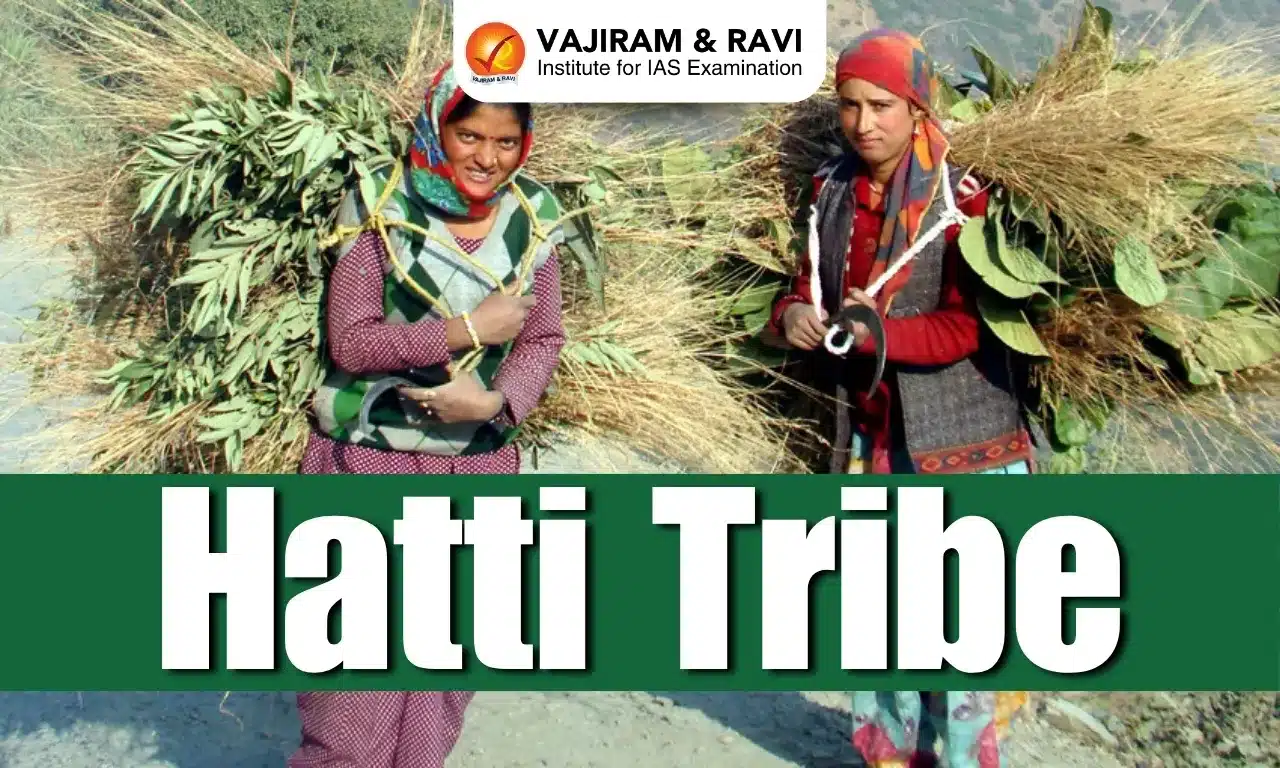
Hatti Tribe Latest News
Recently, two brothers of the Hatti tribe tied the knot to a woman in Himachal Pradesh, with hundreds of people witnessing the marriage solemnised under the anachronistic tradition of polyandry.
About Hatti Tribe
- The Hattis are a close-knit community who take their name from their traditional occupation of selling home-grown crops, vegetables, meat, and wool at small-town markets known as ‘haats’.
- Hatti men traditionally don a distinctive white headgear on ceremonial occasions.
- These tribal people reside in the Himachal-Uttarakhand border in the basin of the Giri and Tons rivers, both tributaries of the Yamuna.
- There are two main Hatti clans: one in the Trans-Giri area of the Sirmaur district in Himachal Pradesh and the other in Jaunsar Bawar of Uttarakhand.
- The two Hatti clans have similar traditions, and intermarriages are common.
- They are governed by a traditional council called ‘khumbli’ which decides community matters.
- Economy: The Hatti population relies on agriculture for livelihood and bare subsistence since their climate is ideal for growing “Cash Crops.”
- Population: According to the 2011 census, members of the community numbered 2.5 lakh, but at present population of the Hattis are estimated at around 3 lakhs.
- In 2023, the Indian government granted Scheduled Tribe (ST) status to the Hatti community in Himachal Pradesh.
- The Jaunsar- Bawar region of Uttarakhand was granted tribal status in 1967.
Source: IE
Hatti Tribe FAQs
Q1: What are the criterias for inclusion in the Scheduled Tribes List in India?
Ans: The criteria presently followed for specification of a community as a Scheduled Tribe are : (i) indications of primitive traits, (ii) distinctive culture, (iii) geographical isolation, (iv) shyness of contact with the community at large, and (v) backwardness.
Q2: In which state is the Hatti tribe?
Ans: They inhabit in the Trans-Giri region along the Himachal Pradesh–Uttarakhand border.
