UPSC Daily Quiz 25 July 2025

UPSC Daily Quiz

The Daily UPSC Quiz by Vajiram & Ravi is a thoughtfully curated initiative designed to support UPSC aspirants in strengthening their current affairs knowledge and core conceptual understanding. Aligned with the UPSC Syllabus 2025, this daily quiz serves as a revision resource, helping candidates assess their preparation, revise key topics, and stay updated with relevant issues. Whether you are preparing for Prelims or sharpening your revision for Mains, consistent practice with these Daily UPSC Quiz can significantly enhance accuracy, speed, and confidence in solving exam-level questions.

[WpProQuiz 28]

UPSC Daily Quiz FAQs

Q1: What is the Daily UPSC Quiz?

Ans: The Daily UPSC Quiz is a set of practice questions based on current affairs, static subjects, and PYQs that help aspirants enhance retention and test conceptual clarity regularly.

Q2: How is the Daily Quiz useful for UPSC preparation?

Ans: Daily quizzes support learning, help in revision, improve time management, and boost accuracy for both UPSC Prelims and Mains through consistent practice.

Q3: Are the quiz questions based on the UPSC syllabus?

Ans: Yes, all questions are aligned with the UPSC Syllabus 2025, covering key areas like Polity, Economy, Environment, History, Geography, and Current Affairs.

Q4: Are solutions and explanations provided with the quiz?

Ans: Yes, each quiz includes detailed explanations and source references to enhance conceptual understanding and enable self-assessment.

Q5: Is the Daily UPSC Quiz suitable for both Prelims and Mains?

Ans: Primarily focused on Prelims (MCQ format), but it also indirectly helps in Mains by strengthening subject knowledge and factual clarity.

Article 166 of Indian Constitution, Interpretation, Significance

Article 166 of Indian Constitution

Article 166 comes under Part VI of the Constitution of India. The article talks about the conduct of business by the State Government and provides the guidelines of the executive powers in a state. It also talks about the role of the Governor as a constitutional head and makes sure that all executive actions of the state government are expressed and authenticated in their name. In this article, we are going to talk about Article 166, its interpretation and its significance. 

Article 166 of the Constitution of India Interpretation

Article 166 of Constitution states - “1) All executive action of the Government of a State shall be expressed to be taken in the name of the Governor. 2) Orders and other instruments made and executed in the name of the Governor shall be authenticated in such manner as may be specified in rules to be made by the Governor, and the validity of an order or instrument which is so authenticated shall not be called in question on the ground that it is not an order or instrument made or executed by the Governor. 3) The Governor shall make rules for the more convenient transaction of the business of the Government of the State, and for the allocation among Ministers of the said business in so far as it is not business with respect to which the Governor is by or under this Constitution required to act in his discretion.

In a more simplified manner, Article 166 has the following interpretation: 

  • Under Article 166 of the Constitution of India, all State actions by the government have to be done on behalf of the government. This provision helps to show that the governor is the constitutional head and nominal authority behind all executive actions. 
  • Only the rules made by the Governor can authenticate the orders and instruments issued by the Governor. It makes sure that the legal validity is retained and not get used by the governor for his personal use. 
  • The Governor possesses the power to make rules for the effective transaction of the business of the state government including distribution of responsibilities among ministers. However, the governor also has the power to act independently using his power of discretion. 

Article 166 of the Indian Constitution Significance

Article 166 manages the conduct of business of the Government of a State. It talks about how the executive actions are to be formally expressed, authenticated, and conducted within a state government.

  1. Provides Accountability and Legitimacy
    It makes it necessary that all executive actions of a State Government shall be expressed in the name of the Governor, lending formal legitimacy and constitutional authority to such actions.
  2. Promoting Balanced Administrative Process
    It outlines the rules about how orders and instruments made in the Governor’s name can be authenticated,  making a consistent and standardized procedure for state-level administration.
  3. Prevents Arbitrary Governance 

While the governor is expected to make rules about the convenient translation of business, Article 166 makes sure that checks and balances are ensured and systematic delegation of authority is established within the state executive. 

  1. Protects Against Invalid Acts
    Clause (3) gives protection to government actions from being challenged on the grounds of improper procedure, so long as the formality of being in the Governor’s name is followed.
Also Check Related Post
Article 295 of Indian Constitution Article 194 of Indian Constitution
Article 39 of Indian Constitution Article 191 of Indian Constitution
Article 20 of Indian Constitution Article 16 of Indian Constitution
Article 67 of Indian Constitution Article 40 of Indian Constitution
Article 78 of Indian Constitution

Article 166 of Indian Constitution FAQs

Q1: What is Article 166 of the Indian Constitution?

Ans: It outlines how the executive actions of a State Government shall be conducted in the name of the Governor and lays rules for authentication and transaction of business.

Q2: What is the importance of Article 166?

Ans: It ensures procedural uniformity, accountability, and legitimacy in the executive actions of a State Government.

Q3: What is the 166 days Constitution?

Ans: There is no such concept as “166 days Constitution” in the Indian constitutional framework — this may be a misinterpretation or error.

Q4: What is Article 167 of the Indian Constitution?

Ans: It defines the duties of the Chief Minister to communicate with the Governor and furnish information on state affairs.

Q5: What are the powers of the Governor of a state?

Ans: The Governor exercises executive, legislative, and discretionary powers, including appointing the Chief Minister, giving assent to bills, and recommending President’s Rule.

Article 35 of Indian Constitution, Interpretation, Importance

Article 35 of Indian Constitution

Article 35 of the Constitution of India provides the Parliament the authority to create laws important for implementing the provisions provided in Part III that is the Fundamental Rights. The parliament has the exclusive right to legislate on certain fundamental rights like Articles 12(3), 32(3) and 34. This allows the Parliament to pass laws that ensure the protection and enforcement of the rights. In this article we are going to cover all about Article 25 of the Indian Constitution, its interpretation and significance. 

Article 35 of the Indian Constitution Interpretation

Article 35 of the Constitution of India gives the Parliament the exclusive authority to create laws that are important for the enforcement of Fundamental Rights written in Part III of the Constitution. The article makes sure that fundamental rights are given legal protection and equally implemented all over India and not just remain aspirational. 

Article 35 highlights the importance of legislative backing of fundamental rights and centralises the responsibility of making laws with the Parliament, in order to prevent legislative inconsistencies all over states. 

Article 35 Provisions

Article 35 of the Constitution of India has the following provisions: 

  • Article 35(a): Gives power to the Parliament to make laws regarding:
    • Conditions for employment under the State (Article 16(3)),
    • Enforcement of rights through other courts besides the Supreme Court (Article 32(3)),
    • Modifications of rights for armed forces and police (Article 33),
    • Suspension of rights during martial law (Article 34).
    • Allows Parliament to give punishments for opposition to such laws.
  • Article 35(b): Makes sure that laws in force before the commencement of the Constitution remain valid unless amended or repealed by Parliament.
    • Refers to Article 372, allowing the President to adapt existing laws for up to three years post-Constitution.
    • The term “law in force” includes pre-constitutional laws still applicable unless explicitly repealed.

Article 35 Importance

Article 35 of the Indian Constitution has the following importance: 

  • The article reinstates the superiority of Parliament in legislating matters in relation to Fundamental Rights. 
  • It promotes uniformity and equality to protect and enforce these rights all over the nation. 
  • Protects the validity of pre-constitutional laws till the time the Parliament reviews them. This helps in making a smooth legal transition post-independence. 
  • Maintain efficiency and integrity of Fundamental Rights by making sure they are not undermined by inconsistent state-level laws. 

Landmark Case Laws on Article 35

Article 35 of the Constitution of India was used in the following cases: 

  1. Satyajit Kumar vs State of Jharkhand (2022):
    • 100% reservation for Scheduled Tribes in teaching posts in Scheduled Areas.
    • The Supreme Court removed the reservation as violative of Articles 14 and 16, declaring the notification ultra vires the Constitution.
  2. Chebrolu Leela Prasad Rao vs State of Andhra Pradesh (2020):
    • Government order providing 100% reservation for ST candidates in Scheduled Areas.
    • The Court held it unconstitutional, reiterating that any legislative or executive action, including those by the Governor, must conform to Fundamental Rights.
Also Check Related Articles
Article 295 of Indian Constitution Article 194 of Indian Constitution
Article 39 of Indian Constitution Article 191 of Indian Constitution
Article 20 of Indian Constitution Article 16 of Indian Constitution
Article 67 of Indian Constitution Article 40 of Indian Constitution
Article 78 of Indian Constitution

Article 35 of Indian Constitution FAQs

Q1: What is the Article 35 of the Constitution of India?

Ans: Article 35 empowers only the Parliament to make laws relating to certain fundamental rights, especially those in Articles 16(3), 32(3), 33, and 34.

Q2: Is Article 35A removed?

Ans: Yes, Article 35A was effectively abrogated on 5 August 2019 along with Article 370, revoking the special status of Jammu and Kashmir.

Q3: What is the importance of Article 35?

Ans: Article 35 ensures uniformity in fundamental rights-related laws by restricting law-making powers on certain matters exclusively to the Parliament.

Q4: Are fundamental rights legally binding in nature?

Ans: Yes, fundamental rights are legally enforceable, and citizens can approach the Supreme Court or High Courts for their enforcement under Articles 32 and 226.

Q5: What is Article 327 of the Constitution of India?

Ans: Article 327 empowers Parliament to make laws related to elections to legislatures, including all matters necessary for their conduct.

Daily Editorial Analysis 25 July 2025

Daily Editorial Analysis

The India-U.K. FTA Spells a Poor Deal for Public Health

Context

  • The signing of the Comprehensive Economic and Trade Agreement, commonly known as the India-UK Free Trade Agreement (FTA), on July 24, 2025, marks a significant milestone in the bilateral relationship between India and the United Kingdom.
  • While the deal is lauded for its economic potential, it has prompted serious public health concerns in India, particularly regarding the surge of High Fat, Sugar and Salt (HFSS) food
  • Therefore, it is important to analyse the multifaceted impacts of the FTA, drawing comparisons from international experiences and highlighting the urgent policy interventions needed to safeguard public health.

Economic Prospects of the India-UK FTA

  • Trade agreements such as the India-UK FTA stimulate economic growth by:
  • Eliminating tariffs, thereby lowering consumer prices.
  • Encouraging cross-border investment and generating employment.
  • Deepening trade ties and diversifying import-export portfolios.
  • For India, cheaper imports of U.K.-made products, expanded market access for goods and services, and closer strategic cooperation are anticipated benefits.

Public Health Challenges: Lessons from Mexico

  • The optimism surrounding FTAs is not without caveat.
  • The case of Mexico post-NAFTA (1992) serves as a cautionary tale.
  • The North American Free Trade Agreement (NAFTA) was signed between Mexico, the United States and Canada, Mexico made the mistake of not implementing robust public health safeguards.
  • Lax regulation and lack of public health safeguards resulted in:
  • A dramatic rise in the import and consumption of sugary drinks and processed foods.
  • Escalating rates of obesity, diabetes, and related chronic illnesses.
  • The need for reactive policies, such as the imposition of a Soda Tax and the adoption of mandatory warning labels in 2014, well after the negative health impact had materialized.
  • This experience underscores the risks for India, where regulatory frameworks are even less robust.

Regulatory Gaps in India vs. the UK

  • The UK Approach
    • HFSS Advertising Ban:
    • The UK enforces strict bans on advertising HFSS foods to children on television before 9 p.m. and will introduce a total ban on online paid advertisements for such products from October 1, 2025.
    • Front-of-Pack Nutrition Labelling (FOPNL):
    • A color-coded traffic light system helps consumers identify levels of fat, sugar, and salt immediately, empowering healthier choices.
  • The Indian Scenario
    • Weak Advertisement Controls
    • India lacks binding restrictions on junk food advertising, particularly towards children.
    • Self-regulation by industry bodies like the Advertising Standards Council of India is unreliable and often ineffective.
  • Misleading Marketing: Celebrity endorsements and cartoon mascots influence children and normalise unhealthy behaviours, with minimal accountability.
  • FOPNL Issues
    • India’s move toward mandatory nutrition labelling remains stalled.
    • While warning labels are globally recognised as effective, Indian authorities have delayed implementation, focusing instead on a potentially ambiguous star rating system influenced by industry lobbying.

Rising Tide of Lifestyle Diseases and Commercial Determinants of Health

  • Rising Tide of Lifestyle Diseases

    • From 2011-21, the Compound Annual Growth Rate (CAGR) of Ultra Processed Food (UPF) and HFSS food sales in India was 13.3%.
    • As a result, non-communicable diseases such as obesity and diabetes are on the rise, especially among children and adolescents.
    • The lack of robust food labelling and advertising controls exacerbates these trends.
  • Commercial Determinants of Health

    • Trade deals, while crucial to economic ambitions, also serve as commercial determinants of health, that is, practices and policies by commercial actors that influence public health at a large scale.
    • Without sufficient restrictions and awareness, FTAs risk becoming Trojan horses for the spread of diet-related diseases.

Path Forward: Opportunities for Policy Action

  • Implement Strong Advertising Regulations: Enforce comprehensive, binding controls on the marketing of HFSS foods, especially toward children, as recommended by recent government surveys and dietary guidelines.
  • Adopt Mandatory Warning Labels: Prioritise clear, effective warning labels on HFSS and UPF products, in line with international best practices, rather than the less effective “star rating” system.
  • Promote Healthy School Environments: Institutionalise bans on the sale of unhealthy food and beverages in school and college canteens, and introduce holistic HFSS Boards in schools as part of a health-promoting educational framework.
  • Engage Health Policymakers: Encourage active involvement of public health practitioners in trade negotiations to ensure health considerations are not subsumed by economic interests.

Conclusion

  • Striking a balance between economic gains and public health imperatives is vital as India forges ahead with present and future FTAs.
  • Immediate implementation of effective labelling, marketing restrictions, and public health safeguards can avert a health crisis like that experienced in Mexico.
  • This is a pivotal moment for India to take decisive action, ensuring that the promise of economic prosperity does not come at the cost of its citizens' health.

The India-U.K. FTA Spells a Poor Deal for Public Health FAQs

Q1. When was the India-UK Free Trade Agreement signed?
Ans. The India-UK Free Trade Agreement was signed on July 24, 2025.

Q2. What public health risk does the India-UK FTA pose to India?
Ans. It may increase the availability and consumption of unhealthy High Fat, Sugar, and Salt (HFSS) food products.

Q3. Which country’s experience serves as a cautionary example for India regarding FTAs?
Ans. Mexico’s experience after signing NAFTA in 1992 is a cautionary example.

Q4. What kind of food advertising regulation does the UK implement that India currently lacks?
Ans. The UK bans HFSS food advertising on TV before 9 p.m. and online paid ads for such products.

Q5. What labelling system is considered most effective for informing consumers about unhealthy foods?
Ans. Mandatory warning labels are considered the most effective for food packaging.

Source: The Hindu


The Fault Lines in India’s Electoral Architecture Are Visible 

Context

  • As the Election Commission of India (ECI) closes the first phase of its Special Intensive Revision (SIR) of electoral rolls in Bihar by August 1, 2025, the state finds itself embroiled in familiar controversy.
  • Allegations of disenfranchisement, especially of the poor, minorities, and migrants, have taken centre stage in political debate.
  • Critics claim the ECI’s methods are partisan and exclusionary, while supporters argue for the necessity of maintaining the integrity of election rolls.
  • Both arguments, however, fall short by failing to address the deeper, structural misfit between India’s election laws and its increasingly mobile society.

Flawed Foundations: Historical and Legal Context

  • The Representation of the People Act, 1950, was drafted for a post-colonial India characterised by predominantly rural and sedentary populations.
  • Over 82% of Indians lived in villages, and less than 8% were migrants at the time.
  • The electoral laws, therefore, presumed that citizens would vote where they were born.
  • Unfortunately, this assumption has persisted, surviving profound demographic and economic shifts.
  • Today, India is among the world’s most migrant-heavy societies, over 450 million internal migrants constitute 37% of its population.
  • Bihar exemplifies this: 36% of its households have at least one migrant, and more than 20% of the working-age population lives outside the state at any given moment.
  • The 2011 census indicated nearly 13.9 million Biharis resided outside Bihar; current estimates suggest that number is now between 17 and 18 million.
  • The legal fixation on geographic ordinary residence thus inevitably produces material exclusions.
  • In 2025 alone, over 1.2 million names, primarily those absent during verification, were deleted in Bihar.
  • Some districts with high migration rates saw roll deletions between 5%-7%, systematically disenfranchising citizens compelled by economic need to move.

Citizenship vs Residency and ECI’s Dilemma

  • Citizenship vs. Residency: The Conceptual Collapse

    • The current public debate often conflates citizenship, a juridical status guaranteed by the Constitution and Citizenship Act, with residency, which is a contingent and administrative basis for enrolling a voter in a specific constituency.
    • The Representation of the People Act, by prioritising residency, locks out millions of internal migrants.
    • For such voters, disenfranchisement is not merely a bureaucratic hurdle, but an existential erasure: they are left in a liminal space, neither fully here nor there, with little prospect for political inclusion.
  • The ECI’s Dilemma: Administrative Minimalism

    • The ECI’s approach, administrative minimalism, centres on procedural compliance rather than substantive justice.
    • By strictly enforcing procedural rules without questioning the underlying legal assumptions, the ECI often preserves the appearance of neutrality at the cost of perpetuating systemic exclusion.
    • Cleansing the rolls of non-residents may meet formal requirements, but it cannot be regarded as just when the rules themselves are unfit for a mobile society.

Perspectives from Abroad

  • Democracies facing similar challenges have innovated to balance roll integrity and inclusiveness:
  • United States:Absentee and mail-in ballots permit tens of millions of voters to remain registered in their home states while voting from wherever they reside.
  • Philippines:Facilitates absentee voting for its 1.8 million overseas workers, regularly achieving turnout rates above 60%.
  • Australia:Mobile polling stations in remote and transient communities have driven voter participation above 90%.
  • These solutions demonstrate that designing for inclusiveness is possible when supported by institutional will and creative reform.

Political Instrumentalization and Public Awareness

  • Political parties often exploit voter disenfranchisement as a means for electoral mobilisation, rather than educate or assist affected citizens.
  • Practical safeguards, such as the ability to scrutinise draft rolls and submit claims or objections, remain largely inaccessible due to illiteracy, poor communication, and the hardships of migratory labour.
  • Surveys indicate that more than 60% of Bihar’s voters, and less than one-quarter of migrants, were aware they could challenge roll changes, leaving the majority voiceless and vulnerable.

Conclusion

  • Defending the ECI against scapegoating is important, but insufficient. True electoral justice requires demanding more from both the institution and ourselves.
  • The integrity-inclusiveness trade-off is not inevitable; it is a matter of legislative and institutional design.
  • The ECI must not only conscientiously enforce the law but actively advocate for reforms that align India’s electoral practices with the realities of a migratory society.
  • Meanwhile, political actors and civil society must work to educate, empower, and include the marginalised, ensuring that no citizen is left voiceless by administrative oversight or legislative inertia.

The Fault Lines in India’s Electoral Architecture Are Visible FAQs

Q1. What is the main issue highlighted in the Bihar electoral roll revision?
Ans. The main issue highlighted in the Bihar electoral roll revision is the systemic disenfranchisement of migrants, the poor, and minorities due to outdated electoral laws.

Q2. Why are many Bihari voters being removed from electoral rolls?
Ans. Many Bihari voters are being removed from electoral rolls because the current law excludes those who are not residing in their constituency at the time of verification.

Q3. What key concepts are being conflated in the public debate?
Ans. The public debate often conflates the two key concepts of citizenship and residency.

Q4. How have other countries addressed voter mobility?
Ans. Other countries have addressed voter mobility by implementing absentee voting, mail-in ballots, and mobile polling stations.

Q5. What is recommended for improving voter inclusion in India?
Ans. Improving voter inclusion in India requires legislative reform and greater public education about voting rights and procedures.

Source: The Hindu

Daily Editorial Analysis 25 July 2025 FAQs

Q1: What is editorial analysis?

Ans: Editorial analysis is the critical examination and interpretation of newspaper editorials to extract key insights, arguments, and perspectives relevant to UPSC preparation.

Q2: What is an editorial analyst?

Ans: An editorial analyst is someone who studies and breaks down editorials to highlight their relevance, structure, and usefulness for competitive exams like the UPSC.

Q3: What is an editorial for UPSC?

Ans: For UPSC, an editorial refers to opinion-based articles in reputed newspapers that provide analysis on current affairs, governance, policy, and socio-economic issues.

Q4: What are the sources of UPSC Editorial Analysis?

Ans: Key sources include editorials from The Hindu and Indian Express.

Q5: Can Editorial Analysis help in Mains Answer Writing?

Ans: Yes, editorial analysis enhances content quality, analytical depth, and structure in Mains answer writing.


Palna Scheme

Palna Scheme 

Palna Scheme  Latest News

Recently, the Minister of State for Women and Child Development informed the Rajya Sabha about the Palna Scheme.

About Palna Scheme

  • It is a Centrally Sponsored Scheme introduced by the Ministry of Women and Child Development under the Samarthya Vertical of Umbrella Mission Shakti for all States and UTs.
  • Objective: The objective of the Scheme is to provide quality crèche facilities in a safe and secure environment for children (from ages 6 months – 6 years), nutritional support, health and cognitive development of children, growth monitoring & immunization.
  • Crèche facilities under Palna are provided to all mothers, irrespective of their employment status.
  • There are two types of Crèches under Palna: Standalone Crèches and Anganwadi-cum-Crèches (AWCCs).
  • The Mission Shakti Guidelines state that the crèche timings need to be flexible depending on the local requirements.
  • Crèches shall be open for 26 days in a month and for seven and half (7.5) hours per day as per the work schedule of the majority of the mothers in the area.
  • The Standard Operating Procedures for AWCCs also state that the Creche timings may be decided by State/ UT governments as per local need.
  • Funding: For General States it is in the ratio 60:40, for North Eastern & Special Category States (90:10) UTs with Legislature (60:40) and for UTs without Legislature centre will provide 100% assistance.
  • Services: The scheme will provide an integrated package of the following services:
    • Daycare Facilities including Sleeping Facilities.
    • Early Stimulation for children below 3 years and Pre-school Education for 3 to 6 years old children.
    • Supplementary Nutrition (to be locally sourced)
    • Growth Monitoring.
    • Health Check-up and Immunization

Source: PIB

Palna Scheme FAQs

Q1: What is the Palna scheme under Mission Shakti?

Ans: The Ministry of women and Child Development has introduced Palna Scheme under the Samarthya Vertical of Umbrella Mission Shakti for all States and UTs w.e.f. 01 April 2022, to provide day care facilities and protection to children.

Q2: What is the Mission Shakti of Umbrella Yojana?

Ans: Mission Shakti' is a scheme of Ministry of Women and Child Development aimed at strengthening interventions for women safety, security and empowerment.

Syros Island

Syros Island

Syros Island Latest News

A cruise liner carrying Israeli tourists has been forced to reroute to Cyprus after being turned away from the Greek island of Syros after a quayside protest over the Gaza war.

About Syros Island

  • Syros, also known as Siros or Syra, is a Greek island in the Cyclades island group, in the Aegean Sea.
  • The island is hilly, denuded, and irregular in shape, and it reaches an elevation of 1,450 feet (442 metres). 
  • Syros is about 78 nautical miles (144 km) south-east of Athens, the capital of Greece. 
  • The island covers an area of 83.6 sq.km. 
  • In 2021, about 21,124 people lived there.
  • The biggest towns on Syros are Ermoupoli, Ano Syros, and Vari. 
  • Ermoupoli is the main city of the island. 
    • It is a hillside town that overlooks the Aegean Sea.
    • It is also the capital for the whole Cyclades region and the South Aegean area. 
  • The island is famous for its stunning beaches, charming villages, and cultural festivals.
  • Industries include shipbuilding, tanning, cotton mills, weaving, and confectionery, but the main source of revenue is from maritime trade and commercial shipping.

Source: TG

Syros Island FAQs

Q1: Where is Syros Island located?

Ans: It is a Greek island located in the Aegean Sea.

Q2: Syros Island is part of which island group?

Ans: Cyclades Islands

Q3: Which is the main city on Syros Island?

Ans: Ermoupoli

Preah Vihear Temple

Preah Vihear Temple

Preah Vihear Temple Latest News

Fighter jets, landmines, and diplomatic expulsions marked the sharpest escalation in tensions between Thailand and Cambodia in years over a dispute that stretches back over a century, and at the centre of it lies the 11th-century Preah Vihear Hindu temple.

About Preah Vihear Temple

  • It is a Hindu temple located in the Preah Vihear Province, in the northern part of Cambodia.
  • It is located atop a cliff on the Cambodia–Thailand border in the Dangrek Mountain range .
  • It is dedicated to Lord Shiva. 
  • It was built primarily during the golden period of the Khmer Empire, in the eleventh and twelfth centuries.
  • It was built firstly by King Suryavarman I (1002-50) and then expanded upon by Suryavarman II (1113-50).
  • It is a UNESCO World Heritage Site.

Preah Vihear Temple Architecture

  • It is an outstanding masterpiece of Khmer architecture.
  • The temple is composed of a series of sanctuaries linked by a system of pavements and staircases over an 800-metre-long axis.
  • It features more than five successive gopuras. 
  • Unlike other structures of this kind, the gopuras here are connected by a long path and topped with multi-tiered platforms. 
  • Each gopura has a small staircase. Some of these gopuras have stone roofs, while others have wooden roofs, many of which are in ruins. 

Preah Vihear Temple Dispute

  • Preah Vihear Temple is the subject of a long-running territorial dispute between Thailand and Cambodia. 
  • In 1962, the International Court of Justice ruled that it belonged to Cambodia.
  • However, Thailand has maintained that the land surrounding the temple — especially a 4.6 sq.km. patch —remains unresolved. 
  • Tensions escalated again in 2008 after Cambodia succeeded in registering Preah Vihear as a UNESCO World Heritage Site. 
  • Thai nationalists objected, and skirmishes broke out, culminating in a deadly exchange in 2011 that killed at least 15 people.
  • The ICJ reaffirmed its ruling in 2013, this time declaring that the surrounding land was also Cambodian — a decision that still stings in Bangkok.

Source: TOI

Preah Vihear Temple FAQs

Q1: Preah Vihear Temple is located in which country?

Ans: Cambodia

Q2: The Preah Vihear Temple is dedicated to which Hindu deity?

Ans: Shiva

Q3: In which mountain range is Preah Vihear Temple located?

Ans: Dangrek Mountains

Q4: When was the Preah Vihear Temple constructed?

Ans: 11th and 12th centuries

AI for India 2.0 Programme

AI for India 2.0 Programme

AI for India 2.0 Programme Latest News

The Minister of State (Independent Charge), Ministry of Skill Development and Entrepreneurship (MSDE), informed the Rajya Sabha about AI for India 2.0 Programme.

About AI for India 2.0 Programme

  • It was launched in 2023 on the occasion of the ‘World Youth Skills’ Day.
  • The objectives and components of the Programme are
    • Free online training in Artificial Intelligence and Machine Learning.
    • Special focus on vernacular accessibility—content available in nine Indian languages (e.g., Hindi, Telugu, Kannada).
  • Aim: It is aimed at college students, fresh graduates, and early-career professionals, especially from rural and non‑english-speaking backgrounds.
  • This programme has been a tech platform, enabled tech learning in 9 vernacular languages empowering the youth by providing them with the access to expert-curated Python courses.
  • The Programme had nationally accredited recognition.
  • It is a joint initiative by GUVI (Grab Ur Vernacular Imprint), IIT Madras- IIM Ahmedabad incubated ed-tech company and Skill India, which targets the education of students in vernacular languages.
  • This online program reportedly holds the accreditation of NCVET and IIT Madras, which aim to equip young individuals with cutting-edge skills.

Source: PIB

AI for India 2.0 Programme FAQs

Q1: What is the national program on AI in India?

Ans: The Ministry of Electronics and Information Technology (MeitY) of India envisions the AI program as an umbrella initiative for utilizing transformative technologies to promote inclusion, innovation, and adoption for social impact.

Q2: What is Artificial Intelligence?

Ans: Artificial Intelligence refers to machines performing human-like tasks. Its main components are Machine Learning algorithms that train on data, Neural Networks that mimic the brain’s structure, and Natural Language Processing that understands human language.

Long-Billed Bush Warbler

Long-Billed Bush Warbler

Long-Billed Bush Warbler Latest News

A team of birders recently recorded the first confirmed Indian sighting of the elusive Long-billed Bush Warbler in 46 years, spotting the Near Threatened species in Ladakh’s Suru Valley.

About Long-Billed Bush Warbler

  • It is a medium-sized bush warbler (songbird) with a relatively long tail and long bill.
  • Scientific Name: Locustella major
  • Distribution
    • It has a limited distribution in the mountains of Central Asia. 
    • It's found in parts of China, India, Pakistan, and Tajikistan.
  • Habitat: It inhabits grassy slopes dotted with bushes, weeds, and grass; upland terraced cultivation; and edges of alpine meadows and forest clearings, at 2400-3600 m.
  • Features:
    • Plumage is generally brownish-olive with fine streaking on the back.
    • The underparts are paler, usually whitish or buff.
    • Size: Around 15–17 cm in length.
    • Sexes alike.
    • Like other bush warblers, typically very skulking and furtive, preferring to run instead of fly when threatened. 
    • Emerges onto small bushes to sing, producing a dull clicking that would underwhelm a grasshopper.
  • Conservation Status:
    • IUCN Red List: Near Threatened
  •  

Source: HT

Long-Billed Bush Warbler FAQs

Q1: What is the scientific name of the Long-Billed Bush Warbler?

Ans: Locustella major

Q2: Where is the Long-Billed Bush Warbler found?

Ans: It has a limited distribution in the mountains of Central Asia and found in parts of China, India, Pakistan, and Tajikistan.

Q3: What is the IUCN Red List status of the Long-Billed Bush Warbler?

Ans: Near Threatened

India Skills Accelerator Initiative

India Skills Accelerator Initiative

India Skills Accelerator Initiative Latest News

Recently, the Minister of State (Independent Charge), Ministry of Skill Development and Entrepreneurship (MSDE) informed the Rajya Sabha about the India Skills Accelerator initiative.

About India Skills Accelerator Initiative

  • It is an initiative of the Ministry of Skill Development and Entrepreneurship (MSDE), in collaboration with the World Economic Forum (WEF).
  • Aim: It aims to close these gaps through inclusive upskilling and reskilling, mobilizing investment in lifelong learning, and fostering government-industry collaboration.
  • It functions as a national public-private collaboration platform designed to enable cross-sectoral efforts in unlocking innovative ideas and driving systemic progress on complex challenges that demand a multi-stakeholder approach. 
  • At its core, the Accelerator aims to catalyze change across three critical levels:
    • By improving awareness and shifting mindsets around future skills needs
    • Increasing collaboration and knowledge sharing among stakeholders, and
    • Committing to upgrade institutional structures and policy frameworks to support a more adaptive and responsive skilling ecosystem.
  • By enabling agile career transitions, promoting scalable training, and aligning education with industry need - especially in high-growth sectors like AI, robotics, and energy - the initiative is to empower India’s youth and drive future-ready workforce development.

Source: PIB

India Skills Accelerator initiative FAQs

Q1: What is the India skills accelerator program?

Ans: The initiative focuses on bridging skill gaps through investment in lifelong learning, enabling agile career transitions, and aligning education and training with industry needs, particularly in high-growth sectors like artificial intelligence (AI), robotics, and clean energy.

Q2: When was skill India Mission launched in UPSC?

Ans: The Skill Mission launched by the Prime Minister on 15 July 2015.

Scheduled Caste and Scheduled Tribe (Prevention of Atrocities) Act, 1989

Scheduled Castes and Scheduled Tribes (Prevention of Atrocities) Act

Scheduled Castes and Scheduled Tribes (Prevention of Atrocities) Act, 1989 Latest News

The Madras High Court recently held the police cannot conduct preliminary inquiry on receipt of complaints disclosing cognisable offences under the Scheduled Castes and Scheduled Tribes (Prevention of Atrocities) Act of 1989 and that the law enforcing agency should straightaway register FIRs against the suspects.

About Scheduled Castes and Scheduled Tribes (Prevention of Atrocities) Act, 1989

  • It is an act to prevent the commission of offences of atrocities against the members of the Scheduled Castes (SCs) and the Scheduled Tribes (STs) by persons other than SCs and STs.
  • It provides for punishment for offences of atrocities committed against SCs and STs. 
  • It authorizes the Central Government to frame rules for carrying out the purpose of the Act. 
  • The Act is implemented by the respective State Governments and Union Territory Administrations, which are provided due central assistance under the Centrally Sponsored Scheme for effective implementation of the provisions of the Act.
  • In 2015, it was amended to expand offences of atrocities and strengthen legal safeguards for victims and witnesses. The amendments came into force on 26 January 2016. 
  • Offences:
    • This Act does not apply to crimes committed between SCs and STs or between STs and SCs.
    • There are 37 offences included in the Act that involve patterns of behaviour inflicting criminal offences and breaking the self-respect and esteem of the SCs and STs community.
    • Among these are the denial of economic, democratic, and social rights, as well as the exploitation and abuse of the legal system.
  • Investigation:
    • All offences listed in the Act are cognizable
    • An investigation of offence committed under the Act cannot be investigated by an officer not below the rank of Deputy Superintendent of Police (DSP).
    • The investigation should be completed within 30 days, and the report should be sent directly to the director of the state police.
  • Special Courts:
    • The act clearly states the constitution of special courts for hearing cases on atrocities against SCs and STs.
    • For the purpose of providing for a speedy trial, the State Government shall, with the concurrence of the Chief Justice of the High Court, establish in each district a Court of Session to be a Special Court exclusively to try the offences under this Act. 
    • The exclusive Special Courts shall try offences under this Act on a day-to-day basis.
    • For every Special Court, the State Government shall specify a Public Prosecutor or appoint an advocate who has been in practice as an advocate for not less than seven years, as a Special Public Prosecutor for the purpose of conducting cases in that Court.
  • Punishment:
    • The minimum punishment in most cases is six months of imprisonment, while the maximum is a five-year sentence with a fine.
    • In some cases, the minimum is enhanced to one year, while the maximum goes up to life imprisonment or even a death sentence.
    • Section 4 of the act deals with punishment for neglect of duties by a public servant. According to this section, if a public servant, who is not a member of the SC or ST, deliberately neglects his duties, which he should perform under the Act, he is liable for punishment with imprisonment up to six months.
  • Immediate Relief:
    • According to the Scheduled Castes and Scheduled Tribes (Prevention of Atrocities) Rules, 1995, the District Magistrate or the Sub-Divisional Magistrate, or any other Executive Magistrate, shall make arrangements for providing immediate relief in cash or in kind, or both, to the victims of atrocity, their family members, and dependents.
    • Such immediate relief shall also include food, water, clothing, shelter, medical aid, transport facilities, and other essential items necessary for human beings.

Source: TH

Scheduled Castes and Scheduled Tribes (Prevention of Atrocities) Act, 1989 FAQs

Q1: Who is responsible for implementing the provisions of the SC/ST Act?

Ans: State Governments and Union Territory Administrations

Q2: How many offences are listed under the Scheduled Castes and Scheduled Tribes (Prevention of Atrocities) Act, 1989?

Ans: 37

Q3: What is the minimum punishment for most offences under the Scheduled Castes and Scheduled Tribes (Prevention of Atrocities) Act, 1989?

Ans: 6 months imprisonment

Q4: Who can investigate offences under the SC/ST (Prevention of Atrocities) Act?

Ans: Deputy Superintendent of Police (DSP) or above

Q5: What is the maximum time frame within which an investigation under the SC/ST (Prevention of Atrocities) Act should be completed?

Ans: 30 days

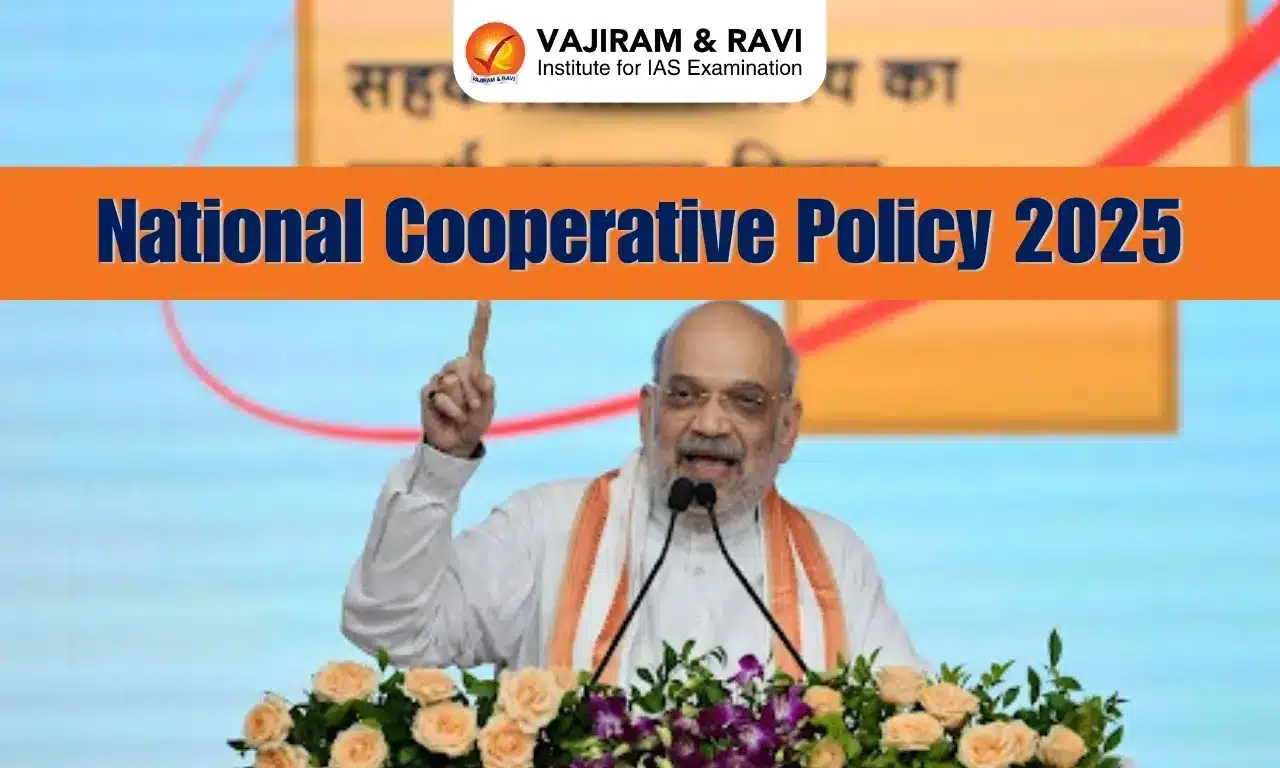
National Cooperative Policy 2025 – Revitalising India’s Cooperative Movement

National Cooperative Policy 2025

National Cooperative Policy 2025 Latest News

  • Union Home Minister Amit Shah has unveiled a new national cooperative policy, replacing one in place for the past 23 years.

National Cooperative Policy 2025

  • Union Home and Cooperation Minister Amit Shah launched the National Cooperative Policy 2025 in New Delhi, replacing the earlier framework introduced in 2002. 
  • The policy aims to strengthen the cooperative sector's institutional capacity, expand its reach into new areas, and align its role with India's broader development goals.
  • Anchored in the vision of Sahkar se Samriddhi (Prosperity through Cooperation), the policy outlines a roadmap for the sector’s growth over the next 20 years, focusing on inclusivity, transparency, technological adoption, and village-level economic empowerment.

Political and Historical Context

  • The National Cooperative Policy 2025 comes after a 23-year gap since the last policy was announced in 2002. 
  • The Union government’s decision to create a separate Ministry of Cooperation in 2021 signalled a renewed commitment to revitalising this sector.
  • With over 8.4 lakh cooperative societies (and a target to increase this by 30%), the sector reaches over 31 crore people, especially in states like Maharashtra and Gujarat. 
  • The policy also seeks to expand this network into other states like Uttar Pradesh and Bihar, thereby decentralising political and economic benefits.

Key Features of the Policy

  • The new policy is structured around six pillars:
    • Strengthening foundational systems
    • Promoting vibrancy in existing cooperatives
    • Preparing for future challenges through digitalisation and innovation
    • Enhancing inclusivity and outreach
    • Expanding into emerging sectors
    • Engaging youth and building capacity for future generations
  • It aims to increase the sector’s contribution to GDP threefold by 2034, establish at least one cooperative society in every village, and bring 50 crore citizens into active cooperative participation.

Expanding into New Sectors

  • Under the new policy, cooperatives will now be supported in non-traditional sectors, including:
    • Green energy
    • Tourism
    • Taxi services (Sahkar Taxi)
    • Insurance
  • PACS (Primary Agricultural Credit Societies) are being enabled to undertake diversified activities like managing fuel outlets, LPG distribution, Jan Aushadhi Kendras, CSCs, and even implementing schemes such as Har Ghar Jal and PM Surya Ghar Yojana.
  • A dedicated roadmap has been prepared for sector-specific cooperative development, particularly in rural India.

Model Cooperative Villages and Rural Integration

  • A major highlight is the Model Cooperative Village initiative. Every tehsil will host five such villages, implemented in coordination with state cooperative banks and NABARD. 
  • These villages will be centres of excellence in cooperative-led development, integrating:
    • Dairy
    • Fishery
    • Floriculture
    • Agri-services
    • Women and tribal participation (via White Revolution 2.0)
  • The goal is to localise economic activity while fostering inclusive growth and community ownership.

Institutional Strengthening and Reforms

  • To ensure efficiency and transparency, the policy mandates:
    • Full computerisation of PACS operations
    • Technology-driven governance for all types of cooperatives
    • Cluster monitoring systems for institutional tracking
    • Legal reviews every 10 years to keep policy aligned with evolving needs
  • As of 2025, over 83 intervention points have been identified for reform, 58 implemented, three completed, and others underway.
  • Additionally, a nationwide cooperative university (Tribhuvan Sahkari University) has been established for professional training and capacity building.

Economic Impact and Inclusive Vision

  • The cooperative sector currently contributes significantly to India’s rural economy:
    • 20% of the total agricultural credit
    • 35% of fertiliser distribution
    • Over 30% of sugar and 10% of milk production
    • Over 21% of the fishing sector
    • 13% of wheat and 20% of paddy procurement
  • With these foundations, the policy envisions a member-centric model where even the smallest cooperative units become self-reliant and future-ready, contributing to employment generation, income stability, and social dignity.

Source: PIB | IE

National Cooperative Policy 2025 FAQs

Q1: What is the National Cooperative Policy 2025?

Ans: It is a strategic policy framework to revitalise India’s cooperative sector for inclusive and sustainable development from 2025 to 2045.

Q2: What are the key goals of the policy?

Ans: The policy aims to triple the cooperative sector’s GDP contribution, establish one cooperative in every village, and include 50 crore active members.

Q3: What new sectors will cooperatives now operate in?

Ans: Cooperatives will expand into taxi services, tourism, insurance, and green energy, among others.

Q4: What is the Model Cooperative Village initiative?

Ans: Five model cooperative villages will be set up in every tehsil to showcase best practices in rural cooperative development.

Q5: How will transparency be ensured in cooperatives?

Ans: Full computerisation, technology-driven management systems, and a 10-year legal review cycle will enhance transparency and accountability.

Draft National Telecom Policy 2025 – Towards a Secure, Inclusive, and Sustainable Telecom Ecosystem

Draft National Telecom Policy 2025

Draft National Telecom Policy 2025 Latest News

  • The Government of India, through the Department of Telecommunications (DoT), has released the Draft National Telecom Policy 2025 for public comment, seven years after the 2018 National Digital Communications Policy (NDCP). 
  • The draft outlines a strategic vision to transform India into a telecom product nation, focusing on connectivity, cybersecurity, indigenous manufacturing, sustainability, and employment generation.

Vision Statement of the 2025 Policy

To create a "telecom product nation" driven by innovation and ensure universal, meaningful, secure, and sustainable connectivity for all citizens.

Key Focus Areas and Policy Highlights of the 2025 Policy

  • Universal and meaningful connectivity:
    • 5G coverage: Target to cover 90% of population with 5G by 2030.
    • 4G coverage: Achieve 100% 4G coverage nationwide.
    • Fiber-connected towers: Increase from 46% to 80% to improve reliability and speed.
    • Wi-Fi hotspots: 1 million new hotspots to be established (revised target from 10 million in 2018).
    • Satellite internet: Promoting satellite-based connectivity in remote areas.
  • Telecom sector employment and skilling:
    • Job creation: Create 10 lakh new jobs in the telecom sector.
    • Upskilling: Reskill another 10 lakh existing workers.
  • Strengthening domestic telecom ecosystem:
    • Domestic manufacturing: Aim for 150% increase in domestic telecom manufacturing by 2030.
    • Telecom manufacturing zone (TMZ): Establish dedicated zones with integrated infrastructure.
    • R&D promotion: Support local R&D and incentivize global standardization participation, including in 6G technologies.
    • CSR recognition: Telecom R&D and standardization efforts may be included under Corporate Social Responsibility (CSR).
  • Cybersecurity and Artificial Intelligence (AI):
    • AI for cybersecurity:
      • Defensive use: AI-enabled systems to detect and prevent cyberattacks.
      • Offensive threats: Address risks from generative AI-based attacks.
      • AI in governance: Use AI chatbots for consumer complaint resolution via a unified grievance portal.
      • Cross-border security: Enhance monitoring of border telecom signals and foreign satellites to reduce interference.
  • Green telecom and circular economy:
    • Carbon footprint: Reduce telecom sector’s emissions by 30%.
    • Material recycling: Promote circular economy by recycling telecom hardware and equipment.
    • Technological advancements:
    • Quantum-secure communications: Focus on quantum encryption technologies for secure communication.
    • Lawful interception: Removed from current policy draft, indicating a shift towards privacy-centric security mechanisms.
    • Mobile number validation: Support for services enabling mobile identity verification; draft regulations already released.

Comparison Between 2018 NDCP and Draft 2025 Telecom Policy

  • Terminology:
    • 2018 NDCP: Named as National Digital Communications Policy (NDCP).
    • 2025 Draft Policy: Termed as National Telecom Policy with a more sector-specific focus.
  • Employment target:
    • 2018 NDCP: Aimed to create 40 lakh jobs in the broader digital communications sector.
    • 2025 Draft Policy: Targets 10 lakh new jobs specifically in the telecom sector.
  • Wi-Fi Hotspot target:
    • 2018 NDCP: Targeted 10 million Wi-Fi hotspots across the country.
    • 2025 Draft Policy: Scaled down to 1 million hotspots, with a more realistic and focused approach.
  • Focus on domestic manufacturing:
    • 2018 NDCP: Had a moderate emphasis on promoting domestic manufacturing.
    • 2025 Draft Policy: Aims for a 150% increase in domestic manufacturing by 2030, including establishment of Telecom Manufacturing Zones (TMZs).
  • Use of AI and cybersecurity:
    • 2018 NDCP: Limited mention of AI in telecom operations.
    • 2025 Draft Policy: Provides a comprehensive strategy for using AI in cybersecurity, complaint redressal, and network security.
  • Environmental sustainability:
    • 2018 NDCP: Sustainability measures were not clearly quantified.
    • 2025 Draft Policy: Aims for a 30% reduction in the sector's carbon footprint and promotes circular economy practices.

Conclusion

  • With its forward-looking emphasis on indigenous innovation, secure communication, and sustainable growth, the Draft National Telecom Policy 2025 positions India to become a global leader in next-generation telecom technologies like 6G and quantum communications. 
  • If implemented effectively, it could serve as the backbone of India’s digital sovereignty and inclusive economic transformation in the decades to come.

Source: TH

Draft National Telecom Policy 2025

Q1: How will the draft National Telecom Policy 2025 make India a telecom product nation?

Ans: By promoting indigenous R&D, 150% rise in manufacturing, and creating Telecom Manufacturing Zones.

Q2: What is the role of AI in telecom cybersecurity?

Ans: AI will detect threats, prevent attacks, and also counter AI-based cyber offenses.

Q3: How does 2025 policy differ from 2018 in jobs and connectivity?

Ans: It narrows focus to telecom, aims 90% 5G by 2030, and creates 10 lakh jobs vs. 40 lakh earlier.

Q4: What are the sustainability goals in the draft policy?

Ans: 30% emission reduction and adoption of circular economy through equipment recycling.

Q5: How will the policy enhance telecom security?

Ans: Through quantum-secure communications, satellite monitoring, and border network control.

ICJ Climate Change Ruling: Legal Accountability, Compensation, and Global Climate Action

ICJ Climate Change Ruling

ICJ Climate Change Ruling Latest News

  • The International Court of Justice (ICJ) has issued a landmark advisory opinion declaring that countries have a legal obligation under international law to reduce greenhouse gas emissions. 
  • While not legally enforceable, the ruling can strengthen climate litigation globally and hold nations accountable for failing to act, including possible compensation. 
  • Prompted by a 2023 UN General Assembly resolution, the opinion underscores that climate action is not just policy but a binding duty—bolstering the demands of developing countries and climate advocates seeking stronger commitments from industrialised nations.

Case Background: Vanuatu's Climate Justice Initiative at the ICJ

Origin of the Initiative

  • In September 2021, the Pacific Island nation of Vanuatu launched a campaign to seek an advisory opinion from the ICJ on climate change. 
  • The move highlighted the urgency for stronger legal action, especially for vulnerable small island nations threatened by rising sea levels.
  • UN General Assembly Resolution
    • Following extensive lobbying by Vanuatu, the UN General Assembly adopted a resolution in March 2023, requesting the ICJ to provide legal clarity on two questions:
      • What are the obligations of States under international law to protect the environment?
      • What legal consequences do States face when they fail to meet these obligations and cause environmental harm?
  • Legal Framework and Importance
    • Under the UN Charter, both the General Assembly and the Security Council have the authority to request advisory opinions from the ICJ. 
    • Although these opinions are not legally binding, they carry significant legal and moral weight, serving to clarify and advance the development of international law.

ICJ Declares Climate Action a Legal Obligation

  • In a landmark advisory opinion, the International Court of Justice (ICJ) ruled that climate action is not optional but a binding legal duty under international law. 
  • Drawing on key climate treaties such as the UNFCCC, Kyoto Protocol, and Paris Agreement, along with environmental agreements like UNCLOS and the Montreal Protocol, the court stated that all countries are legally obligated to reduce greenhouse gas emissions
  • It emphasised that industrialised nations (Annex I countries) must lead in emission cuts and support developing countries through technology and financial aid
  • The court also warned that failing to meet these obligations constitutes an "internationally wrongful act," making countries liable for compensation to those affected by climate-related disasters. 
  • Furthermore, nations may be held accountable for harmful actions by private businesses if they fail to regulate or prevent such behaviour through appropriate laws and oversight.

Significance of ICJ’s Advisory Opinion on Climate Change

  • A Moral and Legal Turning Point
    • Although not legally binding, the ICJ’s advisory opinion is the most authoritative interpretation of international law on climate obligations. 
    • It is expected to influence courts globally and could shape future litigation against countries and corporations for inadequate climate action.
  • Reinforcing Global Climate Responsibility
    • The ruling comes at a time when progress on climate change is faltering. 
    • Many countries, particularly in the developed world, are falling short of their 2030 emission targets. 
    • The ICJ’s opinion reaffirms that countries have legal obligations—not just voluntary commitments—to take meaningful climate action. 
    • This strengthens the voice of vulnerable nations demanding accountability.
  • Loss and Damage: A New Legal Avenue
    • In a significant shift, the court recognised the right of climate-impacted nations—termed “injured states”—to not just compensation but full reparations. 
    • This legal validation of the “loss and damage” principle could pave the way for lawsuits against rich countries and corporate polluters, especially those historically responsible for emissions.
  • Challenges and Future Implications
    • While groundbreaking, the opinion also raises questions. 
    • For instance, the ICJ stated that merely initiating climate action isn’t enough—its adequacy can be challenged. 
    • However, under the Paris Agreement, countries define their own targets, with no provision to judge whether their actions are sufficient. 
    • These contradictions could lead to legal disputes and pushback, even from developing countries.

Conclusion

  • The ICJ’s ruling does not impose penalties or obligations immediately, but it sets a powerful precedent. 
  • Its real impact will emerge as national courts begin referencing it in climate-related disputes and as countries respond politically and legally to its interpretation of their duties under international law.

Source: IE | UN

ICJ Climate Change Ruling FAQs

Q1: What is the ICJ’s climate change ruling about?

Ans: The ICJ declared that countries are legally obligated to reduce emissions under international law and face consequences for failure.

Q2: Who initiated the ICJ advisory opinion on climate?

Ans: The Pacific island nation of Vanuatu, inspired by youth activism, led the movement for the UN to seek ICJ's opinion.

Q3: Are countries legally bound by the ICJ ruling?

Ans: No, it’s advisory. But it holds moral and legal weight, influencing future litigation and international environmental law interpretations.

Q4: What is the impact on developed countries?

Ans: They may face lawsuits, compensation claims, and global scrutiny for not fulfilling their legal climate obligations.

Q5: How does the ruling address corporate pollution?

Ans: Countries can be held liable for harmful actions by private corporations if they fail to regulate or prevent them properly.

India-UK Free Trade Agreement 2025: Key Highlights, Benefits, and Strategic Impact

India-UK Free Trade Agreement

India-UK Free Trade Agreement Latest News

  • India and the United Kingdom signed a landmark Comprehensive Economic Trade Agreement (CETA) during Prime Minister Narendra Modi’s visit to the U.K.
  • Alongside the agreement, both countries unveiled a new strategic cooperation plan — the India-U.K. Vision 2035, replacing the earlier Roadmap 2030
    • The Vision document outlines a comprehensive roadmap to deepen strategic ties across trade, technology, defence, education, climate, and innovation. 
    • It aims to boost jobs, investments, clean energy, and people-to-people links, anchored in shared democratic values and high-level political engagement to ensure mutual growth and global leadership.

Key Highlights of the India-UK Free Trade Agreement

  • The India-UK Free Trade Agreement (FTA), signed on July 24, 2025, offers comprehensive economic gains for India across goods, services, and labour mobility. 
  • Here’s a sector-wise summary:

Market Access: 99% Duty-Free Trade

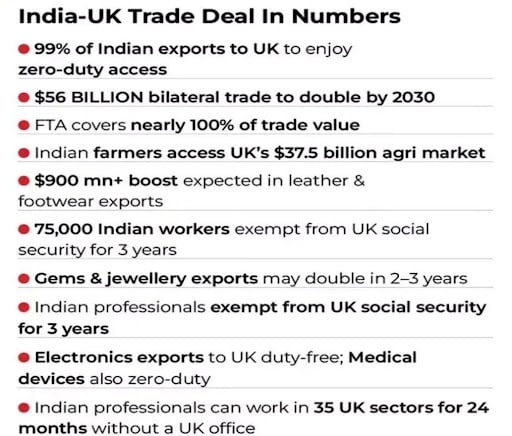
  • India’s Gains: 99% of Indian exports to the UK will now be duty-free, benefitting nearly all trade value.
  • UK’s Gains: 90% of tariff lines will be reduced, with 85% becoming zero-duty within 10 years.
  • Sectors Impacted: Labour-intensive industries like marine, textiles, chemicals, base metals, and processed foods.
    • Tariffs on processed foods drop from 70% to zero; tea, coffee, spices, rubber, and plastics gain free access.

Agriculture: Boost to Rural Economy

  • Duty-Free Access: 95%+ tariff lines now zero-duty.
  • Products Covered: Fruits, vegetables, pulses, spices, pickles, jackfruit, millets, organic herbs.
  • Export Potential: Agri-exports could rise 20% in 3 years, aiding India’s $100B agri-export target by 2030.
  • Sensitive Items Protected: Dairy, oats, apples, edible oils.

Marine Products: A $5.4 Billion Opportunity

  • Tariff Elimination: Zero tariffs on shrimp, tuna, fishmeal, etc.
  • Current Share: India has only 2.25% share in UK marine imports.
  • Growth Potential: Major boost expected for India’s coastal economy.

Textiles & Apparel: Enhanced Competitiveness

  • Coverage: 1,143 product categories, all duty-free.
  • Market Impact: India may gain 5% more UK market share.
  • Key Products: Ready-made garments, carpets, handicrafts, home textiles.
  • Advantage: Levels playing field with Bangladesh and Cambodia.

Engineering Goods: Export Surge Expected

  • Current Status: $4.28B exports to UK; UK imports $193.5B globally.
  • Tariff Cuts: Up to 18% duties scrapped.
  • Projection: Engineering exports may double to $7.5B by 2030.

Pharmaceuticals & Medical Devices

  • Tariff Elimination: On generic medicines and medical devices.
  • Market Potential: UK imports $30B pharma; India exports just $1B.
  • Products Covered: ECG machines, X-ray systems, surgical equipment.

Chemicals & Plastics

  • Chemical Sector: Exports to rise 30–40% to $650–750M in FY26.
  • Plastic Sector: Focus on films, sheets, kitchenware; 15% export growth targeted.
  • Advantage: More competitive pricing versus global suppliers.

Toys, Sports Goods, Gems & Jewellery

  • Toys & Sports Goods: Export edge over China and Vietnam.
  • Jewellery: Exports may double in 2–3 years to capture UK’s $3B market.

Leather & Footwear

  • Tariff Removal: 16% duties scrapped.
  • Export Target: To exceed $900M.
  • Beneficiaries: MSME hubs in Agra, Kanpur, Kolhapur, Chennai.

Services & Professionals: A Global Edge

  • Worker Benefits: 75,000 Indians exempt from UK social security for 3 years.
  • Sectors Opened: 36 services sectors without Economic Needs Test.
  • Professional Access: Indian professionals can work in 35 UK sectors for 2 years.
  • Cultural Exchange: 1,800 chefs, yoga trainers, and artists to be welcomed annually.

Impact of India-UK Trade Deal

  • Gains for Indian Sectors - India’s key export sectors — including agriculture, processed food, textiles, footwear, seafood, gems and jewellery, and engineering goods — will enjoy expanded market access in the U.K. thanks to reduced tariffs.
  • Benefits for British Exports - British exporters will also benefit significantly. The deal is set to ease the sale of whisky, cars, and other British goods in India, helping diversify and broaden the trade portfolio.
  • Boost to Bilateral Trade - UK exports to India are projected to grow by nearly 60%, contributing an additional £15.7 billion by 2040. Overall bilateral trade is expected to surge by 39%, adding £25.5 billion annually compared to trade levels in the absence of the agreement.
  • Services and Mobility Provisions - The FTA includes chapters on services, innovation, and intellectual property, offering enhanced mobility for Indian professionals.
    • Additionally, a Double Contribution Convention Agreement will prevent Indian workers in the UK from paying into both Indian and British social security systems.
  • Strategic Shift after RCEP Exit - India's decision to exit the RCEP in 2019 due to fears of Chinese import surges shifted focus to Western economies. The India-UK deal is part of India’s strategy to forge stronger ties with high-income nations like the UK and EU.

Conclusion

  • The India–UK FTA marks a pivotal shift in India’s global trade posture. 
  • It not only strengthens bilateral relations but also signals India's readiness to engage in complex, high-standard economic agreements aligned with its broader goals of export growth, services integration, and global competitiveness.

Source: IE | ToI | MEA

India-UK Free Trade Agreement FAQs

Q1: What is the India-UK Free Trade Agreement 2025?

Ans: A landmark trade deal removing tariffs and boosting cooperation across goods, services, jobs, and strategic sectors like defence and innovation.

Q2: Which Indian sectors benefit most from the India-UK FTA?

Ans: Sectors like textiles, agriculture, marine, engineering goods, pharmaceuticals, and leather see massive gains from zero-duty access.

Q3: How does the FTA benefit Indian professionals?

Ans: It opens 36 service sectors and grants easier mobility, social security exemption, and new work visa opportunities in the UK.

Q4: What are the projected trade gains from the FTA?

Ans: India-UK bilateral trade is expected to rise 39%, with UK exports to India growing 60% by 2040.

Q5: Why is this agreement strategically important for India?

Ans: After exiting RCEP, India shifted focus to Western partnerships. This FTA signals readiness for high-standard, complex global trade deals.

Enquire Now