UPSC Daily Quiz 28 July 2025

UPSC Daily Quiz

The Daily UPSC Quiz by Vajiram & Ravi is a thoughtfully curated initiative designed to support UPSC aspirants in strengthening their current affairs knowledge and core conceptual understanding. Aligned with the UPSC Syllabus 2025, this daily quiz serves as a revision resource, helping candidates assess their preparation, revise key topics, and stay updated with relevant issues. Whether you are preparing for Prelims or sharpening your revision for Mains, consistent practice with these Daily UPSC Quiz can significantly enhance accuracy, speed, and confidence in solving exam-level questions.

[WpProQuiz 30]  

UPSC Daily Quiz FAQs

Q1: What is the Daily UPSC Quiz?

Ans: The Daily UPSC Quiz is a set of practice questions based on current affairs, static subjects, and PYQs that help aspirants enhance retention and test conceptual clarity regularly.

Q2: How is the Daily Quiz useful for UPSC preparation?

Ans: Daily quizzes support learning, help in revision, improve time management, and boost accuracy for both UPSC Prelims and Mains through consistent practice.

Q3: Are the quiz questions based on the UPSC syllabus?

Ans: Yes, all questions are aligned with the UPSC Syllabus 2025, covering key areas like Polity, Economy, Environment, History, Geography, and Current Affairs.

Q4: Are solutions and explanations provided with the quiz?

Ans: Yes, each quiz includes detailed explanations and source references to enhance conceptual understanding and enable self-assessment.

Q5: Is the Daily UPSC Quiz suitable for both Prelims and Mains?

Ans: Primarily focused on Prelims (MCQ format), but it also indirectly helps in Mains by strengthening subject knowledge and factual clarity.

Gallantry Awards in India, Full List, Eligibility, and Award Details

Gallantry Awards

The Ministry of Defence seeks recommendations twice annually from the Armed Forces and the Ministry of Home Affairs for Gallantry Awards in India. These honours are awarded to personnel who exhibit extraordinary bravery, courage, and commitment to duty, often at great personal risk. The recipients have showcased exceptional courage during a range of operations, including counter-terrorism and counter-insurgency efforts in Jammu & Kashmir and the North-East, anti-piracy missions, and critical fire-fighting operations.

Gallantry Awards in India

The Government of India instituted the Gallantry Awards to honour acts of bravery, courage, and sacrifice by members of the armed forces, other organised forces, and even civilians. These awards are announced twice a year on Republic Day and Independence Day. Soon after independence, on January 26, 1950, the government introduced the First Gallantry Awards in India, the Param Vir Chakra, Maha Vir Chakra, and Vir Chakra, with their effect dating back to August 15, 1947. In 1952, three additional awards were created, Ashoka Chakra Class I, Class II, and Class III also considered effective from the same date. These were later renamed in January 1967 as Ashoka Chakra, Kirti Chakra, and Shaurya Chakra, respectively.

Gallantry Awards in India

Category

Name of Gallantry Awards in India

Level

Awarded For

Wartime

Param Vir Chakra

Highest

Most conspicuous bravery or supreme sacrifice in the presence of the enemy.

Maha Vir Chakra

Second-highest

For acts of conspicuous gallantry in the presence of the enemy.

Vir Chakra

Third-highest

Acts of gallantry on battlefield

Peacetime

Ashoka Chakra

Highest

Bravery away from battlefield (e.g. terrorism, rescue ops)

Kirti Chakra

Second-highest

Courageous action in peacetime (e.g. counter-insurgency, internal ops)

Shaurya Chakra

Third-highest

Bravery during peacetime situations such as rescue or security operations

List of Gallantry Awards 2025

On May 22, 2025, during Phase-I of the Defence Investiture Ceremony held at Rashtrapati Bhawan in New Delhi, President Smt. Droupadi Murmu conferred six Kirti Chakras, including four posthumous honours and 33 Shaurya Chakras, of which seven were awarded posthumously. The recipients included personnel from the Armed Forces, Central Armed Police Forces, and State or Union Territory Police.

List of Gallantry Awards 2025

Name

Service/Unit

Award

Status

Major Malla Rama Gopal Naidu

The Maratha Light Infantry, 56 Rashtriya Rifles

Kirti Chakra

Living

Major Manjit

The Punjab Regiment, 22 Rashtriya Rifles

Kirti Chakra

Living

Rifleman Ravi Kumar

J&K Light Infantry, 63 Rashtriya Rifles

Kirti Chakra

Posthumous

Colonel Manpreet Singh, SM

Sikh Light Infantry, 19 Rashtriya Rifles

Kirti Chakra

Posthumous

Dy. SP Himayun Muzzammil Bhat

J&K Police

Kirti Chakra

Posthumous

Naik Dilwar Khan

Regiment of Artillery, 28 Rashtriya Rifles

Kirti Chakra

Posthumous

Maj. (Lt Col) Vijay Verma

Rajput Regiment, 44 Rashtriya Rifles

Shaurya Chakra

Living

Deputy Commandant Vikrant Kumar

CRPF

Shaurya Chakra

Living

Inspector/GD Jeffrey Hmingchullo

CRPF

Shaurya Chakra

Living

Wg Cdr Vernon Desmond Keane, VM

Indian Air Force (Pilot)

Shaurya Chakra

Living

Sqn Ldr Deepak Kumar

Indian Air Force (Pilot)

Shaurya Chakra

Living

SPO Abdul Latif

J&K Police

Shaurya Chakra

Living

Subedar Sanjeev Singh Jasrotia

5 J&K Rifles

Shaurya Chakra

Living

Colonel Pawan Singh

666 Army Aviation Squadron (R&O)

Shaurya Chakra

Living

Subedar P Pabin Singha

Artillery, 56 Rashtriya Rifles

Shaurya Chakra

Living

Major Sahil Randhawa

Artillery, 34 Rashtriya Rifles

Shaurya Chakra

Living

Maj. (Lt Col) CVS Nikhil

21 PARA (Special Forces)

Shaurya Chakra

Living

Major Tripatpreet Singh

Army Service Corps, 34 Rashtriya Rifles

Shaurya Chakra

Living

Lt Cdr Kapil Yadav

AEO, INS Visakhapatnam

Shaurya Chakra

Living

Deputy Commandant Lakhveer

CRPF

Shaurya Chakra

Living

Asst Commandant Rajesh Panchal

CRPF

Shaurya Chakra

Living

CT/GD Malkit Singh

CRPF

Shaurya Chakra

Living

Subedar Mohan Ram

20 JAT

Shaurya Chakra

Living

Commodore Sharad Sinsunwal

CO, INS Kolkata

Shaurya Chakra

Living

Flt Lt Aman Singh Hans

Indian Air Force (Pilot)

Shaurya Chakra

Living

Sergeant Dabhi Sanjay Hiffabhai

Indian Air Force

Shaurya Chakra

Living

Major Kunal

Army Service Corps, 1 Rashtriya Rifles

Shaurya Chakra

Living

Major Ashish Dahiya

Corps of Engineers, 50 Rashtriya Rifles

Shaurya Chakra

Living

Havildar Prakash Tamang

9 Gorkha Rifles, 32 Rashtriya Rifles

Shaurya Chakra

Living

Major Satender Dhankar

Armoured Corps, 4 Rashtriya Rifles

Shaurya Chakra

Living

Asst Commandant Eshenthung Kikon

4 Assam Rifles

Shaurya Chakra

Living

Subedar Vikas Tomar

1 PARA (Special Forces)

Shaurya Chakra

Living

Major Aashish Dhonchak, SM

Sikh Light Infantry, 19 Rashtriya Rifles

Shaurya Chakra

Posthumous

Sepoy Pardeep Singh

Sikh Light Infantry, 19 Rashtriya Rifles

Shaurya Chakra

Posthumous

Havildar Rohit Kumar

Dogra Regiment, HAWS

Shaurya Chakra

Posthumous

Shri Pawan Kumar, CT/GD

CRPF

Shaurya Chakra

Posthumous

Shri Devan C, CT/GD

CRPF

Shaurya Chakra

Posthumous

OEM GDE-1 Vijayan Kutty G

Border Roads Organisation (BRO)

Shaurya Chakra

Posthumous

Captain Deepak Singh

Corps of Signals, 48 Rashtriya Rifles

Shaurya Chakra

Posthumous

Gallantry Awards Types

Gallantry Awards in India are classified into two distinct categories based on the nature of the act of bravery. The first category includes awards for gallantry in the face of the enemy, which are given for acts of heroism during combat or military engagement. These include the Param Vir Chakra (PVC), Maha Vir Chakra (MVC), and Vir Chakra. The second category recognises bravery not necessarily in direct combat but in situations that demand exceptional courage, such as counter-insurgency, rescue, or peacetime operations. This category includes the Ashoka Chakra, Kirti Chakra, and Shaurya Chakra.

Gallantry Awards Types

Award

Medal Description

Ribbon

Bar System

Param Vir Chakra

Circular bronze medal (1 3/8 inch), embossed with four "Indra’s Vajra" and the State Emblem in the center. "PARAM VIR CHAKRA" inscribed on the reverse in Hindi & English, with two lotus flowers.

Plain purple

Bar added for each subsequent act of bravery. A miniature “Indra’s Vajra” is added to the riband for each bar when worn alone. Posthumous Bars allowed.

Mahavir Chakra

Silver circular medal (1 3/8 inch), five-pointed star touching the rim, State Emblem at center. "MAHA VIR CHAKRA" inscribed in Hindi & English on reverse, separated by two lotus flowers.

Half-white and half-orange

Bar attached to the riband for each additional qualifying act. Miniature Chakra on riband for each bar when worn alone. Posthumous Bars allowed.

Vir Chakra

Silver circular medal (1 3/8 inch), five-pointed star with a chakra and gilded State Emblem in the center. "VIR CHAKRA" inscribed on the reverse in Hindi & English, with two lotus blossoms.

Equal parts blue and orange

Bar added to riband for additional acts. Riband has a small duplicate of the Chakra for each bar. Bars may be awarded posthumously.

Ashoka Chakra

Gold-leaf circular medal (1 3/4 inch), Ashoka Chakra on the obverse encircled by lotus wreath. Inner rim has lotus leaves, flowers, and buds. Reverse has "ASHOK CHAKRA" in Hindi & English, separated by two lotus flowers.

Green ribbon with two halves separated by an orange line

Bar added to riband for each additional brave act. Miniature Chakra on riband for each bar. Bars may be awarded posthumously.

Kirti Chakra

Silver circular medal (1 3/8 inch), Ashoka Chakra on obverse with lotus wreath design. Reverse shows “KIRTI CHAKRA” in Hindi & English, separated by two lotus flowers.

Green ribbon split into 3 parts by 2 orange vertical lines

Bar added for repeated qualifying acts. Miniature Chakra on riband for each bar. Bars may be awarded posthumously.

Shaurya Chakra

Bronze circular medal (1 3/8 inch), Ashoka Chakra on obverse with lotus wreath design. Reverse shows “SHAURYA CHAKRA” in Hindi & English, separated by two lotus flowers.

Green ribbon divided into 4 equal parts by 3 orange lines

Bar added for each additional act of gallantry. Miniature Chakra on riband for each bar. Posthumous Bars allowed.

Gallantry Awards in India Eligibility Criteria

Gallantry Awards in India are divided into two main categories based on whether the act of bravery occurs in the presence of the enemy or in peacetime situations. The Param Vir Chakra, Maha Vir Chakra, and Vir Chakra are wartime Gallantry Awards in India, while the Ashoka Chakra, Kirti Chakra, and Shaurya Chakra are awarded for courageous actions during peacetime. The table below includes the Gallantry Awards in India Eligibility Criteria.

Gallantry Awards in India Eligibility Criteria

Award

Eligible Personnel

Awarded For

Presence of Enemy

Param Vir Chakra

Officers and personnel of the Armed Forces, Reserve Forces, Territorial Army, Militia, and related Nursing/Hospital services; Civilians serving with these forces.

Most conspicuous bravery, daring, or self-sacrifice of the highest order.

Yes

Maha Vir Chakra

Same as above.

Acts of conspicuous gallantry in the presence of the enemy.

Yes

Vir Chakra

Same as above.

Gallant acts in the presence of the enemy.

Yes

Ashoka Chakra

Armed Forces, Reserve Forces, Territorial Army, Central Para-Military Forces, Railway Protection Force, civilians, and nursing services personnel.

Most conspicuous courage, daring act, or self-sacrifice of the highest order in peacetime.

No

Kirti Chakra

Same as above.

Distinguished acts of bravery not involving direct engagement with the enemy.

No

Shaurya Chakra

Same as above.

Bravery and valour shown under circumstances not involving the enemy (e.g., during peacetime operations, rescues).

No

Gallantry Awards in India FAQs

Q1: What are Gallantry Awards in India?

Ans: Gallantry Awards are honors given for bravery, valor, and courage in the face of danger, especially in the armed forces.

Q2: Which is the highest Gallantry Award in India?

Ans: The Param Vir Chakra is India’s highest wartime gallantry award, awarded for the highest degree of bravery.

Q3: What are the main types of Gallantry Awards?

Ans: They are categorized into Wartime (Param Vir Chakra, Maha Vir Chakra, Vir Chakra) and Peacetime (Ashoka Chakra, Kirti Chakra, Shaurya Chakra).

Q4: When are Gallantry Awards announced?

Ans: They are announced twice a year—on Republic Day (26th January) and Independence Day (15th August).

Q5: Who presents Gallantry Awards in India?

Ans: The President of India presents Gallantry Awards during ceremonial functions at the Rashtrapati Bhavan.

Kothari Commission, Formation, Report, Impact, Limitations

Kothari Commission

Kothari Commission was formed under the chairmanship of Dr. Daulat Singh Kothari with 17 other members and is also known as National Education Commission, 1964. It was a temporary committee established by the government of India to streamline the education system of India. The main objective of the Kothari Commission was to create an educational framework and provide recommendations and create policies for the development of the education system in India.

Kothari Commission

Kothari Commission sustained from 1964 till 1966 under the chairmanship of Dr. DS Kothari aimed to lay down the framework for a national education policy from primary school to the highest level. The scope excluded medical and legal education but covered every other aspect of the education system of India.

The Kothari Commission worked for two years and submitted the report on 29th June 1966. It formed 12 Task Forces to focus on key areas like School Education, Technical and Higher Education, and Agricultural Education. Alongside, 7 Working Groups were created to study specific issues in greater detail.

Kothari Commission Formation

The Kothari Commission was formed with the core agenda of crafting a roadmap for the educational development and policy formation to contribute to growth and progress of the country. Other than this commission was formed to address the below mentioned needs:

  • To conduct a thorough review of Education System of India and identify gaps at every level from primary to higher education.
  • To tackle inequalities in access and quality, especially in rural and underprivileged regions.
  • To push for broad reforms in areas like curriculum design, infrastructure, teacher training, and overall learning quality.
  • To make education more relevant to the evolving social and economic needs of a developing India.
  • To introduce a unified and consistent national education framework across the country.

Kothari Commission Report

Kothari Commission Report was submitted on 29th June 1996 with title “Education and National Development” based on how education is the most important and essential resource that every citizen has the right and must equip with for the development of the country. The report was divided into four sub parts including:

  • Part I: Focused on the General issues.
  • Part II: Studied the Stages of Education.
  • Part III: Provided Recommendations and programmes.
  • Part IV: Deals with additional papers.

Also further based on four main themes including:

  • Increase of Productivity
  • Promoting National and social integration
  • Modernization and Education
  • Developing moral, social, and spiritual values

Kothari Commission Recommendations

  • Kothari Commission proposed a unified school system to offer equal learning opportunities to all children, regardless of their background.
  • Recommended free education for all children up to the age of 14.
  • The commission emphasized creativity, critical thinking, and the holistic development of learners through a well-rounded curriculum.
  • Suggested that students should learn three Language:
    • Mother tongue or regional language
    • Official language of the state
    • English
  • Standardized the academic progression into 10+2+3 Education Structure:
    • 10 years of school (Class 1-10)
    • 2 years of higher secondary (Class 11-12)
    • 3 years of undergraduate education (Bachelor’s degree)
  • Teacher-Student Ratio must be an optimal ratio to ensure better attention and instruction.
  • Expanding access to girl’s education, including setting up schools and hostels for female students.
  • Recommended revamping teacher education to improve teaching quality and morale.
  • Focus on Core Subjects by integrating science, mathematics, social studies, and national service throughout the education journey.
  • Proposed increasing the number of universities and investing in research and innovation.
  • Emphasized developing vocational and technical institutions to serve the needs of a modern economy.

Kothari Commission Impact

As a result of the recommendations by the Kothari Commission, National Policy on Education was formed. Other recommendations includes:

  • Education System followed the pattern of 10+2+3
  • Education became the fundamental right which provided education to children who are between the age of 6 to 14 years.
  • The equalization of the education system was adopted to all sections of the society.
  • The revision in the pay scale and status was seen in the aspect of teachers.
  • There was a setup of two different boards i.e. the central board and the state board was done. The Board of Higher Secondary Education was formed in 1986.

Kothari Commission Limitations

There were also some Kothari Commission Limitations which are discussed below:

  • The Commission’s recommendations were leaned toward a centralized model and didn’t fully reflect India’s vast linguistic, cultural, and regional differences.
  • Many recommendations required heavy funding, better infrastructure, and inter-governmental coordination, which were not always feasible leading to delays and uneven execution.
  • While it offered structural suggestions for universities, the Commission fell short of providing a sustainable roadmap for funding higher education.
  • It did not propose a strong framework for revisiting and updating policies over time.
  • The emphasis was more on structure and access than measurable learning outcomes or quality metrics.

Kothari Commission FAQs

Q1: What is the Kothari Commission?

Ans: A landmark education commission formed in 1964 to examine India’s education system and recommend reforms for national development.

Q2: When was the Kothari Commission formed?

Ans: It was established in July 1964 and submitted its final report in 1966.

Q3: Who headed the Kothari Commission?

Ans: Dr. Daulat Singh Kothari, then Chairman of the University Grants Commission (UGC), led the commission.

Q4: Why was the Kothari Commission formed?

Ans: To evaluate the Indian education system and suggest a uniform, modern, and nationalistic educational structure.

Q5: How many members were in the Kothari Commission?

Ans: It had 17 members, including educationists, scientists, and administrators from India and abroad.
Veer Parivar Sahayata Yojana

Veer Parivar Sahayata Yojana

Veer Parivar Sahayata Yojana Latest News

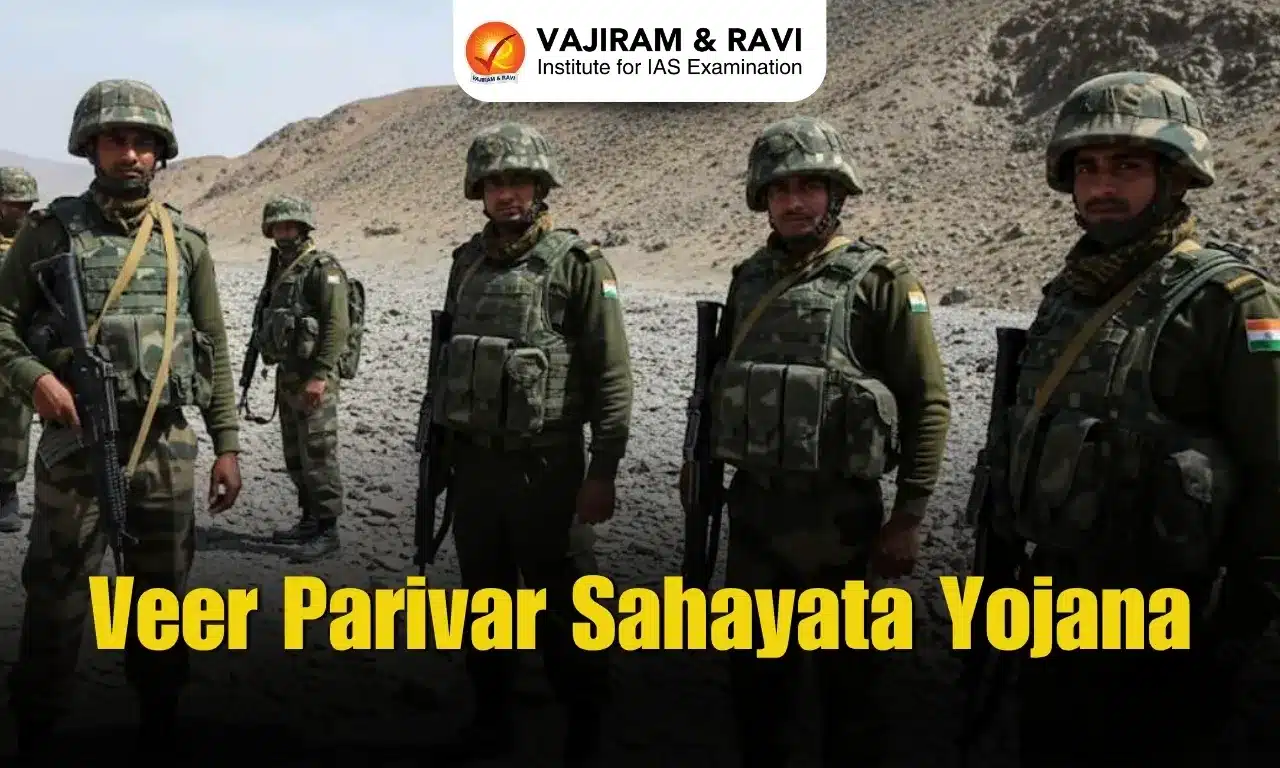
The National Legal Services Authority (NALSA) recently launched ‘Veer Parivar Sahayata Yojana’, a scheme to strengthen legal aid for defence personnel and their families.

About Veer Parivar Sahayata Yojana

  • It is a joint initiative of the National Legal Services Authority (NALSA), the Kendriya Sainik Board (KSB), Rajya Sainik Boards (RSBs), and Zilla Sainik Boards (ZSBs), under the Department of Ex-Servicemen Welfare, Ministry of Defence.
  • Objective: Providing free and competent legal services to defence personnel, ex-servicemen, and their families.
  • It will be implemented through a nationwide network of Legal Services Clinics established across Rajya and Zila Sainik Boards in all states and union territories. 
  • These clinics will operate in close collaboration with the Department of Ex-Servicemen Welfare, Ministry of Defence, and respective Directorates of Sainik Welfare.
  • The scheme is especially relevant for personnel posted in remote locations who often find it difficult to appear in court or follow up on legal matters involving family property, land disputes, or domestic issues. 
  • Through this initiative, NALSA will facilitate proper legal representation in such cases across the country.
  • Panel lawyers and paralegal volunteers of the legal services authority will provide free legal aid to soldiers.
  • The support will also extend to paramilitary personnel, including those from the Border Security Force (BSF), Central Reserve Police Force (CRPF), Indo-Tibetan Border Police (ITBP), and others who serve in similarly isolated and high-risk conditions.

Source: IE

Veer Parivar Sahayata Yojana FAQs

Q1: Which organization is implementing the Veer Parivar Sahayata Yojana?

Ans: National Legal Services Authority (NALSA).

Q2: What is the primary objective of the Veer Parivar Sahayata Yojana?

Ans: Providing free and competent legal services to defence personnel, ex-servicemen, and their families.

Q3: Through which network will the Veer Parivar Sahayata Yojana be implemented?

Ans: Nationwide network of Legal Services Clinics established across Rajya and Zila Sainik Boards in all states and union territories.

Exercise Drone Prahar

Exercise Drone Prahar

Exercise Drone Prahar Latest News

The Indian Army recently held Exercise Drone Prahar in Arunachal Pradesh.

About Exercise Drone Prahar

  • It is a high-tech military drill conducted by the Indian Army to validate the integration of drone technology into tactical battlefield operations.
  • It was conducted at the military station at Rayang in Arunachal Pradesh's East Siang District.
  • Carried out under realistic operational conditions, the exercise demonstrated the effective use of drones for intelligence, surveillance, and reconnaissance, as well as real-time sensor-to-shooter coordination and precision targeting.
  • The aim was to enhance command reach and improve situational awareness for tactical commanders by employing layered surveillance and supporting dynamic decision-making on the ground.
  • The exercise also evaluated critical aspects necessary for seamless drone integration in battlefield scenarios. 
  • This included testing of airspace deconfliction, ensuring secure communication channels, and establishing coordination protocols among various arms and services.

Source: ET

Exercise Drone Prahar FAQs

Q1: Which organisation conducted Exercise Drone Prahar?

Ans: Indian Army

Q2: What is the main purpose of Exercise Drone Prahar?

Ans: Validating drone technology for battlefield operations.

Q3: Where was Exercise Drone Prahar conducted?

Ans: It was conducted at the military station at Rayang in Arunachal Pradesh's East Siang District.

System for Pension Administration (RAKSHA) (SPARSH)

System for Pension Administration

System for Pension Administration (RAKSHA) Latest News

Many ex-servicemen say the SPARSH (System for Pension Administration Raksha) has only added to their troubles — from inaccessible interfaces to endless corrections that never seem to stick.

About System for Pension Administration (RAKSHA)

  • It is an initiative of the Ministry of Defence, Government of India.
  • Objective: Meeting the pension sanction and disbursement requirements for Armed Forces viz. Army, Navy, Air Force and Defence Civilians.
  • It is administered by the Defence Accounts Department through the Principal Controller of Defence Accounts (Pensions), Prayagraj and shall cater to all the three Services and allied organisations.
  • Without relying on a third-party intermediary, this web-based system handles pension claims, and deposits pension payments into the bank accounts of defence pensioners.
  • It is a centralized sanction, claim and pension disbursement system with easy validation and rectification of data through self-verification. 
  • It uses a digital process for pensioner identification, removing the requirement of multiple visits by pensioners to the pension offices.
  • The defence pensioner will be given a completely transparent view of his pension account through this platform.
  • It will capture and maintain a complete history of events and entitlements the pensioner right from the date of commencement of pension to the date of cessation of pension due to his/her last eligible beneficiary.
  • The system would cater to all activities of the pension cycle namely
    • Initiation and Sanction
    • Disbursement
    • Revision
    • Service and Grievance Request Management.

Source: IE

System for Pension Administration (RAKSHA) FAQs

Q1: System for Pension Administration (RAKSHA) (SPARSH) is an initiative of which Ministry?

Ans: Ministry of Defence

Q2: What is the objective of the System for Pension Administration (RAKSHA) (SPARSH)?

Ans: Administering pension sanction and disbursement for defence personnel.

Q3: System for Pension Administration (RAKSHA) (SPARSH) is administered by which body?

Ans: It is administered by the Defence Accounts Department through the Principal Controller of Defence Accounts (Pensions), Prayagraj.

Exercise Bold Kurukshetra 2025

Exercise Bold Kurukshetra 2025

Exercise Bold Kurukshetra 2025 Latest News

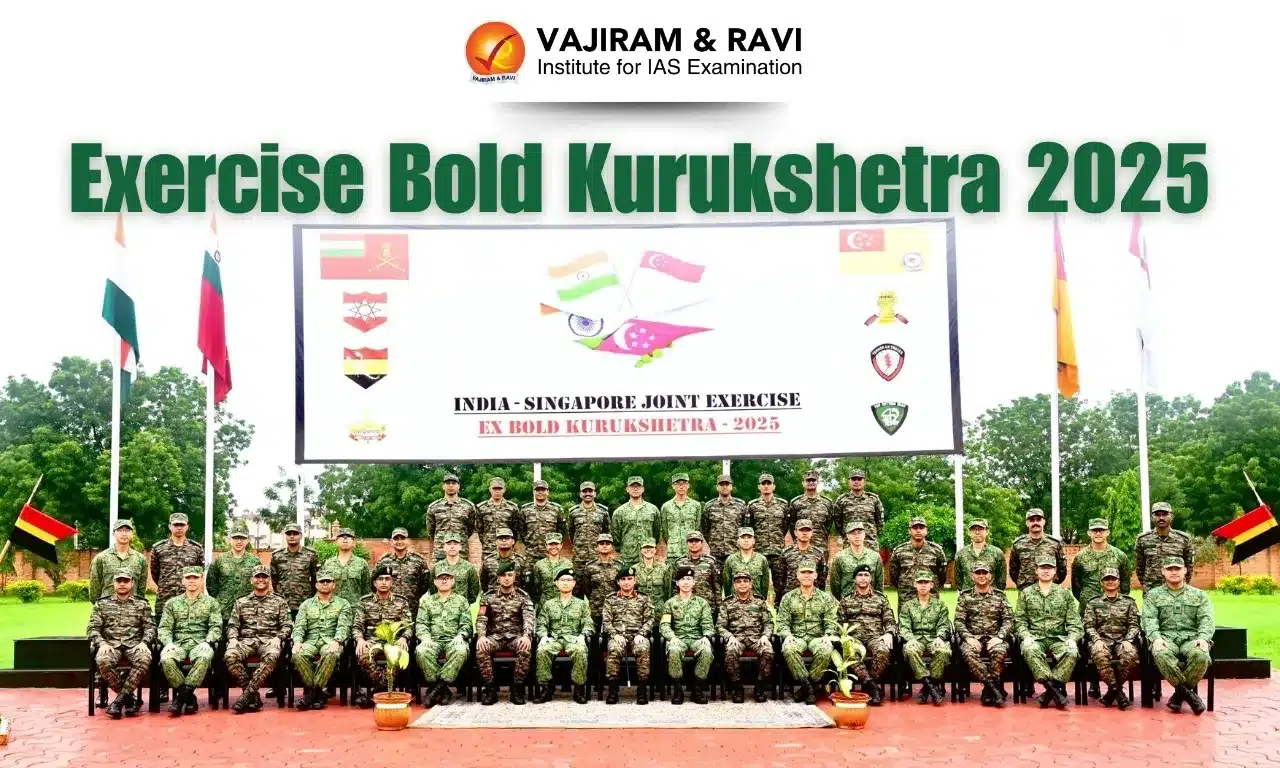
The 14th edition of the Exercise Bold Kurukshetra 2025, is set to commence at Jodhpur and will continue till 04 August 2025.

About Exercise Bold Kurukshetra 2025

  • It is a joint military exercise conducted between India and Singapore.
  • It was first conducted in 2005, this exercise underscores the strong and long-standing bilateral defence relationship between both countries and enhances cooperation between the two armies.
  • The exercise will witness the participation of the 42 Singapore Armoured Regiment of the 4 Singapore Armoured Brigade and the Indian Army’s Mechanised Infantry Regiment.
  • The exercise will be conducted as a Table Top Exercise and Computer-Based Wargame, aimed at validating operational procedures for mechanised warfare.
  • Objective: The objective of the exercise is to enhance interoperability and joint training capabilities of both armies under United Nations mandate, thereby strengthening bilateral defence cooperation.
  • Both defence establishments also interact regularly through high-level visits, policy dialogues, courses and other professional exchanges.
  • Significance: Exercise Bold Kurukshetra 2025 will further consolidate the strong defence ties between India and Singapore and foster greater mutual understanding and collaboration at both tactical and strategic levels.

Source: PIB

Exercise Bold Kurukshetra 2025 FAQs

Q1: What is the bold Kurukshetra military exercise?

Ans: It is a bilateral military exercise between India and the Singapore army.

Q2: What is Tabletop Exercise?

Ans: A tabletop exercise is a form of cyber defense training in which teams walk through simulated cyberattack scenarios in a structured, discussion-based setting.

New Wasp Species

New Wasp Species

New Wasp Species Latest News

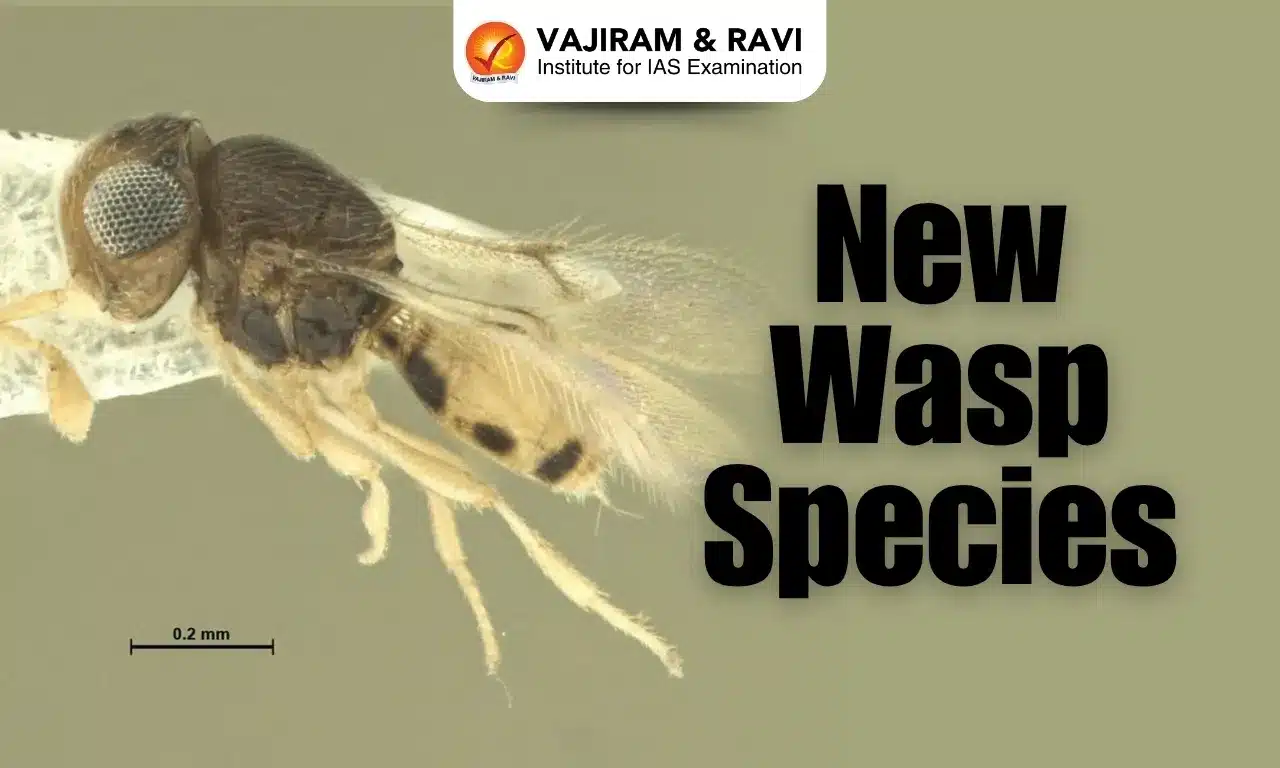
Recently, scientists from the Zoological Survey of India (ZSI) have announced the discovery of four new species of spider-egg parasitic wasps, all from the State of West Bengal.

About New Wasp Species

  • The new species of parasitoid wasps belong to the genus Idris (Hymenoptera: Scelionidae).
  • These tiny wasps — Idris bianor, Idris furvus, Idris hyllus, and Idris longiscapus — were collected from agroecosystems and semi-natural habitats across West Bengal.

Features of New Wasps

  • These extremely small microscopic wasps belong to the genus Idris Förster and are known for laying their eggs inside spider egg sacs.
  • These are primary egg parasitoids of jumping spiders (Salticidae).
  • They exhibit an interesting behaviour pattern, the scientists noted that instead of just one wasp growing inside each spider egg sac, many baby wasps grow together and are called “gregarious parasitism”.
  • Significance of wasps: Parasitoid wasps like Idris play a key role in regulating spider populations and maintaining arthropod community balance.

Key Facts about Parasitism

  • It is a relationship between two species of plants or animals in which one benefits at the expense of the other, sometimes without killing the host organism.
  • In parasitism only one species benefits (parasite and predator, respectively) and the interaction is detrimental to the other species (host and prey, respectively).
  • Predation, parasitism and commensalism share a common characteristic– the interacting species live closely together.
  • Brood parasitism in birds is a fascinating example of parasitism in which the parasitic bird lays its eggs in the nest of its host and lets the host incubate them.

Source: TH

New Wasp Species FAQs

Q1: What is the difference between parasites and parasitoids?

Ans: A parasite is an organism that lives in or on another species (its host) and benefits by deriving nutrients at the other's expense, resulting in the death of the host. A parasitoid is an insect whose larvae live as parasites that eventually kill their hosts (typically other insects).

Q2: Where is the Zoological Survey of India situated?

Ans: Kolkata

TRACERS Mission

TRACERS Mission

TRACERS Mission Latest News

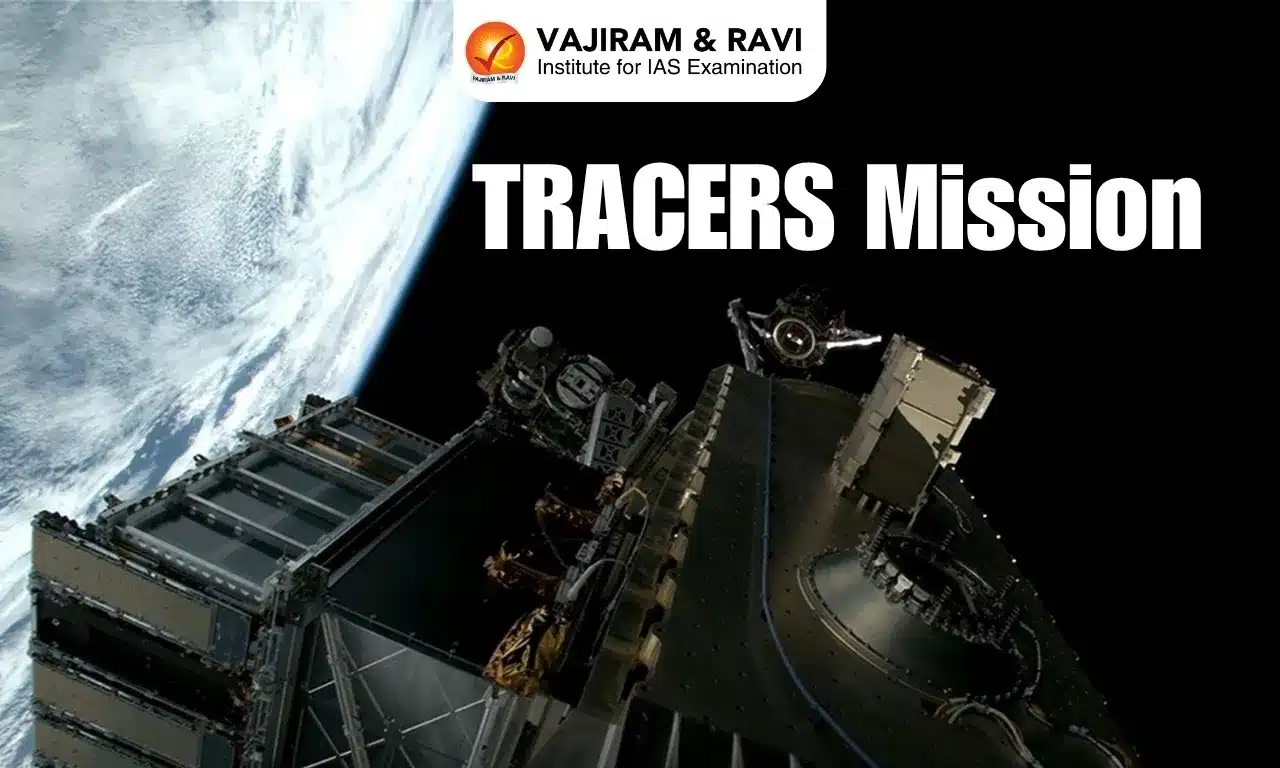
Recently, NASA’s twin TRACERS satellite was launched to study magnetic reconnection and how solar activity affects near-Earth atmosphere.

About TRACERS Mission

  • The Tandem Reconnection and Cusp Electrodynamics Reconnaissance Satellites (TRACERS) will help understand magnetic reconnection and its effects in Earth’s atmosphere.
  • It will fly in low Earth orbit through the polar cusps, funnel-shaped holes in the magnetic field, to study magnetic reconnection and its effects in Earth's atmosphere.
  • This twin satellite system is set to study the constant stream of solar wind and charged particles flowing from the Sun, which interacts with Earth’s magnetic shield, also known as the magnetosphere.
  • Significance: The data gathered from TRACERS will help scientists improve space weather forecasting and better protect critical technology here on Earth. 

What is Magnetic Reconnection?

  • When the solar wind hits this magnetic field, it can lead to magnetic reconnection, which also releases a huge amount of energy.
  • As the solar wind collides with Earth’s magnetic field, this interaction builds up energy that can cause the magnetic field lines to snap and explosively fling away nearby particles at high speeds.
  • These reconnection events can cause beautiful light shows like auroras, but also cause problems for satellites, astronauts, and GPS systems.
  • Over the first year alone, the mission is expected to get information on more than 3,000 such reconnection events.
  • The twin satellites will do this while orbiting through Earth’s polar cusp region, funnel-like openings in the magnetic field where the solar wind has a direct path into our atmosphere.

 Source: Nasa

TRACERS Mission FAQs

Q1: What is the mission of NASA's TRACERS?

Ans: NASA's TRACERS mission will help researchers understand magnetic reconnection and its effects in Earth's atmosphere.

Q2: What is the definition of a magnetic field?

Ans: A magnetic field is a physical field that describes the magnetic influence on moving electric charges, electric currents, and magnetic materials.

Barents Sea

Barents Sea

Barents Sea Latest News

Russia recently rolled its Bastion coastal defence missile launchers onto the bleak shoreline of the Barents Sea, a dramatic opening move in the navy‑wide exercise codenamed “July Storm.”

About Barents Sea

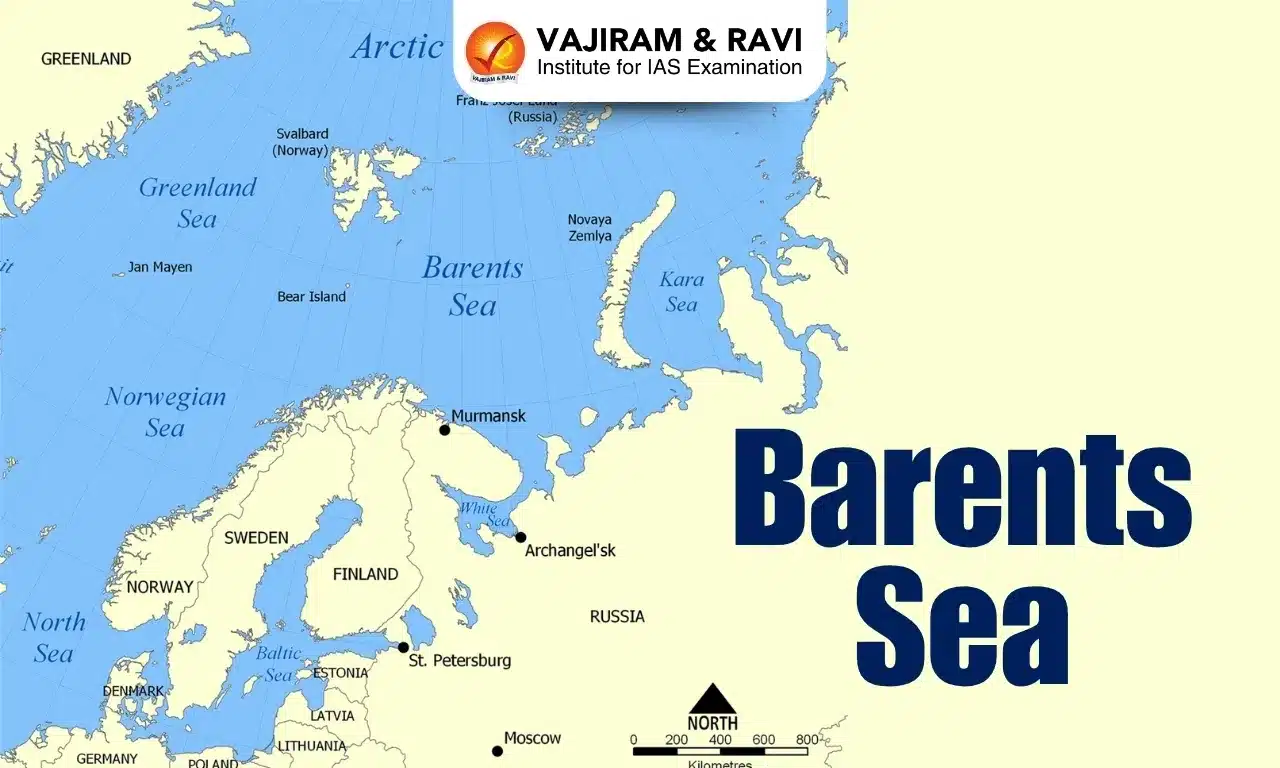
  • It is a marginal sea of the Arctic Ocean located along the northern coasts of Norway and Russia.
  • It covers an area of 1.4 million sq.km.
  • It was named for Willem Barents, a 16th-century Dutch navigator who explored it while searching for a northeast passage to Asia.
  • The sea was known to Vikings and medieval Russians as the Murmean Sea.
  • Boundaries:
    • It is bounded by the Svalbard archipelago in the northwest, the Franz Josef Land islands in the northeast, the Novaya Zemlya archipelago in the east, the Norwegian Sea and the Greenland Sea in the west, and by the Kola Peninsula in the south. 
    • It is separated from the Kara Sea by the Kara Strait and the Novaya Zemlya archipelago. 
    • The White Sea and the Pechora Sea are two parts of the Barents Sea.
    • The White Sea is a southern arm of the Barents Sea, which separates the Kola Peninsula from the Russian mainland.
    • The Pechora Sea is situated in the southeastern part of the Barents Sea.
  • The maximum width of the Barents Sea is 1,050 km, and it is about 1,300 km in length. 
  • It covers a relatively shallow continental shelf fringing the Eurasian landmass. 
  • It has an estimated average depth of 230 m. 
  • The climate of the sea is subarctic.
  • The waters of the Barents Sea have a high salinity of 34 parts per 1,000.
  • The Gulf Stream keeps the Barents Sea and its adjoining coasts significantly warmer than other sub-Arctic regions.
  • It has a rich biological diversity, including some of the world’s most numerous colonies of seabirds such as puffins and guillemots, rich seafloor communities with kelp forests, numerous deepwater coral reefs, and a unique variety of marine mammals such as walrus, bowhead whales, and polar bears.

Source: ET

Barents Sea FAQs

Q1: The Barents Sea is a marginal sea of which ocean?

Ans: Arctic Ocean

Q2: The Barents Sea is located along the northern coasts of which two countries?

Ans: Norway and Russia

Q3: What was the Barents Sea known as to the Vikings and medieval Russians?

Ans: Murmean Sea

Q4: What keeps the Barents Sea warmer than other sub-Arctic regions?

Ans: Gulf Stream

List of Famous Personalities & Their Nicknames, Indian Sports People

Famous Personalities & their Nicknames

Mahatma Gandhi was known as “Bapu” which was his nickname. His nickname also represented his image as the father of the Nation. Many important personalities in India who are also famous are known by nicknames. These names represent the love of people and also the achievements of these famous people that contributed to nation building. In this article, we are going to give you a list of famous personalities and their nicknames.  

List of Famous Personalities & their Nicknames

Famous Personalities in history are often remembered not just by their official titles but also through their nicknames given by the public. These names reflect the deep respect, admiration, or emotional connection people feel toward them. In many cases, such titles highlight a person's extraordinary contributions or the role they played in shaping the nation’s identity. Here is a List of Famous Personalities & their Nicknames: 

Nickname

Personality

Acharya

Vinoba Bhave

Adi Kavi

Valmiki

Desh Ratna, Ajatshatru

Dr. Rajendra Prasad

Akbar of Kashmir

Jainul Abdin

Andhra Kesari

T Prakasam

Anna

C N Annadurai

Babuji

Javjeevan Ram

Badshah Khan / Frontier Gandhi

Abdul Ghaffar Khan

Bapu

Mohandas Karamchand Gandhi

Bengal Kesari

Ashutosh Mukherji

Bengal Tiger

Bipin Chandrapal & Saurav Ganguli

Bihar Kesri

Dr. Srikrishna Singh

Bihar Vibhuti

Dr. Anurag Narayan Singh

Bismark of India

Vallabhai Patel

Biswa Kavi

Rabindranath Tagore

Buddha

Siddhartha Gautama

C R

C Rajagopalachari

Chacha

Jawaharlal Nehru

Deenabandhu

C F Andrews

Desabandhu

C R Das

Desh Ratna

Dr. Rajendra Prasad

Deshbandhu

Chitta Ranjan Das

Deshpriya

Yatindra Mohan Sengupta

Father of Gujrat

Ravi Sankar Maharaj

Father of Nation (India)

Mohandas Karamchand Gandhi

Flying Sikh

Milkha Singh

Gandhiji

Mohandas Karamchand Gandhi

Grand Old Man of India

Dadabhai Naoroji

Grandfather of Indian Films

Dhundiraj Govind Phalke

Gurudev

Rabindranath Tagore

Guruji

M S Gohlwalkar

Haryana Hurricane

Kapil Dev

Hockey Wizard

Dhyan Chand

Indian Machiavelli

Chanakya

Iron Lady of India

Indira Gandhi

Iron Man

Sardar Vallabhbhai Patel

J P

Jayaprakash Narayan

Jana Nayak

Karpuri Thakur

Kaviguru

Rabindranath Tagore

King Maker of Indian History

Sayyed Bandhu

Kuvempu

K.V.Puttappa

Lal, Bal, Pal

Lala Lajpat Rai, Bal Ganghadhar Tilak and Bipin Chandra Pal

Light of Asia

Sreebuddha

Lion of Kashmir

Sheikh Mohammad Abdullah

Lion of Maratha

Bal Gangadhar Tilak

Little Master

Sunil Gavaskar

Lokmanya

Bal Gangadhar Tilak

Loknayak

Jayaprakash Narayan

Machiavelli of India

Chanakya

Magician of Hockey

Dhyanchand

Mahamana

Madan Mohan Malaviya

Man of Iron

Vallabhai Patel

Man of Peace

Lal Bahadur Shastri

Morning Star of India Renaissance

Raja Ram Mohan Roy

Napolean of India

Samudragupta

Netaji

Subhash Chandra Bose

Nightingale of India

Sarojini Naidu

Panditji

Jawaharlal Nehru

Panjab Kesari

Lala Lajpat Rai

Payyoli Express

P. T. Usha

Prince of Kolkata

Saurav Ganguly

Priyadarshini

Indira Gandhi

Punjab Kesari

Lala Lajpat Rai

Rajaji

C Rajagopalachari

Rajarshee

Purushottam Das tandon

Sahid-e-Azam

Bhagat Singh

Saint of Sabarmati

Mohandas Karamchand Gandhi

Saint of the Gutters

Mother Teresa

Shakespeare of India

Kalidasa

Sher-e-Kashmir

Sheikh Abdullah

Sparrow

Major General Rajinder Singh

Strong Man of India

Vallabhai Patel

Swar Kokila

Lata Mangeshkar

Tau

Chaudhury Devi Lal

The Little Master

Sachin Tendulkar

Tiger of Mysore

Tipu Sultan

Tota-e-Hind

Amir Khushro

Udanpari

P.T.Usha

Young Turk

Chandra Sekhar

Famous Indian Sports Personalities and Their Nickname

The table below includes the List of Famous Indian Sports Personalities and Their Nickname:

Famous Indian Sports Personalities and Their Nickname

S.No.

Name of Famous Indian Sports Personality

Nickname

1

Milkha Singh

Flying Sikh

2

Kapil Dev

Haryana Hurricane

3

Dhyan Chand

Hockey Wizard / Magician of Hockey

4

P. T. Usha

Payyoli Express / Udanpari

5

Saurav Ganguly

Prince of Kolkata / Dada / Bengal Tiger / God of the Off Side

6

Sachin Tendulkar

Master Blaster / Bombay Bomber

7

Anil Kumble

Jumbo

8

Sunil Gavaskar

Little Master / Sunny

9

Virendra Sehwag

Veeru

10

Rahul Dravid

Jamie / The Wall

11

Harbhajan Singh

Turbanator

12

Zaheer Khan

Baroda Express

13

Mahendra Singh Dhoni

Mr. Cool / Captain Cool / Mahi

14

Javagal Srinath

Mysore Express

15

Gautam Gambhir

Gauti

16

Mary Com

Magnificent Mary / Meethoileima

17

Virat Kohli

Cheeku / King Kohli

18

Rohit Sharma

Hitman

Famous Personalities & their Nicknames FAQs

Q1: Who are the 10 great men of India?

Ans: Mahatma Gandhi, Jawaharlal Nehru, Subhas Chandra Bose, Bhagat Singh, Dr. B.R. Ambedkar, Sardar Patel, Swami Vivekananda, Rabindranath Tagore, Dr. A.P.J. Abdul Kalam, and Lal Bahadur Shastri are considered among the 10 great men of India.

Q2: Why are famous personalities bestowed with nicknames?

Ans: Nicknames are often given to honor their unique qualities, contributions, or to express public affection and recognition.

Q3: What is the nickname of Gandhiji?

Ans: Gandhiji is famously known as the Father of the Nation or Bapu.

Q4: What was the nickname of Jawaharlal Nehru?

Ans: Jawaharlal Nehru was lovingly called Chacha Nehru, especially by children.

Q5: What was Bhagat Singh’s nickname?

Ans: Bhagat Singh was popularly known as Shaheed-e-Azam (Martyr of the Great Order).

World Food India

World Food India

World Food India Latest News

The Ministry of Food Processing Industries will organise the 4th edition of World Food India 2025 at Bharat Mandapam in New Delhi from 25th of September this year.

About World Food India

  • The first edition was held in 2017, followed by a successful second edition in 2023 and the third in 2024.
  • It is a gateway to the Indian food economy and an opportunity to showcase, connect, and collaborate.
  • It is organized by the Ministry of Food Processing Industries, Government of India,
  • It is the largest gathering of investors, manufacturers, producers, food processors, policy makers, and organizations from the global food ecosystem.
  •  It aims to provide opportunities for both investment and trade in the food processing sector for leading Indian and international companies.
  • WFI serves as a premier platform for stakeholders from across the world to connect, collaborate, and explore opportunities in India's dynamic food processing landscape. Building on the remarkable success of previous editions, 
  • Theme of WFI 2025: “Processing for Prosperity” 
  • The food processing sector is a priority under the Make in India initiative, with the Ministry of Food Processing Industries implementing schemes to attract investment and develop infrastructure. 
  • Mega Food Parks with essential utilities and common processing facilities are being established in agriculturally rich areas, offering a plug-and-play model for entrepreneurs. 

Source: News On Air

World Food India FAQs

Q1: What is world food India?

Ans: World Food India serves as a premier gateway to India's thriving food economy, uniting key players across processing, packaging, logistics, and technology under one platform.

Q2: Which Ministry hosted world food India?

Ans: The Ministry of Food Processing Industries(MoFPI), Government of India

Deep-Brain Stimulation

Deep-Brain Stimulation

Deep-Brain Stimulation Latest News

More than 1.6 lakh people worldwide have received Deep-brain stimulation (DBS).

About Deep-Brain Stimulation

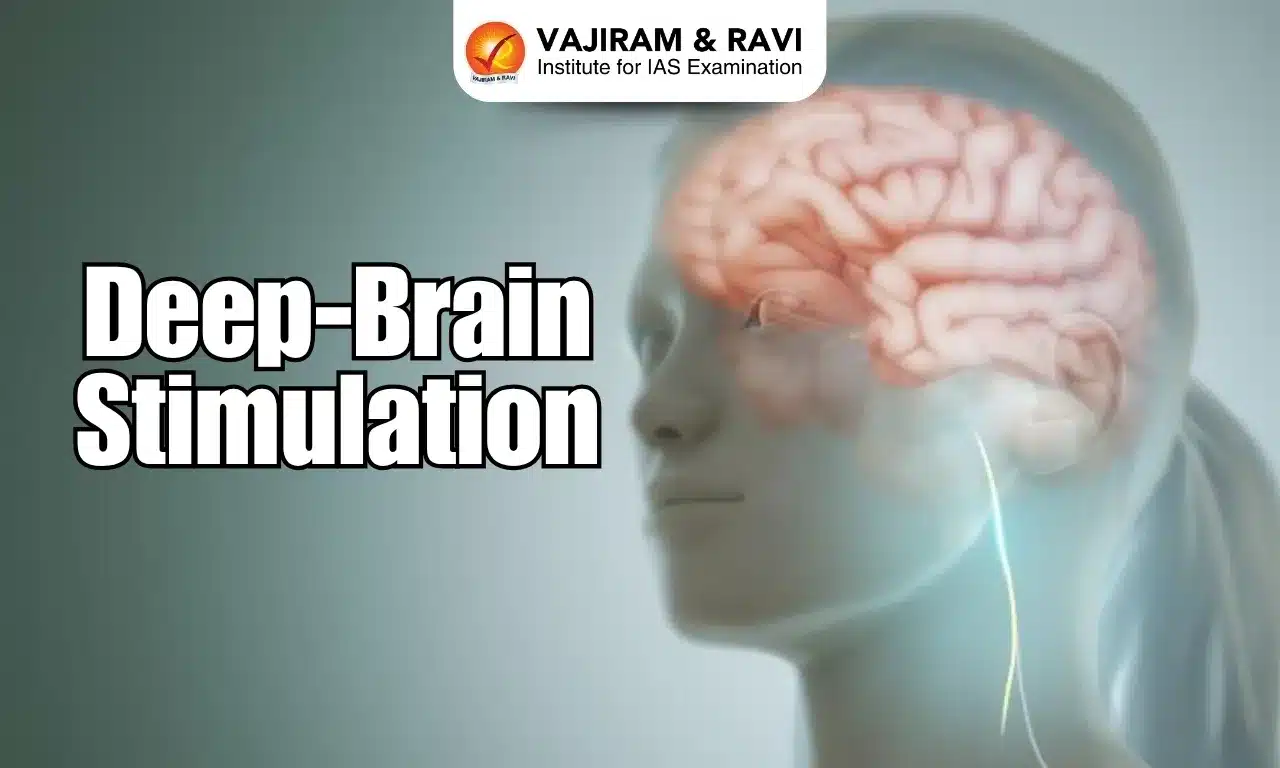
  • It is a medical technique where doctors implant electrodes deep inside specific areas of the brain to treat certain disorders.
  • How does it work?
    • These electrodes are connected by wires to a small device, similar to a heart’s pacemaker, which is usually placed under the skin in the upper chest.
    • The device sends controlled, mild electrical impulses to targeted brain regions, helping adjust abnormal brain activity or chemical imbalances.

Application of Deep-Brain Stimulation

  • DBS is most commonly used for movement disorders, especially in people with Parkinson’s disease, essential tremor, and dystonia, whose symptoms no longer respond well to medication.
  • It has also been approved for some psychiatric conditions like obsessive-compulsive disorder, and is being studied for severe depression and epilepsy.
  • DBS works by modifying how groups of neurons talk to each other. Many of these disorders involve faulty electrical signals in the brain.
  • Delivering electrical pulses through DBS can interrupt these erratic signals, helping reduce symptoms such as tremors or muscle stiffness.

Advantages of Deep-Brain Stimulation 

  • One advantage of DBS is that, unlike brain surgery that destroys tissue, its effects are reversible: if you turn off the device, the stimulation stops.
  • It is believed to help normalise disrupted brain circuits at both the cellular and network levels.

Source: TH

Deep-Brain Stimulation FAQs

Q1: What is Deep Brain Stimulation?

Ans: Deep brain stimulation (DBS) is a neurosurgical procedure that uses implanted electrodes and electrical stimulation to treat movement disorders associated with Parkinson's disease (PD).

Q2: What is Neurocysticercosis?

Ans: Neurocysticercosis is a parasitic infection of the central nervous system and is caused by the pork tapeworm, Taenia solium. Humans become infected after consuming undercooked food, particularly pork, or water contaminated with tapeworm eggs, or through poor hygiene practices.

Indian Computer Emergency Response Team (CERT-In)

Indian Computer Emergency Response Team (CERT-In)

Indian Computer Emergency Response Team Latest News

In a first, the Indian Computer Emergency Response Team (Cert-In) recently made it mandatory for private and public-sector organisations that own or operate digital systems, processes, or infrastructure to undergo a comprehensive third-party cybersecurity audit at least once a year.

About Indian Computer Emergency Response Team

  • It is the national nodal agency for responding to computer security incidents as and when they occur.
  • It is a functional organisation of the Ministry of Information & Electronics Technology, Government of India.
  • Objective: Securing Indian cyberspace.
  • The constituency of CERT-In is the Indian cyber community and Indian cyberspace.
  • CERT-In has been designated under Section 70B of the Information Technology Act, 2000, to serve as the national agency to perform the following functions in the area of cyber security:
    • Collection, analysis, and dissemination of information on cyber incidents.
    • Forecasts and alerts of cybersecurity incidents.
    • Emergency measures for handling cybersecurity incidents.
    • Coordination of cyber incident response activities.
    • Issue guidelines, advisories, vulnerability notes, and white papers relating to information security practices, procedures, prevention, response, and reporting of cyber incidents.
    • Such other functions relating to cyber security as may be prescribed.
  • To perform these functions, CERT-In is empowered to call for information and issue directions to service providers, intermediaries, data centres, body corporates, and any other person. 
  • CERT-In provides services to organizations in the Government, Public, and Private sectors. In addition, CERT-In provides services to individuals and home users as well.
  • CERT-In collaborates with international counterparts to share information regarding emerging threats, vulnerabilities, and malware.
  • Disclosure of information will be followed in accordance with Indian Constitutional laws.

Indian Computer Emergency Response Team Key Projects

  • Cyber Swachhta Kendra (www.csk.gov.in)
  • National Cyber Coordination Centre (NCCC)
  • Cyber Threat Intelligence Sharing Platform
  • Cyber Abhyas Suvidha (CAS) Advanced Skill Development Platform

Source: BS

Indian Computer Emergency Response Team FAQs

Q1: What is the primary objective of the Indian Computer Emergency Response Team (CERT-In)?

Ans: Securing Indian cyberspace.

Q2: CERT-In operates under which ministry?

Ans: Ministry of Electronics and Information Technology (MeitY)

Q3: What is the constituency of CERT-In?

Ans: The constituency of CERT-In is the Indian cyber community and Indian cyberspace.

Ancient India’s Chola Dynasty and Its Legacy

Chola Dynasty

Chola Dynasty Latest News

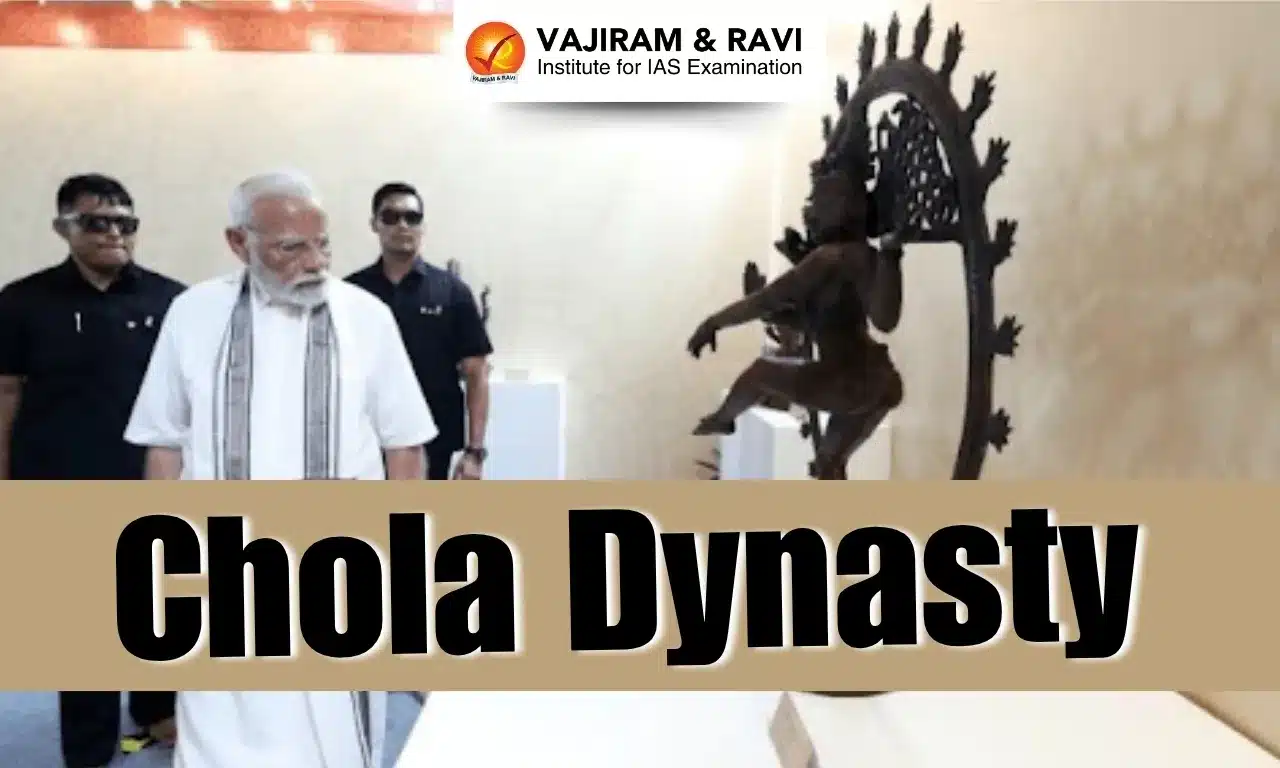
  • Recently, Prime Minister Narendra Modi visited Gangaikonda Cholapuram in Tamil Nadu during the valedictory ceremony of the Aadi Thiruvathirai festival to commemorate the birth anniversary of Emperor Rajendra Chola I. 
  • He highlighted the historical achievements of the Chola dynasty and linked their legacy to India’s vision of becoming a developed and united nation.
  • He also highlighted the democratic traditions of the Chola Empire, particularly the Kudavolai system, comparing it with Western ideals like the Magna Carta (1215 CE) and Enlightenment-era political thought.

The Chola Dynasty

  • It was a Tamil empire that dominated South India and rose in prominence from the 9th (founder - Vijayalaya) to the 13th centuries CE (decline after the reign of Kulothunga I). 
  • They were renowned for their military prowess, maritime dominance, and significant contributions to art (advancements in bronze sculpture), architecture (eg., exemplifying the Dravidian style of temple architecture), and literature. 
  • At its peak (and spearheaded by Rajaraja I and his son Rajendra I), the Chola empire stretched from the islands of the Maldives to the banks of the Ganges River in Bangladesh, with colonies in Southeast Asia. 

PM’s Tribute to Chola Emperors

  • Historical inspiration: PM Modi paid homage to Rajaraja Chola and Rajendra Chola I for their military might, naval expansion, administrative innovations, and cultural contributions.
  • Commemorative coin: A coin was released to honour Rajendra Chola I, commemorating his contributions including the building of Gangaikonda Cholapuram, the Brihadisvara Temple, and Cholagangam lake.
  • Statues announcement: The Centre will install statues of both emperors in Tamil Nadu to reinforce national historical consciousness.

Chola Achievements as a Model for Modern India

  • Economic and strategic vision: Chola-era advancements in trade, defence, water management, and local governance were showcased as templates for India's future development.
  • Strengthening defence: Echoing Rajaraja and Rajendra’s naval legacy, PM Modi emphasized modern India's commitment to national security, citing Operation Sindoor as an example of India’s decisive strategic posture.
  • Democratic foundations: The Kudavolai system introduced by the Cholas was hailed as an early form of grassroots democracy.

The Kudavolai System

  • Electoral innovation:
    • Ballot-pot mechanism: The Kudavolai or “ballot pot” involved placing names on palm leaves in a pot and drawing lots publicly by a neutral child, ensuring transparency and fairness.
    • Institutional integrity: The process symbolised a combination of divine will and civic integrity, aimed at preventing dynastic capture of power.
  • Stringent eligibility and disqualification norms:
    • Eligibility criteria: Candidates had to be tax-paying landowners; 35–70 years old; literate in Vedic texts or administrative principles; free from criminal records, debt defaults, alcoholism, or nepotism
    • Disqualification measures: Individuals with financial misdemeanours or ethical lapses were disqualified, even fined or removed as per epigraphic records (e.g., Inscription No. 24 from Epigraphia Indica).

Rediscovering Ancient Indian Democracy

  • Chola contribution to democratic thought:
    • PM Modi emphasized that the Chola Empire practiced structured electoral governance long before Western democracies emerged.
    • The Uttaramerur inscriptions in Tamil Nadu serve as one of the earliest evidence of local self-governance and electoral processes.
  • Administrative decentralisation and local governance:
    • Village councils: Two bodies (Sabha – for Brahmin villages; and Ur – for non-Brahmin settlements) had real power over revenue, water management, temples, and justice.
    • Merchant guilds as partners: Guilds like Manigramam and Ayyavole were key in decentralised governance and trade expansion.
    • Symbolic statecraft: Rajendra Chola’s act of bringing Ganga water to his capital symbolised a liquid pillar of victory, merging military conquest with ritual legitimacy.
  • Limitations of the democratic system:
    • Exclusionary nature: Despite being advanced for its time, the Chola model excluded women, landless labourers, and lower castes, highlighting inequality in participatory governance.
    • Modern interpretations: Historians assert that while imperfect, the Chola model was an early blueprint of strategic, decentralised rule and civic integrity.

Cultural Unity and Preservation

  • Pan-Indian cultural bonds: Initiatives like Kashi Tamil Sangamam and Saurashtra Tamil Sangamam were referenced to reflect the government's efforts in cultural integration.
  • Return of heritage artefacts: Since 2014, India has repatriated over 600 ancient artefacts, including 36 from Tamil Nadu, reflecting cultural revivalism.
  • Shaivite influence: The Shaivite tradition and Tirumular’s message, Anbe Shivam (Love is God), were highlighted as eternal solutions to global crises.

Conclusion

  • By invoking the achievements of the Chola emperors, PM Modi's speech reaffirmed the importance of drawing upon historical strength to build a self-confident, united, and culturally rooted developed India.
  • The Chola Dynasty’s sophisticated systems of local self-government, democratic accountability, and ritual statecraft provide a powerful counter-narrative to Western-centric ideas of political evolution

Source: TH | IE

Chola Dynasty FAQs

Q1: What was the Kudavolai system?

Ans: An early electoral method used by the Cholas involving ballot pots, ensuring transparent local elections.

Q2: How was the Chola administration decentralised?

Ans: Through elected local bodies like Sabha and Ur that handled key civic and administrative functions.

Q3: How did Rajendra Chola use ritual in statecraft?

Ans: By bringing Gangajal to his capital, symbolising conquest with cultural and spiritual legitimacy.

Q4: How was accountability ensured in Chola governance?

Ans: By setting strict qualifications, annual audits, and penalties for misconduct in public office.

Q5: What were the limitations of Chola democracy?

Ans: It excluded women, landless labourers, and lower castes, reflecting social inequality.

Daily Editorial Analysis 28 July 2025

Daily Editorial Analysis

Clearing the Air on ‘Citizenship’ in Bihar Poll Roll Revision

Context

  • The question of who is eligible to vote in India is not merely an administrative concern but a foundational issue that touches the very core of Indian democracy.
  • At the heart of this issue lies the principle that only Indian citizens are entitled to participate in the electoral process.
  • Yet, controversy has emerged over the Election Commission of India’s (ECI) move to conduct a Special Intensive Revision of electoral rolls in Bihar.
  • Critics of the move argue against the verification of citizenship, betraying either a lack of understanding of the Constitution or a willingness to ignore its mandates for political expediency.

Citizenship as a Prerequisite for Electoral Participation

  • According to Article 326 of the Indian Constitution, elections to both the House of the People and the Legislative Assemblies of states must be based on adult suffrage.
  • However, this right is explicitly limited to individuals who are citizens of India and are not less than eighteen years of age.
  • Further, they must not be disqualified by any law made by the appropriate legislature.
  • Therefore, the right to vote is inextricably linked with Indian citizenship.
  • This constitutional principle is reiterated in The Representation of the People Act, 1950, which provides a detailed legal framework for the preparation and maintenance of electoral rolls.

The Role of the Election Commission of India

  • The Election Commission, under Article 324, is constitutionally mandated to supervise and manage the conduct of elections and the preparation of electoral rolls.
  • This includes revising electoral rolls irrespective of whether elections are impending.
  • The Supreme Court’s ruling in Lakshmi Charan Sen v. A.K.M. Hassan Uzzaman (1985) reaffirms that such revision is a continuous process under the Commission’s purview.
  • Under this framework, the ECI has both the authority and the duty to ensure that only eligible citizens are enrolled as voters.
  • This includes verifying the authenticity of voter claims and deleting names found to be ineligible.
  • Sections 15 to 24 of the 1950 Act codify these processes, with Section 16 specifically disqualifying non-citizens from voter registration.
  • Section 16(2) empowers the deletion of names wrongly included in the electoral rolls, thereby reinforcing the necessity of verifying citizenship.

Legal and Constitutional Disqualifications

  • The connection between citizenship and legislative eligibility is not limited to voting alone. One must be a voter to become a legislator.
  • Consequently, non-citizens cannot contest elections for Parliament or State Assemblies.
  • Articles 102 and 191 of the Constitution make this abundantly clear by disqualifying any individual who is not an Indian citizen, or who voluntarily acquires foreign citizenship or allegiance to another country, from legislative membership.
  • To suggest that a non-citizen can vote or hold legislative office would thus directly contradict constitutional provisions and undermine the very fabric of Indian democracy.

Criteria for Inclusion in Electoral Roll

  • Overseas Citizens

    • Further clarity is offered by The Citizenship Act, 1955, particularly through Sections 7A and 7B.
    • While the Act allows for the registration of Overseas Citizens of India (OCIs), Section 7B(2) clearly denies OCIs the right to vote, thus reinforcing the constitutional restriction that only full citizens may be included in electoral rolls.
  • Residency, Lawful Presence, and Electoral Rolls

    • A key criterion for inclusion in the electoral roll is that the person must be ordinarily resident in a constituency.
    • However, as held in Dr. Yogesh Bhardwaj v. State of U.P. (1990), unlawful residence cannot be equated with ordinary residence.
    • Staying in India in violation of immigration laws does not make one eligible to vote or to claim any residency-based entitlement.

Aadhaar and Citizenship: No Equivalence

  • Another area of confusion arises from the possession of an Aadhaar card, for, some have mistakenly assumed that Aadhaar serves as proof of citizenship.
  • However, The Aadhaar Act, 2016, explicitly clarifies in Section 9 that neither an Aadhaar number nor its authentication confers citizenship or domicile status.
  • Section 3 further states that the card is only for residents, not necessarily citizens, making it legally insufficient for voter registration purposes.

Conclusion

  • The electoral system’s legitimacy depends on the integrity of its voter base, which, by constitutional and statutory mandate, must be comprised solely of Indian citizens.
  • The ECI, as the custodian of India’s electoral machinery, is duty-bound to ensure this through verification mechanisms and roll revisions.
  • Any lapse in doing so would constitute a serious breach of constitutional responsibility and could potentially allow the dilution of Indian democracy by non-citizen participation.
  • The objections raised against the ECI’s revision initiative in Bihar are therefore not only misplaced but fundamentally contrary to the constitutional ethos.

Clearing the Air on ‘Citizenship’ in Bihar Poll Roll Revision FAQs

Q1. Who is eligible to vote in Indian elections?
Ans.
A person is eligible to vote in Indian elections only if they are a citizen of India and at least 18 years of age.

Q2. What legal provision disqualifies non-citizens from voting?
Ans.
Section 16(1)(a) of The Representation of the People Act, 1950 disqualifies non-citizens from being registered as voters.

Q3. Can possession of an Aadhaar card prove Indian citizenship?
Ans.
No, possession of an Aadhaar card does not prove Indian citizenship, as clarified by Section 9 of the Aadhaar Act, 2016.

Q4. What is the role of the Election Commission in maintaining voter rolls?
Ans.
The Election Commission is responsible for ensuring that only eligible Indian citizens are included in the electoral rolls and must revise and verify the lists regularly.

Q5. Can a non-citizen become a Member of Parliament or State Legislature?
Ans. No, a non-citizen cannot become a Member of Parliament or State Legislature, as the Constitution requires all legislators to be Indian citizens under Articles 102 and 191.

 Source: The Hindu

Daily Editorial Analysis 28 July 2025 FAQs

Q1: What is editorial analysis?

Ans: Editorial analysis is the critical examination and interpretation of newspaper editorials to extract key insights, arguments, and perspectives relevant to UPSC preparation.

Q2: What is an editorial analyst?

Ans: An editorial analyst is someone who studies and breaks down editorials to highlight their relevance, structure, and usefulness for competitive exams like the UPSC.

Q3: What is an editorial for UPSC?

Ans: For UPSC, an editorial refers to opinion-based articles in reputed newspapers that provide analysis on current affairs, governance, policy, and socio-economic issues.

Q4: What are the sources of UPSC Editorial Analysis?

Ans: Key sources include editorials from The Hindu and Indian Express.

Q5: Can Editorial Analysis help in Mains Answer Writing?

Ans: Yes, editorial analysis enhances content quality, analytical depth, and structure in Mains answer writing.

China’s Mega Dam on Brahmaputra: A Strategic Concern for India

China Brahmaputra Dam

China Brahmaputra Dam Latest News

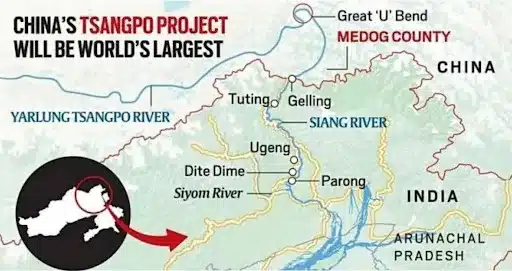
  • China has officially started building a massive $167.8 billion hydropower dam on the Brahmaputra River, near the Indian border in Arunachal Pradesh. 
  • The groundbreaking ceremony was attended by Premier Li Qiang. Once completed, this will be the world’s largest dam. 
  • The project has raised concerns in India and Bangladesh over its potential impact on the river’s natural flow and downstream water availability.

Arunachal Raises Alarm Over China’s Brahmaputra Dam Project

  • China’s construction of a massive 60,000 MW hydropower dam on the Yarlung Zangbo (Brahmaputra) near the “Great Bend” in Tibet, just before the river enters Arunachal Pradesh as the Siang, has sparked serious concerns in India. 

  • Arunachal Pradesh Chief Minister has called it an “existential threat” and likened the project to a potential “water bomb” that could devastate tribal communities and local livelihoods. 
  • He warned that sudden water release could flood the entire Siang region and drastically reduce river flow in the long term. 
  • Experts echo these fears, citing risks of flooding from dam operations, as well as the danger posed by the seismically active and ecologically fragile zone where the dam is being built
  • The project raises broader environmental and geopolitical anxieties for downstream countries like India and Bangladesh.

China’s Brahmaputra Dam: The View From Assam

  • Assam Chief Minister has downplayed immediate concerns about China's dam on the Brahmaputra, highlighting that the river becomes a major waterway only after entering Assam, where it is nourished by tributaries from Bhutan, Arunachal Pradesh, and heavy monsoon rains. 
  • He noted that China's contribution to the Brahmaputra’s flow is limited—about 30–35%—mostly from glacial melt and Tibetan rainfall. 
  • He suggested that even if China were to reduce water flow, it might help manage Assam’s annual floods. 
  • Still, he acknowledged the existence of multiple theories about the dam’s impact and expressed confidence that the central government is either already engaged in talks with China or will initiate discussions soon.

India’s Cautious Response to China’s Brahmaputra Dam Project

  • India has not issued an official response to the recent groundbreaking ceremony of China’s massive dam on the Brahmaputra River, but continues to closely monitor the developments. 
  • The Ministry of External Affairs (MEA) has reiterated India’s concerns as a lower riparian state with established rights, emphasizing the need for transparency and consultation with downstream countries like India and Bangladesh. 
  • MEA had underscored India’s position in January, urging China to avoid actions that could harm downstream interests. 
  • In contrast, China has maintained that the project falls within its sovereign rights and assured ongoing cooperation with downstream nations on hydrological data and disaster management.

Diplomatic Efforts on Multiple Fronts

  • Diplomatic efforts between India and China have continued on multiple fronts. 
  • In October 2024, both nations had agreed on patrolling arrangements along the LAC to resolve past tensions. 
  • Additionally, talks in March 2025 included discussions on cross-border cooperation, including river management. 
  • India also resumed issuing tourist visas to Chinese nationals recently and restarted the Kailash Mansarovar Yatra, signaling a cautious yet active engagement despite the concerns surrounding the dam project.

India’s Mitigation Strategy Amid China’s Brahmaputra Dam Concerns

  • Experts recommend scientific assessment and capacity-building to anticipate any deliberate Chinese actions. 
  • They have proposed constructing storage infrastructure on Brahmaputra tributaries to manage erratic flows. 
  • The Upper Siang project in Arunachal Pradesh, with a 300-metre-high dam, is considered crucial both for hydropower and as a buffer against sudden water releases, although local opposition over environmental concerns has delayed progress.
  • Additional strategies include developing inland channels for excess water diversion and pursuing long-term interlinking projects between the Brahmaputra and Ganga basins, as proposed by the National Water Development Authority. 
  • On the diplomatic front, experts advocate for continuous access to hydrological and project data from China, while also urging coordination with downstream neighbours like Bangladesh, Bhutan, and Myanmar to establish protocols for early warning and disaster preparedness.

Source: IE | TH

China Brahmaputra Dam FAQs

Q1: What is the Brahmaputra dam project in China?

Ans: A 60,000 MW dam near Arunachal, set to be the world’s largest hydropower project.

Q2: Why is Arunachal Pradesh worried?

Ans: Sudden water release could flood Siang region, threatening tribal lives and ecology.

Q3: What is Assam’s view on the dam?

Ans: Assam CM downplays risk, noting Brahmaputra is mainly fed by Indian rainfall and tributaries.

Q4: How has India responded diplomatically?

Ans: India has urged China for transparency and safeguards to protect downstream states' interests.

Q5: What are India’s mitigation strategies?

Ans: Storage dams, inland water channels, data sharing, and regional coordination for disaster response.

India’s Hydrogen Train Coach: A Milestone for Green Railways

India Hydrogen Train

India Hydrogen Train Latest News

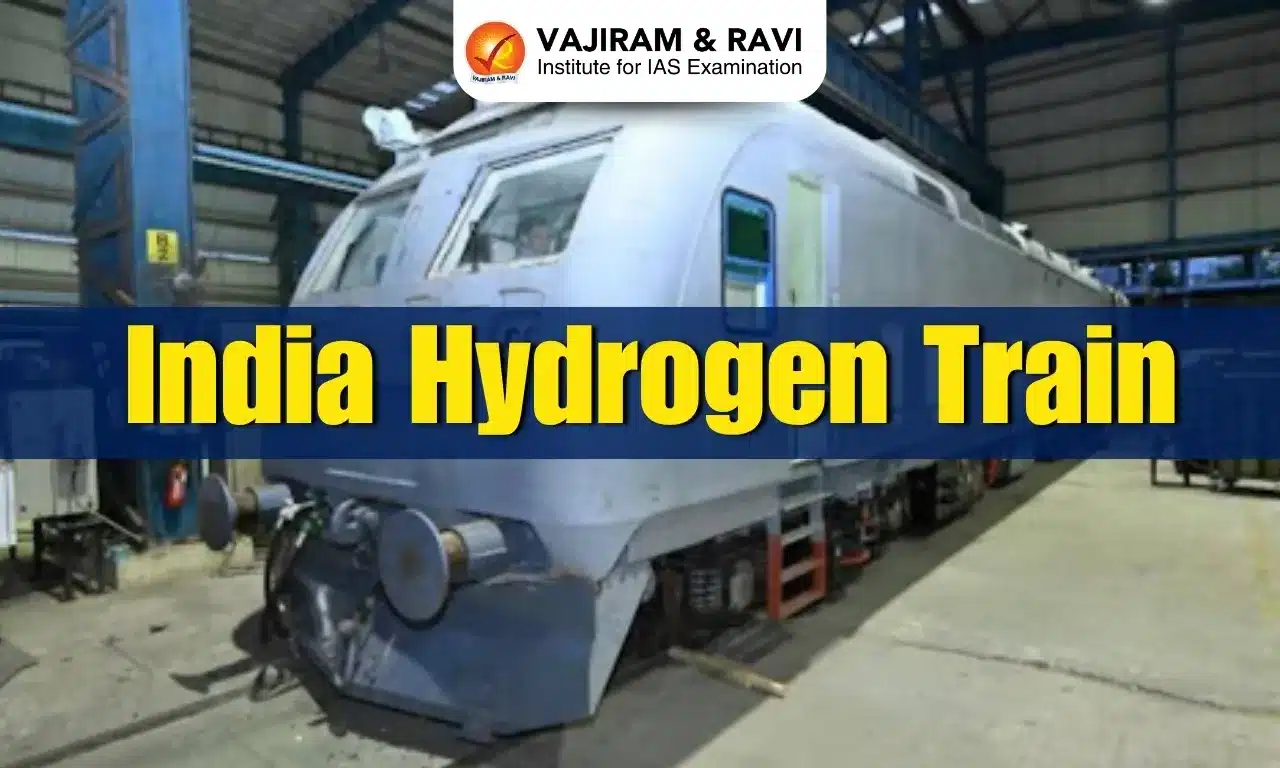
  • Indian Railways has successfully tested its first hydrogen-powered coach at the Integral Coach Factory (ICF) in Chennai, marking a major step towards launching India’s first hydrogen-powered train. 
  • This eco-friendly initiative supports India’s goal of cutting greenhouse gas emissions and boosting renewable energy use. 
  • The project, now in its final stage, is undergoing equipment testing before commercial rollout. Using hydrogen—a clean fuel—will help reduce reliance on fossil fuels. Only a few countries have attempted such projects, most of which remain in the trial phase.

Indian Railways’ Hydrogen Train Project: Key Details

  • Launched by Northern Railway in 2020-21, the hydrogen train project involves converting two 1600 HorsePower (HP) diesel power cars into hydrogen fuel cell-powered units. 
  • The project also includes setting up a hydrogen storage and fuelling facility at Jind, Haryana, with a storage capacity of 3,000 kg of hydrogen. 
  • The Research Design & Standards Organisation (RDSO) is leading the design, testing, and validation. 
  • The converted train, comprising 10 coaches and capable of carrying over 2,600 passengers, will operate between Jind and Sonepat in Haryana, covering two daily round trips of 356 km.

How India’s First Hydrogen Train Will Operate Safely

  • Indian Railways’ hydrogen train project involves retrofitting two diesel power cars with hydrogen fuel cell systems, each storing 220 kg of hydrogen in specially designed cylinders at 350 bar pressure. 
  • Given hydrogen's highly flammable nature, multiple safety measures have been built in, including pressure relief valves, leak and flame detection sensors, temperature monitors, and optimized ventilation systems. 
  • Computational fluid dynamics (CFD) studies have been conducted to simulate worst-case leak scenarios. 
  • Extensive testing of key components—like the traction and auxiliary converters—has been completed. 
  • To ensure global safety standards, German firm TUV-SUD has been brought in as an independent safety auditor, while the engineering is led by Medha Servo Drives at ICF Chennai.

Hydrogen Fuelling Facility at Jind: Backbone of India’s Hydrogen Train Project

  • A dedicated 3,000-kg hydrogen fuelling facility is being established at Jind in Haryana to support the operation of India’s first hydrogen-powered train. 
  • The storage is split into two parts — 2,320 kg at low pressure and 680 kg at high pressure. 
  • The facility will function under the safety norms and specifications of the Petroleum Explosives Safety Organisation (PESO), ensuring strict adherence to national standards. 
  • Northern Railway is also developing supporting infrastructure, including power supply lines, access roads, and a firefighting tank, to make the facility fully operational.

Hydrogen for Heritage: A Green Transport Vision

  • The tested coach is part of the “Hydrogen for Heritage” initiative, under which Indian Railways plans to deploy 35 hydrogen-powered trains on heritage and hill routes. 
  • Each train will cost around ₹80 crore, with an additional ₹70 crore earmarked for ground infrastructure per route.
  • While the running costs of hydrogen-powered trains are currently high, they are expected to fall as scale and efficiency improve. 
    • The main appeal of hydrogen lies in its zero carbon emissions, aligning with India’s green energy goals.
  • India’s hydrogen ambitions are not limited to the rail sector. 
  • In 2024, Union Minister Hardeep Singh Puri presented a hydrogen-fueled bus, developed by Indian Oil, to Bhutan’s Prime Minister during his visit — underscoring India’s broader commitment to clean mobility.

Source: IE | DDN

India Hydrogen Train FAQs

Q1: What is India’s hydrogen train project?

Ans: Retrofit of diesel coaches with hydrogen fuel cells; trial on Jind–Sonipat route.

Q2: How is safety ensured in hydrogen trains?

Ans: Leak detection, flame sensors, pressure relief, CFD testing, and third-party audits.

Q3: Where is hydrogen stored and fueled?

Ans: Jind, Haryana facility stores 3,000 kg hydrogen under PESO guidelines.

Q4: What is 'Hydrogen for Heritage' initiative?

Ans: 35 hydrogen trains planned for heritage/hill routes with green energy goals.

Q5: Why is hydrogen fuel important?

Ans: It enables zero-carbon transport, reducing reliance on fossil fuels in India.

India’s Preparedness Against Glacial Lake Outburst Floods

Glacial Lake Outburst Floods

Glacial Lake Outburst Floods Latest News

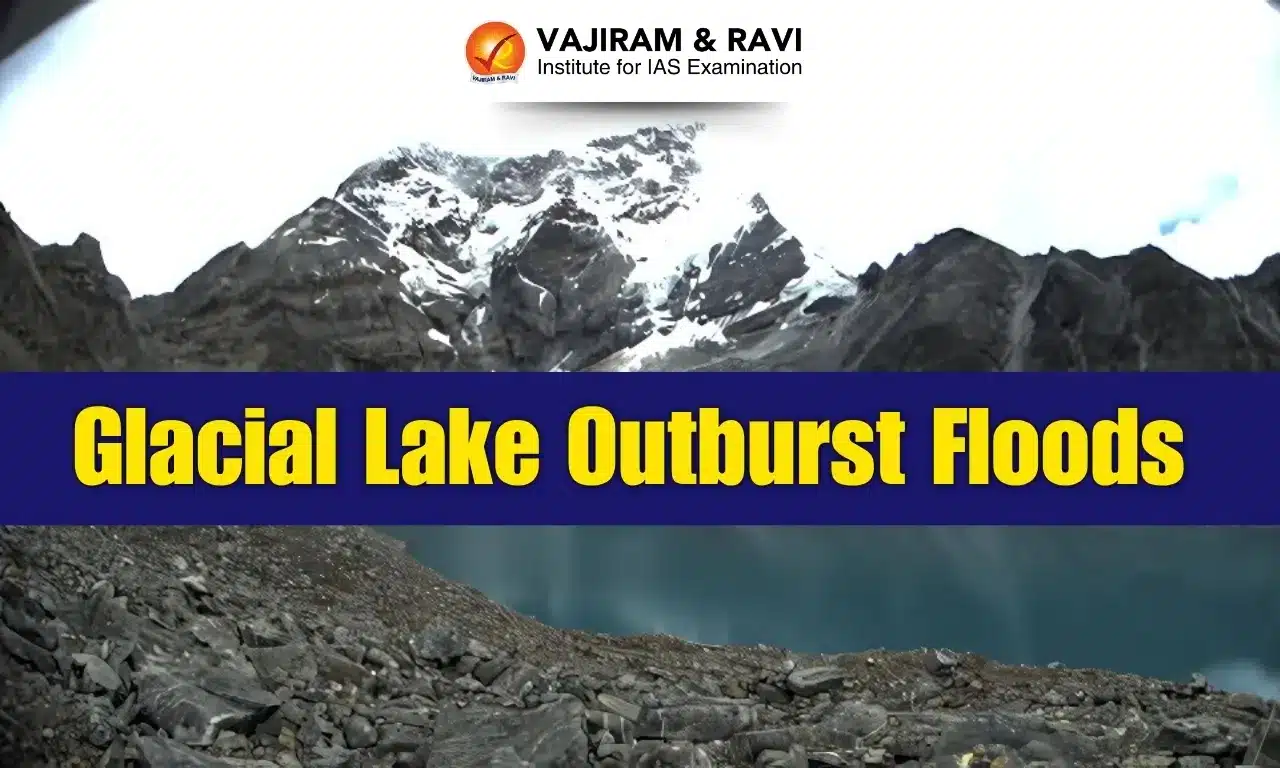
  • India has launched a national programme to monitor and mitigate Glacial Lake Outburst Flood (GLOF) risks, prioritising 195 high-risk lakes in the Himalayan region amid rising climate-induced disasters.

Introduction

  • On July 8, 2025, a severe Glacial Lake Outburst Flood (GLOF) struck Nepal, sweeping away a China-built friendship bridge and rendering multiple hydropower plants inoperative. 
  • This catastrophe underscored the growing threat posed by glacial melt in the Himalayas, a region already vulnerable due to global warming and seismic activity.
  • For India, which houses over 7,500 glacial lakes across 11 river basins, GLOF events pose a serious risk to infrastructure, livelihoods, and ecosystems. 
  • The Indian government, through the National Disaster Management Authority (NDMA), has initiated a multi-pronged strategy focused on early warning, risk mitigation, and community engagement to tackle this emerging challenge.

Rising GLOF Risk in the Himalayas

  • GLOFs occur when unstable glacial lakes, formed due to melting glaciers, suddenly burst, releasing massive volumes of water downstream. In the Indian Himalayan Region (IHR), two major types of glacial lakes are found:
    • Supraglacial Lakes: Formed on the glacier surface, vulnerable to summer melting.
    • Moraine-Dammed Lakes: Formed at the glacier toe and dammed by loose debris, highly prone to collapse due to avalanches or ice-core instability.
  • According to the National Remote Sensing Centre, India is home to around 28,000 glacial lakes, with most situated above 4,500 metres, making ground access difficult and monitoring sparse.

Catastrophic Events and Growing Vulnerability

  • India has already experienced several GLOF disasters, such as:
    • Chorabari GLOF (2013): Triggered the Kedarnath tragedy with cascading floods and landslides, killing hundreds.
    • South Lhonak GLOF (2023, Sikkim): Destroyed the 1,250 MW Chungthang dam, raising the Teesta riverbed and decreasing its water-carrying capacity.
  • The risk is compounded by rising temperatures. 2023 and 2024 were the hottest years globally, leading to increased glacier melt and destabilisation of lake structures. 
  • Additionally, the lack of weather and water monitoring stations in high-altitude areas has left most glacial lakes unmapped and unguarded.

National Strategy for GLOF Mitigation

  • Recognising the scale of the threat, the NDMA launched a $20 million national programme, identifying 195 high-risk lakes, classified into four levels of vulnerability. 
  • The initiative, under the Committee on Disaster Risk Reduction (CoDRR), focuses on five core objectives:
    • Hazard Assessment of each lake
    • Installation of Automated Weather and Water Stations (AWWS)
    • Deployment of Early Warning Systems (EWS)
    • Water drawdown or retention structures at critical lakes
    • Community engagement and education to improve response readiness
  • States housing glacial lakes were encouraged to lead the effort by sending scientific expeditions to 40 of the most vulnerable lakes during the summer of 2024.

Scientific Techniques and Innovations

  • To bridge India's existing data and monitoring gaps, several advanced tools and technologies have been deployed:
    • Synthetic Aperture Radar (SAR) Interferometry: Used for micro-level monitoring of slope stability and lake expansion, accurate up to a centimetre.
    • Electrical Resistivity Tomography (ERT): Helps detect subsurface ice cores that could lead to dam failure.
    • Bathymetry and UAV Surveys: Assess lake volume and surrounding terrain.
  • Notably, two lakes in Sikkim are now equipped with AWWS units, transmitting water level and weather data every 10 minutes along with daily images of lake perimeters, establishing India’s first operational monitoring stations in the cryosphere.

Institutional and Community Preparedness

  • Apart from technical tools, India has turned to ground-level institutions like the Indo-Tibetan Border Police (ITBP) for manual early warnings. 
  • Given their high-altitude deployments, ITBP personnel are now being trained to detect visible signs of GLOF risk.
  • Community engagement has also emerged as a critical element. Several scientific teams were welcomed or rejected based on their rapport with local residents. 
  • The importance of culturally sensitive engagement became apparent when an expedition team had to leave behind a member to honour the sanctity of a lake considered sacred by locals.

Future Outlook and Scaling Efforts

  • The government intends to scale the national programme under the upcoming 16th Finance Commission (FY2027–31)
  • The plan includes expanding risk surveillance across thousands of lakes, scaling up scientific monitoring, and building institutional capacities for coordinated response.
  • However, critical gaps remain:
    • The lack of Indian startups or foundations working in Himalayan risk mitigation
    • Limited use of remote sensing technologies despite their availability
    • Absence of a pan-Himalayan early warning network in partnership with neighbouring countries like Nepal and China
  • Bridging these gaps will be essential for India to protect its mountain communities and key river systems downstream.

Source: TH

Glacial Lake Outburst Floods FAQs

Q1: What are Glacial Lake Outburst Floods (GLOFs)?

Ans: GLOFs are sudden floods caused by the rupture of glacial lakes, often due to melting, avalanches, or dam collapse.

Q2: How many glacial lakes are located in India’s Himalayan region?

Ans: India has over 7,500 glacial lakes, most situated above 4,500 metres in altitude.

Q3: What national efforts are underway to mitigate GLOF risks?

Ans: The NDMA has launched a $20 million programme targeting 195 high-risk lakes with hazard assessments, EWS, and community outreach.

Q4: Which technologies are used to monitor GLOF threats?

Ans: India is using SAR interferometry, UAV mapping, bathymetry, and ERT to monitor lake stability and subsurface ice.

Q5: Why is community engagement critical in GLOF mitigation?

Ans: Local acceptance and cultural sensitivities are essential for the success of scientific expeditions and infrastructure projects in remote Himalayan regions.

Enquire Now